Kansas Business Name Compliance in 2026: When an LLC Needs a DBA Instead of an Amendment
Kansas business name compliance in 2026 gets complicated the moment an LLC tries to fix the wrong thing on the Secretary of State’s record. You opened your Kansas LLC under a formal legal name. Now the public brand is different, and the instinct is to file a name change with the state. That instinct is wrong more often than most owners expect. The Secretary of State record and the public-facing brand are two different jobs, and the state only asks you to file one of them. This article runs through exactly when a Kansas DBA makes more sense than an amendment — and how to make the call before you touch any filing.
Kansas DBA vs. LLC Name Amendment: Which Filing Do You Actually Need
Kansas business name compliance in 2026 gets complicated the moment an LLC tries to fix the wrong thing on the Secretary of State’s record. The Secretary of State’s business center handles registered name changes. The Kansas Department of Revenue handles tax-side naming. These are separate systems, and conflating them is where most Kansas LLCs naming compliance mistakes begin. Before touching any state filing, ask one question: does the formal company name need to change, or does only the customer-facing brand name need updating? If the legal name has changed, the articles of organization are inaccurate and a Certificate of Amendment is the right fix. If the formal name is still accurate but the company wants a cleaner public brand, the answer lives in operating agreements, bank accounts, and tax filings — not in a Secretary of State amendment.
The state’s own Register a Business page makes this explicit: the name reservation process does not register assumed, fictitious, trade, or trade name names. The Secretary of State’s online filing system is telling you directly that two different systems exist. The company name on the articles of organization and the public brand name operate in separate lanes. Using the wrong filing for the wrong problem creates the back-office chain reaction that founders spend months cleaning up.
Kansas LLC Name Requirements: Name Availability, Articles of Organization, and Limited Liability Companies
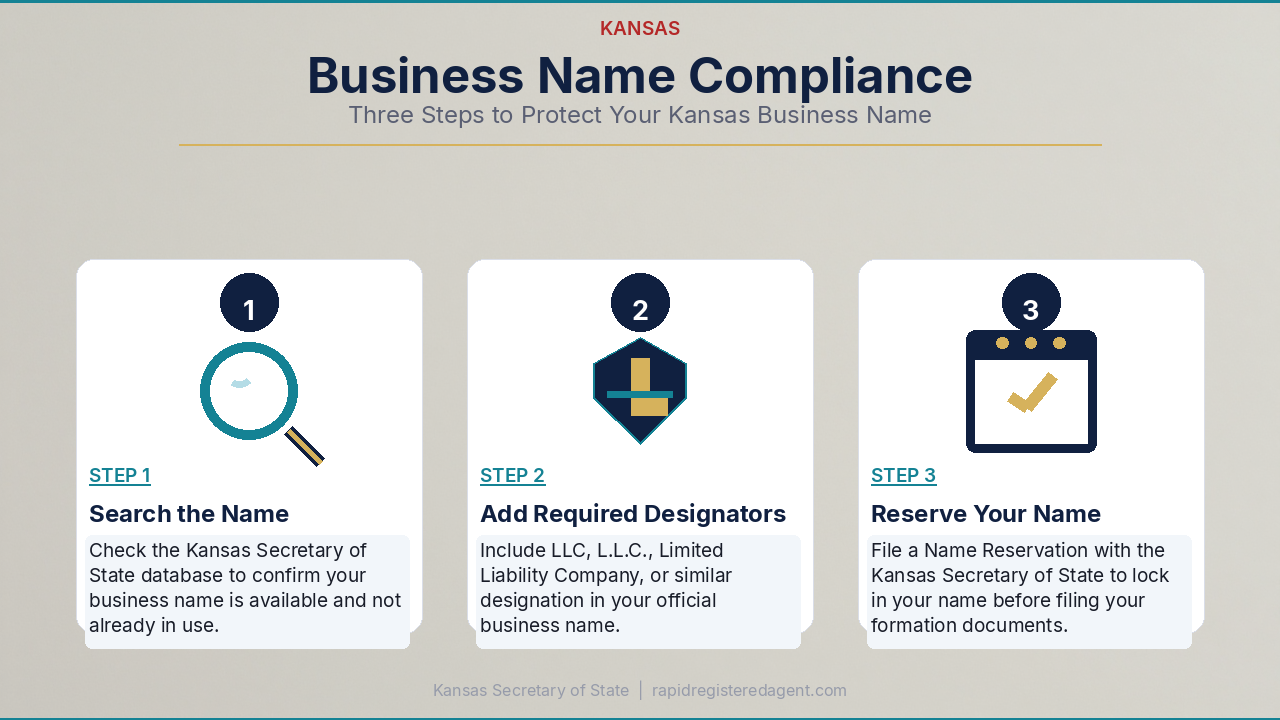
Kansas law sets specific rules for what an LLC’s legal name has to look like. K.S.A. 17-7920 governs LLC name requirements in the state. The legal name must contain “Limited Liability Company,” “L.L.C.,” “LLC,” “Limited Company,” “L.C.,” or “LC.” The name must be distinguishable from every existing business already on the Kansas Secretary of State records. That distinguishability standard is enforced at the point of filing, which means checking name availability before submitting any articles of organization or amendment is the only way to know whether a proposed name will clear the office. If the chosen name is too similar to an existing business, the filing may require additional state approval or the organization will be rejected outright.
The Kansas Secretary of State name availability search is the free official tool. You can use it to check name availability before filing anything. It confirms whether a proposed company name is available under the rules. It does not reserve a name — that requires a separate name reservation filing. A name reservation locks the chosen name for 120 days while the founder finalizes the formation filing. Without a reservation, another entity can claim the name between the check name availability step and the filing. Checking name availability before filing is the only reliable first step for any Kansas LLC formation.
The name availability search covers formal company names only. It does not search trade names, fictitious names, or operating brand names. A name that clears the availability search does not mean the same name is available as a trade name for public use — those are governed by separate considerations including whether the use would be deceptive or confusingly similar to an existing brand.
Kansas Business Entities: Limited Partnerships, LLCs, and Limited Liability Partnerships
Kansas recognizes several business entity types, and each carries different naming requirements. A limited liability company files articles of organization. A corporation files articles of incorporation. A limited partnership files a certificate of limited partnership. A limited liability partnership files a statement of qualification. A business trust files a declaration of trust. Each entity type has its own designator requirement and its own filing process with the Secretary of State. Business entities in Kansas, including corporations and other limited liability companies, must all follow the same distinguishability standard when registering their formal names. To register a business in Kansas, the applicant checks name availability, reserves the name through a name reservation filing, and submits the appropriate formation document for the entity type.
For small businesses, the LLC is the most common structure because it gives founders liability protection without the governance complexity of a corporation. When the LLC’s formal name is set on the articles of organization, that name becomes the legal name. Any change to that name requires an amendment. Operating under a different name in public does not require an LLC name amendment — as long as the operating name is handled correctly in the operating agreement, the tax accounts, and the bank records.
Kansas Registered Agent and Resident Agent Requirements
The registered agent is the person or service designated to accept service of process on behalf of the LLC. The registered agent’s address in Kansas is what appears on the articles of organization and is what makes the LLC reachable by the Secretary of State. A registered agent service does not file name amendments or trade name registrations. What a resident agent does is keep the formation record accurate and current so that when a compliance filing is needed, the process runs without delays caused by bad address information.
The registered agent also files the annual information report that keeps the LLC in good standing with the state. A company that falls out of good standing cannot file an amendment until the annual report is brought current. That is a common delay that surprises founders who are trying to respond quickly to a naming or rebranding situation. The registered office address on file with the Secretary of State must be current for the LLC to receive compliance notices and maintain good standing status. The Kansas address of the registered agent is part of the public record maintained by the Secretary of State’s office.
When a Kansas LLC Amendment Is the Right Move
An amendment is the correct filing when the legal name has actually changed. The test is straightforward: look at the name on the Kansas Secretary of State articles of organization. Does it still match how the company actually exists? Has the operating agreement changed the company name? Has a restructuring renamed the company? If the articles are wrong, the amendment is the right fix.
The Kansas Secretary of State’s online Change a Business page confirms that a Certificate of Amendment is used to indicate a change to the information in the articles of organization. The LLC must be in good standing to file. The current legal name appears at the top of the form. The new legal name goes in the change field. The filing fee applies.
Once filed, the amendment creates a ripple across every record that carries the old company name. Kansas DOR tax accounts tied to the old name need updating. Federal EIN records with the IRS need the new name. Bank accounts need to reflect the fictitious name change. Insurance policies, vendor registrations, contracts, and payroll records all need the updated legal name. This chain reaction is not a reason to avoid the amendment — it is a reason to confirm the amendment is actually needed before filing.
When a Trade Name Makes More Sense Than an Amendment
A trade name is the right approach when the legal name is still accurate but the company wants a different public-facing name. The formal name stays on the Secretary of State formation record. The public brand lives as a trade name — sometimes called a fictitious name — on the operating surfaces where customers encounter it. Kansas LLCs frequently use trade names to operate multiple brands under one LLC without filing an amendment for each new marketing name.
The Kansas Department of Revenue business registration FAQ covers how additional business locations are reported under the same entity and the same federal identification number, with the trade name captured separately on the CR-17 form. The CR-17 is the form for filing a name reservation and adding trade names to the Kansas tax side, including entries for Kansas corporate income tax and withholding tax reporting. That architecture — one legal entity, multiple trade names, one EIN — is the design the state has built for exactly this scenario.
On the banking side, the account opens in the legal name. The trade name goes on the account as a fictitious name or “doing business as” designation. Most Kansas banks handle this with an internal form and no additional state filing. On the customer-facing side, signage, website, packaging, and social profiles carry the trade name without any Secretary of State involvement, as long as the use is not deceptive about the entity’s identity.
For brands that need to stay distinct from the formal name, the Ohio trade name framework runs through the same logic — formal name on the formation record, public brand on the operating surfaces. Kansas follows the same structure. The South Dakota DBA strategy also handles this question in the same way.
Kansas Trade Names and DBAs for LLCs: Operating Under a Different Name
Here are the two scenarios that come up most often in Kansas LLC naming decisions.
Scenario one: Midwest Fulfillment LLC wants to market a local retail concept as Wichita Packing House. The formal company name is not changing. The company wants a cleaner public brand for a specific location or product line. The fix: add the trade name to the operating agreement, update the Kansas DOR CR-17, and add the fictitious name to the bank account. No amendment gets filed. No Secretary of State articles of organization changes. You can use a different brand name publicly without touching the formation document.
Scenario two: Sunflower Prairie Ventures LLC has grown and the owners want the formal company name to become Prairie Range Group LLC. The articles of organization no longer match the company’s actual identity. The fix: file the Certificate of Amendment with the Secretary of State, update every downstream record, and update the operating agreement to reflect the new legal name. This is the right filing for this decision — but if the new name is not distinguishable from an existing business in the Secretary of State’s records, the organization will be rejected until a different name is chosen.
The mistake is treating scenario one like scenario two. The filing feels similar. The consequences are very different. Running the decision test before touching any state form is what separates the founders who get it right from the ones who spend three months untangling a state filing they did not need. Understanding the difference between a dba or trade name approach and an actual LLC name amendment is what keeps Kansas LLCs out of unnecessary compliance trouble. The Secretary of State’s records make clear that these are two separate processes for two separate purposes.
Kansas Business Name Registration: Business in Kansas Starts Here
For founders looking to form an LLC in Kansas, the registration process starts with checking name availability through the Secretary of State business center. The name availability search confirms whether the preferred name is available and distinguishable from existing registered entities. A name reservation locks the name for 120 days while the articles of organization are finalized. This one stop at the business center is where Kansas business name compliance begins for new LLCs.
For a non-Kansas company entering Kansas, foreign qualification has to happen before any branding question is worth touching. Foreign qualification creates the official public record that allows the out-of-state entity to do business in Kansas. Until that registration is in place, the entity cannot file a name amendment or operate legally under its home-state name in Kansas. That separate entity status has to be established first before any dbas or trade names become relevant.
Standard processing for most Secretary of State filings in Kansas is within the week. Expedited options exist for founders who are working against a deadline. The key is making sure the articles of organization are accurate before filing, because corrections after filing require additional amendment work.
What Filing a Name Amendment Does to Your Tax Accounts
When the legal name changes through an amendment, the Kansas Department of Revenue needs to know. The federal EIN stays the same, but the name tied to that EIN changes on the IRS side and on the Kansas DOR side. Sales tax accounts, use tax permits, and withholding accounts all need the updated legal name filed through the normal business tax account update process.
The Kansas DOR business registration FAQ covers how to update existing registrations when the company name changes. Most updates can be handled online. They take a few business days to process, so running the update promptly after the amendment is filed prevents gaps in the tax record that could complicate filings later.
Adding a trade name to an existing tax account is simpler and does not trigger the same chain reaction. The CR-17 form handles trade name reporting, and it can be filed independently of any amendment.
The Amendment and Trade Name Filing Process Side by Side
For a Certificate of Amendment to change a company name, the LLC must be in good standing. The owner fills out the change form available through the Secretary of State’s business center, submits it online, and pays the filing fee. The amended articles of organization are issued once approved. That new document then becomes the basis for updating every downstream record — the DOR tax account, the EIN with the IRS, every bank account, every insurance policy, every vendor contract. That downstream update chain is part of the filing, not an afterthought.
For a trade name, the process is shorter. The owner updates the operating agreement to authorize the trade name, completes the Kansas DOR CR-17 form to register the trade name against the existing entity and EIN, and notifies the bank to add the fictitious name to the account. No amendment goes to the Secretary of State. No downstream chain reaction follows. The trade name exists in the operating agreement and the DOR record, and the business operates under it immediately.
The difference in time and complexity is why running the decision test before filing matters. An amendment takes longer, costs more when accounting for downstream updates, and requires the LLC to be in good standing before the filing can even be submitted. A trade name can be set up in days and involves no state amendment fee.
Kansas DBA vs. LLC Name: Making the Right Call in 2026
The Kansas DBA question comes down to whether the name is appearing on the Secretary of State formation record or on the operating surfaces where customers and tax authorities encounter it. The formation record is governed by the amendment process. The operating surfaces are governed by trade name and operating agreement documentation. Business licenses in Kansas may also need updating if the company name change affects the licensing identity with state agencies.
The state’s own language distinguishes between the legal name (which goes on the articles of organization) and the trade name (which does not). The Register a Business page says the name reservation process does not register assumed, fictitious, trade, or trade name names. That is the state’s way of saying: the company name question and the brand name question are two different questions, and they get answered in two different places.
How a Kansas Name Compliance Audit Runs in Practice
A practical compliance audit takes an afternoon. Pull the Secretary of State record for the LLC. Pull the Kansas DOR tax account. Pull the bank account records. Compare the legal name across all three. Any trade name in use should appear in the DOR account and on the bank fictitious name designation, but not on the Secretary of State articles of organization.
If the legal name has drifted — if an annual report was filed under a slightly different version of the name, for example — file the amendment promptly to restore good standing. If a new public brand is in use but not yet on the tax account, update the DOR CR-17 before the next filing reveals the gap.
Administrative dissolution is the risk that makes this audit worth scheduling as a recurring task. An LLC that fails to maintain a registered agent or file annual information reports can be administratively dissolved, which voids the entity’s good standing status and blocks any subsequent amendment filings until the dissolution is resolved.
What the 2026 Changes Mean for Your Filing Decision
The Kansas Secretary of State moved more filings to the online business center in 2025 and 2026. Name amendments, name reservations, and foreign qualification filings are all handled online. That speeds up processing, but it does not change the decision framework. The company name and the public-facing name are still separate questions.
What has changed is the speed at which a misaligned filing shows up in public records. Banks, vendors, and licensing boards check the Secretary of State business center more frequently now that it is easier to access. A mismatch between the legal name in their records and the name on the articles of organization surfaces faster than it used to. That makes running the decision test before filing more valuable than ever, and it makes the annual compliance audit worth doing on schedule.
Frequently Asked Questions
Does Kansas require an LLC to file anything with the Secretary of State to use a trade name?
No. The Kansas Secretary of State explicitly states that its name reservation and entity registration processes do not register assumed, fictitious, trade, or trade name names. Trade names are handled through operating agreements, bank accounts, and Kansas DOR tax filings — not through the Secretary of State.
How do I check if a Kansas LLC name is available before filing?
Use the Kansas Secretary of State name availability search on the business center. This covers formal entity names only and confirms whether a proposed LLC name is distinguishable from existing registered entities. A name reservation locks the name for 120 days while you finalize the filing.
When is a Kansas LLC amendment actually required?
A Certificate of Amendment is required when the information on the formation document — most often the legal entity name — is no longer accurate. The LLC must be in good standing to file, which means annual reports and registered agent information must be current.
Can a Kansas LLC operate under a different name than its legal LLC name?
Yes. Kansas law requires the LLC legal name to include an LLC designator and be distinguishable from other registered entities, but it does not require the public-facing brand name to match the legal name. Multiple brands can operate against one legal entity using trade name filings on the tax and banking side.
What is the difference between an amendment and a trade name in Kansas?
An amendment updates the legal entity name on the Kansas Secretary of State formation document and ripples into every downstream record. A trade name is an operational or public-facing name that operates separately from the formation document, documented through the operating agreement, the Kansas DOR CR-17, and the bank fictitious name form.
Will filing a name amendment affect the LLC's Kansas tax accounts?
Yes. A legal entity name change requires updates to every Kansas DOR tax account, the federal EIN name on file with the IRS, every bank account, every insurance policy, and every vendor registration that uses the old entity name. Trade name additions do not trigger this chain reaction.
Related Reading
- Ohio Trade Name vs. LLC Name in 2026
- South Dakota DBA Strategy in 2026
- Nevada DBA vs LLC Name in 2026: When a New Offer Needs a Fictitious Firm Name Instead of a New Entity
Kansas business name compliance in 2026 comes down to one decision rule: amend only when the articles of organization are wrong, and use a trade name plan when only the public brand needs updating. That distinction keeps the Secretary of State record accurate, keeps the Kansas DOR tax accounts clean, and keeps the business flexible enough to grow into new brands without filing a state amendment every time the marketing changes.
Kansas LLC compliance
Know which Kansas filing you actually need.
Amend the formation document when the legal name changes. Use a trade name plan when only the public brand needs updating. We can help you make the right call.
- States Covered
- 50 + DC + PR
- Serving Businesses Since
- 2007
- Plans Start At
- $10/mo per state