Wisconsin Registered Agent Privacy in 2026: What Home-Based Owners Can Keep Off Public Listings

Wisconsin Registered Agent Privacy in 2026 starts with the question most home-based owners really care about.
Can I keep my home address off the public record if I use a registered agent.
The honest answer is better than the sales answer.
A Wisconsin registered agent can protect one important line of the filing.
It does not automatically make every address tied to the LLC disappear, which helps you plan before you file instead of cleaning up surprises later.
What home-based Wisconsin owners are really asking
Most founders are not trying to win a legal debate.
They are trying to keep lawsuits away from the front porch.
They are trying to avoid putting a home address on a state filing if they do not have to.
They are trying to separate family life from business mail.
And they are trying to understand whether use a registered agent means my home never appears anywhere.
That last assumption is the one that causes problems.
Wisconsin gives you a narrower answer than many marketing pages do, which makes good setup easier.
What Wisconsin actually requires in the LLC filing
Wisconsin is specific about what has to go into the articles of organization.
Under Wisconsin Statutes section 183.0201, the articles must include the street and mailing addresses of the company’s principal office.
The same section also requires the name and street, mailing, and e-mail addresses of the initial registered agent.
It also requires the name and address of each organizer.
That means the filing has multiple address and identity fields from the start.
So the real privacy question is not whether Wisconsin allows one public address.
The real question is which field the registered agent changes and which fields it does not, which gives you a better filing plan.
What a Wisconsin registered agent can help keep off public listings
The clearest privacy gain is on the registered-agent line.
If you hire a commercial Wisconsin registered agent, the public registered-agent field can show the agent’s information instead of your own residence for that role.
That matters because the registered agent is not just a contact placeholder.
Under section 183.0119, an LLC may be served with process, notice, or demand by serving its registered agent.
So when you use a commercial agent, you are not only cleaning up a public-facing line.
You are also moving the main legal-contact lane away from your house, which can make business life calmer.
Why that benefit is real even if it is limited
Some founders hear warnings about privacy marketing and assume the registered agent is barely useful.
That swings too far the other way.
Using a commercial agent can still help you avoid putting a home address on the most obvious service-of-process field.
It can keep official legal deliveries from aiming at your residence.
It can make the business look more organized.
And it can create a cleaner separation between the owner and the public state contact point.
Those are real protections.
They just are not the same as blanket privacy, which keeps the promise believable.
What a Wisconsin registered agent does not automatically hide
This is the piece home-based owners need before they spend money.
A registered agent does not automatically replace every other address in the filing.
Wisconsin still requires the company’s principal office address in the articles.
Wisconsin still requires the organizer address.
So if you file from home and use your residence for the principal office, that field can still point back to your house.
If you sign as organizer and use your home address there too, that can create another home-address trail.
The registered agent solves one address problem well.
It does not solve every address problem by itself, which prevents bad assumptions.
The clean three-line rule for Wisconsin privacy
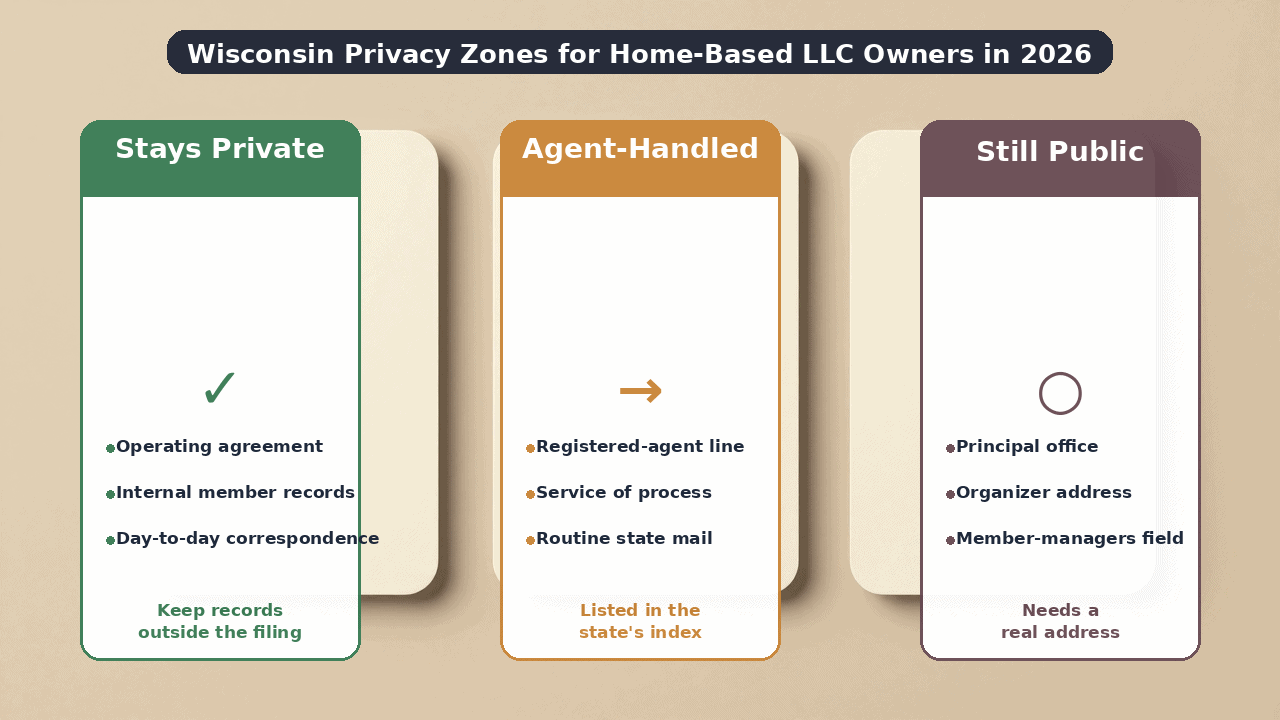
For most founders, the easiest way to understand this is to treat the filing as three separate lines.
Line one is the registered-agent field.
Line two is the principal office field.
Line three is the organizer field.
A commercial agent can clean up line one.
It does not automatically clean up lines two and three.
That is the whole Wisconsin privacy lesson in one simple frame, which makes the filing easier to explain.
A real-world example of where owners get tripped up
Picture a solo designer in Milwaukee working from a spare bedroom.
She hears that a registered agent helps with privacy.
So she hires a commercial Wisconsin agent and assumes the home-address issue is solved.
Weeks later, she looks at the filed record.
The registered-agent field looks clean.
The principal office still shows her home.
The organizer address still shows her home too.
The registered agent did its job.
It was the owner’s assumption that was too broad.
This is the everyday version of how privacy confusion happens, which is why field-by-field planning matters.
Why the principal office field matters more than people think
The principal office field is not just a dusty filing detail.
Wisconsin’s service-of-process rule says that if an LLC has no registered agent, or if the registered agent cannot be served with reasonable diligence, the company may be served at its principal office as shown on the department’s records.
That means the principal office matters in both privacy and compliance terms.
Even if the registered-agent side is clean, the principal office is still part of the legal structure.
So when a founder uses a home address there, it is not just cosmetic.
It becomes part of how the LLC can be reached, which makes the field more important.
Why the organizer field matters too
The organizer field gets overlooked because people focus on the registered agent first.
But Wisconsin does not let the organizer disappear from the filing logic.
If the founder signs as organizer and uses a home address, that creates another personal trail in the articles.
This does not make a commercial registered agent less valuable.
It just means privacy planning has to happen before the form is filed.
The owner needs to decide what address will be used for the organizer and principal office fields with the same care used for the registered-agent field, which avoids a partial fix.
Why privacy planning is easier before filing than after
Once the record is on file, some cleanup is possible.
But cleanup is not the same as prevention.
Wisconsin allows changes to the registered agent or registered office under section 183.0116.
The registered agent can also file certain changes under section 183.0118.
The fee schedule in section 183.0122 shows these change filings still carry fees.
That is manageable.
But it is still more work than getting the fields right before the original filing, which saves friction.
What this means in practice for a home-based owner
If you run the LLC from home, the privacy-safe way to think about Wisconsin is simple.
Use a commercial agent if you do not want your home on the registered-agent line.
Then separately decide what goes on the principal office line.
Then separately decide who signs as organizer and what address is used there.
That may feel less magical than the phrase registered agent privacy.
It is also the version that actually holds up when the state record is filed and later searched, which keeps expectations real.
Why searchability changes how owners should think about privacy
Home-based owners often think about privacy as a filing-day issue only.
But privacy becomes more emotional after the record is searchable.
The moment a founder imagines a client, neighbor, or random internet user pulling up the state record, the address question feels more personal.
That is why small wording mistakes matter so much in this space.
If a service page says keep your home off public listings, the founder may hear keep my home off every public field.
Wisconsin does not promise that broad result through the registered-agent role alone.
The cleaner promise is that the service helps protect the registered-agent contact field while the owner still has to think carefully about the other required filing fields, which builds trust faster.
What founders should not rely on if privacy is the goal
Do not rely on vague blog copy.
Do not rely on a friend who formed an LLC in another state and assumes Wisconsin works the same way.
Do not rely on the idea that once a commercial agent is hired, every filing line somehow updates itself.
And do not rely on after-the-fact cleanup as the main plan.
The better move is to read the actual Wisconsin filing requirements, map the address fields, and decide up front which fields the registered agent touches and which ones need a separate strategy.
That saves more stress than any privacy slogan ever will.
What a Wisconsin registered agent is still very good for
Even with those limits, a Wisconsin registered agent is still a strong move for many small businesses.
It gives the LLC a dedicated legal-contact lane.
It helps keep your home off the registered-agent line.
It creates a cleaner place for service of process.
It helps separate business-facing compliance work from personal life.
And it reduces the chance that legal papers show up where you least want them.
Those are meaningful benefits.
They just work best when the owner understands their scope, which improves decision-making.
How annual-report maintenance fits into privacy
Privacy planning is not only a formation issue.
It is also a maintenance issue.
If the LLC later changes its registered-agent setup, office details, or other state-facing record items, the owner needs to keep the file current.
That is why our Wisconsin annual report filing windows guide belongs in the same conversation.
It is also why our Wisconsin registered-agent change walkthrough is a practical companion.
A clean privacy plan can drift if the maintenance side gets sloppy, which is why ongoing compliance still matters.
A simple before-you-file checklist for Wisconsin privacy
Before filing, confirm whether you are comfortable with the principal office address that will appear in the articles.
Confirm who will sign as organizer and what address that person will use.
Confirm the registered agent is commercial and reliable if keeping your home off the registered-agent line is part of the goal.
Confirm you understand how later maintenance works if any of those fields change.
And confirm that your privacy goal is realistic for Wisconsin’s actual filing structure.
That checklist turns privacy from wishful thinking into a filing plan, which gives you more control.
What founders should ask before they buy a registered-agent service
Ask whether the service replaces only the registered-agent line or whether it also helps you think through the principal office and organizer fields.
Ask how service of process is handled.
Ask what changes later require a separate filing and fee.
Ask whether the company is helping you understand Wisconsin’s actual form fields or just selling the word privacy.
Those questions do not kill the sale.
They improve the sale because the buyer knows what is being purchased, which creates better-fit customers.
How this fits with the rest of the Wisconsin filing record
If you want the bigger picture, our Wisconsin LLC documents guide is the right next read.
That guide helps connect the articles, maintenance filings, and other paperwork that shape what the state record actually looks like.
Privacy is easiest to understand when it is framed inside the full filing stack instead of marketed as a single feature, which reduces confusion.
Related reading
For the update process after formation, read Wisconsin Registered Agent Change for LLCs in 2026: Online Filing Walkthrough.
For ongoing record maintenance, read Wisconsin Annual Report Filing Windows for LLCs in 2026.
For the full filing-document picture, read Wisconsin LLC Documents: Example and State Comparisons.
Final takeaway
A Wisconsin registered agent can do something valuable for a home-based owner.
It can move the public registered-agent line away from your house and create a cleaner service-of-process setup.
It does not automatically hide the principal office or organizer address fields required in the LLC filing.
The clean 2026 rule is simple.
Wisconsin Registered Agent Privacy in 2026 works best when home-based owners understand exactly what can stay off public listings and what still needs a separate address decision before the LLC is filed.
Frequently Asked Questions
Does a Wisconsin registered agent keep my home address off the public record?
It can, but mainly on the registered-agent line. Wisconsin still requires the company’s principal office address and the organizer address in the articles, so a registered agent does not automatically replace every other address field.
What does Wisconsin require in the LLC filing?
Wisconsin Statutes section 183.0201 says the articles of organization must include the company’s principal office addresses, the initial registered agent’s name and addresses, and the name and address of each organizer.
Why does the principal office field matter for Wisconsin privacy?
Because Wisconsin Statutes section 183.0119 says the company may be served at its principal office if there is no registered agent or the registered agent cannot be served with reasonable diligence. That makes the principal office a meaningful compliance and privacy field.
Does a Wisconsin registered agent hide the organizer field too?
No. If the founder signs as organizer and uses a home address there, that address can still become part of the filing trail even when the registered-agent line is commercial.
Can I change my Wisconsin registered agent later?
Yes. Wisconsin allows a change filing for the registered agent or registered office under section 183.0116, and section 183.0118 covers certain changes made by the registered agent. Those filings still involve maintenance work and fees.
What is the cleanest privacy plan for a Wisconsin home-based owner in 2026?
Use a commercial registered agent for the registered-agent line, then separately choose the best address strategy for the principal office and organizer fields before filing the LLC. Planning those fields early works better than trying to clean them up later.
Related reading
Wisconsin Privacy Basics
Need the Wisconsin filing set up with cleaner address choices from day one?
Rapid Registered Agent helps home-based owners protect the registered-agent line while keeping expectations honest about what Wisconsin still requires elsewhere in the filing.
- States Covered
- 50 + DC + PR
- Serving Businesses Since
- 2007
- Plans Start At
- $10/mo per state