Nebraska Certificate of Good Standing in 2026: When an LLC Needs It for Contracts and Expansion
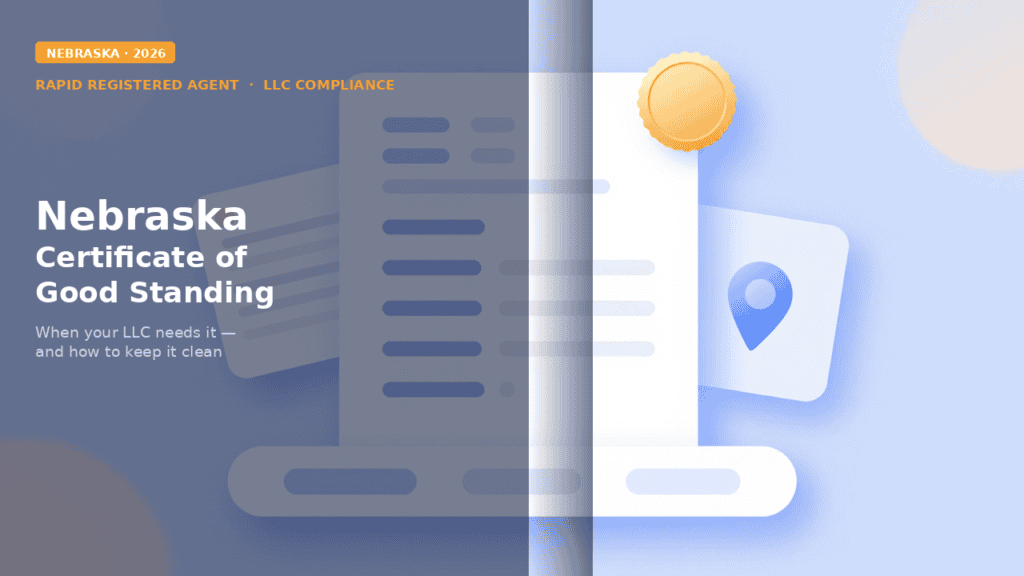
Nebraska Certificate of Good Standing in 2026 becomes urgent the minute a lender, customer, or new state asks your LLC to prove it is still clean on the Nebraska record.
That pressure usually hits when the contract is moving, the loan file is open, or the expansion deadline is already close.
Most owners do not worry about this document until somebody else controls the timeline, which is why it turns into a scramble.
The good news is that Nebraska gives you a clear map for what the certificate proves, what breaks good standing, and where tax registrations fit into a different system, which helps you fix the right problem faster.
What a Nebraska certificate of good standing really proves
The Nebraska Secretary of State says on its Corporate and Business page that you can order certificates of good standing to verify an entity’s existence in the state of Nebraska.
That is the core idea.
The certificate is not a trophy for being a serious owner.
It is state-issued proof that the LLC is active enough on the Secretary of State side of the record for Nebraska to certify it.
That matters because third parties trust the state record more than your memory, which makes deals move.
Why this document shows up during contracts and expansion
Most counterparties ask for the certificate when they want proof, not promises.
A procurement team may ask for it before vendor onboarding.
A bank may ask for it before releasing funds.
An investor lawyer may ask for it during diligence.
Another state may ask for it before allowing a foreign registration filing.
The pattern is simple.
The bigger the commitment, the less the other side wants to rely on informal statements, which protects their risk.
Contracts are where the Nebraska certificate starts to matter fast
Plenty of routine customers never ask for this document.
That can fool a new LLC owner into thinking the certificate is rare.
Then a larger customer, public bid, franchise deal, or enterprise contract wants proof that the business entity signing the paper is still valid.
That is when the compliance file meets the revenue file.
If the state record is clean, the request is a task.
If the record is messy, the request becomes a delay, which can slow cash.
Lenders care because Nebraska itself says lenders care
Nebraska’s New Business Information page says that an entity that is administratively dissolved would no longer be in good standing and would not be able to obtain a certificate of good standing that many lenders require before loaning money.
That is unusually direct guidance from the state.
Nebraska is telling owners that good standing is not just an internal paperwork issue.
It can affect whether financing moves at all.
If you wait until closing week to find that out, you lose leverage you could have protected earlier.
Expansion is where owners confuse entity proof with tax setup
This is the part that trips up new LLC owners.
They hear that another state wants proof of status and assume the Nebraska certificate covers every government issue tied to the business.
It does not.
The Nebraska certificate comes from the Secretary of State.
Nebraska tax accounts live with the Department of Revenue.
That split matters because a clean entity certificate does not replace tax registration work, which avoids false confidence.
Nebraska splits entity status and tax accounts into different systems
This point is an inference from Nebraska’s own agency structure, and it is an important one.
The Secretary of State handles the entity record, annual or biennial reporting, registered-agent records, and certificate ordering on the business-services side.
The Department of Revenue handles business tax registration through its Register Your New Business Online page.
That Revenue page says the application is for registering businesses that do not already have a Nebraska Tax ID Number.
The same page lists programs like sales and use tax and income tax withholding.
That tells you the tax-account side is separate from the certificate side, which helps you ask for the right document.
A Nebraska certificate is not the same thing as tax compliance
Owners sometimes say, “We already formed the LLC, so we should be good.”
That is only half the picture.
If the business has taxable activity, payroll, or other state tax obligations, those accounts are tracked through Revenue systems, not inside the certificate itself.
Nebraska’s Online Filing for Nebraska Business Taxes page has separate e-file or pay entries for sales and use taxes and income tax withholding.
Its tax calendar separately lists due dates for Form 10 sales and use tax returns and Form 941N quarterly withholding returns.
So when a counterparty wants a certificate, do not assume that means your tax-side work is covered too, which prevents avoidable gaps.
Why the Nebraska biennial report is the first thing to check
For an LLC, the fastest good-standing audit starts with the report calendar.
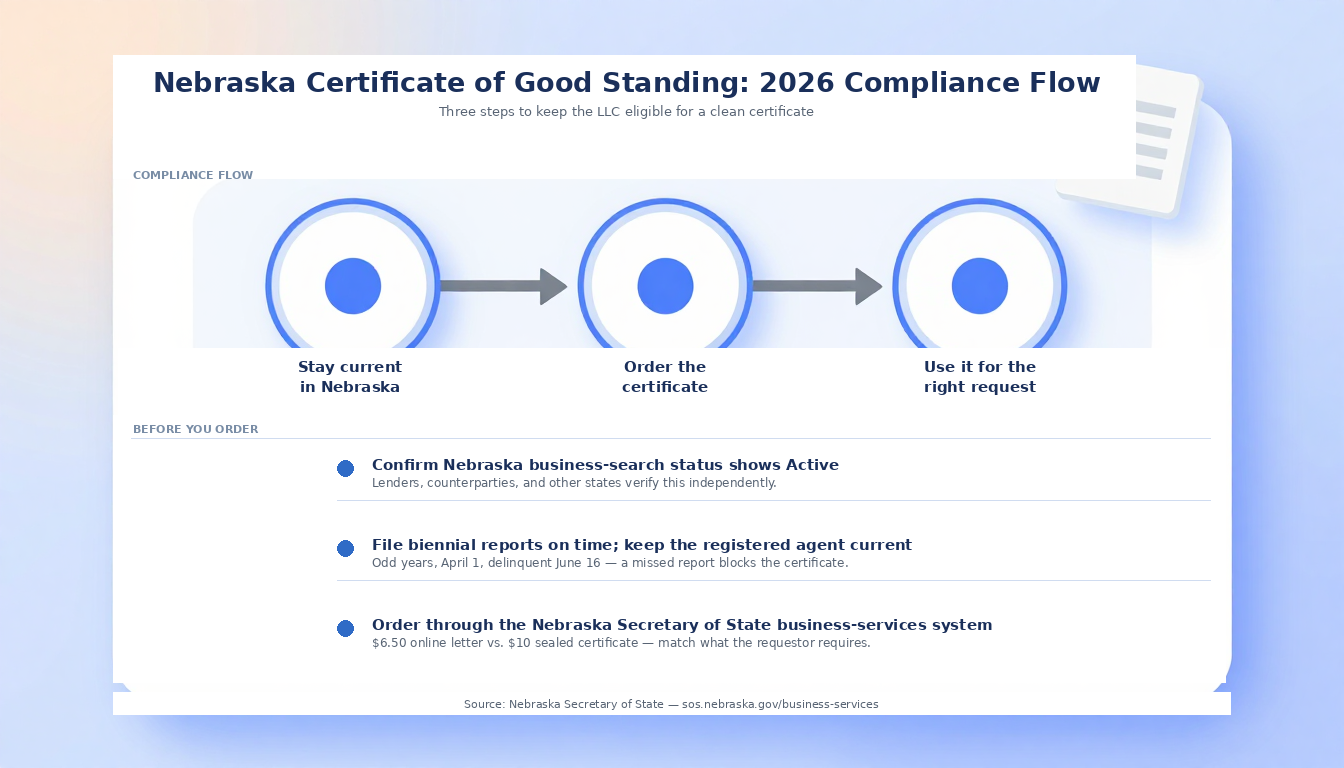
Nebraska’s Annual or Biennial Reporting page says domestic and foreign LLCs and professional LLCs file biennial reports in odd-numbered years by April 1 and become delinquent June 16.
That means 2026 is not the regular Nebraska LLC report year.
That does not mean 2026 is safe by default.
It means the owner should confirm the 2025 biennial report was filed and the entity still shows active before assuming a 2026 certificate request will be easy.
That one check can reveal trouble early, which saves time.
What Nebraska says happens when reports are missed
The same Nebraska reporting page says that if the report is not filed by the delinquency date, the company will be administratively dissolved or have its authority administratively revoked.
That sentence explains why a certificate request can fail after months of silence.
The problem does not start on the day somebody orders the certificate.
The problem usually starts when the business ignores the report cycle and stops watching the state file, which turns one missed task into a bigger repair.
Registered-agent mistakes can break good standing too
Many owners focus on the report and miss the address side of the file.
Nebraska’s registered-agent guidance says the registered agent is the agent for service of process and official government communications.
The page also says your business must maintain a registered agent in this state.
Nebraska’s New Business Information page adds that failure to maintain a registered agent or office can result in administrative dissolution.
That matters because the certificate request often exposes an older maintenance failure, which lets you fix the root cause.
How the problem usually unfolds in real life
A founder forms the LLC and gets busy.
The registered agent or office changes.
A notice goes to the wrong place.
The biennial report does not get filed.
The status issue sits quietly until a bank, customer, or expansion filing asks for a certificate.
Then the owner thinks the problem is document ordering.
The real problem is record maintenance that drifted for months, which is why prevention is cheaper.
How to order the Nebraska certificate
The official path starts with the Nebraska Corporate and Business page.
Nebraska says its free search can be used to review entity information and order certificates of good standing and copies of filed documents.
That means the clean workflow is to search the entity first, confirm the status is active, and then place the order through the state system.
That search-first approach matters because it shows whether you are ordering a document or uncovering a cleanup project, which sets expectations sooner.
Nebraska has two different status products and owners mix them up
Nebraska’s certificate FAQ draws a sharp line between a Letter of Good Standing and a Certificate of Good Standing.
The FAQ says a Letter of Good Standing is an online verification available immediately for viewing or printing and costs $6.50.
The same FAQ says a Certificate of Good Standing is prepared by Secretary of State staff, contains the State Seal and signature, is sent by regular mail within 2 to 3 business days of the online order, and costs $10.00.
That distinction matters because some counterparties will accept fast online proof and others will want the formal certificate, which helps you avoid ordering the wrong thing.
Why the document type matters in contract work
If the other side only needs a quick confirmation, the online letter may be enough.
If the other side wants a formal state-sealed certificate for diligence or a filing packet, the lighter letter may not solve the problem.
This is one of the easiest Nebraska mistakes to avoid.
Ask the lender, customer, buyer, or filing office which document they require before you order anything.
That one question can save a few days at the worst possible time, which keeps momentum.
Expansion planning needs a cleaner checklist than most owners use
When an LLC plans to register in another state, the document stack tends to grow fast.
You may need a Nebraska certificate.
You may need a foreign registration filing in the new state.
You may also need separate tax registrations if the new state activity creates tax obligations there.
That is why the best habit is to treat the certificate as one line in a larger expansion checklist, not the whole checklist.
That mindset lowers surprises because each agency requirement gets its own lane.
What to check before promising a Nebraska certificate to anyone
Start with the Secretary of State search.
Confirm the LLC shows active.
Confirm the biennial report history makes sense for the entity.
Confirm the registered agent and registered office are current.
Ask whether the recipient needs the instant online letter or the formal mailed certificate.
Then look separately at Revenue-side registrations if the project also involves payroll, taxable sales, or other state tax activity.
That sequence keeps a simple request from turning into a multi-agency mess.
What to do if the LLC is not in good standing
Do not promise the certificate first and figure it out later.
Fix the state record first.
Nebraska’s reporting page says corporations and LLCs that are administratively dissolved or revoked may reinstate by filing the appropriate reinstatement forms with the business services division.
Once the entity is back in active status, the certificate request becomes realistic again.
The key is to treat reinstatement as the project and the certificate as the result, which keeps priorities straight.
Why 2026 is a tricky year for Nebraska LLC owners
Because 2026 is an even-numbered year, some owners assume Nebraska LLC reporting can be ignored altogether.
That is too casual.
The rule says LLC biennial reports are due in odd-numbered years, but certificate eligibility in 2026 still depends on what happened before 2026.
If 2025 was missed, 2026 will not magically repair the record.
If the registered-agent file drifted, 2026 will not hide that either.
A non-report year can still be a cleanup year, which is why a quick status check is worth it.
The tax-side misunderstanding that slows expansion deals
Here is the clean way to explain it to a new owner.
The Nebraska certificate proves Secretary of State standing.
A Nebraska Tax ID and related filings handle Revenue obligations.
Those are connected in real life, but they are not the same document trail.
If a business is hiring employees, Nebraska’s Revenue pages show withholding registration and separate withholding return due dates.
If a business is collecting taxable sales, Nebraska’s Revenue pages show separate sales and use tax registration and separate Form 10 filing dates.
So do not let one clean certificate make you assume the tax side is fully covered, which reduces compliance drift.
Internal Nebraska checks that pair well with a certificate request
If you want the state-entity side cleaner, our Nebraska Biennial Report Checklist for LLCs in 2026 is the first companion read because missed reports are the most common good-standing blocker.
If you want the broader filing map behind the Nebraska record, our Real Documents You’ll Need for a Nebraska LLC guide helps connect formation, maintenance, and proof-of-status paperwork.
If expansion is the real project, our 50-state compliance calendar guide shows why a single document request often uncovers a wider timing problem.
Using those three checks together keeps the document request from becoming a late surprise.
Final takeaway
The Nebraska certificate is usually not hard because of the order form.
It gets hard when the request reveals a missed biennial report, stale registered-agent record, or a founder who assumed entity proof and tax accounts were the same thing.
If the Secretary of State file is active, the right document type is chosen, and the tax side is handled in its own lane, contracts and expansion move with a lot less friction.
Nebraska Certificate of Good Standing in 2026 works best when the LLC treats good standing as an ongoing record to maintain before the contract, loan, or expansion deadline arrives.
Related reading
For the filing cycle behind many Nebraska status problems, read Nebraska Biennial Report Checklist for LLCs in 2026.
For the main paperwork stack behind a Nebraska entity record, read Real Documents You’ll Need for a Nebraska LLC.
For the bigger multi-state timing problem that often sits behind certificate requests, read How to Build a 50-State Compliance Calendar Without Missing Registered Agent Deadlines in 2026.
Frequently Asked Questions
What does a Nebraska Certificate of Good Standing prove in 2026?
It proves the Nebraska Secretary of State can verify the LLC’s existence and good standing on the state entity record. It is state-issued proof tied to the Secretary of State file.
When does a Nebraska LLC usually need a certificate of good standing?
Most often when a lender, contract counterparty, investor, or another state’s filing office asks for current proof that the LLC is active and in good standing.
Is a Nebraska certificate of good standing the same as a Nebraska Tax ID or tax compliance?
No. Nebraska splits these functions between agencies. The certificate comes from the Secretary of State, while business tax registration and filings such as sales and use tax or withholding run through the Department of Revenue.
What can stop a Nebraska LLC from getting a certificate of good standing?
Missed biennial reports, administrative dissolution or revocation, and failure to maintain a correct registered agent or registered office can all block clean good-standing status.
What is the difference between Nebraska's Letter of Good Standing and Certificate of Good Standing?
Nebraska’s FAQ says the Letter of Good Standing is an online verification available immediately for viewing or printing and costs $6.50, while the Certificate of Good Standing is prepared by staff, contains the State Seal and signature, is mailed within 2 to 3 business days, and costs $10.00.
Why does this matter for expansion into another state?
Because another state may ask for recent home-state proof before allowing a foreign registration filing, and that expansion timeline can stall if the Nebraska record needs cleanup first.
Related reading
Nebraska Compliance
Need the Nebraska record clean before a contract or expansion deadline?
Rapid Registered Agent helps Nebraska LLC owners keep the registered-agent side of the file current so status requests are less likely to turn into last-minute cleanup work.
- States Covered
- 50 + DC + PR
- Serving Businesses Since
- 2007
- Plans Start At
- $10/mo per state