Utah Hiring Checklist in 2026: State Accounts an LLC Needs Before the First Employee Starts
A Utah hiring checklist is one of the easiest places for a new LLC to skip ahead and then spend the rest of the year catching up.
Founders often think about payroll, offer letters, and onboarding first. Utah is thinking about something else: whether the employer already has the state accounts and coverage required to put that first worker on payroll legally.
For most Utah LLCs in 2026, the practical pre-hire checklist has three major state items:
- a Utah employer withholding account,
- a Utah unemployment insurance employer account,
- and workers’ compensation coverage.
After that, new-hire reporting and recurring quarterly filing obligations start almost immediately, which is why a clean Utah hiring checklist usually saves the LLC from a much more painful compliance cleanup later.
The main Utah state accounts to open before the first employee starts
The cleanest way to think about a Utah hiring checklist is to separate true setup from ongoing reporting.
Before the employee starts, most Utah LLCs need:
- a federal EIN,
- a Utah withholding account through the Utah State Tax Commission,
- a Utah unemployment insurance account through the Department of Workforce Services,
- and workers’ compensation coverage unless a narrow exception applies.
Those are the items that make the business hiring-ready at the state level.
Utah withholding comes first for wage payments
Utah’s withholding rules apply when you pay wages to an employee for work done in Utah, and in some cases to Utah residents working outside the state. The Utah State Tax Commission’s Employer Withholding guidance says employers file online using form TC-941E and file and pay through TAP at tap.utah.gov.
Utah’s Publication 14 adds a point many employers miss: it is a class B misdemeanor to have Utah employees without a withholding license. The same publication says employers must have a federal EIN before registering in Utah.
So if your LLC is about to run wages, the Utah withholding account is not optional cleanup. It belongs on the front end of the hiring process.
Utah unemployment insurance registration is a separate employer account
The second major setup item on a Utah hiring checklist is unemployment insurance.
The Utah Department of Workforce Services runs a dedicated Unemployment Insurance and New Hire Reporting portal, which includes business registration for creating a new UI account for a business.
Workforce Services’ employer handbook says new employers register through the site, receive a Utah Employer Registration Number and PIN, and then use that account to file tax reports, make payments, and file new-hire reports. It also says employers subject to the Act must file quarterly wage contribution reports online each calendar quarter until the account is properly closed or exempted.
That means Utah unemployment insurance is not folded into the withholding account. It is its own employer registration, with its own reporting cadence.
Workers’ compensation coverage is part of the pre-hire checklist, not a later fix
Utah’s Labor Commission says that, with a few exceptions, every employer is required to provide workers’ compensation coverage for all employees. That comes from the Labor Commission’s Employers’ Guide to Workers’ Compensation, which cites Utah Code Ann. §34A-2-201.
This is where some LLC owners get tripped up. An owner-only LLC may not have needed workers’ compensation coverage before hiring. But once the business has an employee, the question changes.
For a real first-hire checklist, workers’ comp is not an after-the-fact insurance task. It belongs in the setup stack before day one because it is one of the clearest state-level employer obligations tied to having employees at all.
New-hire reporting is not the same as employer registration
Utah also requires new-hire reporting, but it helps to keep that in the right bucket on a Utah hiring checklist.
The state’s new-hire materials say every employer must report all newly hired or rehired employees within 20 days of the first day of work. That reporting runs through the same Workforce Services ecosystem, but it is a reporting obligation that follows hiring, not a substitute for opening the actual employer accounts first.
In other words:
- the UI account helps establish the employer,
- the new-hire report tells the state about a specific worker after hire.
That distinction matters because new founders sometimes think they can “just report the employee” and handle the employer setup later. Utah’s system is built the other way around.
The practical Utah order that avoids rework
For most Utah LLCs, the low-friction order on a Utah hiring checklist looks like this:
- Form the LLC and get the federal EIN.
- Open the Utah withholding account through TAP.
- Register for Utah unemployment insurance through Workforce Services.
- Put workers’ compensation coverage in place.
- Set up payroll using the Utah withholding and UI account information.
- Hire the employee.
- File the Utah new-hire report within the required window.
That order keeps tax, wage reporting, and insurance aligned from the first payroll instead of making the LLC backfill state accounts after someone is already working.
What starts recurring right after the first hire
The setup work is only half the story. Once the first employee starts, recurring filing obligations begin fast.
On the withholding side:
- Utah requires electronic filing,
- employers file using
TC-941E, - and the annual reconciliation is combined with the fourth quarter return.
On the unemployment side:
- Workforce Services requires quarterly reporting,
- employers file online each calendar quarter,
- and they keep filing until the account is properly closed or the agency determines the employer is exempt.
That is why the best Utah hiring checklist is not just “open the accounts.” It is “open the accounts early enough that the first filing cycle is not a surprise.”
The most common first-hire mistake Utah LLCs make
The most common mistake on a Utah hiring checklist is assuming payroll software creates the state compliance automatically.
Payroll software can help you run payroll, but it does not erase the need to:
- obtain the Utah withholding account,
- obtain the Utah unemployment insurance account,
- carry workers’ comp coverage,
- and handle new-hire reporting on time.
Another common mistake is waiting until the employee’s first day to start registration. That compresses too many state tasks into the same week and raises the odds of payroll delays, missing IDs, or late reporting.
If your Utah LLC is already staying ahead of entity maintenance, this related guide may also help: Utah Annual Renewal Filing for LLCs in 2026.
The clean 2026 Utah hiring checklist
Before the first Utah employee starts, make sure the LLC has:
- a federal EIN,
- a Utah withholding account,
- a Utah unemployment insurance employer account,
- workers’ compensation coverage,
- and a payroll process ready to use those account IDs correctly.
Then, once the employee is actually hired:
- report the new hire within the required timeframe,
- and calendar the Utah withholding and unemployment reporting deadlines immediately.
That is the difference between “we hired someone” and “we were actually ready to hire someone.”
If you want the LLC side of the setup handled cleanly before you start adding employer accounts and payroll obligations, start your Utah LLC with Rapid Registered Agent.
A clean Utah hiring checklist is what separates the LLCs that hire smoothly from the ones that spend their first year chasing paperwork.
Most Utah LLCs need a federal EIN, a Utah withholding account through the Utah State Tax Commission, a Utah unemployment insurance account through the Department of Workforce Services, and workers’ compensation coverage. Yes. Utah Publication 14 says it is a class B misdemeanor to have Utah employees without a withholding license, and the same publication requires a federal EIN before registering in Utah. No. Utah unemployment insurance is a separate employer registration through the Department of Workforce Services, with its own employer number, PIN, and quarterly reporting cadence. Utah’s Labor Commission says that, with narrow exceptions, every employer is required to provide workers’ compensation coverage for all employees. That is tied to having employees at all, so it is a pre-hire checklist item, not an after-the-fact fix. Utah requires every employer to report newly hired or rehired employees within 20 days of the first day of work. That is a reporting obligation that follows hiring, not a substitute for opening the employer accounts first. Utah requires electronic withholding filing using form TC-941E with the annual reconciliation bundled into the fourth quarter return, and the Department of Workforce Services requires quarterly UI wage contribution reports until the account is properly closed or the employer is exempt.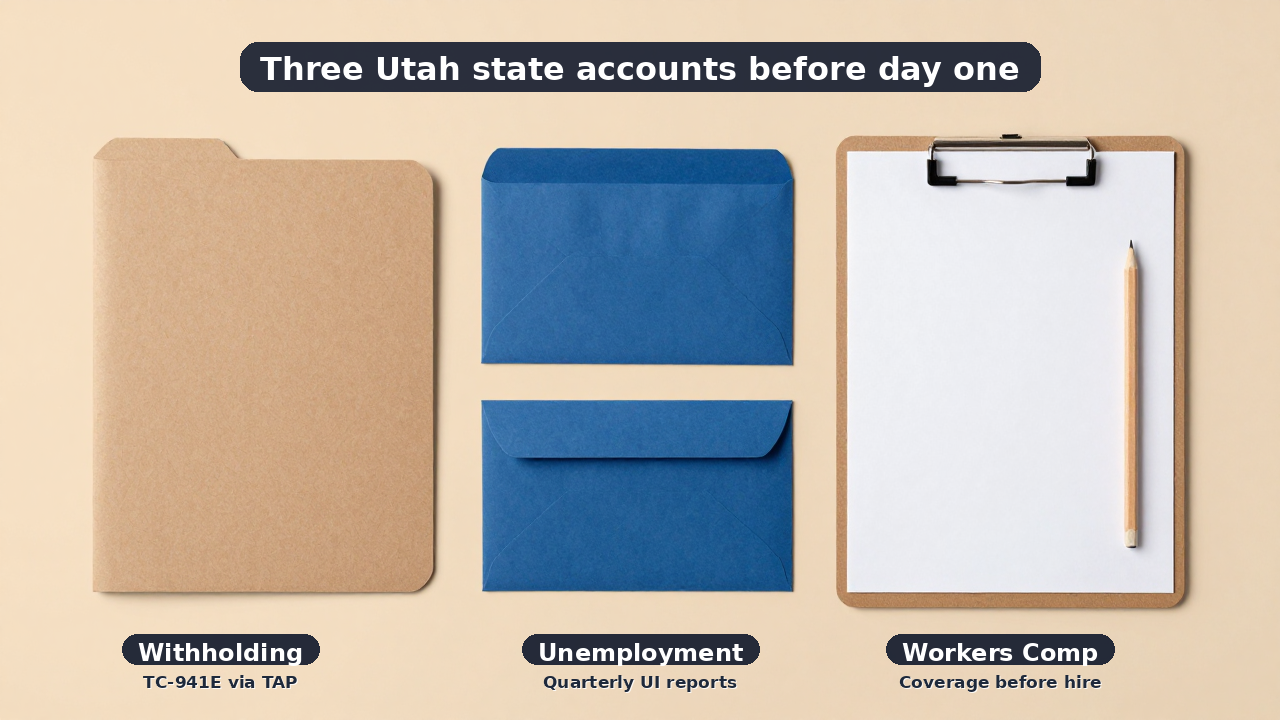
Frequently Asked Questions
What state accounts does a Utah LLC need before hiring its first employee?
Does a Utah LLC need a withholding license to have employees?
Is Utah unemployment insurance part of the withholding account?
When does a Utah LLC need workers' compensation coverage?
When does Utah new-hire reporting have to happen?
What recurring filings start after the first Utah hire?
Utah LLC
Hire the Right Way in Utah — Without Chasing Paperwork
A clean Utah hiring checklist means opening the right state accounts before the first paycheck, not after. RRA helps Utah LLCs get the registered agent, entity setup, and ongoing compliance handled so employer registrations stay current.
Get Started
Utah Hiring Checklist in 2026: State Accounts an LLC Needs Before the First Employee Starts
Ready to take the next step? Rapid Registered Agent handles the paperwork so you can focus on running your business. Sign up in minutes at the link below.