Utah Hiring Checklist in 2026: State Accounts an LLC Needs Before the First Employee Starts

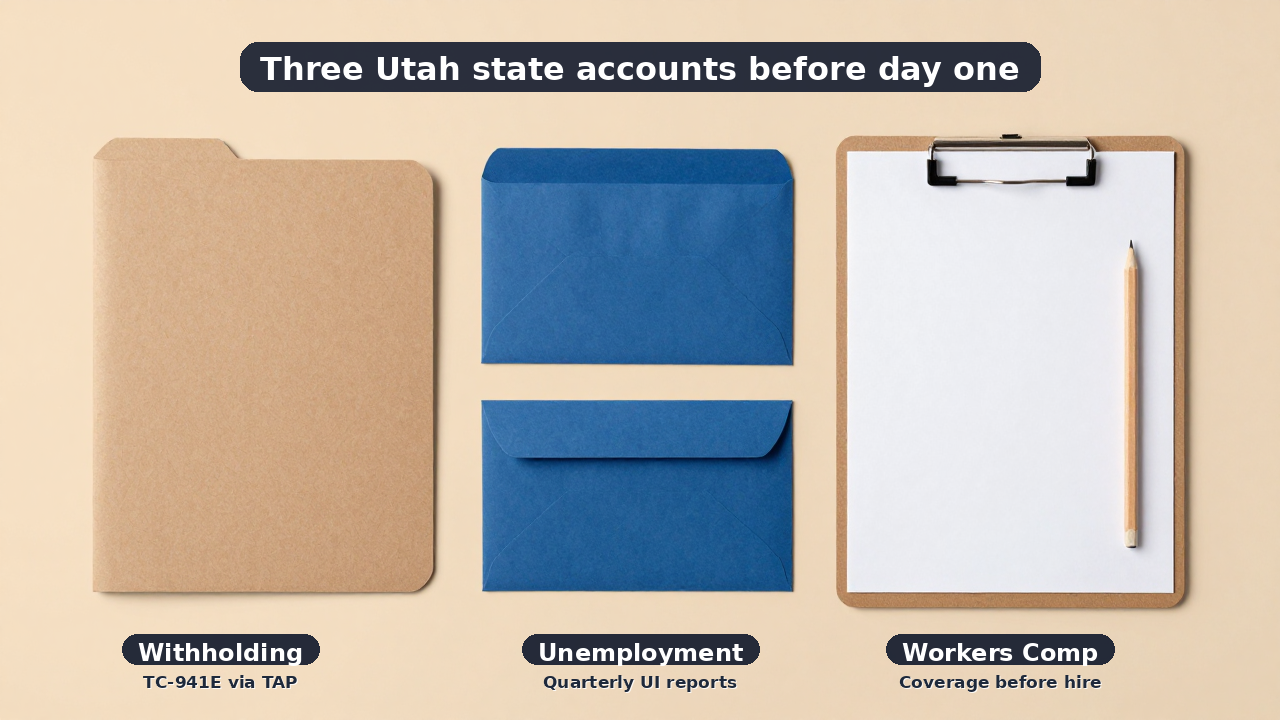
A Utah hiring checklist is one of the easiest places for a new LLC to skip ahead and then spend the rest of the year catching up. Founders usually think about payroll, offer letters, and onboarding first. Utah is thinking about something else. Utah wants to know whether the employer already has the state accounts and coverage required to put that first worker on payroll legally. For most Utah LLCs in 2026, the practical pre-hire checklist has three major state items. A Utah employer withholding account, a Utah unemployment insurance employer account, and workers’ compensation coverage. After that, new-hire reporting and recurring quarterly filing obligations start almost immediately, which is why a clean Utah hiring checklist usually saves the LLC from a much more painful compliance cleanup later.
Why a Utah LLC needs a state-side checklist before the first W-2
A new LLC rarely hires by accident. A founder signs a contract, brings on a friend, or hires the first full-time employee, and the LLC suddenly has a payroll obligation it did not have thirty days earlier. The mistake most founders make is to treat that obligation as a payroll-software problem. It is not. It is a state-accounts problem. Until the LLC has the right state accounts open and the right filings set up, the LLC is technically out of compliance the moment that first paycheck runs. A Utah hiring checklist is the tool that catches that gap before the first W-2 lands.
The three Utah state accounts every LLC needs before hiring
The cleanest way to think about a Utah hiring checklist is to separate the actual setup from the ongoing reporting. Before the first employee starts, most Utah LLCs need a federal EIN, a Utah withholding account through the Utah State Tax Commission, a Utah unemployment insurance account through the Department of Workforce Services, and workers’ compensation coverage unless a narrow exception applies. Those four items are what make the business hiring-ready at the state level. The rest of the checklist is recurring reporting that starts the moment payroll does.
Federal EIN
The federal Employer Identification Number is the foundation of every state account. Utah’s Publication 14 is explicit on this point. It says employers must have a federal EIN before registering in Utah. The EIN is free, comes from the IRS, and usually takes less than fifteen minutes if the LLC is structured as expected. A founder we worked with in January ran payroll for two weeks before realizing the EIN was never assigned to the LLC because the original IRS confirmation was filed under the founder’s Social Security Number. Two weeks of payroll had to be re-filed under the LLC’s correct EIN, and the bank reconciliation had to be rebuilt. The Utah hiring checklist catches that mistake on day one.
Utah employer withholding account
Utah’s withholding rules apply when the LLC pays wages to an employee for work done in Utah, and in some cases to Utah residents working outside the state. The Utah State Tax Commission’s Employer Withholding guidance is the cleanest starting point. It says employers file online using form TC-941E and file and pay through TAP at tap.utah.gov. The same guidance says the FEIN and withholding account ID number have to appear on each return. A founder who skips the withholding account and runs payroll anyway is exposed twice. The LLC has no clean way to remit the Utah withholding, and the LLC cannot show the state a complete filing record if an audit or a worker complaint lands.
Utah unemployment insurance account
The unemployment insurance account is a separate employer account with the Department of Workforce Services. It is not the same as the withholding account, and it is not the same as the federal IRS account. The unemployment insurance account is what the LLC uses to pay the state unemployment tax on wages, and it is what the state uses to process any unemployment claim filed by a former employee. A founder we worked with in March hired two seasonal employees, paid them through a payroll service, and never opened a Utah unemployment insurance account because the payroll service did not flag it. Six months later, when one of the seasonal employees filed for unemployment, the LLC was on the hook for unpaid contributions plus interest. The Utah hiring checklist catches that gap on day one.
Workers’ compensation coverage
Most Utah employers are required to carry workers’ compensation coverage from day one. There are narrow exceptions for certain sole proprietors and family members, but those exceptions are narrower than most founders expect. The clean move is to set up coverage before the first employee starts so there is no gap between the first workday and the first covered shift. A founder who hires before coverage is in place is exposed to fines, to the cost of any claim out of pocket, and to the state’s surprise when the first audit lands. The Utah hiring checklist puts workers’ compensation right next to the other state accounts because the timing matters that much.
What the Utah State Tax Commission expects on the front end
The Utah State Tax Commission’s withholding guidance is clear about the pre-hire sequence. Get the federal EIN first. Register the Utah withholding account through TAP. File and pay through TAP using form TC-941E. Keep the FEIN and the Utah withholding account ID on every return. The same TAP system is what the LLC uses to amend returns, pay by ACH debit or ACH credit, and pay by eCheck or credit card. A founder who builds the Utah hiring checklist around TAP avoids the most common filing errors and keeps the rest of the hiring paperwork clean.
What the Department of Workforce Services expects on the front end
The Department of Workforce Services runs the unemployment insurance side of the Utah hiring checklist. The LLC has to register as an employer, set up the unemployment insurance account, and start paying contributions once wages cross the state threshold. The state contribution rate is set annually based on the LLC’s industry and claim history, and the rate notice usually arrives before the first wage payment. A founder who treats the unemployment insurance account as an afterthought is the one who ends up owing contributions on wages that were already paid, and that is the kind of surprise that turns into a state notice.
Workers’ compensation is not a tax but it lives on the same checklist
Workers’ compensation is technically an insurance product, not a state tax. It still lives on the Utah hiring checklist because the LLC cannot legally run payroll without it for most worker classifications. The right move is to work with a Utah-licensed workers’ compensation carrier, set up the policy before the first employee starts, and keep the certificate of insurance on file with the LLC’s records. If the state audits the LLC, the certificate of insurance is the first document the auditor asks for. A founder who keeps that document in a known folder usually clears the audit on the first pass.
New-hire reporting is the first ongoing obligation
Once payroll runs, the LLC has a new-hire reporting obligation that starts almost immediately. Utah requires new-hire reports to be filed within twenty days of the hire date through the Utah New Hire Reporting Center. The report includes the employee’s name, address, Social Security Number, and the employer’s federal and state identifiers. A founder who files the new-hire report on time usually has no trouble with child-support enforcement or with the state later. A founder who misses the window is the one who hears from the state first, and that contact almost always comes with a penalty.
The quarterly filing rhythm that follows
After the first month, the Utah hiring checklist turns into a quarterly filing rhythm. The LLC files the Utah withholding return on form TC-941E each quarter through TAP. The LLC files the federal Form 941 each quarter. The LLC files the unemployment insurance contribution return on the schedule the Department of Workforce Services sets. The LLC runs payroll, sets aside the employer share of Social Security and Medicare, and remits the state withholding on the same TAP schedule. A founder who builds that rhythm before the first employee starts usually runs payroll on autopilot by the second quarter. A founder who treats the quarterly filings as surprises usually ends the year with at least one late-filing penalty.
How a registered agent fits the Utah hiring checklist
A registered agent does not handle payroll for the LLC. What a registered agent does is keep the LLC’s Utah record current so the hiring paperwork has a clean foundation. The registered agent is the address where service of process and state notices land, and the LLC’s Utah record has to show a real, staffed in-state address. A founder we worked with in February hired a remote employee in Utah before opening the LLC’s registered agent account. The Department of Workforce Services sent a notice to the LLC’s mailing address, the notice bounced, and the LLC missed a contribution window. A registered agent service gives the LLC a stable Utah address for state notices and a clean separation between the founder’s home and the LLC’s official state record.
What 2026 changes mean for the Utah hiring checklist
Utah did not rewrite the hiring rules in 2026. The Utah State Tax Commission moved more employer filings to TAP, tightened the new-hire reporting window enforcement, and pushed harder against employers that run payroll without a state withholding account. The Department of Workforce Services automated more of the unemployment insurance account setup and started sending rate notices through TAP instead of paper mail. None of that changes what is on the Utah hiring checklist. What it changes is the speed at which an outdated account shows up in a state audit, a worker complaint, or a vendor search. A founder who keeps the four state accounts current usually clears every 2026 Utah hiring checklist check on the first pass.
How long a clean Utah hiring checklist takes in 2026
A clean Utah hiring checklist takes one afternoon for the state accounts and another afternoon for the workers’ compensation policy. The federal EIN is the fastest part. The Utah withholding account usually takes a business day to come back through TAP. The Utah unemployment insurance account usually takes a few business days. The workers’ compensation policy usually takes a week once the carrier has the LLC’s information. A founder who starts the checklist four weeks before the first employee begins usually has every account in place by the first paycheck. A founder who starts the checklist the week of the first paycheck usually runs into at least one gap, and that gap is what turns into the cleanup the LLC was trying to avoid.
What to do right now if the Utah LLC is already past the first paycheck
Start by mapping every state account against the actual payroll that has run. If the federal EIN was issued under the wrong name or the wrong entity, fix the IRS record first, then re-file the state returns under the correct EIN. If the Utah withholding account is missing, register through TAP and amend the prior quarterly returns to bring the LLC current. If the unemployment insurance account was never opened, register with the Department of Workforce Services and start paying contributions for the wages that already ran. If workers’ compensation coverage was never bound, talk to a Utah-licensed carrier about retroactive coverage and the steps needed to bring the policy current. Each fix is recoverable, and each fix is faster than letting the gap show up in a state audit, a worker complaint, or a vendor review. The Utah LLCs that stay out of trouble treat the Utah hiring checklist as a layered checklist, not a single form, and that is the rule that keeps payroll clean in 2026.