
Oregon Service-Area Pages in 2026: How Registered Agent Brands Can Localize Without Thin Content
Most Oregon businesses that serve customers across several areas hit the same wall when they try to boost local seo for their website. They have a Google Business Profile set up correctly. They have a website. But when someone searches “plumber in Bend” or “landscaper near me in Eugene,” using organic search, they are invisible. That wall is usually thin content on their landing pages for those areas. This optimization guide shows registered agent brands and local businesses in Oregon how to optimize service area pages that rank, build trust, and do not trip Google’s doorway page filters now.
Local SEO and Service Area Pages: Why Both Matter for Local Search
A service area page is a specific page on your website that targets a location where you do business — even if you have no physical location there. For an Oregon plumber based in Portland, a service area page for Lake Oswego is different from your homepage. It mentions Lake Oswego by name. It talks about plumbing services for Lake Oswego homeowners. It earns the right to show up when someone searches in Lake Oswego.
These separate pages are not optional if you want strong organic search performance. Without them, your local exposure depends entirely on your Google Business Profile. With them, you can rank for multiple location-based searches at the same time. Every city you serve is a chance to appear in Google’s local results with a dedicated service page when someone nearby needs your service.
Google decides which businesses show up in local search results using relevance, distance, prominence, and the quality of your web pages. For service-area businesses — companies that go to the customer rather than the customer coming to them — the Google Business Profile is the primary location signal. But your website landing pages reinforce it. A well-optimized service area page tells Google Maps and local seo results that you genuinely serve Lake Oswego, that you understand the neighborhood, and that past customers there can vouch for you.
The game changed in 2024 and 2025 when search changed how businesses appear in search. Google local packs and google’s local packs and AI Overviews pull from pages that demonstrate genuine local expertise. Thin, template-style pages with nothing but a phone number do not make the cut anymore. Original content — written for real people in that specific area — is what earns prominence in Google’s AI Overviews. Every page on your site should represent a real answer to a customer’s question, not just a keyword match — this is what builds local visibility in search over time.
Why Location Pages and Service Area Pages Are Not the Same Thing
A location page is for a business with a physical address in that city. A service area page is for a business that travels to customers. Both can rank in Google’s local results, but they are optimized differently — and the distinction matters for your local marketing when Google decides which result to show. A plumber with an office in Portland and service area pages for Beaverton, Hillsboro, and Lake Oswego uses location landing pages differently than a plumber who only has a home base and serves all three cities as service areas.
Understanding this difference matters for your local marketing strategy. If your local business has a physical address in Bend, your Bend page should show that address, list your hours, and describe your Bend location. If your local business does not have a Bend address — you simply drive there to serve customers — your Bend page should be framed as a service area page that explains what you do for Bend residents, not a storefront page.
Many seo strategy guides conflate these two types of pages. The result is that businesses either build location pages for cities they do not have offices in (which triggers Google’s spam filters) or they build no service area pages at all (which means they only rank for searches near their home base).
How Google Ranks Service Area Pages Right Now
Google’s local ranking factors for service areas come down to signals that prove you actually serve the location. Relevance means your page content matches what the searcher needs. Distance is built into the search. Prominence comes from reviews, backlinks, and how well-known your local business is in that area.
As one local SEO practitioner put it, service area businesses do not rank without real content — and the key question people ask is whether service area businesses need physical locations, and whether city landing pages that list multiple service areas work better than individual pages for each location to rank in Google’s local results. The short answer is no — but you need to be honest about it. Google allows service-area businesses to hide their home address and serve customers across a defined service radius. What you cannot do is pretend you have an office in a city when you do not. Your GBP service areas and your website content must match.
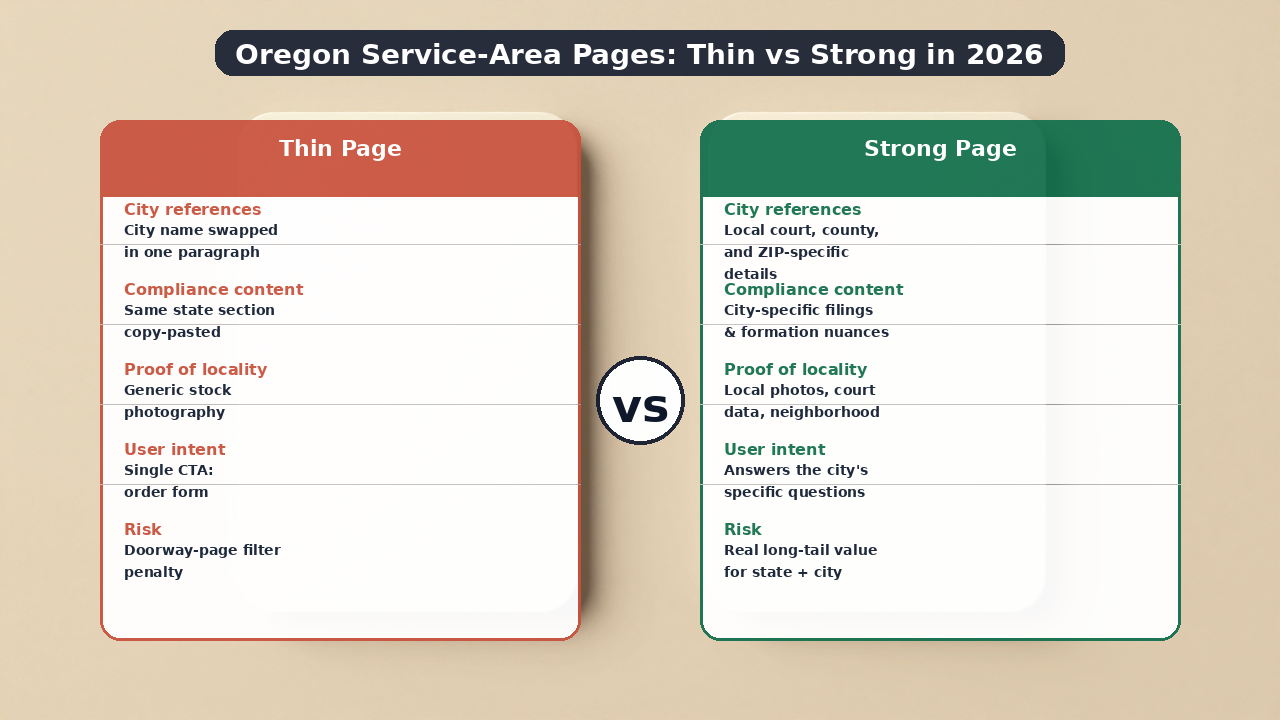
Doorway pages are the trap to avoid. A doorway page is a low-quality page built only to rank for a keyword by inserting a city name into a template. Google calls this a violation of its spam policies. A page that says “We serve Albany, Corvallis, and Lebanon” in one sentence with no specific location detail is a doorway page. A page that explains what your services look like for Albany homeowners, mentions local neighborhoods, links to a local blog post about Albany, and has reviews from Albany customers — that is a service area page worth keeping.
Step One: Set Up Your Google Business Profile and SEO Foundation
Before you create service area pages, get your foundation right. Your Google Business Profile tells Google where you serve. Make sure your service areas are listed accurately — not just Portland, but every city and town you actually serve. Google uses this to match your business to searches and to improve your local presence. If your GBP says you serve Salem and your website has a page targeting Salem, the signals reinforce each other. If they do not match, Google’s algorithm gets confused and your local ranking drops.
SEO is the backbone of every service area page. Each page needs a unique title tag and meta description that includes the city and the service. Your URL structure should be logical — /oregon/bend/ sends a clear location signal, while /service-areas.php?id=42 does not. Schema markup helps search engines understand what the page is about. Add LocalBusiness schema and Service schema to each service area page — the service and location markup tells Google exactly what you do and where in the structured data.
Links between your pages spread ranking signals. Your service area pages for different service areas should link to your main Oregon page. Your Oregon page should link to each individual city page, and those city pages should link back to the main Oregon page. This internal linking and the service locations you list tells Google how your pages relate to each other and gives site visitors a clear path to the specific city they care about.
Step Two: Technical SEO for Service Area Pages and Avoiding Duplicate Content
Thin content is the most common reason service area pages fail. If every city page on your site says the same four sentences with only the location swapped out, Google sees the similarity and ranks none of them well. Each service area page needs content that is genuinely different from the others.
Start with the city itself. What do people in Bend care about that people in Portland do not? Bend is a mountain town with a strong DIY renovation culture. Its water is hard, which means specific plumbing problems show up there that you would not see in the valley. When your page for Bend mentions hard water issues specific to Central Oregon where you have done work, and references Bend-specific service calls, it becomes unique content that Google has not seen before.
Content quality matters more than ever because of AI. Google’s AI Overviews surface content that demonstrates E-E-A-T signals — experience, expertise, authoritativeness, and trustworthiness. For an Oregon service business landing pages targeting Bend specifically, that means content written by someone who understands what Bend customers need. It means local customer testimonials from Bend customers and descriptions of how you help potential customers in Bend. It means mentioning specific neighborhoods and landmarks that show you have real experience working there.
One page might target “emergency plumber in Bend.” Another targets “Bend drain cleaning.” A third targets “commercial plumbing Bend Oregon.” These variations capture different keyword searches and keep each page’s service content distinct from the others. Using the city name naturally throughout the first paragraph, in subheadings, and in the title tag signals local intent keywords without keyword stuffing.
Step Three: Add Local Specificity That Proves Real Service Area Experience
Google’s quality raters look for evidence that a business actually serves the area it claims to serve. For an Oregon service business with service area pages, that evidence lives in the specifics. Mentioning Mt. Bachelor and how it affects seasonal drain issues in Central Oregon is experience proof. Describing how the school district calendar in Salem affects service demand during back-to-school season is local expertise. These details come from actually doing the work in these communities and reflect genuine local optimization expertise.
Specific neighborhoods make service area content stronger. For Portland, mentioning the Pearl District, Alberta Arts District, and Sellwood matters because these neighborhoods have distinct demographics and property types. For Eugene, the University of Oregon campus area has different needs than south Eugene. This neighborhood-level detail is what separates a helpful local resource from a generic landing page.
Your business profile and your website should reinforce each other — optimize both together for the best search result. Your GBP posts and reviews should align with the content on your service area pages. If your service area page for Beaverton claims you have been serving the community for ten years, but your GBP shows you opened last month, the mismatch hurts you. Consistency between your online properties builds the trust signal that Google uses to rank your business in the local area and increase your visibility.
Step Four: Avoid the Patterns That Get Service Area Pages Penalized
The most common penalty trigger is content thinness. Google’s helpful content system measures pages against its standards. If your page does not add value beyond what the searcher could find on your homepage or on a generic directory listing, the helpful content filter suppresses it. Each service area page needs at least a few hundred words of original content that speaks directly to customers in that area.
Another common mistake is building pages for cities you do not actually serve. Every page on your site represents a promise to the searcher — those pages represent your commitment to answering their question honestly through local search marketing that reflects your actual service areas. If you only actually go to Beaverton and Hillsboro, but you built pages for Sherwood, Tualatin, and Lake Oswego because those are nearby towns, those pages generate frustrated searchers who call and find out you do not come to their area. That frustration shows up in click-through behavior and phone calls, which are ranking signals.
A third pattern that trips up local businesses is ignoring mobile experience. Most local searches happen on phones. If your location pages load slowly or do not display cleanly on a mobile screen, your search performance drops. Google uses page experience as a direct ranking factor. For a service area business where the first contact often happens from a mobile search, a poor mobile experience directly hurts your search ranking.
Step Five: Keep Your Oregon Service Area Pages Growing Over Time
Local seo is not a one-time project. Your service area pages need to be living documents that reflect changes in your business and in the communities you serve. When you complete a large project in Ashland, write about it on your Ashland page. When you earn a review from a Medford customer, feature it on your Medford service areas page. Fresh content and ongoing review collection keep these pages active in Google’s index and signal that your business is genuinely present in each service area through strong local search performance.
Updating pages helps with AI search. As Google’s AI Overviews become more prominent, the pages that get featured tend to be comprehensive and current. A service area page for Medford that was written in 2023 and never touched again is less likely to appear in an AI Overview than one updated recently with current information, current reviews, and current service offerings.
Your service area pages should grow alongside your business. If you add a new core service, it belongs on your main Oregon page and on each city pages for multiple cities where you offer it. If you expand into a new service area like Grants Pass, create a service area page first before you create landing pages for it before you start marketing there. Short, thin pages and multiple pages built in a rush to capture a new market before you have real service experience there will do more harm than good.
Your visibility in local search improves when every city page answers real questions that customers in that city actually ask. Generic content that could apply to any city does not build local search visibility — specific, original content does.
This is where pages matter for local seo — Google decides which result to show. A thin page for a city you serve signals low relevance, while a detailed service area page signals high relevance. This is why the content quality on each individual city page shapes your overall organic ranking.
Registered agents building location pages for Oregon clients should write content that specifically describes services in their area for each community, and build landing pages for their physical service areas with genuine local detail.
Frequently Asked Questions
Do service area businesses need physical locations to rank locally?
No. Google allows service-area businesses to hide their address and serve customers across a defined service radius. What matters is that your Google Business Profile and your website content match. You cannot claim to serve a city on your website if your GBP only lists your home base.
Is it better to focus on PPC ads rather than building service area pages?
PPC gives immediate, measurable results while organic local seo builds long-term ranking that does not disappear when your ad budget runs out. Most established Oregon businesses run both. But if you have to choose between a well-optimized service area page and a pay-per-click campaign with no organic foundation, the page wins for strong organic search performance and improved local rankings.
How many service area pages should an Oregon local business create?
Only as many as you can genuinely support with unique content and real service experience. Ten pages for ten cities you actually serve is better than fifty pages for fifty cities where you have no reviews, no case studies, and no local experience. Quality of local signals beats quantity of pages every time.
What is the biggest mistake businesses make with service area pages?
Building thin, template-based pages that only differ by city name. Google flags this as duplicate content and suppresses the pages. The fix is real, specific content for each location — testimonials from local customers, mentions of actual neighborhoods, and service descriptions that reflect how you help that specific community.
How do I avoid triggering Google's doorway page penalty with my location content?
Make sure each page answers the specific questions a customer in that city would ask. Do not just insert a city name into a generic paragraph — write about the services in their area as if you have done the work there. If you have a page for Bend and a page for Eugene, a Bend customer should be able to read your Bend page and feel like you understand their town.
What SEO elements do service area pages need?
Each page needs a unique title tag with the city and service, a unique meta description, a logical URL structure, and LocalBusiness schema markup. Internal linking from your main Oregon page down to each city pages and from each city page back up to the main page helps Google understand the relationship between your pages and distribute ranking signals.
Related Reading
- Oregon Registered Agent Services
- Local SEO for Service Businesses
- Service Area Pages vs Location Pages: What’s the Difference
Oregon Service Area Pages in 2026 are the clearest path for local businesses to show up in every city they serve. Build each one with real content, keep them updated, and your local search visibility grows with every page.
Oregon Service-Area Pages in 2026
Ready to Expand Your Oregon Service Area?
Rapid Registered Agent helps Oregon businesses build a solid registered agent foundation and stay compliant across every city they serve. We know what it takes to show up in local search — and we can help you build the operational foundation that supports it.
- Businesses Served in Oregon
- 4,000+
- Years of Oregon Experience
- 12+
- Service Areas Covered
- 40+