
Rhode Island Certificate of Good Standing in 2026: Fixing Compliance Issues Before a Deal Closes
Most business owners in this state find out the hard way that a good standing certificate is the one item a bank, investor, or licensing board asks for at the worst possible moment — right before a deal is ready to close. There are two separate documents that carry the “good standing” name in the state of Rhode Island: the Certificate of Good Standing issued by the Secretary of State, and the Letter of Good Standing (LOGS) issued by the Division of Taxation. Confusing the two is one of the most common mistakes in a transaction, and it can cost days when the closing calendar is already tight. A Rhode Island LLC from Rapid Registered Agent gives you the structure to keep both documents current and avoid the last-minute scramble.
This article covers what the Certificate of Good Standing actually is, what it verifies, how to obtain one, how to fix it if the status has lapsed, and what causes a business to fall out of compliance in the first place. FAQs are at the end.
What the Certificate of Good Standing in Rhode Island Proves
The Secretary of State issues the Certificate of Good Standing — also referred to as a Certificate of Status — to confirm a business entity is in good standing with the state. The Rhode Island Department of State corporate database is the system of record and tracks every LLC, corporation, limited partnership, and foreign qualification filed in the state.
The certificate confirms three core requirement criteria have been met: all required annual reports have been filed, all state taxes and fees have been paid, and a registered agent with a valid Rhode Island address is on file. An entity with an outstanding annual report or an unpaid fee will have an inactive status flag in the database, and the Secretary of State will not issue the certificate until that flag is cleared.
It is worth noting the Certificate of Good Standing does not verify tax obligations. Tax clearance comes from a separate Letter of Good Standing issued by the Division of Taxation. Lenders and investors sometimes use the phrase “good standing” to mean either document without being specific — and that ambiguity is where deal teams get burned. Getting the question answered in writing before starting work saves everyone time. Financial institutions run this check as part of every commercial lending decision.
Two Documents People Confuse in Rhode Island Transactions
Rhode Island uses two distinct “good standing” documents. Mixing them up can stall a deal.
Certificate of Good Standing. Issued by the Secretary of State through the business services division. Confirms the entity is current on annual reports and registered agent requirements. Banks, investors, and out-of-state filing offices routinely ask for this one. The Certificate of Good Standing is referred to as a Certificate of Existence for LLCs and limited partnerships — but the function and the request process are identical.
Letter of Good Standing (LOGS). Issued by the Division of Taxation. Confirms the entity has no outstanding state tax obligations. Federal lenders, surety bond underwriters, and some M&A counterparties specifically require this document. The LOGS has its own $50 filing fee and its own request process through the Division of Taxation website. You can register the entity for a LOGS online through the Division of Taxation portal. You can request the LOGS electronically or by mail.
The Certificate of Good Standing and the Certificate of Existence are the same document in Rhode Island. LLCs receive a Certificate of Existence; corporations receive a Certificate of Good Standing — but both provide the same proof of compliance.
When You Need a Certificate of Good Standing in Rhode Island — and When the Clock Starts Running
The most common situations that require the Certificate of Good Standing in this state involve financing, business sales, and out-of-state expansion.
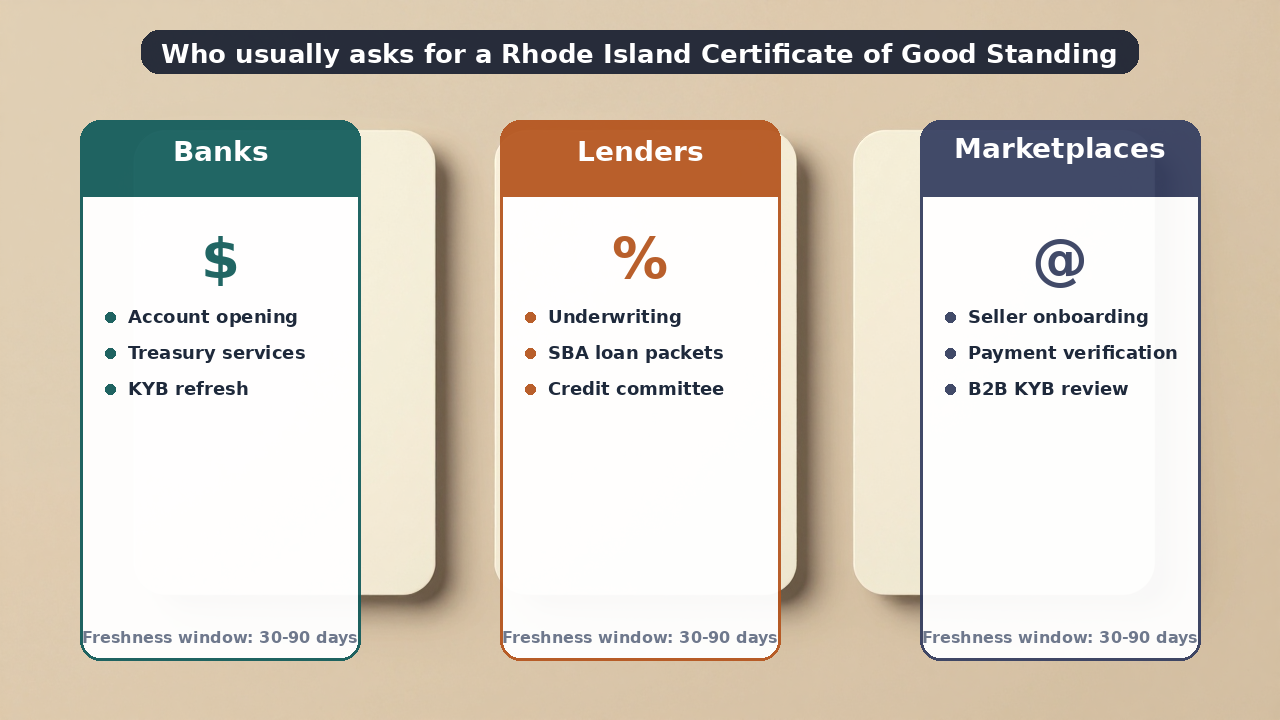
A commercial bank will request the certificate before approving a business loan or opening a commercial account. An investor conducting due diligence before a capital raise will add it to the document checklist. A lender finalizing a commercial mortgage will not fund without it. Banks also provide a certificate of good standing request as part of their standard due diligence package. These are the situations where the request tends to surface at the worst possible time — because the deal has already progressed to the point where the certificate is a formality, until it is not.
Beyond financing, the document appears in several other contexts. Obtaining state licenses and permits from state regulatory agencies often requires proof that the entity is in good standing with the Secretary of State first. When a business wants to register to operate in another state — also called foreign qualification — the receiving state typically asks for a home-state Certificate of Good Standing as part of the filing package. When a company is sold in a mergers and acquisitions transaction, the buyer will request it as part of due diligence. Government contract bids may also require proof of good standing with the state before the procurement office will accept the submission.
The good standing certificate is issued as a snapshot in time. It confirms compliance on the date it is issued. A document dated today is valid for today — but most banks and investors expect a certificate dated within the last 30 to 90 days. For transactions that span multiple rounds or months, the receiving party may request a fresh copy at each stage.
When the Secretary of State Will Not Issue the Certificate of Good Standing
The Secretary of State will not issue the Certificate of Good Standing if the inactive status field in the corporate database is not blank. That flag appears when an annual report is overdue, when a registered agent has resigned and no replacement has been filed, or when the entity has been administratively dissolved.
The annual report deadline for most entities is November 1. The Secretary of State does not send reminder notices — the registered agent on file is responsible for tracking the deadline and submitting the filing on time.
When a filing is outstanding, the request stalls. The fix is to submit the missing annual report and pay any associated late fees. Once the Division of Taxation removes the tax hold (if one exists) and the Secretary of State processes the filing, the inactive status flag clears and the certificate becomes available.
The revoked entities list published by the Secretary of State shows every business that has lost good standing and not been reinstated. A deal counterparty running a basic entity search will see that flag immediately. Discovering it during due diligence is embarrassing and can be expensive.
How to Check Entity Status Before the Deal Gets Tight
Before promising a delivery date to a lender or buyer, run a preflight check on the Rhode Island corporate database. Search the entity by name or file number. Confirm the inactive status field is blank and the request certificate process can proceed without delay. Confirm the most recent yearly filing shows as submitted. Verify the registered agent mailing address is current. This check takes ten minutes and prevents the discovery of a problem when the closing calendar is already full.
If the entity is revoked or the inactive flag is present, start the reinstatement process before promising anything. The timeline for reinstatement is not a matter of days — it involves coordinating with the Division of Taxation for the LOGS and submitting a complete reinstatement packet to the Secretary of State.
What Causes Loss of Good Standing in Rhode Island
Three root causes account for most lost good standing in this state: a missed annual report, an unpaid state tax balance, or a registered agent issue.
Missed annual reports. Rhode Island requires every business entity to file an annual report each year. The November 1 deadline applies to most LLCs and corporations. If the filing is not submitted by that date, the inactive status flag appears. The Secretary of State does not send reminders — the registered agent bears the responsibility for tracking and submitting. Losing good standing over a missed annual report is common and preventable.
Unpaid state taxes and fees. The Division of Taxation places a hold on the entity’s record when a tax obligation is outstanding. This hold prevents the Secretary of State from issuing the good standing certificate until the Division of Taxation issues the LOGS confirming the account is clear. This is a two-agency process — both must be resolved independently.
Registered agent issues. If the registered agent resigns or the listed address becomes invalid, the entity becomes non-compliant. Rhode Island requires every business entity to maintain a registered agent with a physical address in the state at all times. When a registered agent resigns, the entity has a limited window to appoint a replacement — during which the entity is technically not in good standing.
Administrative dissolution. If an entity remains non-compliant for an extended period, the Secretary of State may administratively dissolve it. A dissolved entity no longer exists as a legal business in Rhode Island. A good standing certificate cannot be issued for a dissolved entity — reinstatement is required first.
Order a Certificate of Good Standing in Rhode Island: Rush, Entity, and Processing Time
The request runs through the Secretary of State business services portal. To request a certificate of good standing in Rhode Island, the entity must be in compliance with all state requirements at the time of the request. The filing can be submitted online, by mail, or in person at the Providence office. Online requests are faster and are the preferred method for most standard orders.
To obtain a certificate of good standing in Rhode Island, the entity needs its file number or exact legal name as it appears on record, the type of certificate requested, and the applicable fee. Both standard and rush options are available. A standard request typically takes two to three business days to process. A rush request can be fulfilled the same day or within 24 hours for an additional fee. The fee varies depending on submission method and whether it is a rush order.
Here is the step-by-step process to request a certificate of good:
- Go to the Secretary of State business services portal and select Certificate of Good Standing from the document request menu.
- Search for the entity by name or file number to confirm the exact legal name on record.
- Select the certificate type — standard or rush — and confirm the number of copies needed.
- Pay the filing fee by credit card or ACH. The fee schedule is posted on the Secretary of State website.
- Receive the certificate by email or download it from the portal, depending on the processing speed selected.
The certificate is issued as a PDF with an official seal from the Rhode Island Department of State. Good standing is issued only after the system confirms the entity has met all requirements. The PDF can be downloaded immediately after issuance and should be saved right away — requestors have reported losing access to the portal document after a short window. The certificate will list the entity name, the entity type (LLC, corporation, LP, etc.), the date of issuance, and a statement confirming compliance. The payment and request confirmation are sent electronically for online orders.
Obtain a Certificate of Good Standing in Rhode Island: Certificate of Existence vs. Certificate of Good Standing
For most entities, these are the same document. The terminology differs by entity type: Rhode Island refers to LLCs and limited partnerships as having a Certificate of Existence, while corporations receive a Certificate of Good Standing. Both are obtained through the same business services division and are subject to identical compliance requirements.
The practical difference shows up when a deal counterparty specifies one by name. If a lender asks for a Certificate of Good Standing and the entity is an LLC, the Secretary of State will issue a Certificate of Existence — and it works perfectly. But confirming the exact document name required before filing prevents an exchange of correspondence that adds days to the closing timeline.
Certificate of Good Standing vs. Letter of Good Standing in Rhode Island: Which One Do You Need?
The Certificate of Good Standing is issued by the Secretary of State and confirms corporate registration status. The Letter of Good Standing (LOGS) is issued by the Division of Taxation and confirms tax obligations are current. Transactions sometimes require one, the other, or both — always confirm which document the requesting party needs before starting either process. Rhode Island’s own guidance ties the Letter to reinstatement, financing, mergers and acquisitions, and sale-of-assets work. Lenders sometimes request the Letter even for routine refinancing without specifying it by name.
How to Fix a Lapsed Certificate of Good Standing in Rhode Island: Reinstatement Steps
The fix depends on what caused the lapse.
Missed annual report. File the missing annual report and pay any late fees through the Secretary of State website at sos.ri.gov. Resolving the outstanding filing clears the inactive status flag and makes the entity immediately eligible for a certificate. Our Rhode Island annual report guide covers the November 1 deadline and the online filing process so you never miss a due date.
Outstanding state tax balance. Contact the Division of Taxation to resolve the outstanding balance. The Division must issue the Letter of Good Standing (LOGS) confirming the tax account is clear before the Secretary of State will act. This process takes longer than an annual report fix because it involves a second agency. Once the LOGS is in hand, the entity can request the Certificate of Good Standing from the Secretary of State.
Registered agent issue. Appoint a new registered agent and ensure the registered agent address on file is current. If the previous agent resigned, act immediately — the window to appoint a replacement without forming a gap in compliance is short.
Administrative dissolution. File a reinstatement application with the Secretary of State. The packet must include all outstanding annual reports, proof that all outstanding fees and taxes have been paid (including the LOGS from the Division of Taxation), and the reinstatement filing fee. The Secretary of State will reject incomplete packets — all pieces must arrive together. Once the reinstatement is processed, the entity is restored to good standing and the Certificate of Good Standing can be requested immediately.
In all cases, the best course of action is to resolve compliance issues before they become urgent. A deal that stalls because the certificate cannot be produced is an expensive problem. Maintaining good standing year-round costs far less than a rush reinstatement in the middle of a transaction.
Foreign Qualification and Out-of-State Filings
Businesses registered in this state that operate in other states often need to file a foreign qualification in those states. Most receiving states ask for a Certificate of Good Standing from the home state as part of the filing package. This means the Rhode Island certificate is not just a local compliance document. It can be a blocking item for out-of-state expansion, a new client contract in another jurisdiction, or a vendor requiring proof of good standing before signing a master agreement. Standing with the Secretary of State record clean has downstream value. Good standing with the Rhode Island record needs annual filings, a current registered agent, and a clear Division of Taxation account. beyond the home state.
Why the Registered Agent Record Often Causes the Problem
The Secretary of State sends compliance reminders to the registered agent on file. If the agent address is outdated or the agent is no longer available, those reminders do not reach anyone. The state can initiate revocation when reminder letters come back undeliverable. A stale registered agent record is frequently the root cause of the compliance gap that surfaces during due diligence.
If a certificate request exposes a bad contact record, correct it at the same time as the certificate request. Fixing the registered agent and filing the reinstatement at the same time prevents the problem from re-surfacing in six months.
Final Takeaway: The Certificate Is Rarely the Real Problem
The Certificate of Good Standing in Rhode Island is rarely the real problem. The compliance gap it reveals is.
If annual filings are current, the inactive status field is blank, the Division of Taxation account is clear, and the registered agent record is accurate, obtaining a Certificate of Good Standing in Rhode Island is straightforward — two to three business days for a standard online request, same day for a rush. If those pieces are broken, the request becomes a multi-step repair project fast.
Businesses that check the corporate database before the deal clock gets tight avoid the scramble and keep closings on track. Running this preflight check once a quarter is a habit that pays off when a deal opportunity appears.
Related Reading
- [Rhode Island LLC Documents: Key Forms & Filing Guide](/rhode-island/rhode-island-llc-documents-example-and-state-comparisons/) — Everything your Rhode Island LLC needs to stay compliant and ready for a deal.
- [Rhode Island Annual Report Filing for LLCs in 2026](/rhode-island/rhode-island-annual-report-llc-2026/) — November 1 deadline, online filing, and how to catch up if you missed a year.
- [Rhode Island Reinstating a Revoked LLC in 2026](/rhode-island/rhode-island-llc-reinstatement-2026/) — If the entity has already been dissolved, here is how to restore it.
A Rhode Island Certificate of Good Standing in 2026 keeps every deal on track — request yours before the deal starts, not when the deal is already on the line.
A Certificate of Good Standing in Rhode Island is an official document issued by the Secretary of State confirming that a business entity has filed all required annual reports, paid all state taxes and fees, and maintains a registered agent in the state. Banks, investors, and licensing boards request it to verify that the entity is legally authorized to conduct business. Yes. The Secretary of State business services portal allows entities to request a Certificate of Good Standing online. Standard processing takes two to three business days. A rush option is available for same-day or next-day issuance for an additional fee. To obtain a Certificate of Good Standing in Rhode Island, submit a request through the Secretary of State business services division online at sos.ri.gov, by mail, or in person. The entity must be current on all annual reports, state taxes, and registered agent requirements before the certificate can be issued. The Certificate of Good Standing is issued by the Secretary of State and confirms corporate registration status. The Letter of Good Standing (LOGS) is issued by the Division of Taxation and confirms tax obligations are current. Transactions sometimes require one, the other, or both — always confirm which document the requesting party needs. The most common causes are failing to file an annual report by the November 1 deadline, having an outstanding state tax obligation with the Division of Taxation, and issues with the registered agent such as resignation or an invalid address. The certificate is required when opening a business bank account, applying for a business loan, raising capital from investors, registering as a foreign entity in another state, bidding on government contracts, or completing a business sale or merger.Frequently Asked Questions
What is a Rhode Island Certificate of Good Standing?
Can you get a Certificate of Good Standing in Rhode Island online?
How do I obtain a Rhode Island Certificate of Good Standing?
What is the difference between the Certificate of Good Standing and the Letter of Good Standing (LOGS) in Rhode Island?
What causes a business to lose its good standing in Rhode Island?
When do you need a Rhode Island Certificate of Good Standing?
Rhode Island Certificate of Good Standing Rapid Registered Agent helps Rhode Island businesses obtain Certificates of Good Standing, fix compliance issues, and stay in good standing with the Secretary of State year-round.Need a Rhode Island Certificate of Good Standing before your deal closes?
Related Reading
- Rhode Island LLC Documents: Key Forms & Filing Guide — Everything your Rhode Island LLC needs to stay compliant and ready for a deal.
- Rhode Island Annual Report Filing for LLCs in 2026 — November 1 deadline, online filing, and how to catch up if you missed a year.
- Rhode Island Reinstating a Revoked LLC in 2026 — If the entity has already been dissolved, here is how to restore it.
Frequently Asked Questions
What is a Rhode Island Certificate of Good Standing?
A Certificate of Good Standing in Rhode Island is an official document issued by the Secretary of State confirming that a business entity has filed all required annual reports, paid all state taxes and fees, and maintains a registered agent in the state. Banks, investors, and licensing boards request it to verify that the entity is legally authorized to conduct business.
Can you get a Certificate of Good Standing in Rhode Island online?
Yes. The Secretary of State business services portal allows entities to request a Certificate of Good Standing online. Standard processing takes two to three business days. A rush option is available for same-day or next-day issuance for an additional fee.
How do I obtain a Rhode Island Certificate of Good Standing?
To obtain a Certificate of Good Standing in Rhode Island, submit a request through the Secretary of State business services division online at sos.ri.gov, by mail, or in person. The entity must be current on all annual reports, state taxes, and registered agent requirements before the certificate can be issued.
What is the difference between the Certificate of Good Standing and the Letter of Good Standing (LOGS) in Rhode Island?
The Certificate of Good Standing is issued by the Secretary of State and confirms corporate registration status. The Letter of Good Standing (LOGS) is issued by the Division of Taxation and confirms tax obligations are current. Transactions sometimes require one, the other, or both — always confirm which document the requesting party needs.
What causes a business to lose its good standing in Rhode Island?
The most common causes are failing to file an annual report by the November 1 deadline, having an outstanding state tax obligation with the Division of Taxation, and issues with the registered agent such as resignation or an invalid address.
When do you need a Rhode Island Certificate of Good Standing?
The certificate is required when opening a business bank account, applying for a business loan, raising capital from investors, registering as a foreign entity in another state, bidding on government contracts, or completing a business sale or merger.
Rhode Island Certificate of Good Standing
Need a Rhode Island Certificate of Good Standing before your deal closes?
Rapid Registered Agent helps Rhode Island businesses obtain Certificates of Good Standing, fix compliance issues, and stay in good standing with the Secretary of State year-round.
- Standard processing
- 2-3 business days
- Rush available
- Same day
- Online request
- Yes