West Virginia Business Registration Tax and Hiring in 2026: What Changes Once Payroll Begins

West Virginia Business Registration Tax and Hiring in 2026: What Changes Once Payroll Begins is the question that hits right after a founder thinks the state setup is finished, only to learn that the first employee changes the whole compliance map.
That surprise is common.
The LLC gets formed.
The business registration certificate gets issued.
The owner assumes the state side is done.
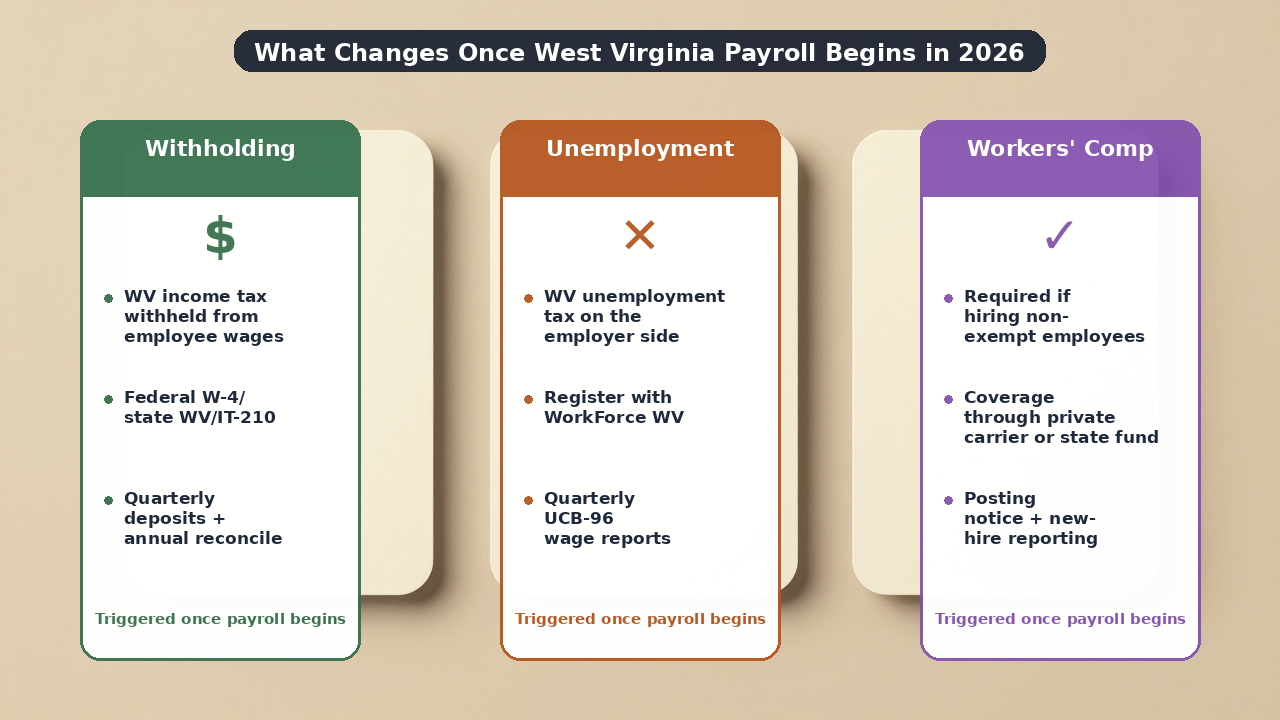
Then payroll starts and three more systems suddenly matter.
That is why the real West Virginia answer is not just about the certificate.
What the West Virginia business registration certificate does before hiring
The West Virginia Tax Division says any person engaging in business activity in the state must register with the state before commencing business activity.
The official business registration page says a business registration certificate can be obtained through the Business for West Virginia website or by filing the BUS-APP with the Tax Commissioner.
The companion business registration FAQ says the same thing more directly: register before doing business.
That certificate gets the business into the West Virginia tax system and gives it the baseline state registration record.
It is the start of compliance.
It is not the whole employer setup.
Why payroll changes the compliance picture so fast
Before hiring, the core question is usually whether the LLC exists and whether the business is registered with the state.
After hiring, the real question becomes whether the company is ready to withhold, report, remit, and insure correctly.
That is a different operating profile.
The same West Virginia business can go from a quiet entity-registration problem to an employer-compliance problem the moment wages start, which is why the first employee matters so much.
Why founders think the certificate covered more than it did
The confusion is easy to understand.
The business registration certificate feels official.
The state issues a number.
The business can start operating.
That makes many owners assume the employer side must already be bundled in.
But West Virginia is really doing two different jobs through two different systems.
One system recognizes the business for state registration and tax purposes.
The other systems respond once the business starts paying wages.
That is why the first hire is not just a staffing step.
It is the moment the company stops being only a registered business and starts being an employer in the state’s eyes, which changes the compliance burden.
The three systems payroll wakes up
Once payroll begins, most West Virginia employers immediately feel the weight of three practical compliance lanes.
There is state withholding with the Tax Division.
There is unemployment-tax employer registration and quarterly reporting with WorkForce West Virginia.
And there is workers’ compensation coverage through the state insurance framework.
That stack is what owners miss when they assume business registration and hiring are basically the same step.
What changes with West Virginia withholding once wages begin
The Tax Division’s withholding help and general information page explains what employer life actually means after the first payroll runs.
It says every employer making payment of wages subject to West Virginia personal income tax must deduct and withhold the tax from those wages and remit it to the Tax Division.
The same page says withheld tax is due on or before the fifteenth day of the succeeding month.
It also says quarterly returns are due on or before the last day of the month following the end of the quarter.
That is the key shift founders need to understand.
Hiring does not just mean “run payroll.”
It means the business now lives on a monthly and quarterly filing calendar, which creates a real compliance rhythm.
The filing thresholds owners miss
The same withholding guidance says employers with ten or more employees are required to file and pay electronically.
It also says employers with prior-year liability above the state’s threshold must pay by Electronic Funds Transfer.
That means the compliance burden grows with the payroll footprint, which is one more reason to set the system up correctly before the team grows.
What changes with unemployment tax once payroll begins
WorkForce West Virginia draws the next line clearly.
Its UI tax FAQ says most employers are liable to pay unemployment taxes and report wages paid to employees.
The same FAQ says employers can apply online at the West Virginia business portal and complete the Employer’s Initial Statement.
That means payroll creates a second state-agency consequence beyond Tax Division withholding.
The business registration certificate did not finish the job.
It only got the business into the state’s broader tax system.
WorkForce registration is the separate employer-side step that follows, which keeps the wage side lawful.
Quarterly wage reporting becomes normal operations
WorkForce West Virginia’s tax filing and reporting page says quarterly unemployment tax filings are typically due one month after the end of each calendar quarter.
The same guidance says employers are required to submit quarterly wage and contribution reporting.
That is the practical shift once payroll starts.
The LLC moves from a one-time registration mindset into a repeat reporting mindset, which is where founders either build a real calendar or get surprised later.
What changes with workers’ compensation once hiring begins
The West Virginia One Stop Business Portal’s Employer Responsibilities page says all West Virginia businesses that hire employees are required to meet both federal and state labor regulations.
The same page points employers to the state’s insurance framework for workers’ compensation coverage.
That matters because workers’ compensation is not a tax filing.
It is a coverage obligation that appears because employees exist.
So once payroll begins, the compliance stack is not just “more taxes.”
It is tax plus unemployment plus coverage, which makes hiring a bigger state-compliance jump than many owners expect.
Why the Business4WV portal matters more once payroll begins
The WV One Stop registration page says online filing can complete registration with the West Virginia Secretary of State, the State Tax Department, and WorkForce West Virginia.
That is a major clue for founders.
West Virginia wants businesses to think about startup compliance as a connected system, not as scattered agency steps discovered one at a time.
The portal’s EIN guidance page also says businesses generally need an EIN and that it is part of online registration through the One Stop Business Portal.
That makes the pre-payroll setup cleaner, because the entity, the EIN, and the employer-side registrations can be lined up before the first wage hits the books.
Why this matters for timing, not just paperwork
Owners often assume they can hire first and clean up the account side a week later.
That is the backwards version of the process.
Once wages exist, deadlines exist too.
So the real planning win is not just having the right forms.
It is having the right accounts, filing rhythm, and agency contacts in place before the employee starts, which keeps the first month from turning into a correction project.
A real-world example of what changes once payroll begins
Picture a small West Virginia LLC that registered, got its certificate, and spent the first year as a solo operation.
Then a new client contract required a part-time employee.
The owner got payroll software.
The wages started.
But the owner had not yet finished the withholding setup, the unemployment-tax account, or the workers’ compensation side.
Now one hire has created three compliance gaps instead of one hiring win.
That is the shape of the problem in real life.
It is not that the first employee is hard.
It is that the first employee changes the state’s expectations immediately, which is why the calendar needs to be ready first.
The clean sequence for founders in 2026
For a West Virginia LLC, the clean sequence is simple once you stop pretending the business registration certificate finishes the whole state setup.
Step 1: form the entity and obtain the registration certificate
Get the LLC formed and obtain the West Virginia business registration certificate before business activity starts.
That puts the company into the state system the right way.
Step 2: line up the EIN and payroll structure before day one of wages
Do not wait until the first payroll run to think about tax accounts.
Get the EIN, the payroll workflow, and the responsible contact information lined up first.
Step 3: set up West Virginia withholding correctly
Before wages begin, make sure the withholding side is ready for the monthly remittance and quarterly-return calendar the Tax Division requires.
Step 4: register with WorkForce West Virginia
Use the WorkForce system or the One Stop portal path so the business receives the employer account it needs for unemployment-tax reporting.
Step 5: put workers’ compensation coverage in place
Do not treat coverage as something to figure out after the hire starts.
That is the backwards version of the process.
Step 6: move into the ongoing filing rhythm
Once payroll begins, the business now has a monthly withholding rhythm and a quarterly unemployment-reporting rhythm on top of its entity-level maintenance work.
That is the real state change once payroll begins.
What does not change just because payroll starts
The entity-level obligations do not disappear just because the business becomes an employer.
The LLC still has to maintain its broader West Virginia record too.
Our West Virginia annual report and business registration tax guide covers those standing entity obligations.
If the business falls behind badly enough to lose good standing, our West Virginia LLC reinstatement guide is the recovery-path companion.
And if the owner is building a broader reminder system around hiring and state filings, our 50-state compliance calendar guide is the practical next read.
The registration tax still matters after hiring
Payroll adds employer obligations, but it does not replace the underlying West Virginia registration-tax and annual-report work.
The business still has to stay current as an entity while also staying current as an employer.
That is why the smartest founders stop treating the certificate as a one-time launch task and start treating it as part of a recurring compliance system, which keeps the whole record steadier.
Why the registered-agent side still matters after hiring
Payroll does not replace the need for a stable entity record.
The registered agent still matters because legal mail, notices, and state correspondence still need a reliable doorway into the business.
Our guide on the role of a registered agent in maintaining good standing is a useful companion here, because employer compliance only works well when the base entity-compliance system is steady too.
West Virginia hiring checklist once payroll begins in 2026
Use this checklist before the first employee starts so hiring does not outrun compliance.
- Confirm the LLC and business registration certificate are already in place.
- Confirm the EIN is ready for payroll and employer registrations.
- Set up West Virginia withholding before the first wage payment.
- Register with WorkForce West Virginia for unemployment-tax reporting.
- Put workers’ compensation coverage in place for employees.
- Calendar the monthly withholding remittance deadline.
- Calendar the quarterly unemployment-reporting cycle.
- Keep the entity-level annual-report and registration-tax calendar running too.
Related reading
For the standing entity obligations that continue after hiring starts, read West Virginia Annual Report Filing and Business Registration Tax for LLCs in 2026.
For the recovery path after losing good standing, read West Virginia LLC Reinstatement in 2026.
For the broader compliance-calendar system around recurring deadlines, read How to Build a 50-State Compliance Calendar Without Missing Registered Agent Deadlines in 2026.
Final takeaway
West Virginia Business Registration Tax and Hiring in 2026: What Changes Once Payroll Begins is really about recognizing that the business registration certificate is only the beginning once employees enter the picture.
Hiring adds withholding.
Hiring adds unemployment-tax reporting.
Hiring adds workers’ compensation obligations.
If you want help getting the LLC side clean before the employer-side stack gets layered on top, Rapid Registered Agent can keep the base business setup predictable.
West Virginia Business Registration Tax and Hiring in 2026: What Changes Once Payroll Begins gets much easier when the business treats payroll as a state-compliance upgrade instead of just a staffing event.
Frequently Asked Questions
Does the West Virginia business registration certificate cover hiring?
No. The certificate gets the business into the state’s tax system, but hiring also creates employer-side withholding, unemployment-tax reporting, and workers’ compensation obligations.
What changes first when a West Virginia LLC starts payroll?
The biggest immediate change is that the business moves onto an employer filing calendar. West Virginia withholding rules, unemployment-tax registration, and workers’ compensation all become practical issues once wages begin.
How often does West Virginia withholding get remitted?
The West Virginia Tax Division says withheld tax is due on or before the fifteenth day of the succeeding month, and quarterly returns are due on or before the last day of the month following the end of the quarter.
Does a new West Virginia employer need WorkForce West Virginia registration?
Yes, most do. WorkForce West Virginia says most employers are liable for unemployment taxes and wage reporting, and new employers can apply through the business portal workflow.
Does workers' compensation become a state issue once hiring begins?
Yes. West Virginia’s employer-responsibility guidance points employers to the state’s workers’ compensation framework once they have employees, which makes it part of the first-hire compliance stack.
What is the clean 2026 sequence before the first employee starts?
Get the entity and business registration certificate in place first, line up the EIN and payroll structure, set up withholding, register with WorkForce West Virginia, put workers’ compensation coverage in place, and then move into the monthly and quarterly filing rhythm.
West Virginia employer compliance
Get the West Virginia LLC setup clean before payroll changes the state-compliance map
West Virginia Business Registration Tax and Hiring in 2026: What Changes Once Payroll Begins gets easier when the entity record, the EIN, the withholding setup, and the employer registrations are lined up before the first employee starts. Rapid Registered Agent helps keep the base business setup steady before the employer-side stack gets layered on top.
- Withholding due
- Monthly
- Unemployment reports
- Quarterly
- Payroll trigger
- First hire