
How to Build a 50-State Compliance Calendar Without Missing Registered Agent Deadlines in 2026
How to build a 50-state compliance calendar without missing registered agent deadlines in 2026 is the right question for any multi-state LLC that has run out of “we’ll just remember” and needs one master view, one source of truth, and one failure mode. You opened the LLC’s home-state calendar. You opened the LLC’s foreign-qualification states’ calendars. You opened three different Department of Revenue calendars. You pulled up the LLC’s registered-agent renewal dates. You now have five calendars, four deadline types, and one event horizon you cannot keep in your head. You have also missed at least one deadline — maybe more. Multi-state compliance calendars fail at scale because they look manageable until they are not. A 5-state portfolio is something the LLC’s operations lead can hold in their head. A 15-state portfolio starts to slip when someone goes on vacation. A 30-state portfolio fails visibly because no one person knows every state’s anniversary date. A 50-state portfolio fails every quarter because the calendar itself has not been built. This article walks through the seven-step build for a working multi-state compliance calendar, the four dashboards most multi-state companies actually run, the four things that turn a working calendar into a missed-deadline incident, and the practical order for staying ahead of state filings for all 50 states from one desk.
Here is the broader framework that a 50-state compliance program sits inside, as the registered-agent side of the calendar:
For the broader franchise angle — what changes when a master service agreement handles the registered-agent side of the calendar for an entire portfolio — this walkthrough covers the standardization a 50-state calendar needs:
What “missing a registered-agent deadline” actually means in 2026
A registered-agent deadline is one of three things, and the answer changes depending on which one the LLC misses.
Annual-report deadline. Every state the LLC is registered or foreign-qualified in has an annual report (or biennial, in a few states) the LLC files with the Secretary of State. Most states tie the deadline to the LLC’s anniversary date. Some states tie it to calendar year-end. Missing an annual report costs the LLC a late-filing penalty (typically $25 to $200), triggers administrative dissolution after a 60 to 90 day window, and usually triggers loss of good standing until the LLC reinstates. For an LLC with a 50-state footprint, missing even one annual report cascades into vendor onboarding, banking, and foreign qualification frictions.
Registered-agent renewal or fee deadline. Most registered-agent subscriptions renew annually. Some states require the LLC to confirm the registered agent of record each year as part of the annual report. Some states charge a separate registered-agent filing fee that is separate from the annual report fee. Missing a registered-agent renewal does not cost the LLC the LLC’s good standing directly — but it leaves the LLC without service of process coverage for the renewal gap, which means the LLC’s statutory service rights are held in a third party’s mailbox and the LLC cannot be reached.
Tax-account renewal deadline. The Department of Revenue in most states requires the LLC to renew its tax accounts periodically — sales tax permits, withholding accounts, unemployment insurance accounts, business license renewals. Most run on calendar year or quarterly cycles. Missing a tax-account renewal causes the LLC to lose the LLC’s ability to do business in that state in a tax sense — the LLC can no longer collect sales tax in good standing or claim certain credits.
A 50-state compliance calendar that misses any of these three deadlines across any of the 50 states creates an LLC that is at least partially non-compliant somewhere. The mission of the calendar is to make sure no state falls out of compliance on any of the three.
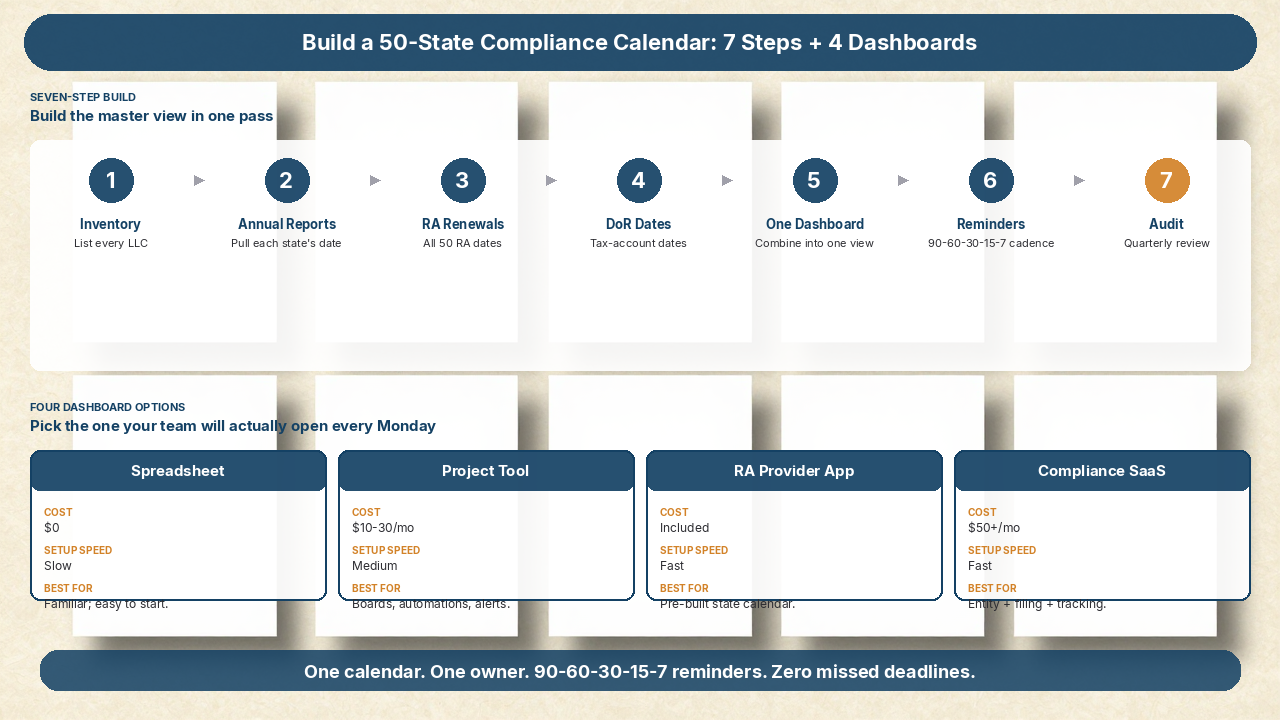
The seven-step build for a 50-state compliance calendar
A working 50-state compliance calendar is built in seven steps, in order, with each step depending on the prior.
Step 1 — Inventory every entity the LLC owns and the state each entity is registered in
The first row of the LLC’s compliance inventory is the LLC’s formation state. The next rows are every foreign-qualification state the LLC has entered. For each entity in each state, the LLC records:
- The LLC’s legal name (matching the state’s record).
- The LLC’s charter number / entity ID.
- The LLC’s formation date (for anniversary-based deadlines).
- The LLC’s registered agent of record and the agent’s address.
- The LLC’s principal office address on the state’s record.
A 50-state LLC with 1 entity in each state has 50 rows. A 50-state LLC with 5 entities (LLC, holding LLC, IP LLC, payroll LLC, equipment LLC) has 250 rows. The cost of doing this wrong compounds because every later step builds on this inventory.
Step 2 — Pull the annual-report deadline and fee for every entity in every state
For each row, the LLC records:
- The state’s annual-report deadline type (anniversary-based, calendar year-end, anniversary + fixed window, biennial, etc.).
- The annual-report fee.
- The state’s late-filing penalty schedule.
- Where the annual report is filed (Secretary of State portal, Department of State, equivalent).
Most of this data is on each state’s Secretary of State website under “Annual Reports,” “Periodic Reports,” or “Statements of Information.” The data is also consolidated on the registered-agent provider’s state-by-state compliance page. The state index on the site covers the most common states and is a starting point, but the LLC’s actual deadline for its actual formation date can only be confirmed by the LLC’s state’s record — and the LLC’s state-by-state data is published by each Secretary of State independently under each state’s fee schedule (e.g., California Secretary of State, Delaware Division of Corporations, Texas Secretary of State, New York Department of State, Florida Division of Corporations).
Step 3 — Pull the registered-agent renewal date and any state-specific registered-agent fee
For each row, the LLC records:
- The registered-agent provider’s renewal date (usually the contract anniversary).
- The state’s registered-agent statutory fee, if any.
- Any annual confirmation step the LLC’s state requires (a small number of states require the LLC to file an annual confirmation that names the LLC’s registered agent of record even if the agent has not changed).
Step 4 — Pull the Department of Revenue and tax-account renewal dates
For each row, the LLC records:
- The state’s sales tax permit renewal date.
- The state’s withholding account renewal date.
- The state’s unemployment insurance account renewal date.
- The state’s franchise tax or business license renewal date, if any.
- Any city or county business license renewal date that the LLC has to maintain.
Step 5 — Combine the three deadline types into one master calendar view
The master calendar view is the dashboard that shows, for every entity in every state, every upcoming deadline of all three types over the next 12 months. Most multi-state operators use one of four dashboard systems:
- Spreadsheet with conditional formatting — a Google Sheet or Excel workbook, with one row per entity per state, columns for each deadline type, and conditional formatting that turns a row red as the deadline approaches.
Cheap, flexible, requires manual maintenance.
- Notion or Airtable base — a custom-built database with the entity inventory and deadline types as columns, automated reminders as date rules, and a calendar view as a secondary surface.
Slightly more setup, slightly better automation, scales to 100+ entities without breaking.
- Registered-agent provider dashboard — the dashboard the LLC’s national registered-agent service provides, which already has every state’s annual-report data populated.
Free with the subscription, low-effort to maintain, limited to the deadline types the provider tracks (typically only Secretary of State annual reports, not Department of Revenue accounts).
- Specialty compliance platform — a service like Harbor Compliance, CorpNet, or similar that maintains the LLC’s full calendar across all three deadline types.
Highest cost, highest coverage, scales to several hundred entities cleanly. The Multistate Tax Commission Nexus Program is one of the cross-state references these platforms use to track sales-and-use tax threshold changes that affect the LLC’s tax-account side of the calendar.
For a 50-state LLC, the registered-agent provider dashboard is the right starting point because most annual-report and registered-agent renewal data is already there. The LLC supplements with a spreadsheet or Airtable base for the Department of Revenue dates the provider’s dashboard does not track.
Step 6 — Set reminder cadences for each deadline type
The reminder cadence is the cadence at which the LLC’s calendar fires a “deadline approaching” alert. Most multi-state operators settle on a 90-60-30-15-7 cadence:
- 90 days out: notice of upcoming deadline.
- 60 days out: confirm who owns the filing.
- 30 days out: begin preparing the filing (pull data, request signatures).
- 15 days out: confirm filing ownership and confirm a draft is ready.
- 7 days out: file or escalate.
For tax-account renewals, the cadence is typically 60-30-7. For registered-agent renewals, the cadence is typically 60-30-15 since the LLC’s provider is the actor.
Step 7 — Audit the calendar every quarter against actual filings
The audit step is the discipline the LLC’s calendar needs to stay clean. Every quarter, the LLC’s compliance lead walks the calendar against actual filings in each state and verifies that every deadline in the next 90 days has an owner. Filings completed in the prior quarter are marked done. Filings missed (rare, if the calendar is working) are flagged and escalated immediately. Filings coming up are confirmed against owners.
The audit step is what catches the LLC’s compliance posture in states that have changed deadlines, fees, or filing requirements since the LLC’s calendar was last audited — which happens every legislative session.
What a 50-state compliance calendar does not catch
Three classes of compliance issue do not show up on the LLC’s calendar, no matter how good the calendar is:
Service of process that arrives without warning. A calendar tracks deadlines the LLC has to file. Service of process can arrive on any day, and the calendar does not predict it. A separate service-of-process protocol (registered-agent forwarding SLA, escalation chain, on-call rotation) handles this.
State-specific rule changes that move deadlines. Some states shift annual-report deadlines by a few weeks for administrative reasons. The LLC’s calendar has to be updated. A quarterly audit catches this if the LLC’s compliance lead is watching for state-specific announcements. A calendar alone, without an audit, does not. The LLC’s reference for tracking changes is the U.S. Small Business Administration’s state-by-state business resource, which pulls together each state’s Secretary of State and Department of Revenue links and is one of the more reliable public cross-state indexes.
Statutory-agent resignations. A registered-agent resignation is a quiet event. The LLC finds out when the LLC receives a notice from the Secretary of State that the LLC is administratively dissolved for having no agent on file. This is a separate workflow from the calendar; the calendar does not predict it.
For the annual-report side of the calendar specifically, How to Organize Annual Report Deadlines Across Multiple States in 2026 covers the multi-state annual-report pattern in detail, including a state-by-state deadline map and the typical fee + penalty ranges the LLC sees.
The four things that turn a working calendar into a missed-deadline incident
Even with a well-built calendar, four failure modes cause real incidents in 2026:
Failure 1: a registered-agent resignation went unnoticed. The LLC’s calendar tracks the deadline, but the deadline is meaningless if no one is on the receiving end. The LLC’s registered-agent provider’s resignation notice is the trigger. A calendar that does not watch for resignation notices assumes the LLC’s registered agent is on file — and the assumption is wrong on the day the agent resigns.
Failure 2: a state-specific filing-window rule slipped past the calendar. Some states require the LLC to file during a narrow window (e.g., Delaware’s franchise tax window is March 1 through June 1, and missing the window triggers a higher penalty tier). A calendar that captures only the deadline date can miss the window rule. The LLC’s compliance audit has to surface the window rules, not the dates.
Failure 3: a state changed its fees mid-year. State fee schedules get revised; the LLC’s calendar carries stale fees; the LLC under-pays; the LLC’s filing is rejected or struck through as incomplete. A calendar that does not pull fresh fee data from each state’s Secretary of State at least annually has stale fees. The IRS EIN application page and the IRS small-business tax hub are the LLC’s reference for the federal side of the fee calendar (federal tax deposits, federal franchise-related updates on the same timeline as state filings), and the Multistate Tax Commission publishes the cross-state sales-and-use-tax rate changes the LLC needs to track for filings that depend on effective rates.
Failure 4: a tax-account renewal was not in the calendar. The LLC’s calendar covered annual reports and registered-agent renewals but missed the state’s sales-tax permit renewal or unemployment-insurance renewal. The LLC loses the LLC’s ability to do business in that state in a tax sense, which is not visible from the Secretary of State side of the calendar. A calendar that does not include all three deadline types is incomplete.
The common thread: a calendar is necessary but not sufficient. The LLC still needs an audit cadence, a registered-agent watchpoint, and a Tax-Account track that runs in parallel. For the LLC’s registered-agent compliance cycle specifically, the Registered Agent Mail Automation: AI Workflows for Multi-State Compliance Teams piece covers the operational layer that runs on top of the calendar and what to automate vs. handle manually.
Building a calendar that survives turnover
The biggest risk to a 50-state compliance calendar is not the calendar itself but the people who run it. When the LLC’s compliance lead leaves, the calendar has to keep working. The discipline that makes calendars survive turnover:
- One canonical inventory file the LLC’s compliance team always updates.
- A documented refresh process the LLC can hand to a new analyst.
- A quarterly audit checklist tied to the calendar, not tied to the analyst.
- An annual review of the LLC’s whole cycle against the LLC’s actual filings.
- An escalation path the LLC knows how to use.
The cycle that builds the discipline is: build the calendar → audit the calendar → fix the calendar → re-audit. That cycle, run quarterly, is the LLC’s calendar.
For the franchise side of the same problem — what happens when a multi-state entity portfolio is owned by a franchise or other entity that runs a master service agreement across all states — see How Franchises Should Standardize Registered Agent Processes Across Multiple States in 2026, which is the c066 companion piece.
The practical rule for 2026
The practical rule for any multi-state LLC building a 50-state compliance calendar in 2026 is to centralize all three deadline types (annual reports, registered-agent renewals, and Department of Revenue tax-account renewals) into one master view, set a 90-60-30-15-7 reminder cadence against that view, and audit the calendar against actual filings every quarter.
The LLC builds the inventory of every entity in every state. The LLC pulls the deadlines for all three deadline types per state. The LLC consolidates them into one dashboard — typically the registered-agent provider’s dashboard as a starting point, supplemented by a spreadsheet or Airtable base for Department of Revenue dates. The LLC sets the 90-60-30-15-7 reminder cadence. The LLC audits the calendar quarterly against actual filings.
The order is the value. The LLC stops running 50 separate calendars. The LLC stops relying on institutional memory. The LLC moves to one master view that survives turnover. A 50-state compliance calendar build with registered-agent coordination puts the LLC’s annual-report side of the calendar on rails, and the LLC’s compliance team handles the Department of Revenue side with the same cadence.
That is the practical path on how to build a 50-state compliance calendar without missing registered agent deadlines in 2026 — and the practical order for staying ahead of state filings for all 50 states from one desk.
Related reading
- How to Organize Annual Report Deadlines Across Multiple States in 2026
- How Franchises Should Standardize Registered Agent Processes Across Multiple States in 2026
- Registered Agent Mail Automation: AI Workflows for Multi-State Compliance Teams
Frequently Asked Questions
How do you build a 50-state compliance calendar without missing registered agent deadlines in 2026?
You build the calendar in seven steps in order: inventory every entity in every state, pull the annual-report deadline and fee per state, pull the registered-agent renewal and any state-specific registered-agent fee, pull the Department of Revenue and tax-account renewal dates, combine all three deadline types into one master dashboard, set a 90-60-30-15-7 reminder cadence for each type, and audit the calendar against actual filings every quarter. A working calendar covers all three deadline types — annual reports, registered-agent renewals, and Department of Revenue accounts — and survives compliance-lead turnover.
What three deadline types should a multi-state compliance calendar cover?
Annual reports (filed with the Secretary of State on each state's deadline), registered-agent renewals (the registered-agent provider's contract anniversary plus any state-specific registered-agent fee or annual confirmation), and Department of Revenue tax-account renewals (sales tax permits, withholding accounts, unemployment insurance accounts, franchise tax, business licenses). Missing any one of the three across any state creates partial non-compliance.
What is the right dashboard for a 50-state compliance calendar?
Most multi-state operators start with the LLC's registered-agent provider's dashboard because most annual-report and registered-agent renewal data is already populated there, then supplement with a spreadsheet or Airtable base for the Department of Revenue dates the provider's dashboard does not track. Larger operators move to specialty compliance platforms like Harbor Compliance or CorpNet that maintain the LLC's full calendar across all three deadline types.
What reminder cadence should a 50-state compliance calendar use?
The 90-60-30-15-7 cadence is the standard: 90 days out the calendar fires a notice of upcoming deadline, 60 days out confirms who owns the filing, 30 days out begins preparing the filing, 15 days out confirms ownership and a ready draft, and 7 days out files or escalates. For tax-account renewals the cadence can be tighter — 60-30-7 — and for registered-agent renewals the cadence can be looser — 60-30-15 — since the provider is the actor.
What does a compliance calendar miss?
A calendar tracks deadlines the LLC has to file. It does not predict service of process, state-specific rule changes that move deadlines, registered-agent resignations, or tax-account renewals the LLC did not inventory. The LLC needs a quarterly audit, a registered-agent-resignation watchpoint, and a tax-account track that runs in parallel with the annual-report side of the calendar.
How often should the LLC audit the calendar against actual filings?
Every quarter. The audit confirms every deadline in the next 90 days has an owner, flags any filings completed in the prior quarter that have not been marked done, and surfaces any state-specific rule changes or fee revisions the LLC should know about. A calendar that is not audited every quarter drifts within 6 to 12 months because every state adjusts fees, deadlines, or filing rules in every legislative session.
50-state compliance calendar
Keep every state deadline in one place before one miss turns into many.
Rapid Registered Agent helps multi-state LLCs keep the registered-agent side organized, visible, and easier to coordinate before missed filings create bigger cleanup work.
- States covered
- 50
- Reminder cadence
- 90-60-30-15-7
- Support
- Mon-Fri