Vermont Operating Agreement Updates in 2026: When an LLC Should Rewrite Member Roles

Vermont Operating Agreement Updates - inline illustration
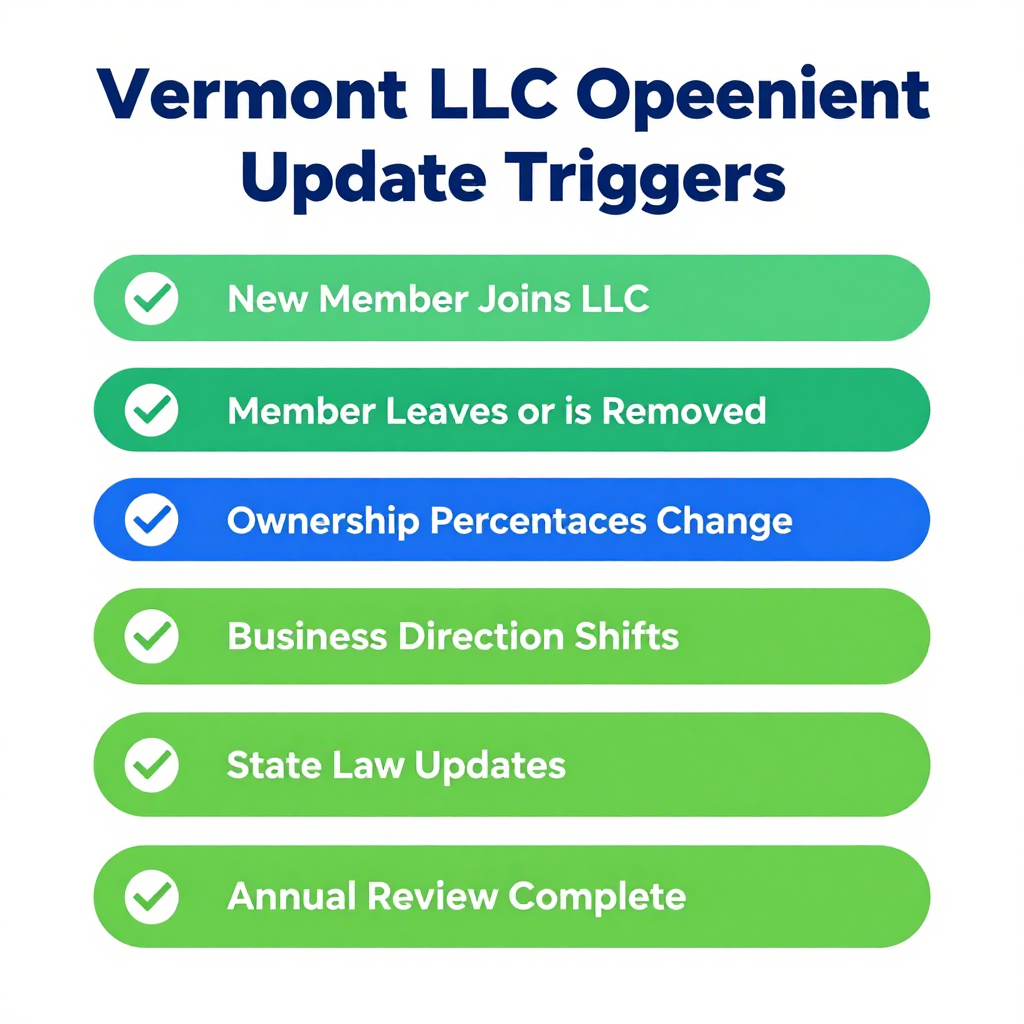
Vermont operating agreement updates in 2026 are the kind of task that stays on the to-do list until a lawyer, a bank, or a new member makes it urgent. The LLC filed its formation papers. The operating agreement was signed once, maybe at the beginning, and then life happened. Someone joined. Someone left. Profits split differently than the original document described. The manager took on more responsibility than the agreement reflected. And now someone needs the document to do something, and it does not say what should actually happen. This guide covers when to update a Vermont operating agreement, what the update process looks like in the state, and which specific Vermont rules affect how amendments work.## What a Vermont Operating Agreement Actually DoesThe operating agreement is the governing document for a Vermont LLC. It defines who the members are, what percentage each person owns, how profits and losses are divided, who manages the company, and what happens when a member wants to leave. Vermont law treats the operating agreement as a private contract. It does not get filed with the Secretary of State. It stays with the LLC’s records and gets produced when a bank, a lawyer, or a potential investor asks to see it.The IRS guide on LLCs clarifies that an LLC is classified as a partnership for federal tax purposes by default when there is more than one member, and as a disregarded entity when there is only one. The IRS publication on multi-member LLCs covers the partnership tax rules that govern most multi-member Vermont LLCs, including how profits and losses pass through to members. The operating agreement does not change this classification, but it governs the internal relationship between members in ways that state law defaults do not cover.Vermont has its own LLC statute under Title 11, Chapter 21 of the Vermont Statutes, which governs LLC formation, management, and member rights in the state. The statute provides default rules for LLCs that do not have an operating agreement, or whose agreement is silent on a particular issue. Those defaults are rarely what an LLC actually wants. Updating the agreement to reflect the actual arrangement is what protects every member.## The Five Moments That Demand a Vermont Operating Agreement UpdateMost operating agreements get updated because something changed. These are the moments that trigger the update most often for Vermont LLCs.A new member joins. This is the most common trigger. The existing agreement probably did not have a slot for this person. The ownership percentages shift. The profit split changes. The new member needs to sign the amended agreement. Without an update, the original agreement governs the new arrangement by default, which creates confusion and potential disputes.A member leaves or is bought out. When a member exits, the LLC needs to document the buyout, the reallocation of ownership, and any non-compete or confidentiality obligations that survive the departure. Without an updated agreement, Vermont’s default rules govern how the remaining members handle the transition, and those defaults are rarely what anyone planned.The profit split changes. If members agree to change how profits are divided without amending the operating agreement, the original document still controls. This creates a gap between what the members think they agreed to and what the document says. When a dispute arises, the document wins.The management structure changes. A member-managed LLC that brings in a professional manager needs an updated agreement to reflect the manager’s authority and the members’ reduced role. A manager-managed LLC where the manager is replaced needs the same update. Without it, banks and counterparties read the old document and draw conclusions that may no longer reflect reality.The LLC takes on debt or a major contract. Lenders and counterparties often require an operating agreement review as part of their due diligence. They want to see that the person signing on behalf of the LLC actually has the authority to do so. An agreement that does not reflect the current management structure can delay or derail a deal.## How Vermont Rules Affect Operating Agreement AmendmentsVermont’s LLC statute gives LLCs flexibility in how they amend their operating agreements. Most amendments require the consent of all members unless the operating agreement specifies a different approval threshold. If the original agreement says amendments require a majority vote, that provision governs. If it is silent, Vermont law defaults to unanimous consent.Any amendment needs to be in writing. Vermont courts treat oral agreements about ownership and profit-sharing as difficult to enforce, especially when they contradict a written document. Get every amendment in writing, have every member sign it, and keep the signed copy in the LLC’s records book.The amendment does not get filed with the Vermont Secretary of State. It is an internal document. However, if the LLC’s annual report or other state filings reference member information, those filings may need updating separately. The Secretary of State’s business database is separate from the operating agreement, and changes to one do not automatically update the other.## What to Include in a Vermont Operating Agreement AmendmentA clean amendment references the original agreement by date, describes what is changing, states the effective date, and includes signature blocks for all members. It does not need to rewrite the whole document unless the changes are extensive enough that a full restatement is clearer.For a Vermont LLC updating member roles, the amendment typically covers the member list and ownership percentages, the management structure and manager authority, the profit and loss allocation, the voting rights and decision-making thresholds, and the buyout provisions for member departures. These are the provisions that banks, investors, and counterparties most often ask to review.A full restatement of the operating agreement replaces the original document entirely and is used when changes are significant enough that maintaining two documents would create confusion. For most Vermont LLC updates, a targeted amendment is sufficient.## Common Mistakes Vermont LLCs Make With Operating Agreement UpdatesNot updating the agreement when a member leaves is the most common mistake. The departure changes the ownership structure, but the document still shows the departed member as an owner. When the LLC later tries to sell an asset, sign a major contract, or refinance debt, the other party asks for proof that the departed member’s interest was properly handled. If the agreement was never updated, that proof does not exist in the document.Not getting signatures from all members is the second most common mistake. Vermont’s default rule requires unanimous consent for amendments unless the agreement specifies otherwise. If one member signs an amendment and the others do not, the amendment may not be effective. This creates a situation where some members believe the agreement was updated and others believe it was not. When a dispute lands in front of a judge, the unsigned version usually loses.Not keeping the updated agreement in a safe place is the third mistake. The operating agreement only works if it can be produced when needed. A document stored on a founder’s personal laptop that gets reformatted is not accessible when a bank requires it three years later. Keep a copy in the LLC’s records book, with a backup in a secure cloud location.## How Vermont Annual Reports Connect to the Operating AgreementThe Vermont annual report filed with the Secretary of State asks for basic LLC information including the registered agent, principal office, and member or manager names in some cases. This is separate from the operating agreement, but the two should be consistent. If the operating agreement has been updated to reflect a new member or a change in management, the annual report should reflect the same information on the next filing.The Vermont Secretary of State Corporation and Business Services Division administers the annual report filing. Missing the filing deadline puts the LLC in delinquent status, which becomes part of the public record. For an LLC that has recently updated its operating agreement, the annual report filing is a good moment to confirm that what the state has on file matches what the agreement says.For more on the Vermont annual report filing schedule and what it requires, see the guide to Vermont annual report deadlines for LLCs in 2026.## What Happens When the Operating Agreement and Reality DivergesCourts in Vermont and across the country have consistently held that a written operating agreement governs the relationship between members, even when the actual practice diverged from the document. This principle is well established under the Vermont LLC statute and the uniform LLC acts that most states have adopted. This is sometimes called the anti-abstraction principle — the idea that members cannot simply ignore a written agreement because they agreed to something different informally.The practical risk for a Vermont LLC is this. If two members have been splitting profits 60/40 in practice but the agreement says 50/50, and a dispute arises, the agreement governs. The member who has been receiving 60 percent in practice may be required to return the excess under a court ruling that enforces the document as written.The fix is to update the agreement before a dispute arises. If the actual arrangement differs from the written one, the written one should be amended to match.## Building an Update Process Into the Vermont LLC Compliance RoutineThe operating agreement is not a set-it-and-forget-it document. The most well-managed Vermont LLCs review it annually alongside the compliance calendar. The review asks a simple question: does this document reflect what we actually agreed to? If the answer is no, the amendment process starts.The cost of an amendment is low compared to the cost of a dispute. A lawyer can draft a targeted amendment for a straightforward ownership change in a few hours. A dispute between members over an unclear agreement can take years to resolve and cost more in legal fees than the LLC itself is worth.For a broader look at what documents a Vermont LLC needs and how they relate to each other, see the guide to Vermont LLC documents and state comparisons, which covers the formation documents, operating agreement, and annual filings that every Vermont LLC should track.For a deeper look at how manager-managed LLC language affects a Vermont LLC’s ability to sign contracts and access banking, see the guide to Wyoming manager-managed LLC language in 2026, which walks through the same management structure questions with specific language examples.Vermont operating agreement updates in 2026 come down to this: five moments trigger an amendment, and every one of them costs less to fix proactively than reactively. Review the document annually. Sign every amendment. Keep it somewhere safe.

Frequently Asked Questions

How often should a Vermont LLC update its operating agreement?

A Vermont LLC should review its operating agreement at least once a year and any time a significant change occurs in the business. Significant changes include a new member joining, a member leaving, a change in profit split, a change in management structure, or a major transaction like a loan or acquisition that requires due diligence on the company’s governance.

Does Vermont require operating agreement amendments to be filed with the state?

No. Vermont does not require operating agreement amendments to be filed with the Secretary of State or any other state agency. The agreement is a private document that stays with the LLC’s records. However, the annual report filed with the Secretary of State may need to reflect member or manager information that is consistent with the operating agreement.

What happens if a Vermont LLC operates under a different arrangement than what the operating agreement says?

Vermont courts generally enforce the written operating agreement over informal arrangements between members. If members have been splitting profits differently than the agreement states, a court will typically apply the agreement as written. The fix is to amend the agreement to reflect the actual arrangement before a dispute arises.

Can a single-member Vermont LLC skip the operating agreement?

Vermont law allows single-member LLCs to operate without a formal operating agreement, but having one is still good practice. The document clarifies the sole member’s authority, defines how business decisions are made, and creates a written record that is useful if the LLC later converts to a multi-member structure or brings in a partner.

Who should sign a Vermont operating agreement amendment?

All members should sign the amendment unless the original operating agreement specifies a different approval threshold. Vermont’s default rule requires unanimous consent for amendments when the agreement is silent on the question. If one member refuses to sign, the amendment may not be effective and the existing agreement continues to govern.

How does a Vermont operating agreement relate to the annual report?

The operating agreement and the annual report are separate documents with different purposes. The operating agreement governs the internal relationship between members. The annual report confirms basic LLC information with the Secretary of State. Vermont operating agreement updates keep the governing document aligned with the actual business arrangement while the annual report keeps the state database current. Both need to be kept current separately.

Vermont Operating Agreement

Update Your Vermont LLC Operating Agreement Before the Next Major Decision

Vermont operating agreement updates in 2026 catch the gaps that form when member roles, profit splits, or management structures change. Rapid Registered Agent helps Vermont LLC owners track the documents that protect every member’s interest and keep the company in good standing with the state.

Amendment Triggers Caught Early
5 Key Moments
Document Conflicts Avoided
100% Possible
Vermont Annual Report
Kept Consistent
Back To Top