Vermont First Payroll Setup in 2026: State Accounts New LLCs Miss Before Hiring

Vermont First Payroll Setup - inline illustration
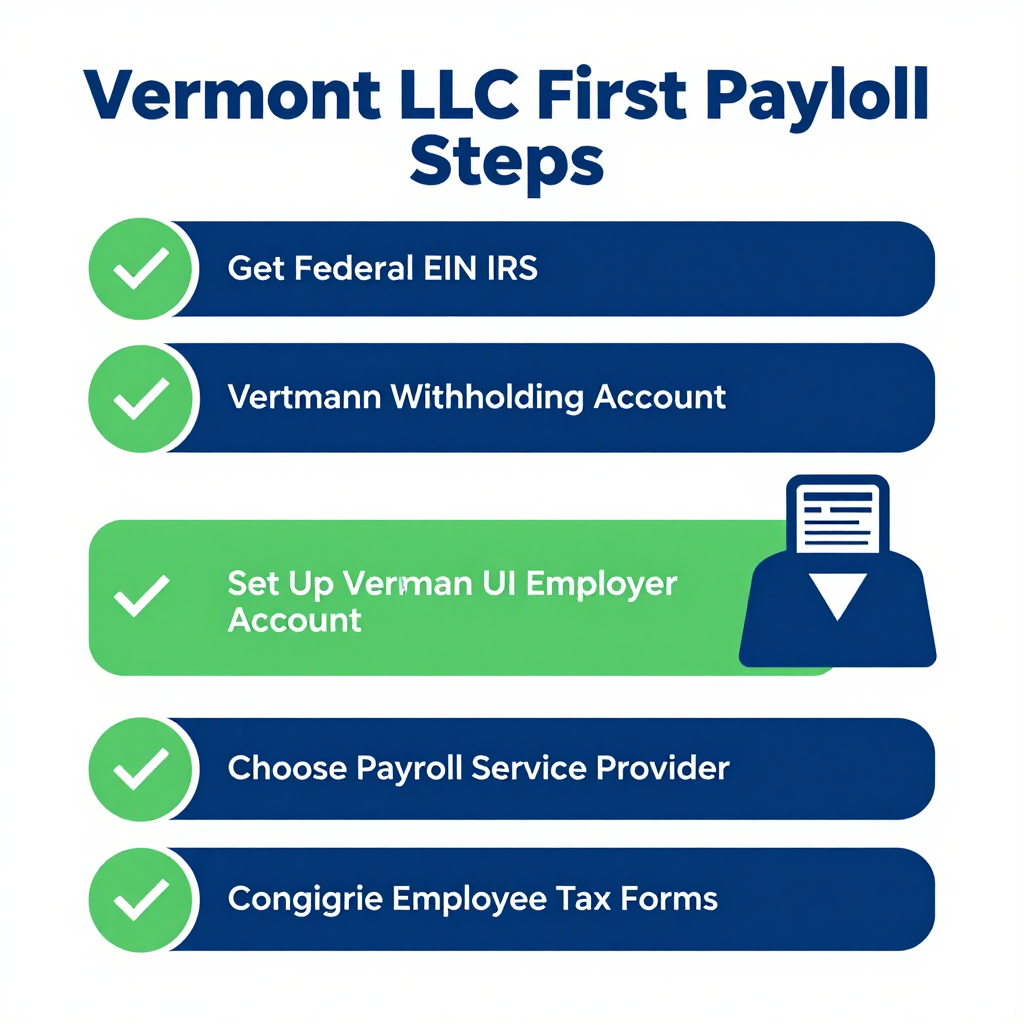
Vermont first payroll setup in 2026 catches most new LLC owners off guard at the worst possible moment. You filed the formation papers. You opened the business bank account. You hired someone. And then the first payday arrives and you realize the checks you planned to write are not enough because you do not have the accounts set up to handle the taxes that come out of every paycheck. The federal and Vermont state agencies that need to know about your new employee all require separate registrations before you run payroll. Doing them after the fact means retroactive filings, penalties, and interest that were completely avoidable. This guide covers exactly which accounts to set up and the order to do it in so the first payroll runs cleanly.This article focuses on Vermont because the state has its own employer registration requirements that differ from the federal process and from other states. A Vermont LLC hiring its first employee needs accounts at the IRS, the Vermont Department of Taxes, the Vermont Department of Labor, and optionally the Social Security Administration for reporting purposes. Each one has its own form, its own timeline, and its own penalty for missing the registration deadline.## The EIN Comes First — AlwaysBefore anything else, the LLC needs an Employer Identification Number from the IRS. This is the federal tax ID number that identifies the business to every tax agency. It goes on the federal tax return, the W-2s you issue to employees, and every federal payroll form you will file. If the LLC already has an EIN from a prior year, check that it is still active and that the business name and address on file match what is on the formation documents. If anything changed, update it before running the first payroll.The IRS EIN application takes five minutes online at irs.gov. The number is issued immediately once the application is complete. There is no filing fee. The EIN is the one thing on this list that can be done in an afternoon, and it is the prerequisite for every other account on this list.## Vermont Employer Withholding Account — The One Most Vermont LLCs ForgetThis is the account that catches new Vermont employers. Vermont requires every business that pays wages to employees to withhold Vermont personal income tax from those wages. The withholding is based on the Vermont withholding tables, which are updated annually. To withhold correctly, the LLC needs a Vermont withholding account number from the Vermont Department of Taxes.Register for the Vermont withholding account online through the Vermont Department of Taxes business tax portal. The registration is free. The account number is issued within a few business days. Once active, the LLC will file quarterly withholding returns and remit the withheld amounts on the state filing schedule.The penalty for running payroll without a Vermont withholding account is real. The Department of Taxes can assess penalties on the unpaid withheld amounts, and those penalties apply even if the LLC intended to comply but simply did not register in time. Registering before the first paycheck goes out is the move that avoids those penalties entirely.## Vermont Unemployment Insurance — Your LLC Must Register Before Payroll RunsVermont operates its own unemployment insurance program through the Vermont Department of Labor. Every Vermont employer with employees is required to pay unemployment insurance premiums into the state fund. The rate starts at a standard rate for new employers and adjusts based on the employer’s experience rating over time.Register for a Vermont unemployment insurance account through the Vermont Department of Labor employer services portal. The registration should be completed before the first payroll is run. Once registered, the LLC will receive a rate notice and will file quarterly wage reports and pay premiums on the state schedule.The unemployment insurance account connects directly to the LLC’s payroll records. Every quarter, the LLC reports total wages paid to each employee and the unemployment insurance premium due. The state uses this to determine benefits for former employees who file claims. Running payroll without an active UI account means those wages are not covered, which exposes the LLC to back taxes, penalties, and potentially a denied UI claim from a former employee who was owed benefits.For a step-by-step that covers the federal and state employer account sequence in more detail, see the guide to first payroll timeline for new LLCs in 2026, which walks through the same account setup process across multiple states.## Federal Unemployment Tax Account — the FUTA Step That Still Applies to Vermont LLCsEven though Vermont has its own state unemployment insurance, the federal government also requires employers to pay into the federal unemployment trust fund. This is the FUTA tax, currently at 6 percent on the first $7,000 of wages paid to each employee per year. Most employers can claim a credit of up to 5.4 percent based on state UI contributions, which brings the effective federal rate down to 0.6 percent for employers in good standing with their state UI program.The FUTA account is not a separate registration. It is reported annually using IRS Form 940. The LLC pays the tax quarterly if the annual liability is expected to exceed $500, otherwise it is paid annually. This is one of the simpler parts of the payroll setup, but it is still something to know about before running the first payroll. The tax is an employer-only cost — it does not come out of the employee’s wages.## New Hire Reporting in VermontVermont requires every employer to report newly hired employees to the state within ten days of their start date. This is the New Hire Reporting program, and it is how the state locates parents who owe child support and verifies employment for various benefit programs. The reporting is done through the Vermont Department of Labor new hire reporting portal.The ten-day window is not a suggestion. Vermont can impose penalties for late new hire reporting. The good news is that the process is straightforward: enter the employee’s name, address, Social Security number, start date, and payroll frequency. For a single employee, this takes under five minutes. Setting this up before the first payroll run means the LLC is already compliant when the first paycheck goes out.## Workers Compensation Insurance in VermontVermont requires most employers to carry workers’ compensation insurance. This covers medical costs and lost wages if an employee is injured on the job. The requirement applies to businesses with one or more employees in most industries. The workers’ comp policy is purchased from a private insurance carrier — Vermont does not run a state fund for this.Not having workers’ comp insurance when it is required is a serious exposure. An uninsured employee who gets hurt on the job can file a claim that exposes the LLC to the full cost of the injury plus penalties. Before the first payroll runs, confirm whether the LLC’s industry requires coverage and get a quote from a workers’ comp carrier if it does. For most small Vermont LLCs, the annual premium is manageable and the protection is worth having.## The First Vermont Payroll: What Actually HappensOnce all the accounts are active, running the first payroll involves calculating gross wages, withholding federal income tax, withholding Vermont state income tax, deducting the employee share of Social Security and Medicare, calculating the employer share of Social Security and Medicare, calculating federal unemployment tax, calculating Vermont unemployment insurance premium, and issuing the net paycheck. The numbers all need to match what the quarterly filings will later report.For a small Vermont LLC with one or two employees, this can be done by hand using the IRS withholding tables and the Vermont withholding tables. For anything more than that, payroll software or a payroll service handles the calculations and the filings and keeps the LLC compliant. The main cost of doing it wrong is not the penalty itself — it is the time spent correcting the filings and potentially amending prior returns.A new employee who starts mid-quarter does not change the payroll calculations. The employer still owes the full employer taxes on all wages paid in the quarter. The accounts are already set up, so the calculations run as normal.## What Happens When Vermont LLCs Miss the Account RegistrationsRetroactive employer account registrations are possible but costly. Vermont employer accounts can be registered after the fact, but the LLC will owe all accumulated taxes, premiums, and penalties from the period when the accounts were inactive. The penalty for late Vermont withholding registration is a percentage of the unpaid withholding. The penalty for late Vermont UI registration includes both the unpaid premiums and an additional assessment.The IRS also assesses penalties for late federal payroll tax deposits. These penalties apply even if the LLC had the money and intended to pay — the penalty is triggered by the late deposit, not by willful nonpayment. Setting up the accounts correctly from the start is consistently cheaper than cleaning up a missed registration later.## Building a Vermont LLC Hiring Compliance ChecklistThe accounts above need to be set up before the first paycheck. Here is the sequence in the order that makes the most sense.Get the EIN first. Register the Vermont withholding account second, because it takes the longest to process. Register the Vermont unemployment insurance account third, in parallel with or immediately after the withholding account. Register for Vermont new hire reporting fourth — this takes minutes. Confirm workers’ comp insurance requirements fifth, and get a quote if needed. Run the first payroll only after all five steps are confirmed complete.Mark the Vermont employer account numbers in the LLC’s compliance file. These accounts need annual filings even if no wages are paid in a given quarter. An LLC that hires one employee in January and then pauses hiring still needs to file quarterly UI returns and withholding returns all year. The compliance calendar is not empty just because the LLC is a small operation.For a broader checklist that covers the federal and state sequence for any new LLC hiring across state lines, see the guide to Nebraska new hire paperwork for 2026, which walks through the same process with a different state-specific focus.Vermont first payroll setup in 2026 comes down to this: three to five employer accounts need to be registered before the first paycheck goes out. The EIN is free and takes five minutes. The Vermont withholding and unemployment accounts are free to register and take a few days to process. The penalty for skipping them is real and completely avoidable. Setting up the accounts correctly from the start costs nothing beyond time, and that time is a fraction of what the cleanup costs if the registrations are missed.

Frequently Asked Questions

Does a Vermont LLC need a separate state employer account before hiring?

Yes. Vermont requires employers to register for a withholding account with the Vermont Department of Taxes and a unemployment insurance account with the Vermont Department of Labor before the first payroll is run. These are separate from the federal EIN and the federal employer accounts.

What is the penalty for running payroll without a Vermont withholding account?

The Vermont Department of Taxes can assess penalties on the unpaid withheld amounts even if the LLC intended to comply. The penalty rate depends on how late the registration is. Registering before the first payroll is issued is the only way to avoid it entirely.

How do I register for Vermont unemployment insurance?

Register through the Vermont Department of Labor employer services portal at labor.vermont.gov. The registration should be completed before the first payroll is run. New employers start at a standard rate that adjusts over time based on the employer’s experience rating.

What is new hire reporting and does Vermont require it?

Vermont requires employers to report each new hire to the Vermont Department of Labor within ten days of their start date. The report includes the employee’s name, address, Social Security number, start date, and payroll frequency. The ten-day window is a state requirement and late reporting can result in penalties.

Does a single-member Vermont LLC need workers comp insurance?

Vermont requires workers’ compensation insurance for most employers with one or more employees, regardless of LLC structure. A single-member LLC that has no employees may not need coverage, but any LLC with even one employee should confirm its industry requirements before the first payroll runs.

How does the Vermont annual report connect to payroll compliance?

The Vermont annual report filed with the Secretary of State confirms the LLC’s registered agent, principal office, and member information. It does not replace the employer accounts at the Department of Taxes or Department of Labor. Both filings are required separately. An LLC that is current on its employer accounts but misses the annual report filing still faces penalties for the missed report.

Vermont First Payroll Setup

Set Up Your Vermont LLC Payroll Accounts Before the First Paycheck

Vermont first payroll setup in 2026 means getting the EIN, the Vermont withholding account, and the Vermont unemployment insurance account registered before the first paycheck goes out. Rapid Registered Agent helps Vermont LLC owners handle the employer registrations and stay compliant from the first hire forward.

Employer Accounts Before First Payroll
3-5 Required
Penalty Risk Without Registration
100% Avoidable
Vermont Annual Report
Separate Filing Required
Back To Top