
Kentucky Certificate of Authority vs Registered Agent Service in 2026: What Expanding LLCs Need Both
Kentucky Certificate of Authority vs registered agent service is the kind of comparison that trips up expanding LLCs because the two items often show up in the same filing conversation, even though they do very different jobs.
One gives the out-of-state LLC permission to transact business in Kentucky.
The other gives Kentucky a reliable in-state contact for service of process and official notices.
If your LLC is expanding into the Commonwealth in 2026, the practical answer is usually not choosing one or the other. It is understanding why Kentucky expects both.
What a Kentucky Certificate of Authority actually does
A Kentucky Certificate of Authority is the foreign-qualification filing for an LLC that was formed somewhere else and now wants authority to transact business in Kentucky.
The Kentucky Secretary of State’s Certificate of Authority form and instructions say the foreign business entity applies for authority to transact business in Kentucky by filing the certificate with the Secretary of State.
That filing is about legal entry into the state as a foreign LLC.
Without it, the LLC may be operating in Kentucky without the state-level authorization that should be in place.
What a Kentucky registered agent service actually does
A registered agent service does not qualify the LLC to do business in Kentucky by itself.
Instead, it fills one of the requirements inside the qualification and compliance system.
The same Kentucky Certificate of Authority instructions say the registered office must be in Kentucky and must maintain a street address, and they explain that the registered agent is the person or business designated to receive service of process if the business becomes part of a legal action.
That is a different function from the Certificate of Authority.
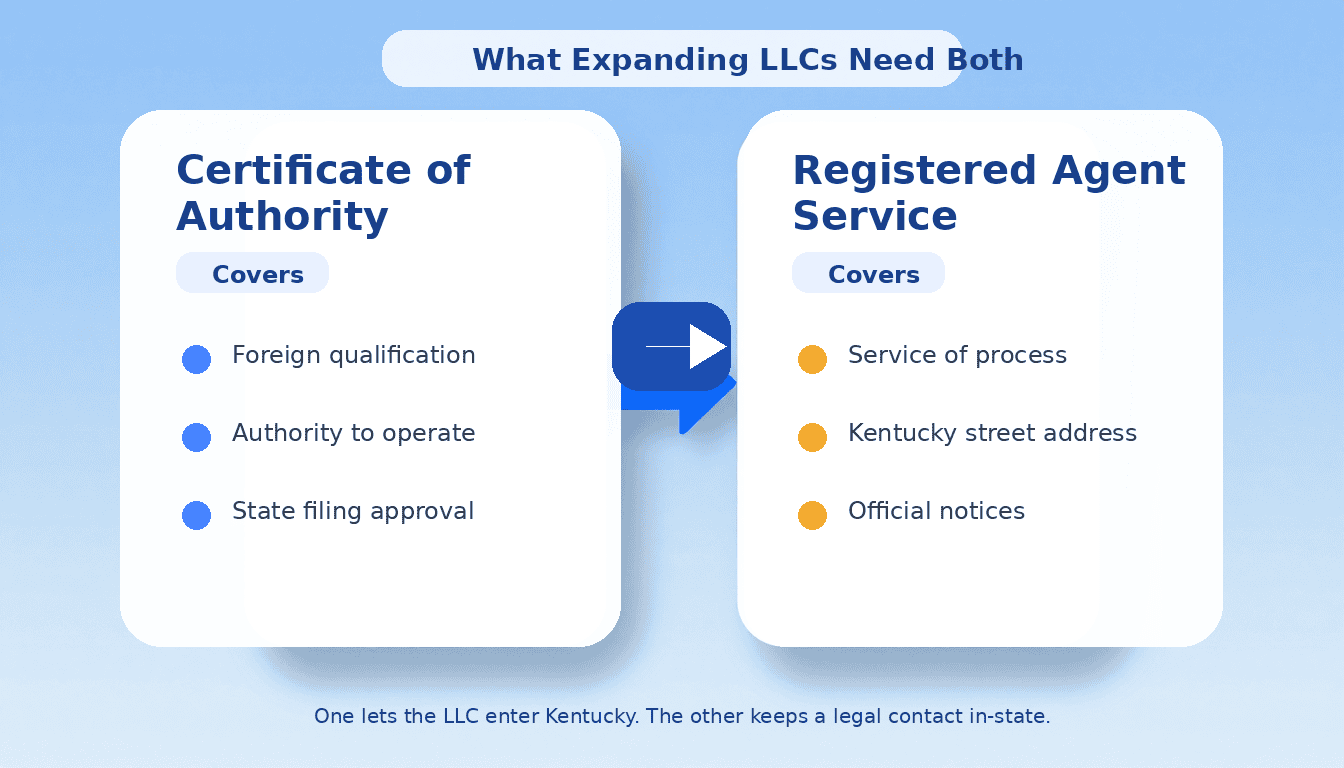
The certificate is the permission to operate. The registered agent is the in-state legal contact point.
Why expanding LLCs usually need both
This is the simplest way to think about it:
- the **Certificate of Authority** answers: “Is this foreign LLC authorized to transact business in Kentucky?”
- the **registered agent** answers: “Who in Kentucky can receive legal papers and official notices for this LLC?”
The Kentucky form combines both ideas because the state wants the foreign LLC not only to qualify, but also to have a Kentucky-based registered office and agent in place when it does.
That is why a registered agent is not a substitute for foreign qualification, and foreign qualification is not a substitute for a registered agent.
What Kentucky requires from the registered agent record
Kentucky is fairly direct here.
The Certificate of Authority instructions say:
- the registered office must be in Kentucky
- the registered office must use a street address, not a PO box
- and the registered agent must be an eligible individual or business entity that can serve in that role in Kentucky
The instructions also say the company seeking formation shall not act as its own registered agent.
That matters for expansion because some owners assume that once the LLC is qualified, they can list any mailing address or simply reuse the out-of-state office. Kentucky’s instructions say otherwise.
Where the filing process and the service relationship overlap
The overlap is real, but it is narrow.
You need registered-agent information to complete the Kentucky foreign-qualification filing. The form even addresses the registered agent’s written consent if the agent does not sign the filing directly.
But once the foreign LLC is authorized, the registered agent relationship keeps mattering long after the filing is finished.
That is one reason this is better understood as a two-part system:
1. qualify the foreign LLC to transact business 2. maintain a valid Kentucky registered agent and registered office after qualification
Why the difference matters after approval too
The Kentucky instructions also point beyond the initial filing.
They note that the entity must file annual reports and that a statement of change for the registered agent, registered office, or principal office must be filed when a change occurs.
If you want the recurring deadline side of that process in one place, this guide on Kentucky annual report filing for LLCs in 2026 explains the January 1 to June 30 annual-report window and how registered-agent details stay tied to the state record.
That is another reason the certificate-versus-agent comparison matters. The certificate gets you in. The registered-agent record helps keep the foreign LLC’s Kentucky presence usable and current.
What Kentucky says about filing options
Kentucky gives businesses several ways to manage filings and records.
The Secretary of State’s online services page says businesses can complete many filings and searches online, including annual reports and statements of change for the registered agent, registered office, or principal office.
The forms library also lists the Certificate of Authority under foreign limited liability company forms.
That makes the workflow easier to follow, but it does not change the underlying rule: the LLC still needs authority to transact business and a qualifying registered agent setup.
Practical checklist for a foreign LLC entering Kentucky in 2026
- Confirm the LLC is expanding into Kentucky as a foreign entity rather than forming a brand-new Kentucky LLC.
- Prepare the Certificate of Authority filing.
- Line up a Kentucky registered office with a real street address.
- Confirm the registered agent is eligible to serve under Kentucky’s rules.
- Get the registered agent’s consent if needed.
- File the foreign-qualification paperwork and fee.
- Review annual-report and later change-filing obligations after approval.
Frequently Asked Questions
Does a registered agent service give my LLC authority to do business in Kentucky?
No. The registered agent service does not replace the foreign-qualification filing. The Certificate of Authority is the filing that seeks authority to transact business in Kentucky.
Do I need a Kentucky registered agent to get a Certificate of Authority?
Yes, in practice. Kentucky’s Certificate of Authority instructions require a Kentucky registered office and registered agent as part of the filing.
Can I use a PO box as the registered office?
No. The Kentucky instructions say a PO box is insufficient for the registered office address.
Why do expanding LLCs need both?
Because the two items solve different problems. The certificate qualifies the foreign LLC to operate, while the registered agent gives Kentucky a valid in-state contact for legal and official notices.
What happens after the foreign LLC is approved?
The business still has to maintain the Kentucky record, including annual reports and any later statement of change involving the registered agent, registered office, or principal office.
Final takeaway
Kentucky Certificate of Authority vs registered agent service is not really an either-or decision for an expanding LLC in 2026.
The Certificate of Authority is the foreign LLC’s legal permission slip to transact business in Kentucky. The registered agent service is the compliance and service-of-process contact that Kentucky expects the LLC to keep in place.
If you treat them as separate parts of the same expansion system, the filing process makes much more sense and the LLC is less likely to miss a requirement that matters after approval.
Related reading
Expanding an LLC into Kentucky in 2026
File the Kentucky Certificate of Authority and get a Kentucky registered agent in one signup
Skip the back-and-forth. RRA sets up both the foreign LLC qualification and the in-state registered agent together, so your LLC can transact business in Kentucky without juggling two vendors.
- States Covered
- 50 + DC + PR
- Serving Businesses Since
- 2007
- Plans Start At
- $10/mo per state
Kentucky Certificate of Authority
Kentucky Certificate of Authority vs. Registered Agent Service: Knowing the Difference
Kentucky requires a certificate of authority before foreign LLCs can do business there, and the rules differ from just hiring a registered agent. Rapid Registered Agent makes sure you file the right form the first time.
- States Covered
- 50 + DC + PR
- Serving Businesses Since
- 2007
- Plans Start At
- $10/mo per state