
Colorado Statement of Conversion in 2026: When a Business Should Change Entity Type
Colorado Statement of Conversion in 2026: When a Business Should Change Entity Type usually becomes the real question only after owners realize the business they built is no longer a clean fit for the legal shell around it.
That moment catches people off guard.
The company may be growing.
The owners may be adding investors.
The tax plan may be changing.
The business may be crossing state lines.
Then someone asks the uncomfortable question.
Is this still the right entity type.
What a Colorado Statement of Conversion does
Colorado uses a statement of conversion when one entity form is being converted into another.
The Colorado Secretary of State’s Combined Statement of Conversion instructions explain the filing in terms of a converting entity and a resulting entity.
The same instructions say a required statement must confirm that the converting entity has been converted into the resulting entity.
That matters because this is not a cosmetic cleanup filing.
It is the state record of a legal change from one structure into another, which gives owners the right frame for the decision.
When a business should change entity type
Most businesses do not change entity type just to tidy up paperwork.
They do it because the current entity no longer fits how the business works in real life.
A small LLC may want to become a corporation before raising outside money.
A business may want a different governance model.
A restructuring may require the Colorado record to match a new legal plan.
A multistate operation may need the resulting entity to sit in a different jurisdictional posture.
Those are real strategy changes.
When the strategy changes, the entity type sometimes has to change too, which keeps the public record aligned with reality.
When a business should not use a Colorado Statement of Conversion
This is just as important.
If the business only needs to update a principal office, fix a registered agent, or file a routine report, conversion is usually the wrong tool.
Colorado treats those ordinary maintenance items differently.
That is why owners should separate structural change from basic housekeeping before they touch the filing screen.
If the task is really yearly maintenance, our Colorado Periodic Report Checklist for LLCs in 2026 is the better next read.
If the task is really a registered-agent update, our Colorado Statement of Change guide is the cleaner fit.
Why Colorado treats conversion as a serious filing
Colorado does not present this as a throwaway form.
The Combined Statement of Conversion instructions say the filing is made pursuant to section 7-90-201.7 of the Colorado Revised Statutes.
The same state instructions warn filers to review the form carefully because mistakes may have legal consequences.
Colorado also says its office cannot provide legal advice and that questions should be addressed to legal, business, or tax advisors.
That is the state telling you, in plain terms, that conversion can affect more than the screen in front of you.
It can change ownership consequences, tax planning, and multistate filing needs, which is why careful prep matters.
What Colorado asks for in a statement of conversion
The filing asks for more than a simple yes-or-no decision.
Colorado’s conversion help pages show that the system asks for details about the converting entity and the resulting entity.
That includes the true name, form, and jurisdiction of the entity before conversion.
It also includes the resulting entity information and a direct statement regarding the conversion itself.
The main help page also says a principal office street address is required.
Colorado is explicit that the street address must be a physical address and cannot be a post office box.
That detail feels small until a filing gets held up over bad address data, which is easy to avoid.
Attachments and extra information can be part of the process
Colorado’s instructions also leave room for more than the base fields.
The Combined Statement of Conversion page says filers can select yes if additional information is permitted or required by law to be included in the document.
The same page says you will be able to attach documents before completing the filing.
That matters because some conversion situations are simple and some are not.
When a filing path needs extra language or supporting material, Colorado is already signaling that the base form may not be the whole story, which helps owners plan better.
Common situations that trigger a Colorado conversion review
The most common trigger is growth.
An LLC may want a corporate form for investors.
A founder-owned entity may be moving into a more formal ownership structure.
A domestic entity may be converting into a foreign entity as part of a broader restructuring.
The Colorado Secretary of State’s domestic-to-foreign conversion instructions describe that path directly.
That is a reminder that conversion is not only about entity type.
Sometimes it is also about where the resulting entity sits in relation to Colorado after the transaction, which changes the follow-up work.
Some Colorado conversions trigger another filing after the conversion
This is one of the easiest points to miss.
The domestic-to-foreign conversion instructions explain that the resulting foreign entity must address how it will receive service of process.
The same instructions say the resulting foreign entity must either maintain a registered agent in Colorado or designate the entity’s principal office address as the address for service of process.
Colorado then adds an important note.
If the resulting entity plans to qualify for authority to transact business in Colorado, it must have a registered agent with an address in Colorado.
That means the conversion filing may not be the end of the job.
If the business will keep operating in Colorado after the restructuring, owners need to think through the post-conversion authority and agent setup too, which prevents a half-finished transition.
Why service of process and the registered agent matter so much here
Owners sometimes treat the registered agent as a background detail.
Conversion is one of the times that assumption breaks down.
When a resulting foreign entity still needs a Colorado presence, service-of-process planning becomes part of the filing path.
If the registered agent details are wrong, late, or missing, the restructuring can leave loose ends on the public record.
That is why the registered-agent question belongs in the conversion plan early instead of after the filing is submitted.
If your service-of-process setup is changing at the same time, our Colorado Statement of Change article helps map that update, which keeps the record cleaner.
How much Colorado charges for conversion filings in 2026
Colorado’s current Business Organizations Fee Schedule lists Conversion Statements at $50 online and Combined Conversions at $100 online.
That fee gap tells you something useful.
Colorado treats combined conversions as a heavier filing event than a standard conversion statement.
The price itself is not the big risk.
The bigger risk is filing the wrong transaction type and then cleaning up the mistake later.
Knowing the fee schedule in advance helps owners spot whether they are dealing with a simple path or a more involved one.
Where owners start the filing path
Colorado routes business filers through its online forms library.
The state’s Business Forms List includes a conversion section with the filing paths and instructions.
That page is useful because it shows that Colorado does not treat all conversion situations as one identical form.
The path can depend on whether the entity is on file with the office and what kind of conversion is happening.
Starting from the forms list helps owners pick the right lane before they enter data, which cuts down on rework.
A practical example that feels familiar
Picture a Colorado LLC that started small and worked fine for years.
Then the owners bring in outside capital.
The investors want a structure that fits their expectations better.
The tax team wants the restructuring documented correctly.
The owners also expect the business to keep operating in Colorado after the change.
Now the entity-type question is no longer abstract.
In that situation, a Colorado statement of conversion may be the right state filing to evaluate.
But the smart version of that move also includes the resulting-entity setup, service-of-process plan, and any Colorado authority issues after the conversion.
That is how the filing becomes part of a full transition instead of an isolated form, which reduces downstream trouble.
How this fits into the broader Colorado document stack
Conversion is easiest to understand when you see it next to the other documents a business uses.
A periodic report keeps a business current.
A statement of change updates details.
A statement of conversion changes the underlying legal form.
Those are different jobs.
If you want the broader paperwork view, our Real Documents You’ll Need for a Colorado LLC guide helps show how these filings fit together.
That bigger picture makes it easier to pick the right filing the first time.
What owners should sort out before filing
Before filing, owners should be able to answer a few basic questions clearly.
Why is the business changing entity type.
What is the resulting entity going to be.
Will the resulting entity still conduct business in Colorado.
Who will handle service of process.
Will a Colorado registered agent still be needed.
Are there tax or ownership consequences that make the filing path more sensitive than it looks.
Colorado’s own warning about legal consequences is a sign to answer those questions before the filing starts, which lowers the odds of a messy correction later.
2026 Colorado Statement of Conversion checklist
Use this checklist before deciding whether to file.
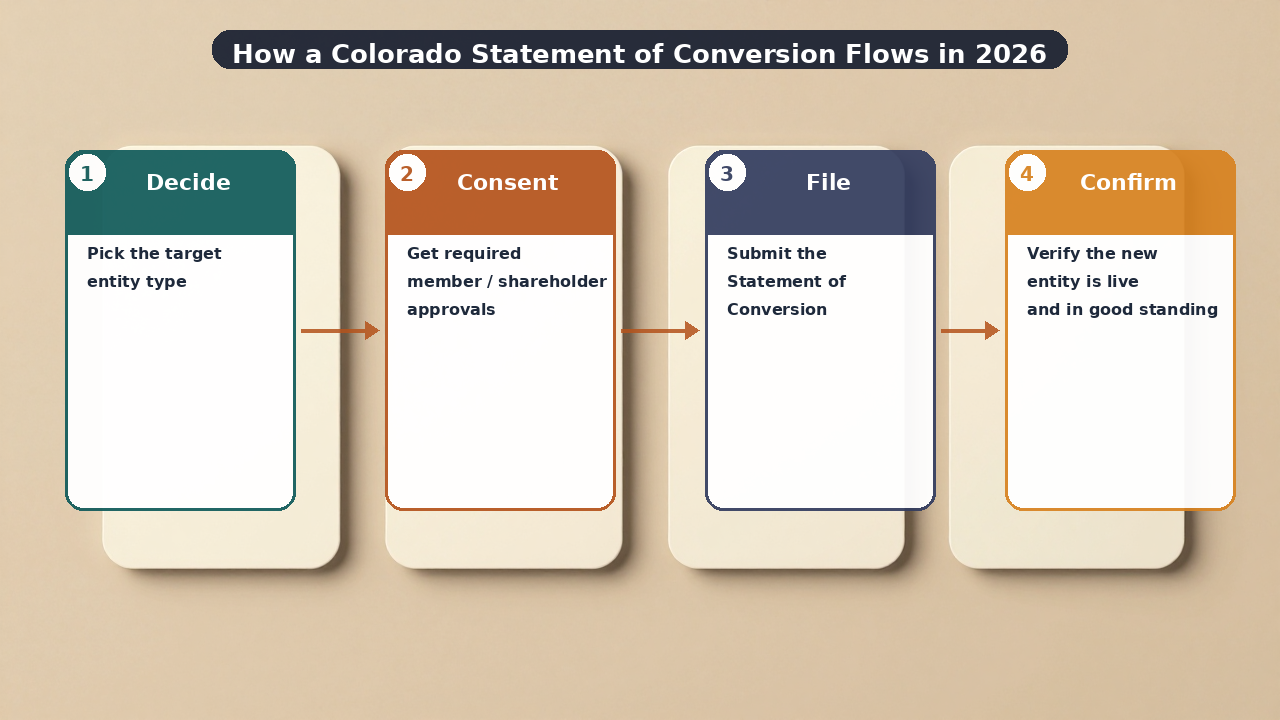
- Confirm the business is making a real structural change instead of a routine update.
- Confirm the converting entity and resulting entity details are accurate.
- Confirm the principal office street address is a real physical address and not a post office box.
- Check whether the conversion path is standard or combined.
- Budget $50 for a conversion statement or $100 for a combined conversion based on Colorado’s current fee schedule.
- Decide whether attachments or additional information will be needed.
- Plan how the resulting entity will handle service of process.
- If the resulting foreign entity will still transact business in Colorado, plan the Colorado registered-agent setup before filing.
Related reading
For Colorado annual maintenance timing, read Colorado Periodic Report Checklist for LLCs in 2026.
For Colorado registered-agent record updates, read Colorado Statement of Change: How to Update a Registered Agent in 2026.
For the wider Colorado paperwork stack, read Real Documents You’ll Need for a Colorado LLC.
Final takeaway
Colorado Statement of Conversion in 2026 is the right conversation when a business is truly changing its legal form, ownership logic, or jurisdictional posture instead of just cleaning up normal compliance items.
Colorado’s own instructions make clear that the filing can carry legal consequences, require accurate entity and address details, and create follow-up service-of-process or registered-agent questions.
That is why the safest move is to sort out the real business strategy before opening the form.
Colorado Statement of Conversion in 2026: When a Business Should Change Entity Type gets much easier when the owners solve the strategy first and the filing second.
Related Reading
Colorado Periodic Report Checklist for LLCs — Line up the recurring Colorado filing that follows any entity change.
How to Update a Registered Agent in Colorado — Pair a conversion filing with a clean agent record.
Colorado LLC Documents and State Comparisons — See the paperwork a Colorado LLC actually keeps on file.
Frequently Asked Questions
What does a Colorado Statement of Conversion do in 2026?
Colorado uses a statement of conversion when one entity form is being converted into another. The state’s instructions describe a converting entity and a resulting entity, and require a statement that the converting entity has been converted into the resulting entity.
When should a business change entity type in Colorado?
Usually when the current legal form no longer matches the business’s ownership structure, funding plan, governance needs, tax planning, or multistate strategy. A Colorado Statement of Conversion is for a real structural change, not a routine cleanup.
What does Colorado ask for in a statement of conversion filing?
Colorado’s help pages show that the filing can require the converting entity’s true name, form, and jurisdiction, the resulting entity information, a statement regarding the conversion, and a principal office street address that cannot be a post office box.
How much does Colorado charge for a statement of conversion in 2026?
Colorado’s current Business Organizations Fee Schedule lists Conversion Statements at $50 online and Combined Conversions at $100 online.
Can a Colorado conversion require another filing after the conversion?
Yes. For example, Colorado’s domestic-to-foreign conversion instructions explain service-of-process requirements for the resulting foreign entity, and note that if the resulting entity plans to qualify for authority to transact business in Colorado, it must have a registered agent with an address in Colorado.
Is a Colorado Statement of Conversion the same as a periodic report or statement of change?
No. A periodic report is routine maintenance, and a statement of change updates details like the registered agent or principal office. A Colorado Statement of Conversion changes the underlying legal form of the business.
Colorado Statement of Conversion
Keep the Colorado Record Clean During Restructuring
Rapid Registered Agent helps businesses keep the Colorado compliance side steady while ownership, entity, and filing changes are being planned.
- States Covered
- 50 + DC + PR
- Serving Businesses Since
- 2007
- Plans Start At
- $10/mo per state