New Mexico Foreign LLC Registration in 2026: When Out-of-State Businesses Must File

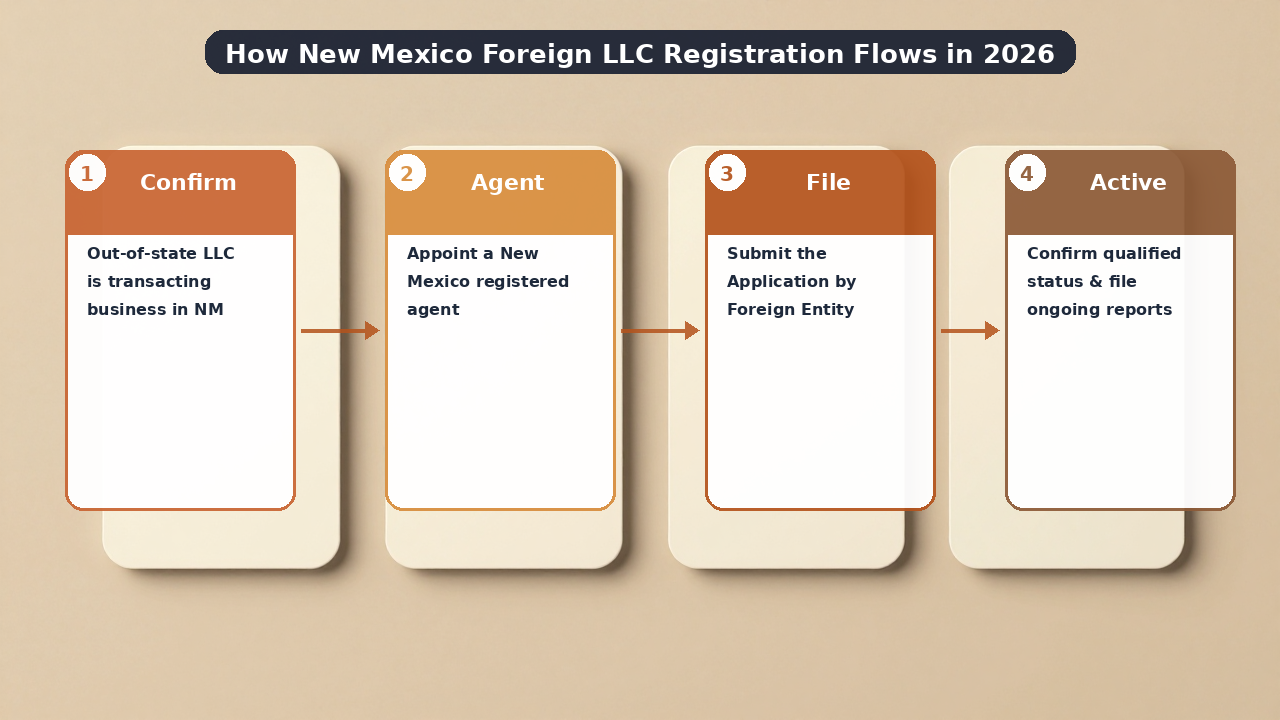
New Mexico Foreign LLC Registration in 2026 becomes mandatory when an out-of-state business stops testing the market from a distance and starts transacting business inside New Mexico.
That is the line owners usually feel only after they have already crossed it.
One week it is a few customers.
The next week it is a lease, a local crew, a contract that needs a New Mexico entity record, or a partner asking why the company is not registered with the state yet.
If your LLC was formed somewhere else, this guide explains when New Mexico foreign LLC registration in 2026 usually becomes necessary, what activity may not trigger the filing by itself, how the online process works now, and why pairing the filing with a clean registered agent setup keeps the LLC’s New Mexico record from drifting.
What a Foreign LLC Means in New Mexico
A foreign LLC is not a special kind of LLC.
It is simply an LLC formed under another state’s laws that wants to do business in New Mexico.
New Mexico’s statutes governing business page points businesses to the Limited Liability Company Act, which includes the foreign-LLC registration rules and the sections on activity that does not count as transacting business.
That framing matters because your company does not become a New Mexico LLC just because it picks up one local customer.
It stays a foreign LLC unless and until it is properly registered to transact business in the state.
The LLC keeps its home-state formation, its home-state articles, and its home-state registered agent as the LLC’s primary record, and New Mexico becomes a second record on top of that primary record once the foreign registration is on file.
When Out-of-State Businesses Usually Must File
The practical rule is simple.
If the business starts looking operationally present in New Mexico, the filing issue becomes real.
The statutory rule is also blunt.
The published text of Section 53-19-48 says a foreign limited liability company must register before transacting business in New Mexico.
In plain English, that usually means the company is no longer just selling from afar.
It is doing things that make New Mexico part of the operating footprint.
The Common Fact Patterns That Push an LLC Toward Filing
Opening or leasing a New Mexico location that the LLC staffs with its own people is one of the clearest filing triggers.
Hiring employees or staffing recurring in-state work also pushes the LLC into the filing trigger, because payroll taxes and unemployment insurance start to follow the in-state footprint.
Running ongoing local projects instead of one-off remote transactions makes the in-state footprint more durable than a single transaction would.
Signing deals where banks, landlords, marketplaces, or counterparties want a state registration record is the moment most owners actually feel the trigger, because the counterparty is doing the analysis for them.
Building a real business presence that goes beyond interstate commerce alone is the broader pattern the statute is written for.
If that sounds like your expansion plan, waiting usually creates more friction than filing early.
What Does Not Always Count as Transacting Business by Itself
This is where owners get tripped up.
Not every contact with New Mexico means the filing trigger has been pulled.
The published text of Section 53-19-54 lists examples of activity that does not, by itself, count as transacting business, including things like maintaining lawsuits, holding internal company meetings, maintaining bank accounts, and transacting business in interstate commerce.
That does not mean an expanding company can rely on those exceptions forever.
It means the analysis depends on the full pattern of activity, not one isolated fact.
A remote seller with no local footprint is in a different position from an LLC with recurring in-state work and local operations, and the statute was written to draw that distinction.
The Interstate Commerce Trap
The interstate-commerce exception is the most overused safe harbor.
Shipping goods to New Mexico customers from a warehouse in another state is still interstate commerce, and the LLC usually does not need to foreign-qualify just for that activity alone.
Once the LLC starts holding inventory in New Mexico, opening a local pickup counter, hiring delivery staff, or staffing recurring local services, the activity drifts past interstate commerce and into transacting business.
The shift is gradual, but the filing trigger arrives when the in-state footprint becomes operational rather than transactional.
Why Owners Misread New Mexico
New Mexico has a reputation for being simple.
That part is true.
The filing system is lighter than in some states, and the online portal is straightforward once the LLC owner has access.
But simple does not mean optional.
The New Mexico Secretary of State Business Services page makes clear that business filings now run through the online process, and the state still expects entities to use that system when registration is required.
So the real mistake is assuming an easier filing state is also a state that does not care about foreign qualification.
The simplicity is procedural, not substantive.
How the New Mexico Filing Process Works in 2026
New Mexico has moved business filings into an online workflow.
The SOS Online Services page points businesses to the filing portal for business records and filings.
The SOS business-services page also says paper business applications are no longer accepted and directs users to create or log in to an account in the business portal.
Once inside, the portal is where businesses locate forms and maintain records.
The public business forms area is also a useful signal that New Mexico expects the filing workflow to be portal-based, not paper-based.
That matters because foreign registration is no longer just a form question.
It is a portal-access and record-maintenance question too.
What the Online Filing Actually Captures
The portal captures the LLC’s legal name, home-state formation details, principal office, registered-agent information, and the nature of the business the LLC is operating in New Mexico.
The portal is also where the LLC will renew, update its registered agent, and amend its New Mexico record over time.
That is why the registered-agent piece is not just a one-time field on the form but an ongoing record-maintenance question for the LLC’s life in New Mexico.
Why the Registered Agent Still Matters
Foreign registration and registered agent service are not the same thing.
But they travel together.
If an out-of-state LLC needs authority to operate in New Mexico, it also needs a reliable in-state contact point for service of process and state record maintenance.
That is one reason this topic should not be handled as a last-minute scramble after a contract partner asks for paperwork.
The filing itself may be manageable.
The cleanup after a rushed filing usually is not.
If you also need the broader maintenance picture, this guide to New Mexico LLC compliance after formation explains how ongoing record updates can pile up after the initial filing is done.
Rapid Registered Agent’s New Mexico registered agent service pairs the foreign filing with a clean New Mexico contact point so the LLC’s service of process and state mail stay routed through a published business address rather than the owner’s home.
Documents and Prep Work to Expect
New Mexico foreign LLC registration in 2026 usually goes faster when the business gathers its details before opening the portal.
That means confirming the legal name, home-state formation details, registered-agent information, and any supporting record the filing workflow expects.
It also helps to review the kind of records business owners usually need in surrounding compliance steps.
This breakdown of real documents you’ll need for a New Mexico LLC helps frame the paperwork side before you file.
The portal will also ask for the LLC’s principal office address and the mailing address the LLC wants on its New Mexico record, so having both ready avoids portal stalls during the filing session.
Common Mistakes Expanding LLCs Make
Assuming one New Mexico customer never turns into a New Mexico filing issue, when the actual analysis is the full pattern of activity rather than the single transaction.
Treating the interstate-commerce exception like a permanent shield, when the exception is meant for genuinely remote sellers rather than expanding LLCs that are building a local footprint.
Waiting until a landlord, bank, processor, or marketplace asks for proof of registration, which is the moment the filing becomes reactive instead of strategic.
Forgetting that the state has moved the workflow online and still trying to think in paper forms, which creates confusion at the portal step.
Treating the registered agent as a throwaway field instead of an ongoing compliance contact, which leaves the LLC without a dependable in-state contact point for service of process.
Practical Checklist for New Mexico Foreign LLC Registration in 2026
Confirm the LLC was formed outside New Mexico and pull the home-state formation record for the filing.
Review whether the business is now transacting business in New Mexico rather than operating only from out of state.
Check whether the fact pattern looks more like true local operations than a narrow statutory exception under Section 53-19-54.
Create or confirm access to the New Mexico SOS portal at enterprise.sos.nm.gov.
Gather the company details, principal office address, mailing address, and registered-agent information before starting the filing.
Pair the filing with a commercial registered agent that publishes a New Mexico business address.
Save confirmations and keep the portal account accessible for later record updates, amendments, and renewals.
Where New Mexico Foreign LLC Registration Fits in the Broader Privacy Story
For LLC owners who chose New Mexico for its anonymous-friendly formation rules, foreign registration adds a second public surface to the LLC’s record.
That second surface carries the LLC’s name, status, registered agent, registered office, and ongoing filings, but it does not by itself surface ownership.
The New Mexico anonymous LLC messaging guide walks through what stays off the public record and what still ends up public at the federal, bank, marketplace, real estate, and court surfaces.
For an LLC that foreign-registers in New Mexico, the privacy posture is the same as the formation posture: keep ownership off the public surface, pair the filing with a commercial registered agent, and avoid voluntarily filing ownership disclosures the state does not require.
Bottom Line for Expanding Companies
The smartest time to deal with New Mexico foreign LLC registration in 2026 is before a third party forces the issue.
Once a lease, lender, partner, or state record problem exposes the gap, the filing becomes reactive instead of strategic.
For most expanding businesses, the question is not whether New Mexico is easy to file in.
The question is whether the company is now operating enough inside the state that registration should already be done.
If the answer is yes, move early, get the record clean, and pair the filing with a dependable registered agent setup through Rapid Registered Agent.
Related reading
For the ongoing record-maintenance side after filing, read New Mexico LLC Compliance After Formation: What Still Needs Updating in 2026.
For the document trail most owners gather before filing, read Real Documents You’ll Need for a New Mexico LLC.
For the privacy angle around public records, read New Mexico Anonymous LLC Messaging in 2026.
Frequently Asked Questions
What is a foreign LLC in New Mexico?
A foreign LLC is an LLC formed under another state’s laws that wants to transact business in New Mexico. The LLC keeps its home-state formation and adds New Mexico as a second record on top of that primary record.
When does an out-of-state LLC usually need to register in New Mexico?
Usually when the company begins transacting business in New Mexico in a real operational sense, such as maintaining an in-state footprint, recurring local work, or other regular business activity beyond isolated remote transactions. The published text of u003ca href=u0022https://law.justia.com/codes/new-mexico/chapter-53/article-19/section-53-19-48/u0022u003eSection 53-19-48u003c/au003e says a foreign limited liability company must register before transacting business in New Mexico.
Does New Mexico still accept paper business filings?
No. The u003ca href=u0022https://www.sos.nm.gov/business-services/u0022u003eNew Mexico Secretary of State Business Services pageu003c/au003e says business filings have moved online and paper business applications are no longer accepted. Filings now run through the portal at enterprise.sos.nm.gov.
Does every New Mexico contact trigger foreign registration?
No. The published text of u003ca href=u0022https://law.justia.com/codes/new-mexico/chapter-53/article-19/section-53-19-54/u0022u003eSection 53-19-54u003c/au003e lists some activities that do not, by themselves, count as transacting business, but businesses should look at the full pattern of activity rather than one isolated fact.
Why does the registered agent matter in a foreign LLC filing?
Because the foreign LLC needs a dependable New Mexico contact point for service of process and ongoing record maintenance, not just a one-time filing approval. Rapid Registered Agent’s u003ca href=u0022https://rapidregisteredagent.com/new-mexico-registered-agent/u0022u003eNew Mexico registered agent serviceu003c/au003e pairs the filing with a clean in-state contact point.
What is the practical checklist for filing in 2026?
Confirm the LLC was formed outside New Mexico, review whether the fact pattern looks more like local operations than a narrow statutory exception, create or confirm access to the SOS portal, gather company details and registered-agent information, pair the filing with a commercial registered agent, and save the filing confirmation for later record updates.
Ready to foreign-register an out-of-state LLC in New Mexico without missing a step. Start at Rapid Registered Agent and we will handle the portal filing, the registered-agent piece, and the ongoing record maintenance so the LLC’s New Mexico record stays clean from day one.
Related reading
- District of Columbia Foreign LLC Registration in 2026: When Out-of-State Businesses Must Qualify
- New Mexico Foreign LLC Registration in 2026: When Out-of-State Revenue Creates In-State Work
- Alaska Foreign LLC Registration in 2026: When Remote Work in the State Stops Being Casual
New Mexico foreign LLC registration in 2026
File your out-of-state LLC in New Mexico the right way
Rapid Registered Agent handles the portal filing, the registered-agent piece, and the ongoing record maintenance so the LLC’s New Mexico record stays clean from day one.
- States Covered
- 50 + DC + PR
- Serving Businesses Since
- 2007
- Plans Start At
- $10/mo per state