
Georgia Certificate of Existence in 2026: Why Banks and Marketplaces May Require It

Georgia Certificate of Existence in 2026 is the document people forget about until a bank, lender, marketplace, or filing office says it needs proof from the state today.
That is when a simple deal turns into a same-day compliance scramble.
Your LLC may already be operating fine.
Your customers may be paying on time.
Your members may think the company is fully set up.
But the other side of the table does not want your word for it.
It wants Georgia to say the business is on record and in standing right now, which removes doubt fast.
What a Georgia Certificate of Existence is in 2026
A Georgia Certificate of Existence is a state-issued certificate ordered through the Georgia Secretary of State’s business system.
The Secretary of State’s online services guide says the portal is used for ordering certificates of existence for entities, which makes the source of the document clear.
In plain English, it is the page that tells a third party the state still recognizes your business record, which builds trust fast.
Other states may call the same kind of record a certificate of good standing or certificate of status.
Georgia uses the name Certificate of Existence.
The label is different, but the job is the same: give someone official state proof instead of informal company paperwork, which keeps approvals moving.
Why banks may require a Georgia Certificate of Existence in 2026
Banks care about risk.
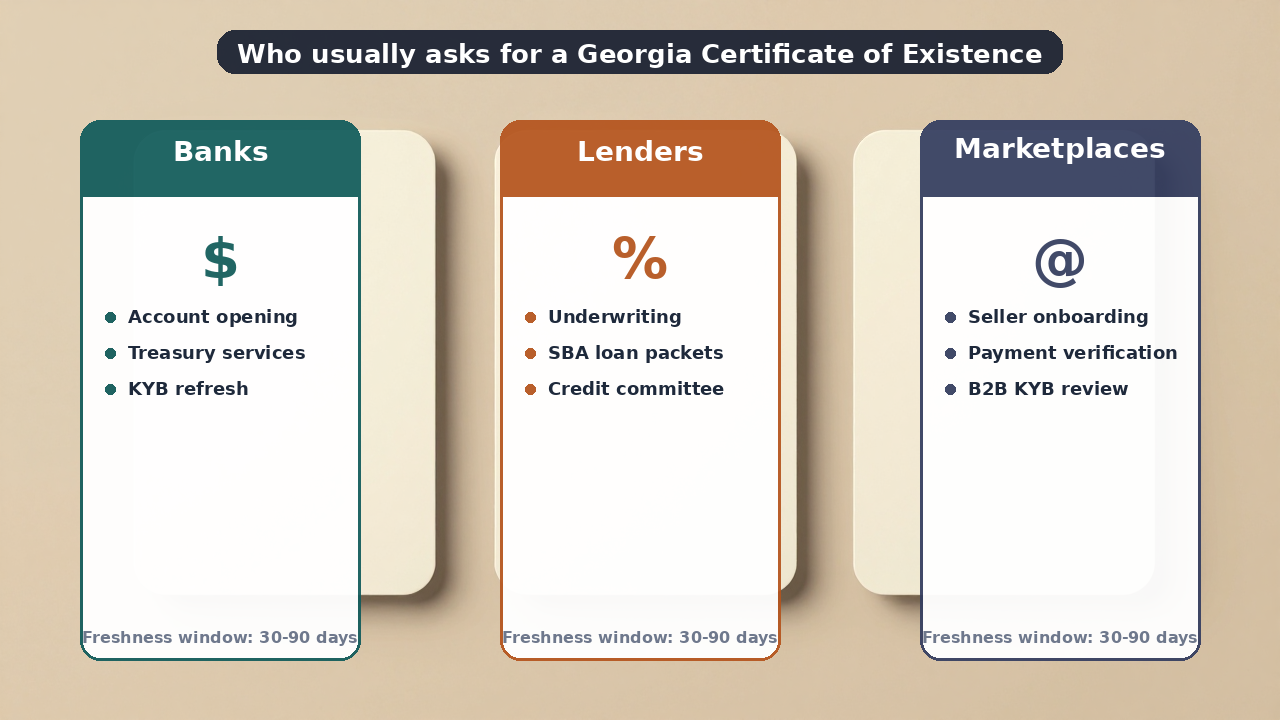
When a business opens an account, adds signers, requests a credit line, updates treasury services, or goes through a periodic review, the bank often wants recent state proof that the entity still exists.
That is especially common when the business is new to the bank or when transaction volume has grown.
A bank can collect your EIN letter, operating agreement, and formation filing, but those items do not answer the same question.
The Certificate of Existence is the state-level answer.
It tells the bank the entity is not just something that was formed once and forgotten later, which clears a common review point.
The certificate date also matters because the bank decides how fresh the document must be for its own file.
That is why ordering too early often creates a second order later, which wastes money.
Why marketplaces and payment platforms may require it
Marketplaces have their own risk teams now.
Large seller platforms, wholesale networks, fintech processors, and high-volume payment providers often run know-your-business reviews before they expand payouts or approve a new seller account.
They want to see that the legal entity behind the account is real, current, and still standing on the state record.
That does not mean every platform asks for a Georgia Certificate of Existence every time.
It does mean the request is normal enough that Georgia LLC owners should expect it once revenue, payout limits, or category risk goes up, which prevents surprise delays.
When the certificate is already planned into the onboarding packet, the marketplace review moves faster.
What the Georgia Certificate of Existence usually proves
The document is used as state confirmation, not as marketing material.
It is not there to tell a bank your business is profitable.
It is not there to tell a marketplace your reviews are good.
It is there to show that your entity record with the Georgia Secretary of State is in order when the certificate is issued, which answers the narrow question the other side cares about.
That makes it a clean fit for diligence packets, closing checklists, and onboarding files.
It also explains why a stale annual registration or unresolved state issue can block the request.
What a Georgia Certificate of Existence does not prove
This is where owners get tripped up.
A Georgia Certificate of Existence does not replace your EIN confirmation.
It does not replace a business license.
It does not prove sales-tax registration, payroll compliance, insurance, or contract authority by itself.
It is one document in a bigger file.
That file may still include your operating agreement, ID checks, beneficial ownership details, or tax records depending on who is asking, which helps you prepare the full packet instead of only one page.
What the Georgia Certificate of Existence costs in 2026
The current Georgia fee schedule is clearer than many owners expect.
The Georgia Secretary of State’s current Corporations Division Filing Fees PDF, effective September 6, 2025, lists the Certificate of Existence at $10 plus a $10 service charge for online filing and the same $20 total for paper requests.
That means the routine certificate order is not the expensive part.
The cost problem usually comes from rush timing, not the base fee, which is easier to budget.
The same fee schedule also lists a Raised Seal Blue Ink Certificate charge of plus $25 when a raised-seal paper version is specifically needed.
If your bank or title team is happy with the normal certificate, there is no reason to pay extra for the raised-seal version.
How expedited Georgia certificate requests work
Rush service is where owners accidentally overspend.
The Georgia Secretary of State’s filing fees and expedited processing page says online Certificate of Existence requests are processed immediately and do not need an expedite fee.
That is the best-case path.
The same page says certificate requests can also carry expedited fees of $60 for two business days and $275 for same-day service.
For broader document filings, Georgia also lists a one-hour expedited option at $1,200.
The practical lesson is simple: if the online certificate works for your use case, order it online before anyone forces you into a more expensive rush lane, which protects the budget.
How to order a Georgia Certificate of Existence
The order flow is meant to happen through the Georgia online system.
The Secretary of State’s online services guide points users to the portal for ordering certificates of existence and other business records.
Most owners start by locating the company record in eCorp, confirming the entity details, and selecting the certificate request.
Once the request is placed and paid, the certificate can usually be printed or shared as part of the diligence file if the receiving party accepts the standard version.
If you want a second walkthrough source, Georgia’s business portal at ecorp.sos.ga.gov is the system that sits behind the process.
That makes the ordering step easier to delegate inside a team.
Why annual registration matters before you order the certificate
A Certificate of Existence is only easy when the entity record is already clean.
Georgia’s annual registration guide says entity annual registrations are due by April 1 each year and may be filed as early as January 1.
The same guide says entities may file up to three calendar years in advance.
That filing cycle matters because a missed annual registration is one of the first reasons the state record stops being easy to rely on.
If you need a refresher on that side of the process, our Georgia Annual Registration for LLCs: 2026 Filing Checklist guide breaks down the timeline and the common mistakes, which helps you stay eligible.
When annual registration is current, the certificate request is a routine admin step instead of a repair project.
What can block the request even when the business looks active
Owners often think active operations equal clean state standing.
They are not the same thing.
The Georgia rules for limited liability companies at Subject 590-7-19 say the state may deny the issuance of a Certificate of Existence or a statement of good standing until full payment has been made when payment problems exist.
That means a dishonored payment, unresolved fee issue, or other record problem can block a certificate even if the company is still selling every day.
This is one reason compliance problems feel invisible until a third party asks for proof.
Finding the issue early gives you room to fix it before a closing date or account review starts slipping.
A simple Georgia example that feels very real
Picture a Georgia LLC that sells on a wholesale marketplace and also wants a new line of credit from its bank.
Nothing is wrong with the business.
Revenue is up.
Orders are shipping.
Then the marketplace wants fresh business verification and the bank wants updated entity paperwork in the same week.
If the LLC’s annual registration is already current, someone logs into the Georgia portal, orders the Certificate of Existence, and sends it into both files.
If the state record is not current, that same week becomes a recovery project with avoidable stress.
The difference is not luck.
It is whether the business treated state compliance as maintenance before the outside request arrived, which keeps growth smoother.
How this connects to expansion and other Georgia paperwork
A Georgia Certificate of Existence often shows up beside other state documents.
If the business is moving into another state, that other state may ask for a recent home-state certificate as part of a foreign qualification filing.
Our Georgia Certificate of Authority for Foreign LLCs article covers the inbound version of that expansion step from Georgia’s side.
If you are trying to sort out which documents belong in your permanent company file, our Georgia LLC documents guide with real certificate samples helps show where this certificate fits in the bigger stack.
Seeing the papers together makes it easier to answer requests without guesswork.
Why your registered agent still matters here
The registered agent does not issue the certificate.
But a reliable registered agent helps the business stay reachable when state notices, annual registration reminders, or service-of-process mail show up.
That matters because missed notices are how small record problems turn into big timing problems later.
Clean mail handling and clean calendar handling rarely feel exciting, but they make certificate requests easier months later.
2026 Georgia Certificate of Existence checklist
Use this short checklist before a bank, marketplace, or lender asks for the document.
- Confirm the exact legal entity name on the Georgia record.
- Confirm annual registration is current before you place the order.
- Ask the receiving party whether it wants a fresh standard certificate or a raised-seal paper version.
- Use the Georgia online portal first because standard online certificate requests are processed immediately.
- Budget the standard $20 total certificate cost.
- Budget the extra $25 only if a raised-seal blue-ink certificate is specifically required.
- Avoid rush fees by ordering inside the receiving party’s timing window instead of at the last minute.
- Save the certificate with the rest of the entity file so the next request is easier.
Related reading
For the Georgia follow-up filing that keeps standing clean, read Georgia Annual Registration for LLCs: 2026 Filing Checklist.
For Georgia expansion rules when an out-of-state LLC enters the state, read Georgia Certificate of Authority for Foreign LLCs: 2026 Filing Triggers and Costs.
For a broader view of the paperwork stack, read Georgia LLC Documents with Real Certificate Samples.
Final takeaway
Georgia Certificate of Existence in 2026 is not hard to order.
The real issue is whether you discover you need it before or after a bank review, marketplace onboarding check, closing, or filing deadline is already moving.
When the Georgia record is current, the base fee is modest, the online order is fast, and the certificate does exactly what it should do.
When the record is messy, the document request becomes a warning light.
That is why the smart move is to keep the entity clean before the ask arrives.
Frequently Asked Questions
What is a Georgia Certificate of Existence in 2026?
It is a state-issued document ordered through the Georgia Secretary of State that businesses use to show a third party that the entity record is current and recognized by the state at the time the certificate is issued.
How much does a Georgia Certificate of Existence cost in 2026?
Georgia’s current fee schedule lists the Certificate of Existence at $10 plus a $10 service charge, for a $20 total. A raised-seal blue-ink certificate is an additional $25 if specifically required.
Why would a bank ask for a Georgia Certificate of Existence?
Banks may ask for it during account opening, credit reviews, signer updates, or periodic business verification because they want fresh state proof that the entity still exists on Georgia’s record.
Why would a marketplace ask for a Georgia Certificate of Existence?
Marketplaces and payment platforms may request it during know-your-business review, seller onboarding, or payout expansion when they need official state proof behind the business account.
Can a Georgia LLC order a Certificate of Existence if annual registration is not current?
That can become a problem. Georgia’s annual registration cycle affects standing, and state record issues or unresolved payments can block certificate issuance until they are fixed.
Are Georgia Certificate of Existence requests processed quickly online?
Yes. Georgia’s filing-fees and expedited-processing page says Certificate of Existence requests submitted online are processed immediately and do not require an expedite fee.
Georgia Certificate of Existence
Stay Ready for the Next Georgia Document Request
Rapid Registered Agent helps Georgia businesses stay current so certificate requests, bank reviews, and marketplace checks are easier to handle.
- States Covered
- 50 + DC + PR
- Serving Businesses Since
- 2007
- Plans Start At
- $10/mo per state