
Pennsylvania Remote Employee Setup in 2026: State Accounts LLC Owners Miss Before the First Hire

Pennsylvania Remote Employee Setup in 2026 catches most first-time LLC owners off guard before their first paycheck goes out. The LLC files its formation documents. The owner hires someone to work remotely — maybe in Philadelphia, maybe in Pittsburgh, maybe across state lines. The owner runs payroll. What the owner did not set up is the separate state account with the Pennsylvania Department of Labor and Industry that the state requires before the first paycheck clears. That missing account triggers a penalty assessment that shows up six months later. Pennsylvania Remote Employee Setup is the checklist that prevents that.
This guide covers the state registrations, accounts, and filings a Pennsylvania LLC needs before the first remote employee is hired, what each one does, and what the penalties look like when an LLC skips one.
Pennsylvania Remote Employee Setup in 2026: State Accounts LLC Owners Miss Before the First Hire
Why Remote Employees Create Extra Setup Steps for Pennsylvania LLCs
Hiring an employee who works in the same city as the LLC is straightforward in Pennsylvania. The employer registers with the state, sets up withholding, and files the new hire report. Hiring a remote employee who lives in Pennsylvania but works for a Pennsylvania LLC from their home office adds a layer that many new employers do not anticipate: the compliance obligations follow the employee, not the business location.
A Scranton-based LLC that hires a remote employee working from their house in Allentown has the same Pennsylvania employer obligations as if the employee were sitting in the main office. The employer must register with the Pennsylvania Department of Labor and Industry, withhold Pennsylvania income tax from day one, and report the new hire to the Pennsylvania New Hire Reporting Program. Missing any of these creates back penalties and interest that the employer will discover during a routine audit, not when the deadline passes.
The setup steps do not take long. They take awareness. An LLC owner who knows what to set up before the first paycheck goes out can have everything registered in a single afternoon. An LLC owner who discovers it after the fact pays penalties that are entirely preventable.
Registering With the Pennsylvania Department of Labor and Industry
Every Pennsylvania employer must register with the Pennsylvania Department of Labor and Industry (DLI) before the first payroll. This registration establishes the employer account for state unemployment insurance, also known as Pennsylvania unemployment compensation.
The registration is done through the PA DLI website. The LLC needs its EIN from the IRS, the date of first wages, and the business address. The account number that PA DLI assigns is separate from the EIN and must be reported on every quarterly wage submission.
The Pennsylvania Unemployment Compensation Law requires employers to register within 30 days of becoming subject to the law. An LLC becomes subject on the first day it pays wages to an employee. Filing the registration late does not create a defense against the penalties — the state assesses them based on when the liability began, not when the registration was filed.
Setting Up Pennsylvania Withholding Tax
Pennsylvania imposes a state income tax on wages earned in the state. The LLC must withhold this tax from every paycheck and remit it to the Pennsylvania Department of Revenue.
The registration for withholding tax is separate from the PA DLI registration. An LLC can complete both simultaneously through the PA Department of Revenue’s online portal. The LLC needs a PA Withholding Tax Account Number before it can file the first withholding return.
Pennsylvania personal income tax withholding returns are filed quarterly using Form PA-WH. The filing due dates are the same as federal withholding deadlines — the last day of the month following the quarter end. Penalties for late filing and late payment apply from the original due date regardless of whether the LLC knew it needed to register.
The withholding tax rate for Pennsylvania employees is 3.07 percent of taxable wages as of 2026, with certain exceptions for charitable organizations and governmental entities. The LLC does not set this rate — it is set by Pennsylvania law and applied uniformly to all covered employees.
Pennsylvania New Hire Reporting
The Pennsylvania New Hire Reporting Program requires every Pennsylvania employer to report newly hired employees to the state within 20 days of the start date. This program supports the state child support enforcement system and helps prevent improper unemployment benefit payments.
The report must include the employee’s name, address, and Social Security number, along with the employer’s name, address, and EIN. Reports can be submitted online through the PA DLI portal, by fax, or by mail.
The consequence of missing new hire reporting is not usually a penalty — it is a gap in the child support enforcement system that creates problems for the employee and administrative friction for the employer when the state tries to match employment records. It is also a data point that state auditors look for when reviewing an employer for other compliance issues.
Pennsylvania Unemployment Insurance Tax
Pennsylvania employers pay unemployment compensation tax to fund the state unemployment insurance program. The rate is calculated based on the employer’s experience rating — essentially, how many former employees have filed unemployment claims against the business.
New Pennsylvania employers start at a standard rate for the first three years of liability. After three years, the rate adjusts based on the employer’s actual claims history. The rate applies to the first $13,600 in wages paid to each employee per year as of 2026.
Quarterly wage reports are filed with PA DLI. The contribution due is calculated by multiplying the applicable tax rate by the taxable wages for the quarter. Filing quarterly wage reports late, even by a day, triggers a penalty assessment that includes interest from the original due date.
Remote Employees Working Across State Lines
When a Pennsylvania LLC hires a remote employee who lives in a different state, the employer obligations become more complex. The employer may need to register for payroll tax withholding in the employee’s state of residence, not just Pennsylvania.
The general rule is that employees pay income tax to their state of residence, and employers withhold tax for that state. A Lancaster-based LLC that hires an employee working from their home in Ohio must register with the Ohio Department of Taxation, withhold Ohio income tax, and potentially pay Ohio unemployment insurance taxes — in addition to the Pennsylvania obligations.
This multi-state situation is where most Pennsylvania LLCs make their costliest payroll compliance mistakes. The LLC registers in Pennsylvania, withholds Pennsylvania tax, and forgets that the employee in Columbus, Ohio also has Ohio income tax withheld. When Ohio sends a notice to the employer six months later about the missing registration, the penalties and interest have already accumulated.
The IRS has a state-by-state employer obligations guide that helps employers identify which states require payroll registrations when employees work across lines. Before the first paycheck, Pennsylvania LLCs hiring out-of-state workers should verify the employee is not working in a state that requires a separate employer registration.
The IRS Side: Federal Payroll Tax Accounts
Before any Pennsylvania state accounts are set up, the IRS requires a few things of every employer. The LLC needs an EIN from the IRS, which serves as the federal identification number for employment tax purposes. The EIN is obtained through the IRS website and is typically issued immediately upon application.
New employers must also register for the IRS Electronic Federal Tax Payment System, known as EFTPS. This is the system for remitting federal income tax withholdings and Social Security and Medicare taxes. Payroll tax deposits must be made through EFTPS on either a monthly or semi-weekly schedule depending on the amount of tax liability. The IRS notifies new employers of their deposit schedule after the first Form 941 is filed.
The IRS does not forgive penalties for missed deposits just because the employer was new and did not know the schedule. Setting up EFTPS on day one and making the first deposit on time prevents a penalty that can equal 10 to 15 percent of the amount that was supposed to be remitted.
What Happens When These Accounts Are Missing
A Pennsylvania LLC that runs payroll without registering with PA DLI first has been paying wages while not being registered as an employer. When the state discovers this — usually during an audit triggered by an employee filing for unemployment — the back penalties and interest can be substantial.
Pennsylvania unemployment tax penalties for late payment include interest at the rate established under the UC Law plus surcharges. The interest compounds monthly. An LLC that operated for two years without registering with PA DLI can face a tax liability that is significantly larger than the original tax debt because of accumulated interest.
Beyond the financial penalties, unregistered employers also lose certain procedural protections. In Pennsylvania unemployment hearings, an employer who was not registered when the liability arose may face a higher contribution rate going forward. The experience rating system, which determines future tax rates, is affected by the compliance history from the moment of first registration.
A Practical Setup Sequence for the First Pennsylvania Remote Hire
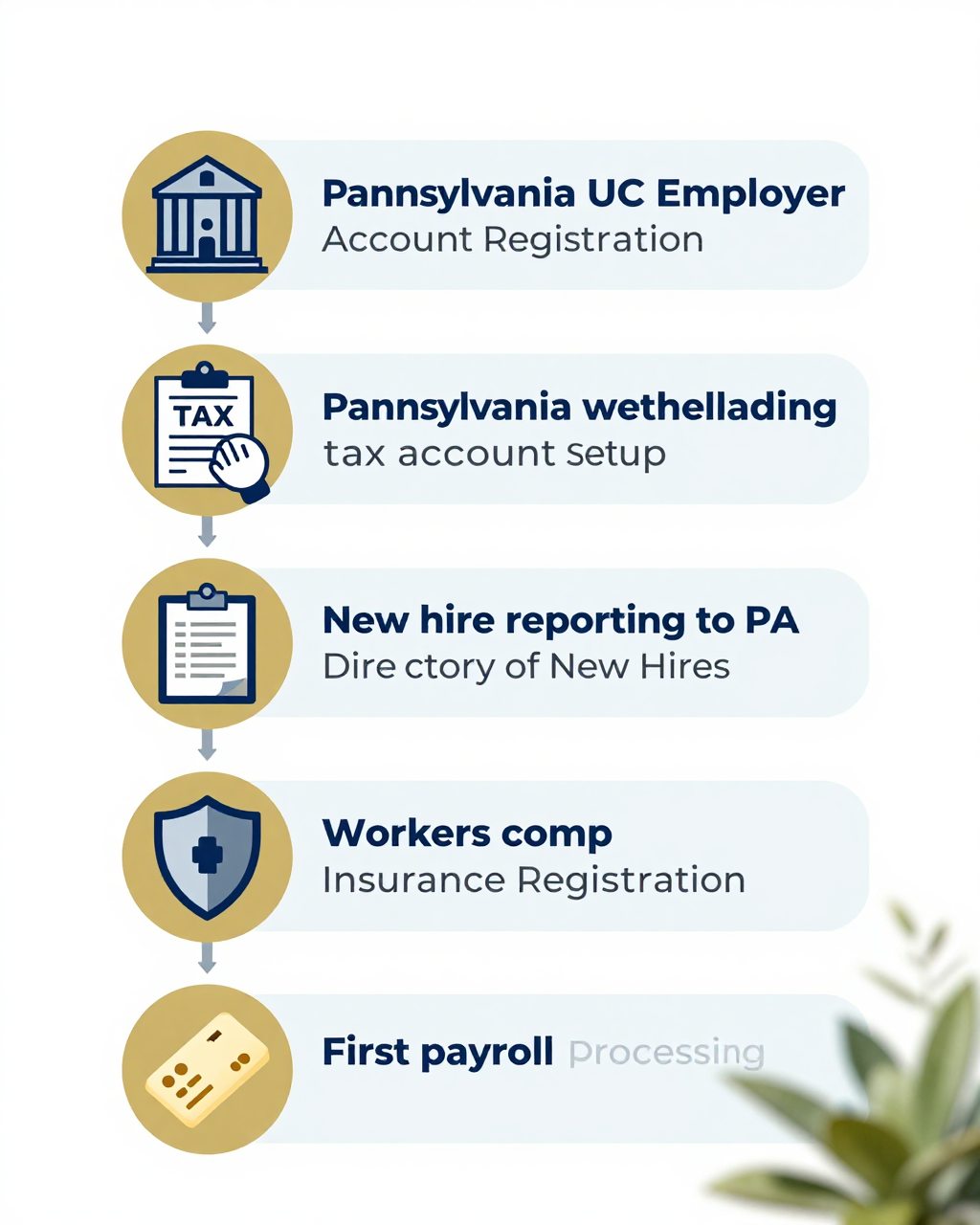
The registration steps can be completed in one to two days if they are done in the right order. The IRS EIN application should be completed first — it takes minutes online and is required for every downstream registration. With the EIN in hand, the PA Withholding Tax registration through the Department of Revenue can be completed next, followed immediately by the PA DLI employer registration for unemployment insurance.
After both Pennsylvania registrations are confirmed, submit the new hire report within 20 days of the employee’s start date. Set up EFTPS with the IRS for federal tax deposits. Then, if the employee works in a different state, verify whether that state requires a separate employer registration and complete it before the first paycheck.
PennDOT is not typically part of the employer setup process unless the business involves commercial driving. Most remote employee situations involve only the DLI, Department of Revenue, and IRS registrations.
Related Reading
Florida First Employee in 2026 — The federal and state employer registration steps for a first hire are similar across most states. This guide covers the same setup process with Florida agencies and deadlines.
Massachusetts First Payroll Run in 2026 — Running payroll for the first time has specific requirements in Massachusetts. This guide walks through the payroll account setup and first filing for Massachusetts employers.
Frequently Asked Questions
Does a Pennsylvania LLC need a separate state account before hiring its first remote employee?
Yes. A Pennsylvania LLC must register with the Pennsylvania Department of Labor and Industry for unemployment insurance and with the Pennsylvania Department of Revenue for income tax withholding before the first paycheck is issued. These registrations are separate from the federal EIN and must be in place before payroll runs.
What is the penalty for running payroll in Pennsylvania without registering first?
Pennsylvania assesses back unemployment taxes with interest from the date the liability began, plus potential surcharges. The interest compounds monthly. An employer who was not registered may also face a higher contribution rate in future years. IRS penalties for missed federal payroll tax deposits also apply independently.
Does a Pennsylvania LLC need to register in another state if the remote employee lives there?
Possibly. If the employee works in a state other than Pennsylvania, that state may require the employer to register there and withhold tax for its department of taxation. Multi-state employment situations require verifying each state where the employee works. The employer must also pay unemployment insurance in the state where the employee works.
How quickly does a Pennsylvania employer need to report a new hire?
Pennsylvania requires new hire reporting within 20 days of the employee’s start date. The report is submitted to the Pennsylvania Department of Labor and Industry and must include the employee’s name, address, Social Security number, and the employer’s information.
What taxes does a Pennsylvania employer withhold from an employee's paycheck?
A Pennsylvania employer withholds Pennsylvania personal income tax at the rate of 3.07 percent of taxable wages. Federal income tax, Social Security, and Medicare are also withheld per IRS requirements. Local taxes may also apply depending on the employee’s municipality of residence.
Can an LLC set up all the Pennsylvania employer accounts at the same time?
Yes. The IRS EIN is obtained first, then the Pennsylvania Department of Revenue withholding registration and the Pennsylvania DLI employer registration can be completed simultaneously through their respective online portals. Both registrations can be done in one to two business days.
Pennsylvania LLC Services
Pennsylvania Remote Employee Setup in 2026
Getting Pennsylvania employer accounts set up before the first paycheck keeps your LLC compliant and penalty-free. Rapid Registered Agent helps Pennsylvania businesses handle the setup right the first time.
- Pennsylvania LLCs Formed in 2025
- 12,800+
- States Served
- 50
- Annual Renewal Support
- Included