
Pennsylvania Registered Agent Resignation in 2026: What to File Before the State Stops Your Mail

Pennsylvania Registered Agent Resignation in 2026 trips up LLCs that change their registered agent without filing the resignation correctly. The old agent sends a letter. The new agent starts receiving mail. The LLC thinks the transition is done. Six months later, a lawsuit gets filed — and the summons gets sent to the old registered agent address because the resignation was never formally processed with the Pennsylvania Department of State. Pennsylvania Registered Agent Resignation is the process that prevents that gap, and getting it right is simpler than most LLC owners assume.
This guide covers the Pennsylvania resignation process, what the outgoing agent must file, what the incoming agent needs to do, and what happens if the transition is not handled correctly.
Pennsylvania Registered Agent Resignation in 2026: What to File Before the State Stops Your Mail
What a Registered Agent Does in Pennsylvania
Before getting into the resignation process, it helps to understand why the registered agent role matters enough to require a formal process to leave it. The registered agent in Pennsylvania is the official recipient for service of process — legal documents, lawsuits, and state administrative notices. Every LLC is required to maintain one at all times.
The registered agent is also the address that appears on the public record for the business entity. When someone searches for a Pennsylvania LLC on the Department of State business entity search, the registered agent name and address are part of the record. Any state agency sending compliance notices, penalty assessments, or annual report reminders sends them to that address.
A registered agent who resigns without going through the formal process has not actually stopped being the agent in the eyes of the state. The LLC is still listed as having that agent until the resignation is processed. Mail that arrives after the informal handoff but before the formal filing goes to whoever is receiving it at the old address — and the LLC has no legal standing to claim the agent should have forwarded it.
The Official Resignation Process in Pennsylvania
The Pennsylvania Department of State requires a registered agent to file a formal resignation before the agent’s name is removed from the entity record. The resignation is submitted on a form provided by the Department of State, signed by the resigning agent or an authorized representative.
The resignation filing does not take effect immediately. Pennsylvania law allows the resigning agent to continue receiving service of process for 30 days after the resignation is processed, even though the agent is no longer the official registered agent of record. This 30-day window is the transition period that gives the LLC time to ensure the new registered agent is in place before the old agent stops receiving mail entirely.
The resignation must include the entity name, the agent name, and a statement that the agent resigns from the appointment. The Department of State processes these filings, updates the public record, and notifies the LLC that the resignation has been accepted. The LLC is responsible for ensuring a new registered agent is in place before or simultaneously with the resignation filing.
What the LLC Must Do Before the Resignation
The LLC must designate a new registered agent and file the change with the Pennsylvania Department of State before or at the same time as the resignation. An LLC cannot have a period with no registered agent on file. If the resignation is processed and the LLC has not yet appointed a replacement, the entity is technically without a registered agent — which creates compliance exposure and can trigger an administrative review by the Department of State.
The appointment of a new registered agent is filed using the same process as the initial designation. The new agent must be a Pennsylvania resident with a Pennsylvania street address, or a business entity authorized to do business in Pennsylvania. The filing can be done online through the Department of State business filing portal.
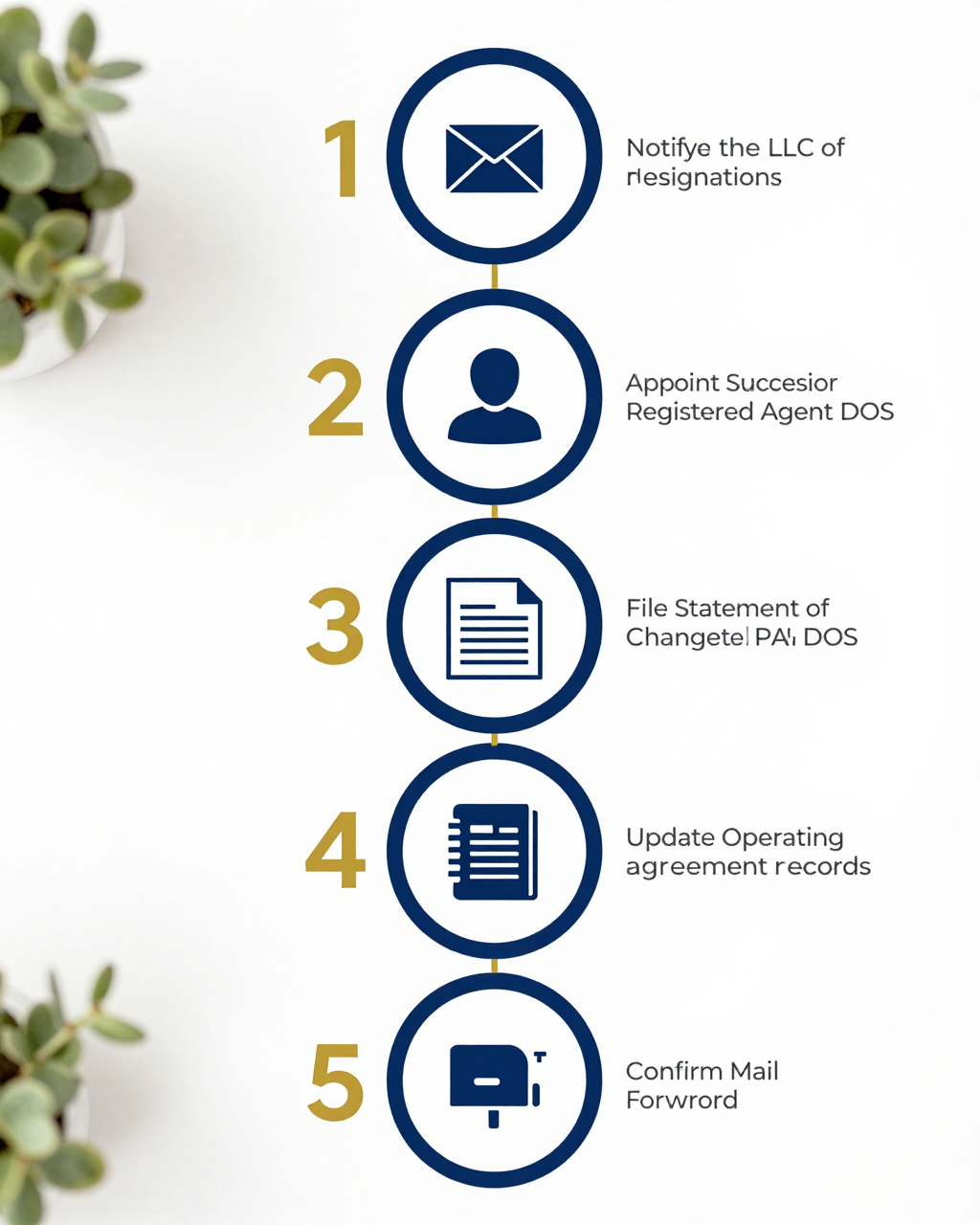
The sequence matters: first, the LLC confirms the new registered agent has agreed to serve and has the correct Pennsylvania address. Second, the LLC files the change of registered agent with the Department of State. Third, the old agent files the resignation. If the old agent files first and the new agent has not yet been appointed, the LLC is in temporary non-compliance during the gap.
The Outgoing Agent’s Responsibilities After Filing
Once a registered agent files its resignation with the Pennsylvania Department of State, the agent’s legal obligations change — but they do not disappear immediately. Pennsylvania law gives the resigning agent a 30-day window during which the agent can still receive service of process on behalf of the LLC, even though the agent is no longer listed on the public record.
During that 30-day window, the resigning agent is required to forward any service of process or official state correspondence to the LLC. This is a contractual and statutory duty, not an optional courtesy. An agent who receives a lawsuit summons during the transition window and does not forward it to the LLC has potentially caused the LLC to miss a response deadline — which can result in a default judgment against the LLC.
The practical implication for LLCs is that the transition agreement with the outgoing agent should explicitly include a commitment to forward any mail received during the 30-day window. The outgoing agent should confirm in writing what will be forwarded, how it will be sent, and for how long. This is especially important if the relationship with the outgoing agent ended on difficult terms.
What Happens When the Resignation Is Not Filed Correctly
The most common problem from an improperly handled resignation is a gap in official mail reception. A Pittsburgh LLC that tells its old registered agent to stop receiving mail, begins receiving mail at the new address, and assumes the transition is complete has a real compliance exposure. The old agent is still the official registered agent on the Pennsylvania Department of State record. Mail sent to that address — including tax notices, penalty assessments, and service of process — is legally the responsibility of that agent until the resignation is formally processed.
The second common problem is a missed lawsuit. A plaintiff filing suit against an LLC will search the Department of State records, find the registered agent, and serve process on that agent. If the old agent has already stopped forwarding mail but has not formally resigned, the LLC may never receive the summons. A default judgment can be entered against an LLC that never appears in a lawsuit because it never received notice. This is one of the most serious consequences of an informal registered agent transition.
The third problem is the LLC’s own ability to change the registered agent on other state filings. Many regulatory registrations — for sales tax, withholding, unemployment insurance — list the registered agent address as the contact address. If that address has been informally changed but the Department of State record has not been updated, the regulatory agencies may continue sending notices to the old address, creating confusion and potential missed deadlines.
Replacing the Registered Agent vs. Resigning and Reappointing
Some LLCs confuse a change of registered agent with a resignation. They are different. A change of registered agent is filed by the LLC and appoints a new agent. The old agent does not need to file anything separately — the new filing automatically replaces the old one on the state record.
A resignation is filed by the agent, not by the LLC, and is used when the agent is leaving the appointment. In most routine agent change situations — the LLC finding a better registered agent service, for example — the correct process is a change of registered agent filed by the LLC, not a resignation. A resignation is appropriate when the agent is the one initiating the separation, not the LLC.
If the LLC is dismissing its current registered agent and appointing a new one, the LLC files a change of registered agent. The current agent does not need to sign anything. The new agent does not need to be pre-approved by the state. The LLC simply files the change and the record is updated.
If the current registered agent is leaving the business and the LLC has not yet found a replacement, the agent files a resignation, which triggers the 30-day transition window. The LLC then has 30 days to find and appoint a replacement, during which the old agent still receives official mail on the LLC’s behalf.
How Quickly the State Processes Registered Agent Changes
The Pennsylvania Department of State typically processes registered agent filings — both changes and resignations — within one to three business days through its online filing system. Expedited processing is available for an additional fee if the LLC needs confirmation sooner.
Once processed, the updated registered agent information appears on the Department of State business entity search immediately or within one business day. The LLC should verify the change has appeared on the public record before considering the transition complete. Checking the record under the entity name is free and takes seconds.
The outgoing agent receives a copy of the processed filing as confirmation. The LLC should ask for this confirmation and keep it with the company records. If the old agent later claims the resignation was never processed, the LLC has documentation showing the filing date and the state confirmation number.
Why This Matters More for Litigation-Prone Industries
LLCs in industries where contract disputes or customer complaints frequently escalate to lawsuits have the most to lose from a poorly handled registered agent transition. A construction LLC in Allentown, a restaurant group in Philadelphia, or a retail operation in Pittsburgh operates in an environment where service of process arrives more frequently than in a low-dispute business.
For those LLCs, the registered agent is not just a compliance checkbox. It is a litigation risk management tool. Having a reliable registered agent who forwards documents promptly, maintains clean records of what was received and when, and processes resignations cleanly is worth paying for. The cost of a missed lawsuit from a sloppy transition is almost always higher than the annual fee for a professional registered agent service.
Related Reading
Florida Registered Agent Change in 2026 — Changing a registered agent in Florida follows a similar process to Pennsylvania. This guide covers the Florida filing steps and what to watch for during the transition.
Massachusetts Registered Agent Change in 2026 — Massachusetts requires a formal agent change filing with the Secretary of the Commonwealth. This guide covers the Massachusetts process with the same emphasis on getting the transition right the first time.
Frequently Asked Questions
What is the first step when a Pennsylvania registered agent resigns?
The first step is for the LLC to appoint a new registered agent and file the change with the Pennsylvania Department of State before or at the same time the old agent files its resignation. Pennsylvania law does not allow an LLC to have no registered agent on file, so the replacement must be in place before the resignation takes effect.
Can a Pennsylvania registered agent resign without a replacement in place?
No. The resignation filing does not eliminate the registered agent requirement. The LLC must have a new registered agent appointed before the resignation is processed, or the LLC will be out of compliance during the gap. The 30-day transition window that follows a resignation is for forwarding mail, not for finding a replacement.
How long does a Pennsylvania registered agent resignation take to process?
The Pennsylvania Department of State typically processes registered agent resignation filings within one to three business days through its online system. Once processed, the resignation takes effect and the 30-day forwarding window begins. Expedited processing is available for an additional fee.
What mail does a resigning registered agent have to forward during the 30-day window?
A resigning Pennsylvania registered agent must forward all service of process, state correspondence, and official regulatory notices during the 30-day window. This includes lawsuit summons, penalty notices, annual report reminders, and any other official mail received at the registered office address. Failure to forward these documents can create liability for the resigning agent.
What happens if a lawsuit is served to the old registered agent after the resignation is filed?
Pennsylvania law gives the resigning agent a 30-day window during which service on the old agent is still legally effective. If the lawsuit is served within that 30-day window, the service is valid even though the agent has resigned. The resigning agent is required to forward the summons to the LLC immediately upon receipt.
How can an LLC verify the registered agent change was processed?
The LLC can verify the updated registered agent information by searching the entity name on the Pennsylvania Department of State business entity search. The updated record should reflect the new registered agent name and address within one business day of processing.
Related reading
- Pennsylvania Compliance Mail Triage in 2026: How AI Can Sort Notices Before Deadlines Get Missed
- Utah Registered Agent Resignation in 2026: What to Fix Before the State Record Goes Stale
Pennsylvania LLC Services
Pennsylvania Registered Agent Resignation in 2026
Getting the registered agent resignation filed correctly keeps your Pennsylvania LLC’s service of process and state mail continuous. Rapid Registered Agent handles Pennsylvania agent appointments and transitions.
- States Covered
- 50 + DC + PR
- Serving Businesses Since
- 2007
- Plans Start At
- $10/mo per state