Pennsylvania Review Response Rules in 2026: How Local LLCs Build Trust Without Starting a Fight

Pennsylvania Review Response Rules in 2026 matter more than most Pennsylvania LLC owners realize. A single negative review can cost a business an estimated 30 customers before the owner even knows it exists. Responding the wrong way can cost more. Pennsylvania law gives business owners specific rights when they respond to reviews, but those rights come with real limits. Local businesses that learn those limits early protect their reputation and their legal exposure at the same time.
This guide covers how Pennsylvania LLCs and small businesses should respond to reviews in 2026 — positive and negative — without crossing lines that could turn a customer dispute into a lawsuit.
Pennsylvania Review Response Rules in 2026: How Local LLCs Build Trust Without Starting a Fight
Why Review Responses Matter More for Local LLCs Than Big Chains
National chains have brand recognition working in their favor. A customer angry at a big retailer has already decided to shop there again before they write the review. Local LLCs do not have that cushion. A Pittsburgh HVAC repair shop, a Philadelphia food truck, a Scranton cleaning service — these businesses depend on neighborhood trust that is built one interaction at a time and can be damaged by one careless response.
Studies consistently show that consumers trust local businesses more when they see the owner engaging with reviews. A thoughtful response to a three-star review often converts a hesitant future customer more effectively than the original service did. Responding signals that the business pays attention, cares about outcomes, and is willing to make things right.
That same response can also create legal problems if it says too much, disputes facts publicly, or reveals information that should stay private. Pennsylvania’s Consumer Protection Law and its defamation statutes set boundaries that most small business owners have never read.
What Pennsylvania Law Says About Responding to Reviews
Pennsylvania does not have a specific statute governing how businesses must or must not respond to online reviews. The relevant legal framework comes from three areas: the Uniform Commercial Code as adopted in Pennsylvania, the Pennsylvania Unfair Trade Practices and Consumer Protection Law (UTPCPL), and common-law defamation doctrine.
The UTPCPL prohibits deceptive or unconscionable acts in trade and commerce. A business that responds to a negative review by claiming services were provided when the customer denies receiving them could be making a material misrepresentation — especially if the business knows the claim is false. That shifts the dispute from a customer relations problem to a potential CPPA enforcement matter.
Defamation law is the bigger practical risk. Pennsylvania recognizes both libel (written false statements of fact that damage reputation) and slander (oral equivalents). A business owner who responds to a negative review by calling the reviewer a liar, accusing them of fraud, or making specific factual claims that are not documented is building a defamation case — potentially against themselves.
The key legal principle is that statements of opinion are protected, but statements of fact are not. Saying “I believe our technician fixed the issue” is different from saying “this customer is lying about what happened.” The first is defensible. The second is potentially actionable if the customer can show the service was actually provided as described.
The Three Types of Reviews and How to Respond to Each
Responding to Positive Reviews
Positive reviews are the easiest to respond to and the most valuable to engage with. A short, genuine response takes 30 seconds and does not carry legal risk.
A Philadelphia restaurant owner responding to a five-star review saying “thank you for dining with us, we loved having you” reinforces the positive experience for anyone reading the review. It also signals to future customers that the business is attentive and grateful.
The risk with positive reviews is over-promising in the response. Saying “we will have your favorite dish ready next time” creates an expectation the kitchen may not meet. Keep responses warm and brief. Do not add new commitments in a response to a review.
Responding to Neutral or Three-Star Reviews
The three-star review is the most strategically important response for a local LLC. These reviews usually say something like “service was okay, nothing special, would probably use again.” They are not angry. They are not fully satisfied. A thoughtful response can move that customer from neutral to loyal.
A Pittsburgh cleaning service that receives a three-star review saying “they did the job but were 20 minutes late” should respond publicly by acknowledging the timing issue, apologizing for the inconvenience, and inviting the customer to contact the business directly to discuss a discount on their next visit. That response does several things at once: it shows future readers that the business takes accountability, it offers something of value to the original reviewer, and it moves the conversation offline where the full context can be addressed without legal risk.
Never argue about facts in a public response to a three-star review. The person reading future reviews sees both the review and the response. A defensive response to a three-star review makes the business look harder to work with than the review itself.
Responding to Negative Reviews
Negative reviews — one star and two star — are where Pennsylvania LLC owners face the highest legal exposure and the highest stakes for customer retention.
The first rule for a negative review response is: do not respond while angry. A negative review triggers a visceral reaction. The instinct is to defend, explain, and correct. Responding in that state almost always produces language that creates legal risk or deepens the customer relationship damage.
The second rule is: do not reveal private information about the customer in a public response. A business owner who responds to a negative review by describing the terms of the customer’s contract, referencing a refund that was already issued, or mentioning details of a dispute that occurred offline has turned a private disagreement into a public one — and may have violated privacy principles under Pennsylvania common law.
The third rule is: move the conversation offline quickly. A response that says “we are sorry you had this experience, please call us at [number] so we can make it right” accomplishes three things: it shows future readers that the business wants to resolve the issue, it keeps the detailed dispute private, and it gives the business owner a chance to resolve the problem without creating a public record of every accusation and response.
A Harrisburg mobile detailing business owner learned this the hard way in 2025. A customer posted a one-star review claiming the interior was left damaged. The owner responded publicly with a detailed description of the pre-service inspection form, including notes about existing damage that had been documented before work began. The customer then posted a second review accusing the owner of sharing private inspection notes publicly. The owner had turned a recoverable reputation issue into a broader dispute that drew significantly more attention than the original complaint.
What Not to Say in Any Public Response
Pennsylvania business attorneys who handle consumer disputes consistently flag the same three categories of statements as the most legally dangerous in review responses.
Accusations of lying or fraud directed at the reviewer are the most common problem. Even if the business owner genuinely believes the customer is being dishonest, a public accusation of lying is a statement of fact that may not be provable. It is also the fastest path to a defamation claim.
Revealing details of ongoing or past legal disputes with the reviewer is the second major category. A response that says “we have already refunded this customer and they agreed to take down the review” tells future readers that the business had a refund dispute — which raises questions the business did not need to raise.
Threatening legal action against the reviewer in a public response is the third. A statement like “we are consulting with our attorney about this matter” in a public review response is not a legal threat in the technical sense, but it signals to future customers that working with this business comes with litigation risk. That is not the brand message a Pennsylvania LLC wants to send.
Using the Pennsylvania Consumer Protection Framework as a Response Guide
The Pennsylvania Unfair Trade Practices and Consumer Protection Law defines specific categories of prohibited conduct. Local LLCs can use those categories as guardrails for what not to say in a public review response.
Making false claims about competitors in a review response — even in reply to a negative review — can constitute an unfair trade practice if the claims are not verifiable. A Lancaster business that responds to a one-star review by saying “the customer was actually looking for our competitor” is making a claim about a third party’s business practices that may not be accurate.
Misrepresenting the terms of service, guarantees, or refund policies in a review response is also a CPPA issue. If a business owner says in a review response that “we offer a satisfaction guarantee” but the business actually has no such policy, that misrepresentation is a separate problem from the original customer complaint.
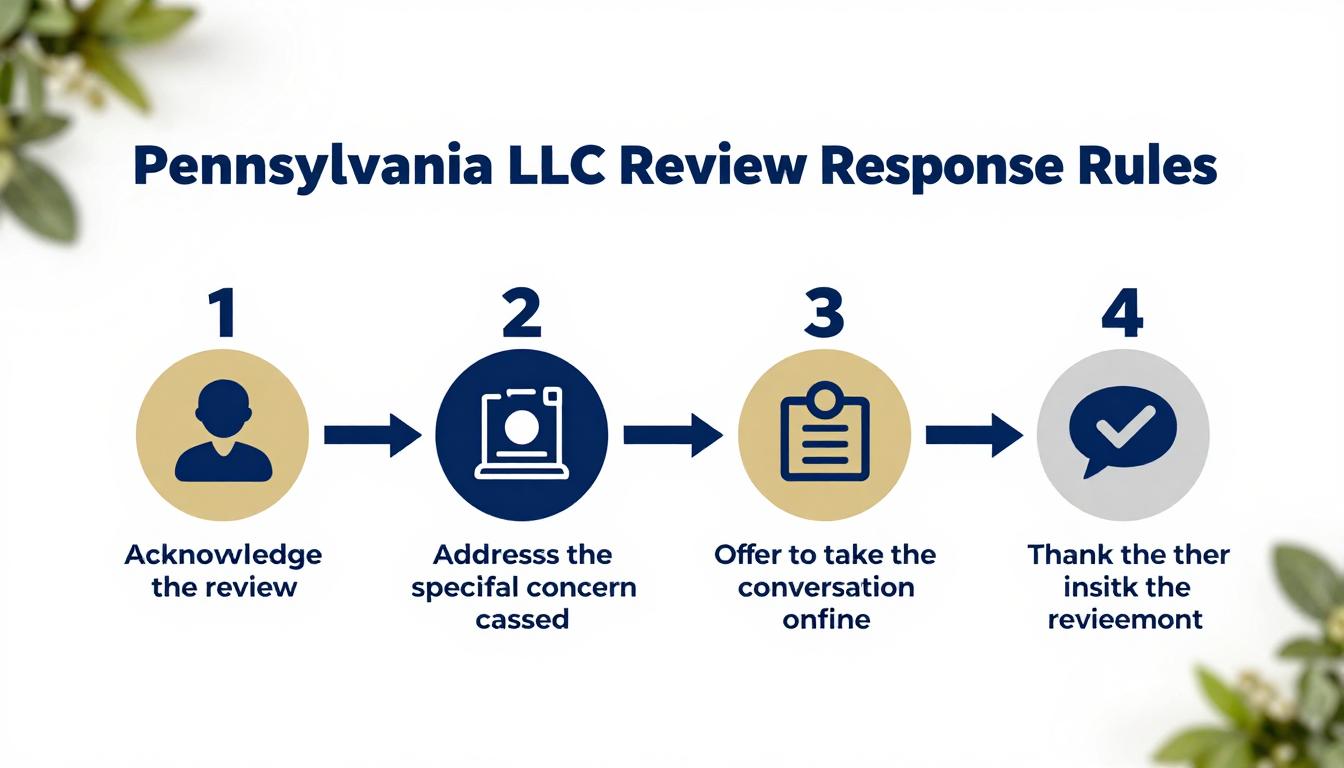
The safest framework for any review response in Pennsylvania is this: stick to what you know, acknowledge what the customer experienced from their perspective, offer a path to resolution, and take the detailed conversation offline.
How Quickly Should a Pennsylvania LLC Respond to a Review
Speed matters in review response, but not at the cost of quality. A response within 24 to 48 hours is ideal for a negative review. That window is long enough to avoid an emotional response and short enough to show the business is paying attention.
A Scranton landscaper who responds to a negative review within two hours with a carefully worded message inviting the customer to discuss the issue directly is making a strong impression on every future reader who sees that exchange. A response two weeks later, even a perfect one, has less impact because it suggests the business only responded when prompted.
For positive reviews, a weekend response works fine. The goal is acknowledgment and warmth, not speed.
Can a Business Ask Happy Customers to Leave Reviews in Pennsylvania?
Asking satisfied customers to leave reviews is legal in Pennsylvania and is a legitimate part of running a review management strategy. There are two firm limits on this.
Do not offer money or other incentives in exchange for positive reviews. The Federal Trade Commission has taken enforcement action against businesses that offered gift cards, discounts, or payments in exchange for five-star reviews, and Pennsylvania follows federal guidance on this. A Scranton restaurant that offers a free dessert for a five-star Google review is building a deceptive practice that could trigger UTPCPL enforcement.
Do not have employees or family members write reviews while posing as customers. This is considered deceptive regardless of whether the review is positive. It is also a violation of the terms of service of every major review platform.
The legitimate approach is simple: after a completed job or service, ask the customer directly if they would be willing to share their experience. Most satisfied customers are happy to do so when asked.
How to Handle Review Gating and Platform Policies
Google, Yelp, and other major platforms allow business owners to flag reviews that violate platform policies. Pennsylvania LLCs dealing with reviews that contain factual inaccuracies, threats, or off-topic content should know that flagging is an option — but it is not a guaranteed removal tool.
Google’s review policies prohibit content that makes false claims about an individual or business, content that includes personal attacks, and content that is off-topic. A business owner who flags a negative review because they disagree with the star rating will not succeed. A business owner who flags a review that makes a specific factual claim the business can disprove with documentation — like a claim that a service was never rendered when invoicing records show it was — has a reasonable case for removal.
Keep documentation of every service interaction. Invoices, contracts, time-stamped photos, and email confirmations are the evidence that supports a successful flag. Pennsylvania business owners who keep clean records have a much stronger case when contesting a false review.
Building a Review Response Policy for Your Pennsylvania LLC
The business owners who handle review responses best treat it as a systematic practice, not a reactive one. A written review response policy protects the business from legal exposure and ensures consistent, professional engagement with customers.
A good policy specifies who in the organization is authorized to respond to reviews. For a single-member LLC, that person is usually the owner. For a multi-member LLC, designate one member as the review response contact and make sure the others know not to respond from their personal accounts.
The policy should include a standard response template for each review category: positive, neutral, and negative. Templates reduce the chance of an emotional response overriding good judgment in the moment.
The policy should also specify that no response is ever made within two hours of a negative review being posted. That cooling-off period is the single most effective guard against a response that creates legal exposure.
Related Reading
Pennsylvania DBA Filing in 2026 — If your Pennsylvania LLC operates under a trade name or brand name different from its legal name, a DBA filing keeps you in compliance with state requirements.
Pennsylvania Registered Agent Change in 2026 — Your registered agent is your LLCs official point of contact for legal and regulatory mail.
Frequently Asked Questions
Can a Pennsylvania LLC be sued for responding to a negative review?
Yes. If a business response makes false statements of fact that damage a reviewers reputation, it can be the basis of a defamation claim under Pennsylvania common law. Responses that call the reviewer a liar, accuse them of fraud, or make specific factual claims that cannot be documented carry legal risk. Statements of opinion and genuine acknowledgments of service issues do not.
What should a Pennsylvania business never say in a public review response?
Never accuse a reviewer of lying, threaten legal action in a public response, or reveal details of a private dispute or prior refund. These statements are the most common triggers for defamation and privacy claims against Pennsylvania businesses. A safe response sticks to the business perspective, acknowledges the customers experience, and moves the detailed conversation offline.
How quickly should a Pennsylvania LLC respond to a negative review?
Aim to respond within 24 to 48 hours of a negative review being posted. This window is long enough to avoid an emotional reaction and short enough to show future readers that the business is attentive and service-oriented. Never respond within minutes of posting a negative review — the likelihood of saying something that creates legal exposure is high.
Can a Pennsylvania business offer incentives for positive reviews?
No. The FTC prohibits paying for or incentivizing reviews in a way that misleads consumers, and Pennsylvanias UTPCPL follows federal guidance on deceptive trade practices. Legitimately asking satisfied customers to share their experience is fine. Paying them or offering free products for reviews is not.
How can a Pennsylvania LLC get a false review removed?
File a flagging request directly through the platform where the review appears, using the specific policy violation reason that applies. Keep documentation of the service interaction including contracts, invoices, and photos that contradict the false claims in the review. Platform responses to flag requests vary, but well-documented cases with specific factual inaccuracies have the best chance of removal.
Is it legal to respond to a review by saying the customer is wrong?
Saying a business believes a customers account is inaccurate is generally a statement of opinion and is protected. The line is crossed when the response makes specific factual claims about the customer that cannot be proven with documentation. Keep review responses focused on what the business knows and can show.
Related reading
- District of Columbia Review Response Rules in 2026: How Local Firms Defend Trust Without Starting a Public Fight
Pennsylvania Business Services
Pennsylvania Review Response Rules in 2026
Local Pennsylvania businesses that respond to reviews the right way build more trust and avoid legal problems. Rapid Registered Agent helps Pennsylvania LLCs stay compliant from day one.
- States Covered
- 50 + DC + PR
- Serving Businesses Since
- 2007
- Plans Start At
- $10/mo per state