
Can You List a Registered Agent Address in Local Citations? Multi-State SEO Risks in 2026
Can you list a registered agent address in local citations in 2026 is a question that sounds simple and answers hard. You pulled the LLC’s citations together for a multi-state launch. You opened Yelp for the LLC’s home city. You pulled up the LLC’s Google Business Profile. You opened the LLC’s home-state registered-agent address — and asked whether that is the address the LLC should publish on every citation source. The short answer is no, not if the LLC wants to drive local-pack traffic. The long answer varies by citation source. A local citation is the Name, Address, and Phone number an LLC publishes about itself on a directory, a mapping service, or an industry site. Google uses the consistency of those citations to decide whether the LLC is a real local business and where the LLC should rank in local-pack results. Bing Places, Apple Maps, Yelp, Facebook, Yellow Pages, the Better Business Bureau, and dozens of vertical directories each consume a version of the citation, and each source has a different tolerance for the LLC’s registered-agent address.
The right answer for an LLC that operates in multiple states is sharper than the simple no. The LLC keeps the registered-agent addresses in the LLC’s state filings (where they belong) and publishes the LLC’s actual operating address in the LLC’s citations in each state where the LLC has real operations. The two systems serve different audiences and the LLC keeps them separate.
Here is the broader picture on local-citation hygiene for registered-agent-driven businesses:
What a local citation actually is
A local citation is any online mention of an LLC’s Name, Address, and Phone number on a third-party site. The citation does not need to link to the LLC’s website to count — Google and Bing consume the citation as a structured data point even without a link. The citation needs to be consistent across all sites (same spelling, same address format, same phone number, same area code) to count as a single citation signal rather than multiple conflicting signals.
The three pieces of the citation have different SEO weights:
- Name. The LLC’s exact legal name (or the exact trade name the LLC publishes publicly).
Variations like “ABC LLC” vs. “ABC, LLC” vs. “ABC Limited Liability Company” are treated as separate entities by Google’s local algorithm until the LLC canonicalizes one form across all citations.
- Address. The LLC’s physical location where customers can visit the business.
The address must be a real, occupied location with a clear storefront, signage, or staffed office — at least in the citation sources that drive local-pack rankings. A CMRA, a registered-agent office, a virtual office, or a PO Box does not qualify as a “physical location” for local-pack purposes in most categories.
- Phone. A local phone number with the LLC’s area code.
A toll-free number (800, 888, etc.) is acceptable as a secondary number but not as the primary citation number for local-pack ranking.
Citations are structured data. Google reads them as NAP triples, Bing reads them as NAP triples, Yelp reads them as NAP triples, Apple Maps reads them as NAP triples. The LLC’s job is to make sure every citation source reads the same triple.
What a registered-agent address actually is
A registered-agent address is the official mailing address the LLC is required to maintain with the state Secretary of State (or equivalent office) for service of process and official state correspondence. The address is typically a commercial address operated by a registered-agent service, an attorney, or a company-statutory-agent provider. The address is sometimes a CMRA (commercial mail receiving agency) — a private mailbox service that operates under USPS Commercial Mail Receiving Agency rules (39 CFR § 508).
Three facts about registered-agent addresses matter for SEO purposes:
- The address is not the LLC’s place of business. The registered-agent address is where the LLC receives service of process and state notices.
It is rarely where the LLC operates, where customers can visit, or where the LLC’s staff works. In many cases, the registered-agent address is in a different state from the LLC’s actual operations.
- The address is shared with many other LLCs. A commercial registered-agent service typically receives mail for hundreds or thousands of LLCs at the same street address.
The address is a delivery point, not a single-tenant office.
- The address is a CMRA in most cases. Most commercial registered-agent addresses are private mailboxes operated under 39 CFR § 508.
The USPS publishes a list of CMRA addresses, and Google’s local algorithm excludes CMRA addresses from local-pack eligibility in most categories.
A registered-agent address is the right address for the LLC’s state filings. It is the wrong address for the LLC’s local SEO citations.
Why the two are not interchangeable
The LLC’s local citations and the LLC’s registered-agent address serve different audiences. The state’s Secretary of State uses the registered-agent address to deliver service of process — the LLC’s compliance obligation. Google’s local algorithm uses the LLC’s citation address to decide whether the LLC is a real local business in the LLC’s market — the LLC’s growth lever.
Mixing the two creates three distinct problems:
Problem 1: the LLC fails Google’s local-pack eligibility. Google explicitly excludes CMRA addresses and registered-agent addresses from local-pack eligibility in most categories. The LLC publishes a registered-agent address as the LLC’s primary citation address; Google’s local algorithm de-prioritizes the LLC’s listings or rejects them entirely; the LLC’s local-pack rankings drop or never appear. The Google Business Profile guidelines on address eligibility explicitly exclude mailbox-style addresses.
Problem 2: NAP inconsistency across states. A multi-state LLC typically has multiple registered-agent addresses — one in each state where the LLC is registered or foreign-qualified. If the LLC publishes one registered-agent address as the LLC’s primary citation address and another registered-agent address as the LLC’s foreign-qualification citation address, Google reads the LLC as two separate businesses in two separate markets. The LLC’s local-pack rankings fragment.
Problem 3: third-party citation confusion. Yelp, Apple Maps, Facebook, and the BBB each consume the citation as structured data. A registered-agent address with a private mailbox number (e.g., “PMB 142”) or a CMRA-style suite number (e.g., “Suite 142”) does not parse cleanly across all sources. The LLC’s citations fragment by suite number across the various sources, and Google’s local algorithm reads the citations as inconsistent NAP triples. The Whitespark local citation finder shows how aggressively aggregators reformat suite numbers — what the LLC writes as “Suite 142” can appear as “#142” or “PMB 142” on a downstream directory.
The practical result is that the LLC’s local SEO is worse — sometimes materially worse — when the LLC publishes a registered-agent address in citations than when the LLC publishes the LLC’s actual operating address.
Which citation sources accept the registered-agent address
The acceptance of registered-agent addresses varies by source. The LLC needs to understand each source’s tolerance to make the right call for the LLC’s specific mix.
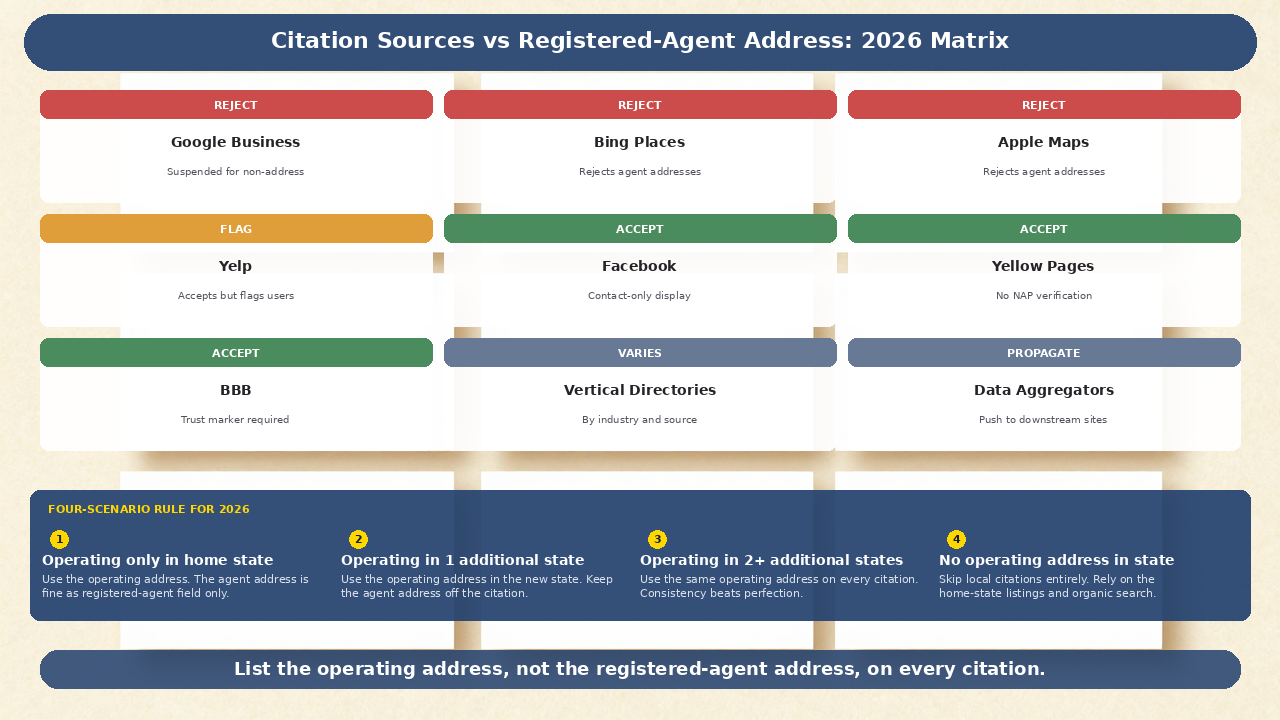
- Google Business Profile. Rejects registered-agent addresses and CMRA addresses in most categories, per Google’s GBP eligibility guidelines and the GBP address rules.
The LLC’s listing is rejected at verification or suspended after review. Covered in detail in Can You Use a Registered Agent Address on Google Business Profile? Multi-State Marketing Rules in 2026.
- Bing Places. Stricter than Google on category-specific eligibility per Bing’s Places for Business quality guidelines.
- Apple Maps. Apple’s Business Connect program does not actively verify addresses, but category eligibility rules reject CMRA-style addresses.
- Yelp. Accepts registered-agent addresses but flags them with a “claimed by owner” or “Yelp unrepresentative” label per Yelp’s business page guidelines.
The LLC’s Yelp ranking suffers.
- Facebook Business Page. Accepts the registered-agent address in the contact field; uses phone or email for verification.
The page will not rank in Facebook local search if the address is a CMRA.
- Yellow Pages, Superpages, Yelp-equivalents. Accept registered-agent addresses without rejection but create NAP inconsistency with the LLC’s GBP listing.
- Better Business Bureau. Accepts registered-agent addresses for the LLC’s BBB business page; does not exclude the LLC from local-pack eligibility.
- Vertical directories (lawyer, contractor, healthcare, real estate): most accept registered-agent addresses; few rank the LLC in geographic searches.
- Data aggregators (Infogroup, Neustar/Localeze, Factual/Foursquare, Acxiom): distribute citation data to Google, Bing, Apple, Yelp, and dozens of others, so a registered-agent address entered at the aggregator level propagates everywhere.
The pattern: Google, Bing, and Apple Maps (the three sources that drive the bulk of local-pack traffic) reject registered-agent addresses. Yelp, Facebook, the BBB, and aggregators accept them but the LLC’s rankings suffer. Yellow Pages and the older directory ecosystem are the only sources that accept the registered-agent address without consequence.
For related multi-state coverage of how the citation rule plays out for service-area pages, see Oregon Service-Area Pages in 2026: How Registered Agent Brands Can Stay Clean.
How NAP inconsistency across multiple states erodes local-pack rankings
A multi-state LLC faces a specific version of the problem. The LLC has:
- A formation state (the LLC’s home state) with one registered-agent address.
- One or more foreign-qualification states, each with its own registered-agent address.
- The LLC’s actual operating locations in one or more states, where customers can visit the LLC.
If the LLC publishes the LLC’s home-state registered-agent address in the LLC’s citations, the LLC’s local-pack rankings in the LLC’s operating state suffer — the registered-agent address is in the wrong state. If the LLC publishes the LLC’s foreign-qualification-state registered-agent address in the LLC’s citations, the LLC’s local-pack rankings in the LLC’s operating state suffer for the same reason. If the LLC publishes one registered-agent address in some citations and another registered-agent address in other citations, Google’s local algorithm reads the LLC as multiple businesses in multiple states.
The dominant pattern of NAP inconsistency for multi-state LLCs is “phantom locations” — citations showing the LLC at an address in a state where the LLC does not operate. Google and Bing treat phantom locations as spam signals. The LLC’s local rankings drop or disappear in the LLC’s actual operating state. California-registered-agent-address rules for local SEO pages and Delaware-registered-agent-vs-operating-state-address rules cover the specific phantom-location risks for the two most common multi-state starting points, and the Moz local-search ranking factors page documents how NAP consistency drives local-pack rank.
The fix is to publish the LLC’s actual operating address in the LLC’s citations in the state where the LLC operates, regardless of where the LLC’s registered-agent addresses are filed. The registered-agent addresses stay in the LLC’s state filings (where they belong). The operating address goes in the LLC’s citations (where it belongs). The two addresses serve different audiences.
The practical approach for a multi-state LLC in 2026
The decision rule for whether to publish the registered-agent address in citations depends on the LLC’s specific situation.
Situation 1: the LLC has a real operating location in a state where the LLC has customers. The LLC publishes the LLC’s actual operating address in all citations for that state. The LLC does not publish the registered-agent address in any citation in that state.
Situation 2: the LLC has a registered-agent address but no operating location in a state. The LLC is foreign-qualified in a state but has no staff, no office, and no customer visits in that state. The LLC does not need to publish citations in that state at all. The LLC’s citation strategy focuses on the LLC’s actual operating states.
Situation 3: the LLC operates virtually across multiple states with no fixed office. The LLC’s options are: (a) establish a real operating location in one state (typically the home state) and publish that address in citations; (b) use a virtual office service (a real, staffed, leased office space — not a CMRA) in one state; or (c) accept that the LLC will not have strong local-pack rankings and focus SEO on organic and paid search.
Situation 4: the LLC’s registered-agent service offers a “primary business address” or “virtual office” service. A staffed office service may qualify for local-pack eligibility if it meets Google’s guidelines.
The common thread: the registered-agent address belongs in state filings. The citation address belongs in citations. The two should be different addresses for any LLC that has a real operating location. For the broader picture on coordinating registered-agent compliance across multiple states — which is what makes a single citation rule work across a multi-state LLC’s filings — Hiring Remote Employees in Multiple States: When Foreign Qualification and Registered Agents Matter is the prior cycle’s companion article.
For a different angle on this question — what the same registered-agent address does when an LLC hires remote employees in multiple states and the registered-agent footprint fragments — here is a related walkthrough:
When publishing the registered-agent address in citations is acceptable
There are three situations where publishing the registered-agent address in citations does not harm the LLC’s local SEO:
Situation 1: the LLC is purely digital with no local search intent. The LLC has no local customers, no physical operating location, and no interest in ranking in local-pack results. The LLC’s SEO strategy is organic and paid search, not local search. The LLC publishes the registered-agent address for completeness, knowing the LLC will not drive local-pack traffic.
Situation 2: the LLC’s citations are for directory completeness only. The LLC wants to maintain consistent citations across aggregators and directories for brand-trust purposes (so that a customer who searches the LLC’s name + address finds the LLC at the registered-agent address). The LLC’s local-pack strategy is separate and uses the LLC’s actual operating address.
Situation 3: the LLC is in formation and has no operating address yet. The LLC publishes the registered-agent address as a placeholder while the LLC finds an operating location. The LLC updates the citations once the operating location is established. This is a temporary state, not a permanent strategy.
In each of these situations, the LLC understands that publishing the registered-agent address does not drive local-pack traffic.
The relationship between citations and the LLC’s multi-state filings
The citation strategy is independent of the LLC’s multi-state filing strategy. The LLC’s filings (formation, foreign qualification, registered-agent appointments) live with the state Secretaries of State. The LLC’s citations live with Google, Bing, Apple Maps, Yelp, and the data aggregators. The two systems do not communicate, and the LLC’s registered-agent address in state filings does not have to match the LLC’s citation address.
The LLC’s registered-agent address stays in the state filings regardless of what the LLC publishes in citations. The LLC’s citation address stays in the citations regardless of where the LLC’s registered-agent addresses are filed. The two are independent.
The only coordination between the two systems is at the LLC level — the LLC’s operator knows that state filings and citations serve different audiences and keeps the addresses separate accordingly.
The practical rule for 2026
The practical rule for whether an LLC should list a registered agent address in local citations in 2026 is that the LLC should not list the registered-agent address in any citation source that drives local-pack rankings (Google Business Profile, Bing Places, Apple Maps) — those sources reject or de-prioritize registered-agent addresses and CMRA addresses in most categories.
The LLC should publish the registered-agent address only in citation sources where the address is not used for local-pack eligibility (Yelp, Facebook, the BBB, data aggregators, vertical directories), and only if the LLC understands that the listings will not drive local traffic.
The decision rule for a multi-state LLC is sharper: the LLC publishes the LLC’s actual operating address in the LLC’s citations in each state where the LLC has real operations. The LLC does not publish any registered-agent address in any citation in any state. The LLC’s registered-agent addresses stay in the LLC’s state filings. The two systems serve different audiences and the LLC keeps them separate.
For an LLC that wants the LLC’s multi-state filings aligned, the registered-agent addresses kept consistent across state records, and the citation strategy designed to avoid NAP inconsistency — typically when the LLC is registering in multiple states, foreign-qualifying into new markets, or coordinating a multi-state launch — a multi-state compliance and citation review through Rapid Registered Agent coordinates the LLC’s filings and citation strategy in one cycle, so the LLC’s compliance footprint and the LLC’s marketing footprint both stay clean.
That is the practical answer to whether you can list a registered agent address in local citations — and the practical order for keeping multi-state citations clean in 2026.
Related reading
- Can You Use a Registered Agent Address on Google Business Profile? Multi-State Marketing Rules in 2026
- Oregon Service-Area Pages in 2026: How Registered Agent Brands Can Stay Clean
- Hiring Remote Employees in Multiple States: When Foreign Qualification and Registered Agents Matter
Not if the LLC wants to drive local-pack traffic. Google Business Profile, Bing Places, and Apple Maps reject or de-prioritize registered-agent addresses and CMRA addresses in most categories. The right answer for a multi-state LLC is to keep the registered-agent addresses in the LLC's state filings and publish the LLC's actual operating address in the citations. The two systems serve different audiences and the LLC keeps them separate. No. Google's local eligibility guidelines explicitly exclude mailbox-style addresses, virtual offices, and commercial mail receiving agencies (CMRAs) from local-pack eligibility. A registered-agent address that is a CMRA-style address will be rejected at GBP verification or suspended after review. The LLC's GBP listing will not rank in local pack or local finder results. Yelp, Facebook Business Page, the Better Business Bureau, data aggregators (Infogroup, Neustar/Localeze, Factual/Foursquare, Acxiom), and most vertical directories accept registered-agent addresses. The cost is that the LLC's rankings in those sources suffer because the address is not a real operating location. Google Business Profile, Bing Places, and Apple Maps reject registered-agent addresses outright. A multi-state LLC that publishes one registered-agent address in some citations and a different registered-agent address in other citations looks like multiple businesses in multiple states to Google's local algorithm. The LLC's local-pack rankings fragment, and Google may treat the citations as spam signals (phantom locations). The LLC's local rankings drop or disappear in the LLC's actual operating state. Sometimes, but only if it is a real, staffed, leased office space — not a CMRA. Virtual offices that meet Google's guidelines for a real-world physical location may qualify for local-pack eligibility in some categories. The LLC should verify with Google's specific address guidelines before committing to a virtual office address in citations. The LLC publishes the LLC's actual operating address in the LLC's citations in each state where the LLC has real operations. The LLC does not publish any registered-agent address in any citation in any state. The LLC's registered-agent addresses stay in the LLC's state filings. The two systems serve different audiences, and the LLC keeps them separate as a permanent strategy, not a temporary placeholder.Frequently Asked Questions
Can you list a registered agent address in local citations in 2026?
Does Google Business Profile allow a registered agent address?
Which citation sources accept a registered agent address?
Why do phantom locations erode local-pack rankings?
Can a virtual office qualify for local-pack eligibility?
How does the LLC keep multi-state citations clean in 2026?