
New Hampshire Registered Agent Change Filing: 2026 Compliance Steps for LLCs

Summary
Changing a registered agent in New Hampshire is not a big filing, but it is an important one. If the LLC changes providers, moves away from an old office routine, or realizes the listed agent information is no longer reliable, the right move is to update the state record before that weak point turns into a missed notice.
For 2026, the core issue is simple: New Hampshire expects an LLC to maintain a registered agent at all times, and the Secretary of State says the change should be filed on Form 10 or through NH QuickStart with the required fee. The filing itself is manageable. The risk comes from waiting too long, using the wrong update path, or assuming the annual report will fix everything later.
What a New Hampshire Registered Agent Change Actually Does
A registered agent change filing updates the LLC’s official legal-contact record with the New Hampshire Secretary of State.
That matters because the registered agent is the party authorized to receive service of process and other official notices for the business. If the agent name or registered office on file is outdated, the LLC can create a compliance problem without noticing it right away.
New Hampshire’s business FAQ says LLCs must appoint and maintain a registered agent, and it warns that failure to maintain one may result in administrative suspension or dissolution of the business.
When an LLC Should File the Change
The clean answer is: file the change when the agent or registered office actually changes.
That includes situations like these:
- The LLC is switching from one commercial registered agent provider to another
- The listed individual agent no longer wants the role
- The registered office address on file is no longer correct
- The business originally used a founder or employee and now wants a more stable compliance setup
Waiting until the next annual report is usually the wrong instinct if the current agent record is already inaccurate.
New Hampshire’s Filing Path in 2026
The New Hampshire Secretary of State’s FAQ says that to change the registered agent or the agent’s address, the business must complete Form 10, Statement of Change of Registered Office or Registered Agent or Both, and file it with the Secretary of State along with a $15 filing fee.
The same FAQ says the filing can also be done online through NH QuickStart.
That gives LLC owners two practical paths:
- file Form 10 with the state; or
- complete the same change online in NH QuickStart.
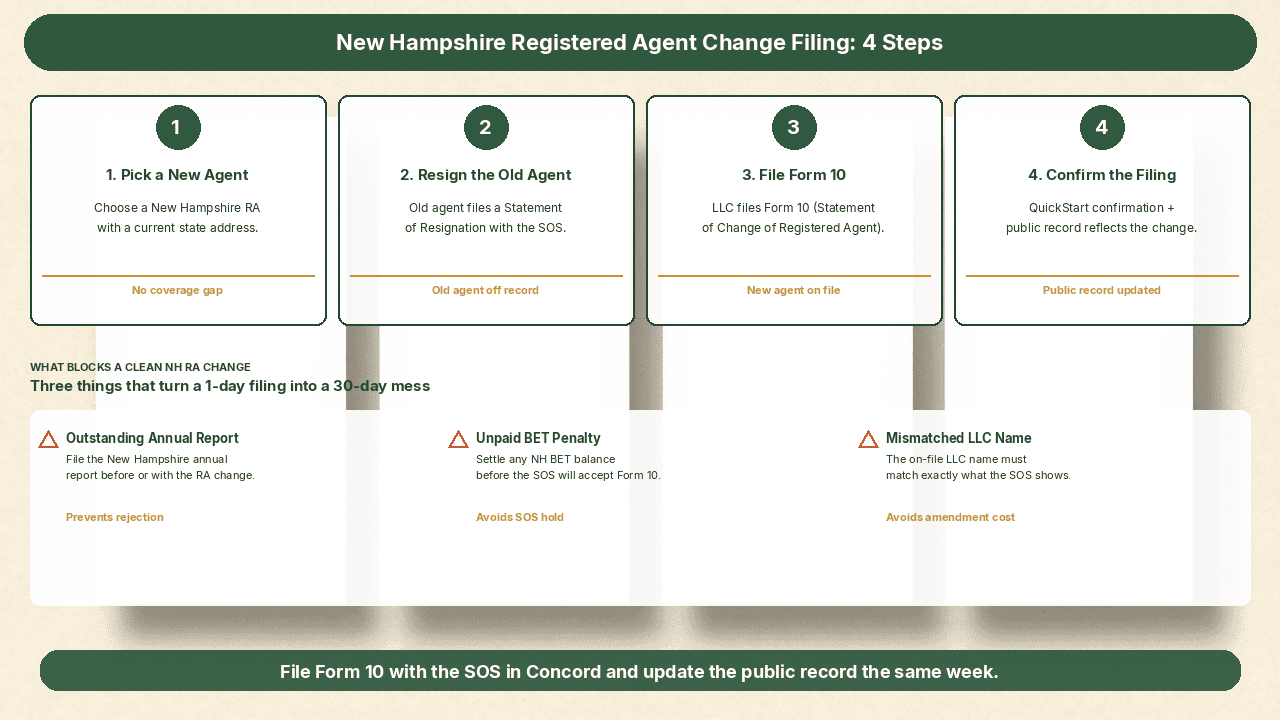
Compliance Steps for a New Hampshire LLC
1. Choose the New Agent Before You Touch the Filing
Do not start with the paperwork. Start with the actual replacement.
Make sure the new registered agent is ready to serve in that role and that the registered office information you plan to list is correct. New Hampshire’s FAQ says a registered agent must be an individual, corporation, or LLC located in New Hampshire.
If the business is upgrading from an informal setup to a commercial service, this is the point where the LLC should stop relying on a home address, a founder’s travel schedule, or a staff member who may not consistently be present.
2. Confirm Whether You Are Changing the Agent, the Address, or Both
Some LLCs are changing only the provider name. Others are changing only the registered office. Some are changing both at once.
That distinction matters because the state filing is meant to match the exact change. Before you file, confirm:
- the current registered agent listed on the state record;
- the current registered office listed on the state record;
- the new registered agent name, if that is changing; and
- the new registered office, if that is changing.
The cleaner your internal review is before filing, the less likely you are to submit a partial fix.
3. File Form 10 or Submit the Change in NH QuickStart
This is the formal state step.
New Hampshire’s Secretary of State says Form 10 is the filing used to change the registered office, the registered agent, or both, and the FAQ directs businesses to NH QuickStart for online filing.
For most LLC owners, the real decision is convenience:
- paper or direct form workflow; or
- online filing through QuickStart.
Either way, the state record is not updated until the filing is actually submitted and processed.
4. Pay the State Fee
The Secretary of State’s FAQ lists a $15 filing fee for this change.
That is a small fee compared with the cost of leaving the wrong legal-contact record in place. The bigger risk is never the filing charge. It is the period where the LLC is still relying on bad registered-agent information.
5. Verify the Record After Filing
Once the change is submitted, confirm that the public business record reflects the new information.
That means checking that:
- the new agent name appears correctly;
- the registered office is correct;
- the LLC still shows the expected active status; and
- your internal compliance notes match what the state now shows.
Do not treat submission as the end of the process. Treat visible confirmation as the end of the process.
Why LLC Owners Get This Wrong
Most mistakes come from treating the registered agent like static background information.
Owners often:
- assume the annual report will clean up the issue later;
- forget that a founder or employee listed as agent has moved or changed roles;
- switch service providers internally but never update the state record; or
- focus on tax and licensing tasks while ignoring the legal-contact line item.
That is how a simple $15 filing turns into a bigger compliance problem.
The Annual Report Is a Review Point, Not the Best Mid-Year Fix
New Hampshire’s annual report cycle is still a useful checkpoint because it forces the LLC to review public-record information each year. If the business needs that broader entity-maintenance context, the natural companion article is New Hampshire Annual Report Requirements for LLCs in 2026.
But if the registered agent record is already wrong, the better move is to file the change promptly instead of waiting for annual-report season.
A Cleaner 2026 Workflow
For most LLCs, the clean workflow looks like this:
- Decide exactly what is changing: the agent, the office, or both.
- Confirm the replacement agent and New Hampshire address details.
- File Form 10 or complete the change in NH QuickStart.
- Pay the $15 state fee.
- Check the business record after processing.
- Reconfirm the same information again at annual-report time.
That sequence keeps the legal-contact record current without creating a gap.
Internal Links That Fit the Next Step
If the LLC also needs the yearly entity-maintenance piece, send the reader next to New Hampshire Annual Report Requirements for LLCs in 2026.
If the owner still needs the broader paperwork picture behind the LLC record, New Hampshire LLC Documents: Example and State Comparisons fits naturally here too.
A short walkthrough of why registered-agent updates matter as a real state-record event rather than a back-office cleanup, the framing this article builds on:
Frequently Asked Questions
What form changes a registered agent in New Hampshire in 2026?
The New Hampshire Secretary of State says businesses use Form 10, Statement of Change of Registered Office or Registered Agent or Both, or complete the change online in NH QuickStart. Both paths produce the same state-record update.
How much does a New Hampshire registered agent change cost?
The New Hampshire Secretary of State fee schedule lists Form 10 at a flat $25 in 2026, paid online at filing through NH QuickStart or by check on paper filings. There is no expedited tier for this filing.
Can an LLC wait until the annual report to fix the registered-agent record?
No. Form 10 is a standalone filing the LLC submits when the agent changes; the LLC does not have to wait for the annual report cycle. Waiting exposes the LLC to the gap between the old agent's resignation date and the new agent's appointment, which is the period in which the LLC has no statutory service coverage.
Who can serve as a registered agent in New Hampshire?
A New Hampshire resident with a physical street address in the state, or a business entity registered to do business in New Hampshire with a registered office at a physical street address in the state. The registered agent must be available at the registered office during normal business hours to receive service of process.
What happens if an LLC does not maintain a registered agent in New Hampshire?
New Hampshire says failure to maintain a registered agent may result in administrative suspension or dissolution. The LLC loses statutory service coverage, the bank or landlord onboarding holds, and the LLC's foreign qualifications in other states may be revoked if the home state falls out of good standing.
How long does a New Hampshire registered agent change take to clear in 2026?
Online filings through NH QuickStart typically clear in 1 to 3 business days. Paper Form 10 filings run 5 to 10 business days depending on volume. The LLC can re-pull its record on the New Hampshire Corporation Division search to confirm the agent of record is updated before relying on the change for any third-party onboarding.
The Bottom Line
The New Hampshire registered agent change filing is not complicated, but it does need to be handled on purpose. In 2026, the best compliance move is to treat agent changes as real state-record updates, not as cleanup you can postpone until some later filing cycle.
If the LLC needs a more dependable legal-contact setup so the state record does not rely on a fragile office routine, start with Rapid Registered Agent.
New Hampshire Registered Agent Change
Switch Your New Hampshire Registered Agent Online
Rapid Registered Agent handles the New Hampshire registered agent change filing so you stay compliant without the paperwork headaches.
New Hampshire Registered Agent
Update Your New Hampshire Registered Agent in Time for 2026
A New Hampshire registered agent change filed wrong means missed legal notices and a potentially dissolved LLC. Rapid Registered Agent files the change correctly the first time, with New Hampshire-specific compliance support built in.