Iowa Sales Tax Permit vs LLC Filing in 2026: Which Registration Comes First?
Iowa Sales Tax Permit vs LLC Filing in 2026: Which Registration Comes First? is the order question that trips up new owners right when they are trying to launch fast without opening the wrong account first.
One filing creates the LLC.
The other opens the tax account for taxable sales.
Iowa does not bundle them.
And if you do them in the wrong order, the cleanup usually lands on the owner after the launch is already moving.
The good news is that the clean Iowa sequence is simple once you understand what each registration actually does.
What each Iowa registration actually does
The Iowa LLC filing is the entity-creation step.
The Iowa sales tax permit is the tax-registration step.
They solve different problems, which is why Iowa keeps them separate.
Iowa LLC filing
The LLC filing is the Certificate of Organization filed with the Iowa Secretary of State under Iowa Code section 489.201.
The Secretary of State’s forms and fees page lists the domestic LLC Certificate of Organization filing fee at $50.
This filing creates the legal entity itself.
It gives the business the legal shell it needs to sign contracts, appoint a registered agent, open the business bank account, and operate as an LLC instead of just an idea.
Iowa sales tax permit
The sales tax permit comes from the Iowa Department of Revenue through Business Permit Registration.
The same Iowa Revenue page says these permits are free of charge.
The permit does not create the LLC.
It authorizes the business to collect and remit Iowa sales tax or use tax when the business makes taxable sales, which keeps the tax side lawful from day one.
Why owners confuse the permit and the LLC filing
The confusion makes sense at first.
Both are state registrations.
Both matter near launch.
Both need the business name and contact details.
That makes them look like one step when they are really two separate tracks.
The Secretary of State tracks the legal entity and the Iowa public record.
The Department of Revenue tracks taxable activity and tax accounts.
Once you see those as separate jobs, the order gets much easier to understand.
Which registration comes first for most Iowa LLCs in 2026
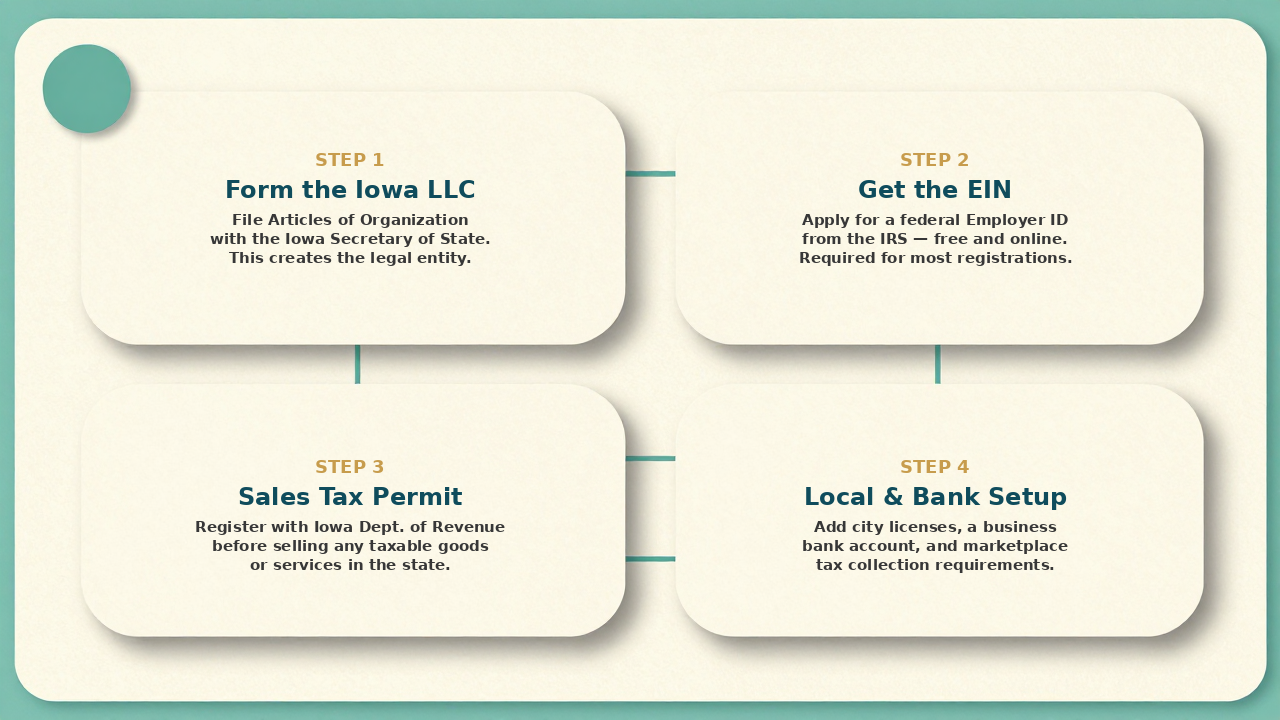
For most businesses that plan to operate as an Iowa LLC, the LLC filing comes first.
Then the EIN comes next.
Then the Iowa sales tax permit follows.
That order keeps the legal name, FEIN, bank account, and tax registration all pointing to the same entity, which avoids rework.
Reason one: the tax permit should match the real legal entity
The Iowa Department of Revenue says corporations, partnerships, limited liability companies, and associations should have the FEIN available before starting online business permit registration.
If the business is going to sell as an LLC, the permit should be opened under the formed LLC’s exact legal name and FEIN, not under a temporary pre-LLC version of the business, which keeps the account cleaner.
Reason two: the LLC is what banks and processors expect to see first
Once the business is formed, the bank account, payment processor, and bookkeeping setup can all be built around the same entity.
That matters because sales tax is money the business collects on the state’s behalf.
You want that money flowing through the correct business account from the start, which keeps the books cleaner.
Reason three: Iowa treats the permit as a tax account, not a formation shortcut
The Revenue registration page is clear that permit registration is its own process.
It is not a shortcut around formation.
It is the tax-account step after you know which business is actually collecting the tax, which keeps the setup aligned.
What the clean Iowa order looks like in real life
For a brand-new Iowa business that plans to operate as an LLC and make taxable sales, the smooth sequence usually looks like this.
Step 1: choose the final business identity
Pick the name, the business model, and the structure first.
If the plan is already to run as an LLC, lock that in now instead of improvising later.
Step 2: form the LLC with the Iowa Secretary of State
File the Certificate of Organization and pay the $50 fee listed on the Secretary of State’s forms page.
That puts the business on the state record and gives the rest of the setup something real to attach to.
Step 3: get the EIN
The permit registration works more cleanly when the LLC already has the FEIN Iowa Revenue expects LLCs to provide.
This is the bridge between the entity record and the tax-account record.
Step 4: open the bank account
Once the LLC and EIN exist, the bank account can match them.
That matters before the business starts collecting tax, which keeps the money trail easier to manage.
Step 5: register for the Iowa sales tax permit
Use the Department of Revenue’s business permit registration system once the entity details are final.
At that point, the permit opens under the same name and FEIN the rest of the business is already using.
When the permit might come first instead
There is one big exception.
If the owner is starting as a sole proprietorship and not as an LLC yet, the tax permit can come first under that sole-prop setup.
Later, if the owner forms an LLC, the owner can update the structure and the tax setup as needed.
But that is not the same thing as saying the permit should come first for an LLC startup.
If the business already plans to launch as an LLC, the LLC first is still the cleaner move, which prevents mismatches.
The foreign-LLC exception
If the business already exists in another state, the Iowa entity step is not a domestic Certificate of Organization.
It becomes the Iowa foreign-registration step first.
The Iowa Secretary of State’s fee page lists the foreign LLC registration statement at $100.
That still means the Iowa entity-record step comes before the Iowa tax permit for most foreign-LLC fact patterns, which keeps the Iowa record aligned.
What the Iowa LLC filing triggers after approval
The LLC filing is not just a one-time receipt.
It starts the Iowa entity-maintenance track.
Biennial report duty
The Iowa Secretary of State says LLCs file biennial reports in odd-numbered years, beginning January 1 and due by April 1.
The same official materials say the fee is $30 online or $45 by paper for LLCs.
Our Iowa biennial report guide is the simplest internal follow-up for that cycle, which keeps the next deadline visible.
Registered-agent upkeep
The LLC also has to keep a registered agent and registered office on the Iowa record.
If the agent or office changes, the record has to change too.
Our Iowa statement-of-change guide covers that update path, which helps avoid stale-record problems later.
Entity-document requests from third parties
Once the LLC exists, lenders, landlords, and counterparties start asking for formation records and related documents.
Our Iowa LLC documents guide is useful when owners start seeing those requests for the first time, which makes the paperwork less confusing.
What the Iowa sales tax permit triggers after approval
The permit starts the tax-compliance track.
That is where many owners underestimate the workload.
You may begin collecting tax right away
The Department of Revenue says that after you complete your registration request, you may begin collecting tax immediately, and your copy of the registration serves as proof until the account-number letter arrives.
That means the permit is built for quick startup once the account is set up, which helps the launch move cleanly.
The permit is tied to places of business
Current Iowa Code section 423.36 says the applicant must have a permit for each place of business in Iowa where sales or use tax is collected.
If the business has multiple Iowa locations, the owner should not assume one permit automatically covers every storefront, which avoids a costly assumption.
The return-filing cadence begins
Once the permit is open, the business starts a return-filing cycle based on the account setup and activity level.
The Iowa Sales and Use Tax Guide is the broad state reference for what Iowa taxes and how the permit fits that tax system, which gives owners one main tax anchor.
There are no temporary permits
The Department of Revenue says it does not issue temporary tax permits.
A permanent permit is what allows taxable selling at events and other selling situations.
That matters for pop-ups, seasonal booths, and short-notice launches, which keeps event planning realistic.
What happens if you get the order wrong
The most common error is opening the permit too early under the wrong setup.
Then the owner forms the LLC and discovers the permit, bank account, and sales platform are not all using the same legal business identity.
That creates avoidable edits and delays.
The second error is forming the LLC and assuming the tax side is handled automatically.
It is not.
The LLC can legally exist and still lack the permit needed for taxable sales, which creates exposure.
The third error is waiting until the first sale to think about permit registration at all.
Iowa lets businesses begin collecting after registration is completed, but that still assumes the registration happened before the taxable selling starts, which keeps the timing legal.
What happens if you skip the permit entirely
This is the real risk point.
Iowa Code section 423.36 says a permit is required to collect sales or use tax.
That makes the permit a legal prerequisite, not a nice extra.
Skipping it can mean tax, penalty, and compliance trouble later.
It can also mean fixing invoices, platform settings, and collected-tax records after the fact.
The cleanup is usually harder than the original registration, which makes early setup worth it.
Common Iowa order mistakes in 2026
Most setup problems are simple mistakes, not hard legal questions.
Filing in parallel without a final entity plan
Parallel filing sounds fast.
In practice, it often creates different names, different contacts, or the wrong tax structure across the records.
That means more correction work later, which slows the launch anyway.
Using the owner’s name on the permit and the LLC name everywhere else
If the business is really operating as an LLC, the permit should usually match that LLC identity.
Using two setups for one business confuses banks, processors, and bookkeeping, which makes everyday operations harder.
Forgetting the post-formation calendar
Owners sometimes focus so hard on launch that they forget the next obligations.
The result is a formed LLC with no biennial reminder, or a tax permit with no return calendar.
Our 50-state compliance calendar guide is a useful follow-up if the owner is building a broader reminder system, which helps the setup stay clean after launch.
The best Iowa sequence for 2026
If you already know the business will be an Iowa LLC and the business will make taxable sales, the best 2026 order is simple.
Form the LLC first.
Get the EIN second.
Get the Iowa sales tax permit third.
Then set the biennial-report and tax-return reminders.
That order matches the Iowa Secretary of State’s entity record, the Iowa Department of Revenue’s permit process, and the way banks and payment systems expect to see the business built, which keeps the launch more stable.
Related Reading
For the Iowa LLC filing cycle that starts after formation, read Iowa Biennial Report Deadlines: A 2026 Compliance Calendar for LLCs.
For the state-record update that matters when the registered agent changes later, read Iowa Statement of Change for Registered Agents: Filing Tips for 2026.
For the broader Iowa paperwork stack, read Iowa LLC Documents: Example and State Comparisons.
Final takeaway
Iowa Sales Tax Permit vs LLC Filing in 2026: Which Registration Comes First? usually ends with the same answer for a real LLC launch.
Form the LLC first.
Open the tax permit second.
Then keep the state-record and tax calendars moving together instead of treating them like unrelated tasks.
If you want help getting the Iowa entity record, the registered-agent side, and the compliance reminders lined up before the tax account opens, Rapid Registered Agent can keep the setup cleaner from the start.
Iowa Sales Tax Permit vs LLC Filing in 2026: Which Registration Comes First? gets much easier when the business forms the LLC first and opens the sales tax permit under the same finished business identity.
Frequently Asked Questions
Should I form my Iowa LLC before I apply for a sales tax permit?
Usually yes. If the business plans to operate as an LLC, forming the LLC first makes the legal name, FEIN, bank account, and tax permit line up from the start, which avoids rework.
How much does Iowa charge to file an LLC in 2026?
The Iowa Secretary of State forms and fees page lists the domestic LLC Certificate of Organization at $50.
How much does an Iowa sales tax permit cost in 2026?
The Iowa Department of Revenue Business Permit Registration page says these permits are free of charge.
Can I start collecting Iowa sales tax right after I register?
Yes. The Iowa Department of Revenue says you may begin collecting tax immediately after completing the registration request, and your copy serves as proof until the state issues the account-number letter.
Does one Iowa sales tax permit cover every business location?
Not always. Iowa Code section 423.36 says the applicant must have a permit for each place of business in Iowa where sales or use tax is collected.
What if my business was already formed in another state?
Then the Iowa entity step is usually a foreign LLC registration before the Iowa tax-permit step. The Iowa Secretary of State’s fee page lists the foreign LLC registration statement at $100, which keeps the Iowa record in place before the tax account opens.
Iowa startup filing order
Set up the Iowa LLC and the sales tax permit in the right order
Iowa Sales Tax Permit vs LLC Filing in 2026: Which Registration Comes First? is easier when the LLC, EIN, bank account, and tax permit all point to the same finished business identity. Rapid Registered Agent helps keep the entity record and compliance calendar lined up before launch gets messy.
- LLC filing fee
- $50
- Permit fee
- Free
- Biennial cycle
- Odd years