Oregon BOI Readiness in 2026: What LLC Records to Keep Even While Rules Shift
Oregon BOI Readiness in 2026 is not a one-time filing. It is a record-keeping discipline that starts now and continues no matter what happens in federal court. The Corporate Transparency Act requires most Oregon LLCs to identify and report their beneficial owners to FinCEN. That requirement exists inside a landscape of ongoing legal challenges, shifted deadlines, and rules that keep changing. Oregon business owners who maintain clean beneficial ownership records from day one are ready for every version of the rule.
What BOI Reporting Actually Requires From Oregon LLCs
The Corporate Transparency Act is a federal law that took effect in 2024. It requires most US LLCs and corporations to file a Beneficial Ownership Information report with the Financial Crimes Enforcement Network, known as FinCEN. The report identifies every individual who owns twenty-five percent or more of the company and every individual who exercises substantial control over the company.
Substantial control covers managers, members with decision-making authority, and anyone who can direct major business decisions. For most single-member Oregon LLCs, the report is simple: one person, the owner. For multi-member Oregon LLCs, it covers every member above the ownership threshold and anyone who governs like a manager.
The FinCEN Beneficial Ownership Information reporting page has the official forms, instructions, and filing portal at boiefiling.fincen.gov. FinCEN also published a small business compliance guide that walks through who must file, what information is required, and how to report changes.
Oregon LLCs that existed before January 1, 2025 had an initial filing deadline. That deadline shifted several times due to court orders. New LLCs formed in 2025 or 2026 have thirty days from formation to file. The filing window stays open past any deadline for as long as the rule is active. The practical rule for every Oregon LLC is this: get the records ready now, file when the window is clear, and update the filing whenever ownership or control changes.
The Legal Landscape That Keeps Shifting
The Corporate Transparency Act has faced multiple court challenges since its passage in 2021. A nationwide injunction paused enforcement in late 2024. Courts have since lifted portions of that injunction. The regulatory landscape continues to evolve. Reporting requirements may shift again.
The important point for Oregon business owners is not which version of the rule is currently active. The important point is that the underlying obligation has not gone away. Congress passed the CTA. FinCEN issued the final rule. The obligation to report beneficial ownership exists inside federal law. Staying ready for BOI filing means maintaining the records regardless of the current deadline status.
FinCEN’s beneficial ownership reporting rule is the legal foundation. Bookmark it and check it every quarter. FinCEN updates guidance when courts act.
The Five Record Categories Every Oregon LLC Needs for BOI Readiness
Company Information Records
Every Oregon LLC needs a complete formation document file. The Articles of Organization filed with the Oregon Secretary of State are the starting point. Any amendments filed since formation must be in the same folder. Changes to the registered agent, changes to the principal address, changes to member interests: all amendments belong in the permanent company record.
The filing date with the Oregon SOS matters for BOI because FinCEN uses it to determine filing deadlines. Keep a copy of the confirmation letter from the SOS filing. Keep every amendment confirmation. Digitize everything and store a physical copy in a fireproof safe.
Member and Ownership Records
Oregon BOI Readiness requires a complete ownership ledger. For every member, track the full legal name, date of birth, residential address, and the percentage of ownership or equity interest. Ownership interests can change over time. Every change must be recorded.
A multi-member Oregon LLC with three equal members needs records for all three. If one member sells a portion of their interest to another, the ledger updates. If a new member joins, their information enters the ledger. Keep historical ownership records. FinCEN may ask for the ownership structure at any point in time, not just the current moment.
Substantial Control Records
Substantial control is not only about ownership percentage. Members or managers who make key decisions about the LLC also report. This covers anyone who serves as a manager, any member who can veto significant transactions, and anyone who directs the LLC on major business matters.
For most small Oregon LLCs, the managing member is the person with substantial control. For LLCs with a formal board or management committee, each person in that role needs a record. Document who has authority and what that authority covers.
The FinCEN BOI small business compliance guide defines substantial control with specific criteria. Review those criteria against the LLC governance structure annually.
FinCEN Identifiers and Document Copies
FinCEN issues identifiers to two categories of people. Reporting companies get a FinCEN ID. Individuals who are beneficial owners can get a FinCEN ID as well. The FinCEN ID simplifies future filings because the individual information does not need to be re-entered each time a report is updated.
When collecting beneficial owner information for the first time, ask each person for a copy of an identifying document: a passport, driver’s license, or government-issued ID. FinCEN accepts these as verification documents. Keep copies on file. They do not get filed with the BOI report but must be available if FinCEN requests them.
Changes and Update Records
The CTA requires reporting companies to update their BOI filing within thirty days of any change in beneficial ownership or company information. A member leaves. A new member joins. The registered agent changes. The principal address moves. Each of these is a reportable change.
Oregon LLCs that maintain a change log track these events as they happen. A simple spreadsheet listing the date, the change type, and a reference to the supporting document is enough. Review the change log every time a company event happens and again at the start of each quarter.
The IRS EIN online application guide covers how to update the EIN record when the LLC structure changes. EIN updates and BOI updates are separate but both require current records.
Oregon-Specific BOI Considerations
Oregon LLCs file their formation documents with the Oregon Secretary of State. The SOS confirmation letter is the primary record proving the LLC existed on a specific date. That date determines which BOI filing deadline applies for new LLCs: thirty days from formation.
The Oregon annual report asks for member and manager information. The BOI report covers similar ground with a different purpose. Both need current, accurate data. An Oregon LLC that keeps clean annual report records is already halfway toward BOI readiness.
The Oregon Secretary of State business resources page provides forms, filing instructions, and entity search tools that help track what the state has on file for the LLC. Cross-reference the state record against the internal beneficial ownership ledger at least once a year.
The Oregon SOS also handles registered agent changes. When the registered agent changes, the BOI filing must reflect the new information within thirty days.
What Happens Without BOI Readiness
An Oregon LLC without organized BOI records faces a specific problem when the filing window opens. The thirty-day window to report a new member or a change runs from the date of the change. If the records are not organized, the window closes before the LLC knows it was open.
If CTA enforcement resumes fully, penalties for failing to file are significant. FinCEN can assess up to five hundred dollars per day of violation. Willful failure to report carries criminal penalties including fines and up to two years imprisonment. Even if the CTA faces further legal challenges, an Oregon LLC with clean ownership records has an asset. Lenders, investors, and potential buyers all want to see clean beneficial ownership records before any transaction closes.
Bank loan applications often require beneficial ownership disclosure as part of the application. Some commercial landlords require it before signing a lease. Business buyers request it during due diligence. A clean ledger speeds up due diligence. A messy ledger creates escrow disputes and delays.
How Oregon BOI Readiness Connects to Annual Compliance
The Oregon annual report filed with the Secretary of State asks for member information and company details. The BOI report filed with FinCEN asks for similar information with different specificity. Both need current data. An Oregon LLC that maintains clean annual report records already has most of what the BOI ledger needs.
Review the BOI ledger against the annual report before filing each year. If the state record shows three members and the BOI ledger shows two, that gap needs resolution. The Oregon Secretary of State annual report instructions cover what the LLC must confirm each year.
How to Build the BOI Record System Now
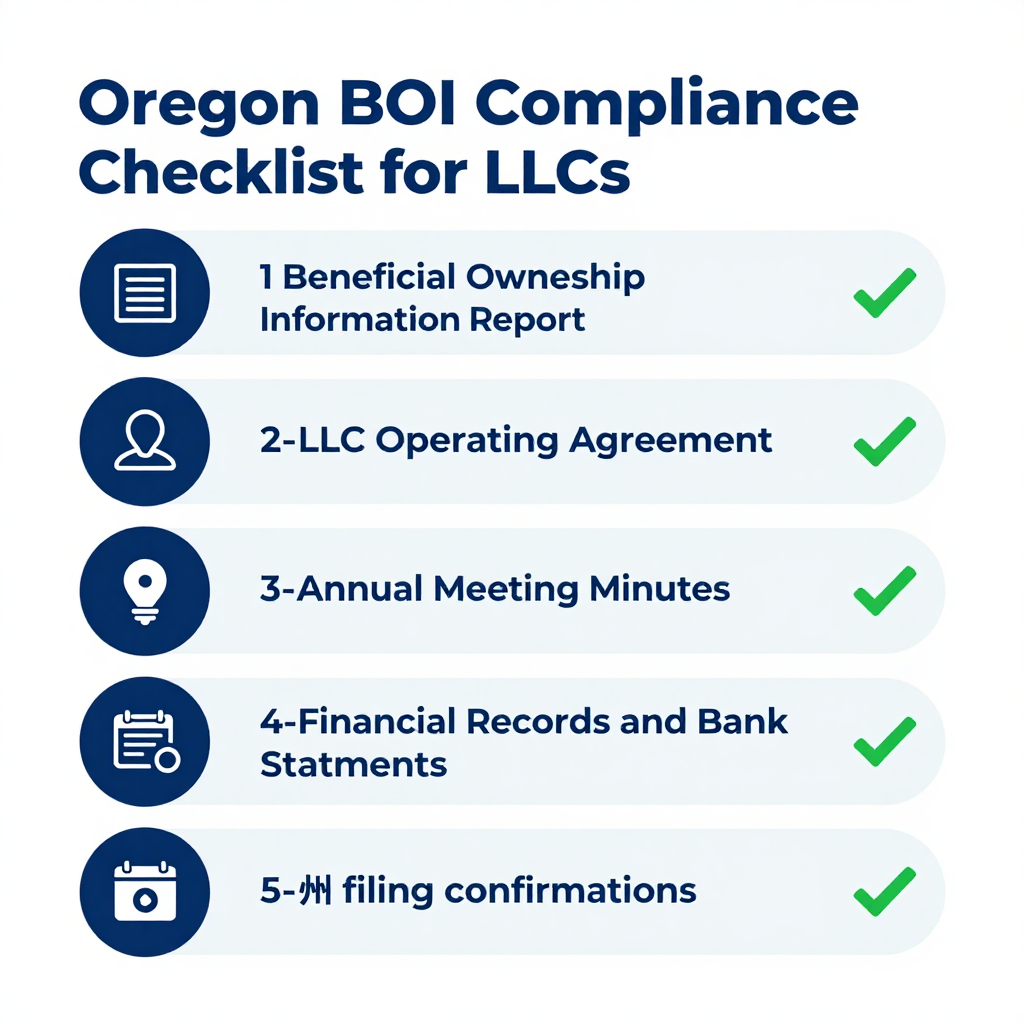
Start with the ownership ledger. List every current beneficial owner with name, date of birth, address, and ownership percentage. Add anyone who exercises substantial control without owning twenty-five percent. Add the formation document to the file. Add the EIN confirmation letter. Add every amendment confirmation from the Oregon SOS. Request a government-issued ID copy from each beneficial owner. Set a quarterly reminder to review the ledger. Update it whenever a change happens. File the BOI update within thirty days of any change.
For bookkeeping and compliance workflows that support clean records year-round, see the Oregon LLC bookkeeping cleanup guide. For annual compliance steps, see the Oregon annual report guide.
The Multi-Member Oregon LLC and BOI Reporting
A multi-member Oregon LLC has more complex BOI reporting than a single-member LLC. Every member with twenty-five percent or more ownership must be reported. Every person who exercises substantial control must be reported, regardless of ownership percentage. The reporting is not one or the other. It is cumulative.
An Oregon LLC with four members at twenty-five percent each reports all four. An LLC with two members at sixty percent and forty percent reports both. An LLC with a managing member who owns fifteen percent but runs the company reports both the ownership and the substantial control information.
Multi-member LLCs also face more frequent updates. A member buyout, a new admission, a transfer of interest: each triggers a thirty-day BOI update. The ledger must track all ownership changes in real time. Oregon BOI Readiness in 2026 works best when every Oregon LLC treats the beneficial ownership ledger as a permanent compliance document, updates it within thirty days of any ownership or control change, and maintains the supporting documents that make every FinCEN filing accurate and on time.
Frequently Asked Questions
What is BOI reporting for Oregon LLCs?
Beneficial Ownership Information reporting is a federal requirement under the Corporate Transparency Act. Most Oregon LLCs must identify every individual who owns 25% or more of the company and anyone who exercises substantial control, and file that information with FinCEN.
Does the BOI filing deadline still apply in 2026?
The CTA is federal law. Reporting requirements remain on the books despite ongoing legal challenges. FinCEN continues to accept BOI filings. Oregon LLCs should maintain records and file when the window is clear.
Who counts as a beneficial owner for an Oregon LLC?
Any individual who owns 25% or more of the LLC equity, or who exercises substantial control over the LLC through management authority, decision-making power, or governance rights.
How long does an Oregon LLC have to file a BOI update after an ownership change?
Thirty days from the date of the change. If a new member joins, a member exits, or the registered agent changes, the BOI update must be filed within 30 days.
What records does an Oregon LLC need to maintain for BOI compliance?
A current ownership ledger, formation documents, amendment confirmations, beneficial owner ID copies, EIN confirmation, and a change log that tracks every update.
Are single-member Oregon LLCs exempt from BOI reporting?
No. Single-member LLCs must file. The sole member is the beneficial owner. The filing is simple but it is still required.
Oregon BOI Readiness
Stay BOI Ready Before the Next Filing Window Opens
Oregon BOI Readiness in 2026 means keeping beneficial ownership records current, organizing company documents, and maintaining the ledger that makes every FinCEN filing fast and accurate. Rapid Registered Agent helps Oregon LLCs handle the compliance infrastructure that keeps BOI records ready year-round, no matter how the federal rules shift.
- Ownership Ledger
- One File, Updated Annually
- Filing Window
- 30 Days From Any Change
- Penalty Risk
- Up to $500 Per Day