
Texas Multi-State Expansion in 2026: The Internal Data Checklist to Clean Up Before You Register Elsewhere
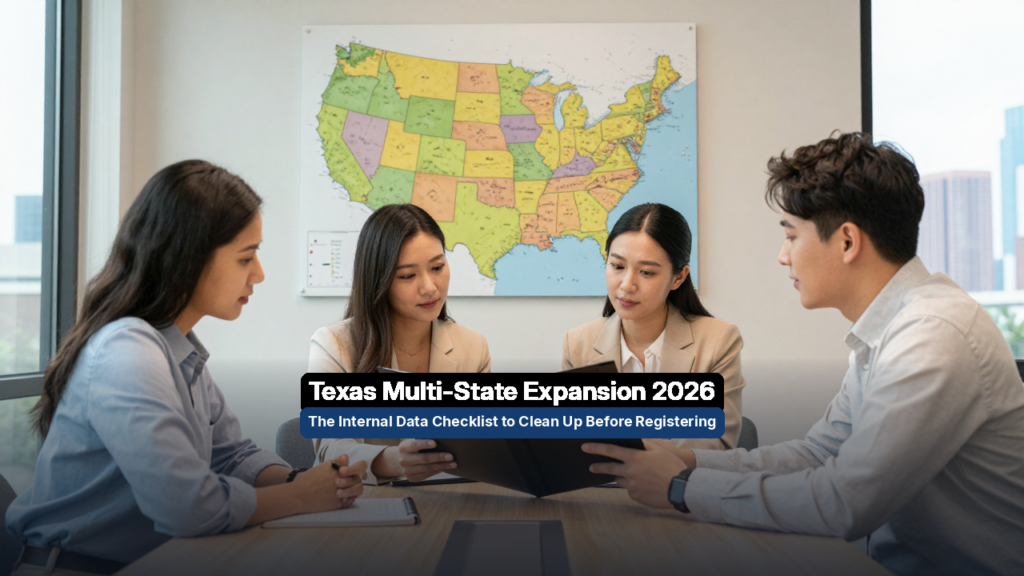
Texas Multi-State Expansion in 2026 begins with a checklist most business owners do not want to hear.
Before you register your Texas LLC in Colorado, New Mexico, or Oklahoma, there is internal housekeeping that has to happen first. The paperwork for foreign registration is the easy part. The hard part is getting your internal data clean enough to share with another state without exposing your business to compliance gaps you did not know existed.

A Texas logistics company found this out the hard way in 2024. They registered in three neighboring states, then spent eight months untangling mismatched EINs, address records that did not match formation documents, and a registered agent in one state who had no idea an account existed. The lesson was expensive. This checklist helps you avoid it.
Why Internal Data Has to Be Clean Before You Expand
When you register as a foreign LLC in another state, you are filing a public document. The SOS filing becomes a permanent record. Every piece of information on it — your legal name, your principal address, your registered agent — must match what your business actually is and where it actually operates.
Mismatched data across states creates what attorneys call inconsistent nexus exposure. If your Texas formation document lists one address and your Colorado foreign registration lists another, you have created a record that suggests your business may have a physical presence in a location you did not intend to claim. State tax authorities share data more than most business owners realize.
Getting your internal records right before you file means your first out-of-state registration sets a clean precedent for every registration that follows.
The Entity Name and Address Audit
Start with your formation document. Pull your Texas Certificate of Formation from the SOS database. Verify the exact legal name, the principal address, and the organizers listed. Any discrepancy between what Texas has on file and what you file elsewhere will surface as a rejection or a correction request.
Next, audit every address where your business has a presence. Warehouse, office, job site, storage unit, even a UPS box that receives business mail. If it appears on any state filing, it is an address a tax authority can examine. Narrow the list to only the addresses that genuinely represent a business activity.
Your registered agent address on your Texas formation should match the principal address on your foreign registrations. This is not required by all states, but it creates a cleaner compliance picture when all states point to the same registered address.
The Registered Agent handoff Across States
Every state where you register requires a registered agent. That agent must have a physical street address in the state, not a PO Box. The agent accepts legal documents on behalf of your business and must be available during business hours.
You have two choices when you expand. You can use a different registered agent service in each state, or you can use a national service that provides registered agent coverage in all fifty states. Using one service across all states simplifies your compliance because you receive notices in one inbox instead of four.
Rapid Registered Agent provides registered agent service in every US state. One login, one set of communications, one renewal date to track. That simplicity becomes valuable once you are managing compliance in four or five states simultaneously.
Understanding Nexus Before You File
Nexus is the word tax authorities use to describe a connection between your business and a state that triggers tax obligations. It is not a filing. It is a legal concept. Once nexus exists, you owe taxes to that state whether or not you have registered.
Physical nexus comes from having employees, inventory, or office space in a state. Economic nexus comes from exceeding a state revenue threshold, which varies by state. Texas businesses selling into states where they have no physical presence may trigger economic nexus simply by crossing a dollar amount in sales.
Before you register, estimate your current nexus exposure. If you are selling into a state, you may already have economic nexus even before you file for foreign registration. Registering does not create nexus — it formalizes an obligation that already exists. Getting registered first and then discovering you have nexus is backwards. Know your nexus exposure, then decide on registration.
The California Department of Tax and Fee Administration publishes economic nexus thresholds annually. Most states publish similar guidance on their Department of Revenue websites.
The EIN Verification and Tax Account Cross-Check
Your EIN is the anchor of your federal tax identity. Before you expand, verify that the EIN on your formation document matches the EIN you use on payroll returns, sales tax permits, and any prior state registrations. One digit off creates a nightmare that takes months to untangle with the IRS.
Pull a transcript of your business tax account using IRS Form 1040-X or the online transcript tool. Confirm the business name, address, and entity type match what you are about to file in other states. If the name on your EIN letter does not match your current legal name due to an amendment, update the EIN record before your first foreign filing.
Contact the IRS Business and Specialty Tax Line at 800-829-4933 to update EIN information. It takes a phone call and a fax. Do it before you file, not after.
Business Licenses and Permits Inventory
Many Texas businesses operating under a general business license or simple sales tax permit do not realize how specific those permits are to Texas jurisdiction. A permit issued by the Texas Comptroller applies to Texas transactions. It does not transfer to Oklahoma or Arkansas.
Create a complete list of every license and permit your business holds. For each one, note whether it is Texas-specific or federal. Contact the issuing agency to ask whether it has reciprocity in other states. If it does not, add the new state permit application to your expansion checklist.
Some industries require permits that are state-specific and have no equivalent in neighboring states. A Texas motor carrier permit is not the same as an Oklahoma DOT number. A Texas alcohol license does not transfer to Louisiana. Know what your industry requires in each target state before you register.
The Registered Agent Service Transition Checklist
If you are using a different registered agent in Texas than you plan to use in your new states, the transition needs to happen in a specific order. You cannot file a foreign registration with an agent who has not already accepted the appointment. And your Texas agent cannot be changed until your Texas annual report is current.
Before you file your first foreign registration, confirm your Texas registered agent is in good standing for the current year. Then, select your multi-state agent and set up the account. Designate the new agent in Texas as your agent for service of process before you begin out-of-state filings. This prevents a gap in coverage during the registration window.
Set calendar reminders for each state’s registered agent annual renewal date. A missed renewal in one state does not just create a late fee. Some states administratively revoke your registration, which means your authority to do business in that state disappears without warning.
Foreign Registration Filing Order
The order in which you file matters more than most advisors acknowledge. Filing in the state where you have the strongest nexus first establishes your compliance track record early. Filing in states with minimal nexus first creates a compliance burden for a business activity that may not yet justify the registration cost.
File in your primary target state first. The state where you expect the most revenue, the most employees, or the most physical presence. That registration validates your legal name, your registered agent, and your principal address. Succeeding registrations in other states can reference the first filing as a template.
File in your secondary states within ninety days of the primary registration. Most states have a window during which foreign registrations filed close together can share an effective date, simplifying your renewal tracking.
Records Management Across States
Once you are registered in multiple states, your business records need to clearly identify which transactions belong to which state. This matters for sales tax, payroll tax, and annual reporting.
Create a state assignment rule for every revenue stream and every employee location. A sale shipped from a Texas warehouse to a customer in Arizona is an Arizona transaction. An employee working from home in Oklahoma is an Oklahoma payroll. Without a clear assignment rule, your quarterly estimates will be wrong and your annual filings will require adjustments.
Use separate profit center or department codes in your accounting software for each state where you are registered. This is not complex. It requires a fifteen-minute setup and a consistent habit of categorizing transactions at the time of entry.
What Happens If You Skip This Checklist
A Dallas e-commerce seller registered in California without cleaning up their address records first. Their Texas formation had a home address. Their California filing used their warehouse address. California CDTFA cross-referenced the two filings and sent a nexus questionnaire asking them to explain the discrepancy. The questionnaire became an audit trigger. The audit took six months to resolve.
The cost in professional fees was eight times what a two-hour data audit would have been. The lesson is simple. Take the time to clean your data before you file. The states are sharing more information than ever, and inconsistent records create exposure that is entirely preventable.
What is the first step before registering a Texas LLC in another state? Audit your internal data first. Confirm your Texas formation document is accurate, your EIN records match, and your principal address is consistent. Filing with bad data creates compliance gaps that are expensive to fix later.
Does registering in another state create tax nexus? No. Nexus is created by business activity, not by registration. If you have employees, inventory, or sales exceeding a state threshold in another state, nexus already exists. Registration formalizes an obligation that already exists under state law.
Can one registered agent handle multiple states for a Texas LLC? Yes. National registered agent services cover all fifty states from a single account. This simplifies compliance because you receive legal notices in one place and manage one set of renewal dates.
What is the biggest mistake Texas businesses make when expanding to other states? Filing for foreign registration before understanding their nexus exposure. Many businesses register in a state where they already have unreported tax obligations, creating retroactive liability instead of forward-looking compliance.
How do I know which state to register in first? Register in the state with the strongest nexus first — the state where you have the most employees, the most sales, or the most physical infrastructure. That establishes your compliance template for subsequent registrations.
Do all states require a registered agent for foreign LLC registration? Yes. Every state requires a registered agent with a physical address in the state for service of process. The agent must be available during business hours and accept legal documents on behalf of your business.
Frequently Asked Questions
What is the first step before registering a Texas LLC in another state?
Audit your internal data first. Confirm your Texas formation document is accurate, your EIN records match, and your principal address is consistent. Filing with bad data creates compliance gaps that are expensive to fix later.
Does registering in another state create tax nexus?
No. Nexus is created by business activity, not by registration. If you have employees, inventory, or sales exceeding a state threshold in another state, nexus already exists. Registration formalizes an obligation that already exists under state law.
Can one registered agent handle multiple states for a Texas LLC?
Yes. National registered agent services cover all fifty states from a single account. This simplifies compliance because you receive legal notices in one place and manage one set of renewal dates.
What is the biggest mistake Texas businesses make when expanding to other states?
Filing for foreign registration before understanding their nexus exposure. Many businesses register in a state where they already have unreported tax obligations, creating retroactive liability instead of forward-looking compliance.
How do I know which state to register in first?
Register in the state with the strongest nexus first — the state where you have the most employees, the most sales, or the most physical infrastructure. That establishes your compliance template for subsequent registrations.
Do all states require a registered agent for foreign LLC registration?
Yes. Every state requires a registered agent with a physical address in the state for service of process. The agent must be available during business hours and accept legal documents on behalf of your business.
Related Reading
- How to Form a Texas LLC in 2026 — the foundation before you expand
- Texas Registered Agent Guide — your compliance address and legal representative
- Texas Sales Team Hiring in 2026 — compliance setup before your first out-of-state employee
Texas Multi-State Expansion in 2026
Clean Up Your Business Data Before You File in Another State
Registering a Texas LLC in a new state with messy internal records is like building a second floor on a cracked foundation. Get the data right first and every registration that follows is faster and cleaner.
- States with Active Nexus Rules
- 50
- CDTFA Cross-Reference Risk
- Audit Trigger
- Registered Agent Annual Renewals
- One Per State