
Massachusetts Delayed Effective Date Filings in 2026: When Timing an LLC Launch Makes Sense

Massachusetts delayed effective date filings let an LLC choose its own legal birthday at formation.
That is not a loophole. It is written into MGL c. 156C § 12(b), which says an LLC comes into existence either at the time of filing or at any later date named in the Certificate of Organization — provided the filing otherwise complies with the section. The standard form gives the filer a checkbox: “Upon filing with the Secretary of the Commonwealth” or a delayed effective date not later than 90 days after filing. The 90-day cap mirrors the parallel rule for Massachusetts corporations under MGL c. 156D § 1.23(b).
For a Massachusetts LLC in 2026, the delayed effective date is a real planning tool. It is also a tool that is easy to use badly. This article covers when the option earns its keep, when it does not, and how the delay interacts with the LLC’s tax year, its annual report obligations, and every other filing that needs to be coordinated on the same calendar.
Watch the short video below for a clear walkthrough of how a Massachusetts delayed effective date works.
What a delayed effective date actually does
The delayed effective date, when elected on the Certificate of Organization, sets the date the LLC comes into legal existence under Massachusetts law. Until that date, the LLC does not exist as a Massachusetts entity — even though the filing has been made and the filing fee has been paid.
That has three practical consequences.
Contracts signed before the effective date are not LLC contracts. If the LLC is filed on October 15, 2026 with a delayed effective date of January 1, 2027, the LLC cannot be the contracting party on October 20. The organizer or a member would be the contracting party in their individual capacity or through a pre-existing entity.
The annual report clock does not start until the effective date. Massachusetts LLCs file annual reports based on the calendar year of formation. A delayed effective date of January 1, 2027 means the LLC’s first annual report year is 2027 — not the year the Certificate of Organization was filed.
Filings that depend on LLC existence wait. Applications for foreign qualification, federal EIN setup as a multi-member LLC, and professional licensure under the LLC’s name all have to wait for the delayed effective date. Federal EINs can technically be obtained before the LLC exists, but the operating agreement, the bank account, and the federal tax elections all anchor to the effective date.
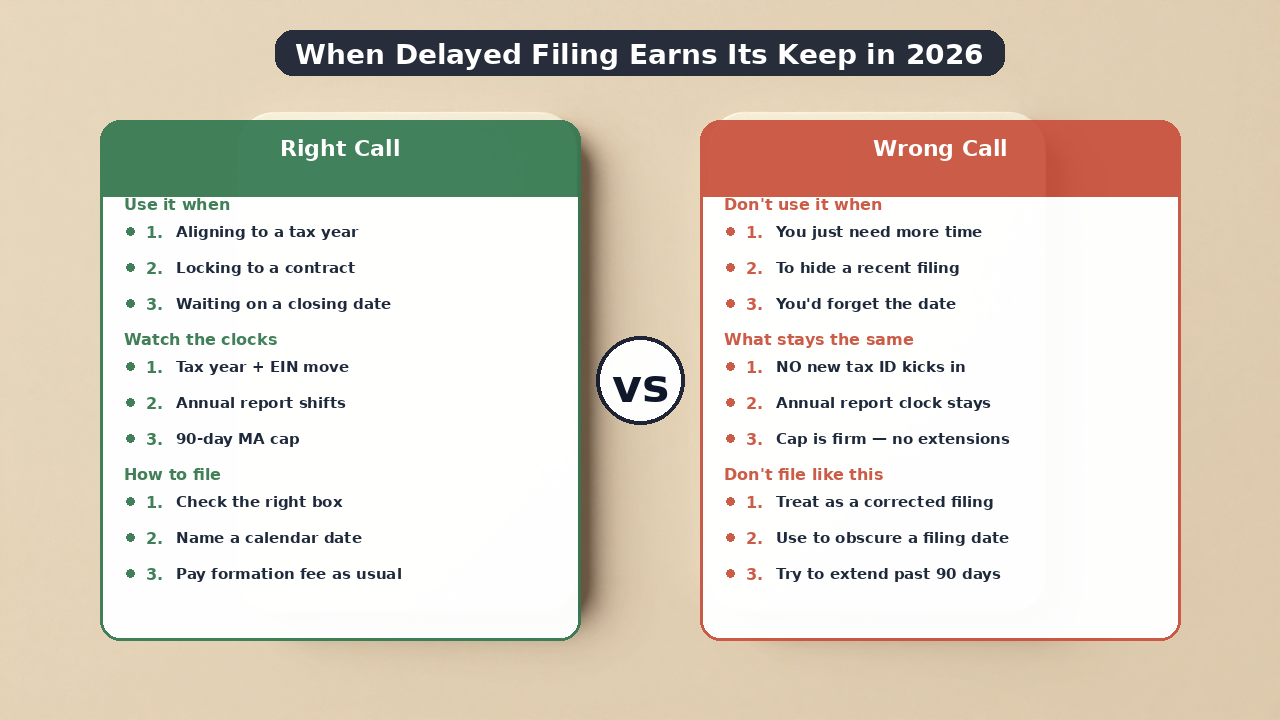
When the delayed effective date is the right tool in 2026
There are four cases where this option makes sense.
Aligning to a clean January 1 effective date for tax and reporting reasons. This is the most common use. A Massachusetts LLC formed in October or November with a delayed effective date of January 1 gets a clean first tax year. The federal tax year lines up with the calendar, which simplifies bookkeeping and in some cases makes the LLC eligible for the full standard deduction on the first return. This is the textbook use of the 90-day cap: file on or after October 3 of the prior year, request a January 1 effective date.
Coordinating multiple state filings on the same calendar. When the LLC will also be registered to do business in another state, the Massachusetts effective date can serve as the anchor. Foreign qualification filings in other states can be sequenced to be effective on the same date as the Massachusetts formation. That avoids the situation where the LLC has been transacting business in a foreign state before its home-state formation date — a problem some states treat as a curable defect and others treat as a real compliance issue.
Launching on a specific business milestone. A Massachusetts LLC formed for a real estate closing, a franchise agreement that takes effect on a future date, a lease that starts in the new year, or a license that does not become active until a regulatory cutover can use the delayed effective date to match the LLC’s legal birthday to the operational start. This is more common for small businesses than it gets credit for, and Massachusetts’s 90-day window is enough to cover most of those cases.
Avoiding a partial-year annual-report obligation in a high-fee year. Massachusetts annual report fees scale with the LLC’s Massachusetts gross assets. A delayed effective date of January 1, 2027 means the LLC’s first annual report year is 2027 — and the LLC can plan its first-year gross-asset position accordingly.
When the delayed effective date is the wrong tool
There are also four cases where the option creates more problems than it solves.
The LLC needs to operate before the delayed effective date. This is the most common misuse. The owners have signed a lease, accepted a deposit, or signed a contract under the LLC’s name before the LLC exists. The contracts are not valid against the LLC. If the LLC has to operate in the gap between filing and the delayed effective date, this option is the wrong choice.
The 90-day cap is not enough. Massachusetts caps the delayed effective date at 90 days after filing. A small business that wants a 120-day or 180-day delay has two choices: file later, or accept the cap. A delay longer than 90 days is not available under MGL c. 156C § 12(b).
The members want the LLC’s existence to backdate. A delayed effective date is forward-looking. Massachusetts does not permit an effective date earlier than the filing date. Owners who try to backdate by filing in the prior year with a blank delayed-effective-date box get the opposite problem: the LLC exists as of the filing date in the earlier year, and the annual-report clock starts immediately.
There is no specific reason for the delay. Some filers default to the delayed effective date without checking whether the immediate effective date would work just as well. Leaving the delayed-effective-date box blank and selecting “Upon filing” is the simpler, more common path. Owners who do not have a specific reason for the delay should default to the immediate effective date.
How the delayed effective date interacts with the rest of the Massachusetts filing year
The delayed effective date coordinates four other dates, and they all need to land on the same calendar.
Federal tax year. A Massachusetts LLC taxed as a partnership or as a disregarded entity uses a calendar tax year by default. A delayed effective date of January 1 lines up the LLC’s first federal tax year with the calendar. A delayed effective date mid-year means the LLC’s first tax year is a short year from the effective date through December 31. That is workable but creates a part-year return.
Massachusetts annual report cycle. The Annual Report is filed based on the calendar year of formation. An LLC formed with a delayed effective date of January 1, 2027 has its first annual report year as 2027, with the report due in 2028. The Secretary of the Commonwealth’s Corporations Division sends reminders based on the LLC’s formation calendar, and the reminder schedule follows the effective date — not the filing date.
Foreign qualification in other states. If the LLC will transact business in another state, that state’s foreign qualification filing should be effective on or after the Massachusetts effective date. Filing before the home-state LLC exists is a real defect in some states. Coordinating the Massachusetts delayed effective date with the foreign qualification effective date avoids that problem entirely.
Bank account, EIN, and operating agreement. The federal EIN application, the operating agreement, and the initial bank account setup all anchor to the LLC’s existence. The LLC does not have a federal identity as a Massachusetts LLC until the delayed effective date. Bank accounts can typically be opened in the days leading up to the delayed effective date with proper documentation, but the operating agreement should reference the correct effective date and the members should sign it on or after that date.
How to elect the delayed effective date on the Massachusetts Certificate of Organization
The filing process in 2026 is straightforward.
- Confirm the desired effective date is within 90 days of the planned filing date. Filing on October 15, 2026 with a delayed effective date of January 1, 2027 is within the 90-day cap. Filing on October 15, 2026 with a delayed effective date of April 1, 2027 is not.
- Complete the Certificate of Organization form. The form has an effective-date section with two checkboxes: “Upon filing with the Secretary of the Commonwealth” or “Delayed Effective Date (not later than 90 days after filing).” Select the delayed-effective-date box and enter the target date.
- File the Certificate of Organization with the Secretary of the Commonwealth’s Corporations Division, either online through the state’s filing portal or by mail. Pay the filing fee.
- Hold the operating agreement, the EIN application, and any bank account setup until the delayed effective date arrives. The LLC does not exist as a Massachusetts entity until that date.
- Once the effective date arrives, treat that day as the LLC’s legal birthday. Annual report reminders, tax year setup, foreign qualification filings, and the operating agreement should all reference the correct date.
Need help completing the form and managing the timing? Start a Massachusetts LLC formation through Rapid Registered Agent.
The practical rule for 2026
Default to the immediate effective date unless there is a specific reason to delay. The “Upon filing with the Secretary of the Commonwealth” checkbox on the Certificate of Organization form is the right answer for most LLCs.
Use the delayed effective date when the LLC’s legal birthday needs to land on a specific calendar date — typically January 1 of the following year, or a date that lines up with a foreign qualification, a license, a lease, or a closing. The 90-day cap is enough for all of these. File on or after October 3 for a January 1 effective date.
Do not use the delayed effective date to backdate the LLC’s existence. Massachusetts does not allow it. Do not use it to delay the LLC’s annual report clock past the calendar year. Do not use it as a substitute for actually operating the LLC.
Check out this video for a step-by-step walkthrough of the LLC formation process in Massachusetts.
Related reading
- Massachusetts Annual Report Deadlines for LLCs and Corporations in 2026 — anchors the LLC’s annual-report clock to the delayed effective date
- Massachusetts Certificate of Organization Amendments: LLC Changes That Require Filing in 2026 — sister-article for the related filing mechanics
- Massachusetts LLC Formation: Everything You Need to Know in 2026 — full formation guide for the state
A delayed effective date filing lets a Massachusetts LLC specify a future date — up to 90 days after filing — when the LLC officially comes into legal existence under MGL c. 156C § 12(b). The election is made directly on the Certificate of Organization form. Under MGL c. 156D § 1.23(b), the delayed effective date cannot be later than 90 days after the Certificate of Organization is filed with the Secretary of the Commonwealth. A Massachusetts LLC’s annual report cycle is based on its effective date, not its filing date. A delayed effective date of January 1 means the LLC’s first annual report covers 2027 and is due in 2028. Most banks require the LLC to exist before opening an account in the LLC’s name. A delayed effective date means the LLC does not exist as a Massachusetts entity until that date, which can affect the timing of bank account setup. No. Massachusetts does not permit backdating. An LLC’s effective date under MGL c. 156C § 12(b) is either the filing date or a date after filing — never before. A delayed effective date of January 1 lines up the LLC’s first annual report year with the calendar year, which can help the LLC plan its gross-asset position before the first report is due. It does not eliminate the annual report obligation entirely.Frequently Asked Questions
What is a Massachusetts delayed effective date filing?
How long can a Massachusetts delayed effective date be?
Does a Massachusetts LLC have to file an annual report in the year it was formed?
Can a Massachusetts LLC open a bank account before its delayed effective date?
Can a delayed effective date be earlier than the filing date in Massachusetts?
Can a Massachusetts LLC use the delayed effective date to avoid annual report fees in its first year?
If a Massachusetts LLC needs to come into existence on a specific future date — typically January 1 of the following year for a clean tax year, or a date that lines up with a foreign qualification, a license, a lease, or a closing — the delayed effective date election on the Certificate of Organization is the right tool in 2026. The election is on the standard form, the cap is 90 days under MGL c. 156D § 1.23, and the coordination work is the real planning problem. File on or after October 3 for a January 1 effective date.
Form a Massachusetts LLC with a delayed effective date through Rapid Registered Agent.
Massachusetts LLC Filing
Massachusetts Delayed Effective Date: How to Time Your LLC Launch
Massachusetts allows LLCs to file with a delayed effective date, so you can lock in your filing date now but push the official launch to a later date. This is useful for planning around events, financing, or other business milestones. Rapid Registered Agent handles Massachusetts LLC filings on your timeline — submit now or schedule for later, and our team makes sure everything is filed correctly with the Secretary of the Commonwealth.
- States Covered
- 50 + DC + PR
- Serving Businesses Since
- 2007
- Plans Start At
- $10/mo per state