
Indiana Certificate of Existence for LLCs in 2026: Common Uses and Filing Tips

An Indiana certificate of existence is a one-page document that proves the LLC is real.
A bank asked for it. A title company closed on it. Another state’s Secretary of State needed it before letting the LLC register to do business there. These requests show up without warning, and they usually come with a deadline attached. The document is easy to get wrong — usually because owners do not know the 60-day freshness rule, or they order the wrong form, or they pay the wrong fee.
This article covers what the certificate actually says, what it does not say, the five situations where an Indiana LLC will be asked for one in 2026, the 60-day rule that makes the document invalid if it sits too long, and how to order it without a last-minute scramble.
Watch the short video below for a clear walkthrough of how the Indiana certificate of existence works.
What an Indiana certificate of existence actually says
The certificate of existence is issued by the Indiana Secretary of State, Business Services Division. It confirms five things under IC 23-0.5-1-5:
The LLC is duly organized under Indiana law. The Secretary of State’s records show the articles of organization were filed and the LLC was formed. This is the existence confirmation.
All fees, taxes, and penalties owed to the state have been paid. The certificate reflects that nothing is outstanding — no unpaid franchise taxes, no penalties, no fees that would block the LLC from doing business.
The LLC’s most recent biennial report has been filed. Indiana requires LLCs to file biennial reports, and the certificate confirms the current filing is up to date. If the report is overdue, the certificate will not issue until it is filed and any associated fees are paid.
Articles of dissolution have not been filed. The LLC has not started the voluntary dissolution process. It is still operating.
Any other facts of record that the applicant asked to include. The long form of the certificate can include additional items the LLC requests — registered agent information, the principal address, management structure, and other facts on file with the Secretary of State.
The short form is what most counterparties actually want. It confirms the first four items only and leaves out the custom facts section. Owners ordering the certificate for a bank or title company almost always need the short form.
What the certificate does not say
This trips up owners who assume the certificate is a character reference for the business.
The certificate does not confirm the LLC is actively doing business. Formation and good standing with the state are not the same as business activity. The LLC could be formed and in good standing but completely dormant.
The certificate does not confirm the LLC is in compliance with federal law. It says nothing about IRS filings, EIN status, employee taxes, or any federal regulatory obligations.
The certificate does not confirm the operating agreement is in place. The Secretary of State has no copy of it and makes no statement about whether the members have one.
The certificate does not confirm the registered agent is currently acting. If the registered agent has resigned and no replacement has been filed, the LLC may be in default with the state even if the certificate issues. The Indiana registered agent resignation and replacement rules for LLCs in 2026 affect the LLC’s standing and should be reviewed before relying on a certificate of existence in a time-sensitive situation.
The certificate does not confirm the LLC is authorized to do business in another state. That is a separate foreign qualification filing with the other state’s Secretary of State. The Indiana certificate confirms Indiana good standing only.
When an Indiana LLC actually needs a certificate of existence in 2026
Five situations come up repeatedly.
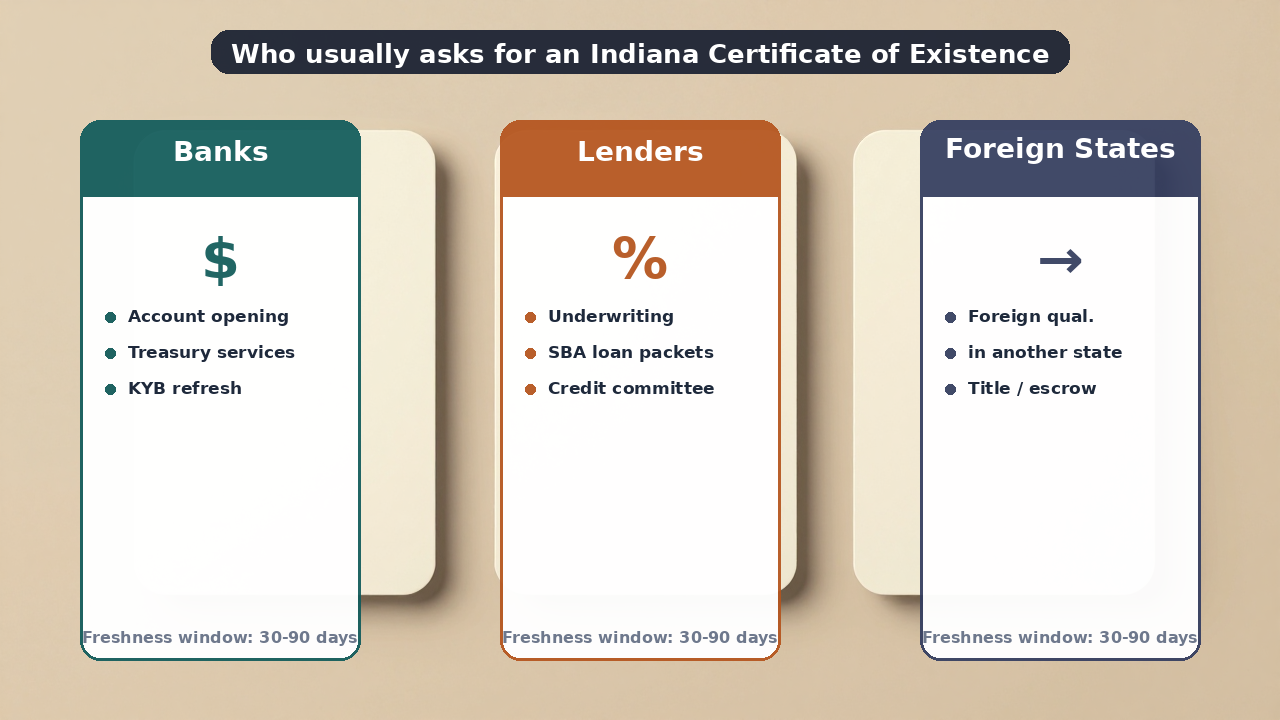
Opening a business bank account. Banks require an Indiana certificate of existence before opening an account in the LLC’s name. This is the most common trigger. The bank wants to confirm the entity is real, formed, and not in default before it will sign the signature card or issue an ACH routing number.
Qualifying to do business in another state. Before an Indiana LLC can register in another state, that state’s Secretary of State typically requires proof the LLC is in good standing in its home state. The Indiana certificate of existence is the standard proof. Without it, the foreign qualification application may be rejected or delayed. The Indiana LLC documents example and state comparisons guide covers this in more detail.
Closing on real estate. Title companies and lenders almost always require a certificate of existence before closing on property purchased in the LLC’s name. The title insurer needs to confirm the LLC is real, formed, and not in dissolution before it will insure the title.
SBA loans and conventional commercial lending. Banks and SBA-approved lenders require a certificate of existence as part of the loan documentation package. The lender wants to confirm the borrowing entity is legitimate and in good standing before it funds the loan.
M&A transactions and contract counterparties. In mergers, acquisitions, and some commercial contracts, the other party will ask for a certificate of existence as part of due diligence. The certificate confirms the entity’s state of formation and standing before the transaction closes.
The 60-day freshness rule
This is the part that catches most owners off guard.
Under 75 IAC 8-3-17, an Indiana certificate of existence is valid for 60 days from the date of issuance. After that, the certificate is stale. The counterparty — the bank, the title company, the other state’s Secretary of State — is supposed to reject a certificate that is more than 60 days old.
That means an owner who orders the certificate in January and tries to use it in April is likely to be told to order a new one. The certificate is not a permanent credential. It is a snapshot of the LLC’s status on a specific date.
The practical rule: order the certificate as close to the date it will be used as possible. If a real estate closing is scheduled for March 15, do not order the certificate in January. Order it in the week before closing. If the closing slips, order a new one.
The 60-day rule also means that an LLC with an overdue biennial report cannot simply pull an old certificate to show a bank. The moment the biennial report goes unpaid, the Secretary of State will not issue a certificate. The LLC has to get current first. This is where owners get caught: they have a pending transaction and suddenly discover the LLC is not in good standing because the biennial report lapsed.
Short form vs. long form
The short form certificate of existence is a one-page document. It confirms the LLC’s existence, good standing, biennial report status, and non-dissolution. It is signed by the Secretary of State or a deputy and delivered electronically.
The long form certificate adds custom facts. An LLC can ask the Secretary of State to certify additional facts on file — the registered agent’s name and address, the principal office address, the members or managers, the management structure, the date of formation, any amendments on file. The long form costs more and takes longer to process. Most counterparties do not ask for it.
The short form is the right choice in almost every transaction. If a bank, title company, or other state asks for “a certificate of existence,” they mean the short form. Do not pay for the long form unless the requesting party specifically asks for it.
Fees and ordering in 2026
Under IC 23-0.5-1-5 and the Secretary of State’s fee schedule, the base fee for an Indiana certificate of existence is $15 for paper filing. For electronic ordering through the INBiz portal at inbiz.in.gov, the total cost is $11 — $15 base fee less the enhanced access fee waiver under 75 IAC 8-3-17, with a $11 enhanced access fee applied, bringing the online total to $26 ($15 + $11). Rush processing is available for an additional fee.
The online order through INBiz is the fastest path. Paper filings by mail take significantly longer. The electronic certificate is issued and delivered by email, usually within one business day for standard processing.
The fee is the same whether the LLC is domestic (formed in Indiana) or foreign (formed in another state and registered to do business in Indiana). A foreign LLC registered in Indiana can obtain a certificate of existence for the foreign registration, which confirms the LLC is authorized to do business in Indiana.
How to order an Indiana certificate of existence
The process through INBiz is straightforward.
Go to inbiz.in.gov and log in or create an account. The INBiz portal handles business filings and orders for the Secretary of State.
Select “Certificate of Existence” from the business services menu. Choose the short form or long form. In almost every case, the short form is the right choice.
Confirm the LLC’s name and business ID number. The order form will ask for the entity’s ID number from the Secretary of State’s records. If the LLC number is not known, it can be looked up on the INBiz search page.
Submit the order and pay the $26 fee online. The certificate is issued and emailed. Rush processing is available for an additional charge if the transaction timeline requires faster delivery.
Verify the biennial report is current before ordering. If the biennial report is overdue, the Secretary of State will not issue the certificate. File the biennial report first. The Indiana biennial report requirements for LLCs in 2026 explain the current cycle and fees.
Where Indiana LLC owners most often get this wrong
Ordering too early because of the 60-day rule. Owners who do not know the rule order the certificate when the transaction starts, not when it closes. The certificate expires before the deal closes. Always order within the final week before the closing or the transaction date.
Not checking biennial report status first. The Secretary of State will not issue a certificate if the biennial report is overdue. The LLC gets a rejection notice instead of the document it needs. Check the biennial report status in INBiz before ordering.
Paying for the long form when the short form is what was requested. The long form costs more and takes longer. The requesting party almost always wants the short form. Confirm before paying the extra fee.
Not realizing foreign LLCs also need one. An Indiana foreign LLC — an LLC formed in another state and registered to do business in Indiana — also gets a certificate of existence from the Indiana Secretary of State. It confirms the foreign registration is current, not that the LLC was formed in Indiana.
Using the certificate as proof of identity rather than legal standing. The certificate says the LLC is in good standing. It does not say the LLC is creditworthy, profitable, or in compliance with every regulation that applies to its industry.
The practical rule for 2026
Treat the Indiana certificate of existence as a transaction-specific document, not a one-time filing. Order it when a counterparty asks for it, not months in advance. Check the biennial report status in INBiz before ordering. Default to the short form. Plan for the 60-day freshness window.
For owners who need the certificate quickly — particularly when a closing is approaching or a bank is waiting — the INBiz online order is the fastest path. Rush processing is available when the standard one-business-day window is not enough.
Check out this video for a step-by-step walkthrough of the certificate of existence ordering process.
Related reading
- Indiana Biennial Report Requirements for LLCs in 2026 — confirms the biennial-report status line on the certificate; file this before ordering the certificate
- Indiana Registered Agent Resignation and Replacement Rules for LLCs in 2026 — affects the LLC’s standing and is related compliance that shows up on the certificate
- Real Documents You’ll Need for an Indiana LLC — covers the full state-level document set for Indiana LLCs
- Georgia Certificate of Existence in 2026: Why Banks and Marketplaces May Require It
- Tips
An Indiana certificate of existence is a one-page document issued by the Secretary of State confirming that an LLC is duly organized, in good standing, has filed its most recent biennial report, and has not filed articles of dissolution under IC 23-0.5-1-5. The online fee through INBiz at inbiz.in.gov is $26 total — a $15 base filing fee plus an $11 enhanced access fee under 75 IAC 8-3-17. Paper filings cost more and take longer to process. Under 75 IAC 8-3-17, the certificate is valid for 60 days from the date of issuance. After 60 days, the counterparty should reject it as stale and a new certificate must be ordered. The short form confirms the LLC is duly organized, in good standing, has filed its biennial report, and has not been dissolved. The long form adds custom facts on file with the Secretary of State — registered agent, principal address, members, management structure. Most counterparties want the short form. Yes. A foreign LLC registered to do business in Indiana can obtain a certificate of existence from the Indiana Secretary of State confirming the foreign registration is current and the LLC is authorized to do business in Indiana. The Secretary of State will not issue the certificate of existence until the overdue biennial report is filed and any associated fees are paid. This is a common surprise for owners who need the certificate quickly for a transaction.Frequently Asked Questions
What is an Indiana certificate of existence?
How much does an Indiana certificate of existence cost in 2026?
How long is an Indiana certificate of existence valid?
What is the short form vs. the long form certificate of existence?
Can a foreign LLC get an Indiana certificate of existence?
What happens if an Indiana LLC biennial report is overdue when ordering the certificate?
If an Indiana LLC is being asked for a certificate of existence — by a bank, a title company, another state’s Secretary of State, a lender, or a contract counterparty — the request is a routine compliance step. The certificate is a one-page state-issued document, the short form is what most counterparties want, and the total cost in 2026 is $26 for an online order. The 60-day freshness rule means the certificate should be ordered close to the date it will be used.
Request an Indiana certificate of existence through Rapid Registered Agent.
Indiana Certificate of Existence
Indiana Certificate of Existence: What It Is and How to Get One
A Certificate of Existence proves your Indiana LLC is active and in good standing with the Secretary of State — banks, lenders, and landlords often request it before working with you. You can request it directly from the Indiana SOS, but the form requirements and processing times can be confusing. Rapid Registered Agent retrieves your Certificate of Existence quickly and delivers it to you, so you can close that deal or open that account without missing a beat.
- States Covered
- 50 + DC + PR
- Serving Businesses Since
- 2007
- Plans Start At
- $10/mo per state