
Arizona Foreign LLC Name Requirements in 2026: When You Need a Fictitious Name

Arizona foreign LLC name requirements in 2026 are simpler than most owners expect, but the rule that trips people up is not the one they were looking for. You pulled your home-state LLC name from Delaware. You want to do business in Arizona. You opened the Arizona Corporation Commission records search to see if the name is available. Another Arizona LLC is already using it — and now you need to know whether you can keep the home-state name in Arizona under a Fictitious Name, whether you have to change the home-state name itself, or whether the Arizona name conflict is going to force a brand decision before you ever file a Certificate of Authority. This is what the rule actually says, what it does not say, and the practical order for getting the name through the Arizona Corporation Commission without bouncing a foreign qualification application.
An Arizona foreign LLC is any LLC formed outside Arizona — Delaware, Wyoming, California, New Mexico, anywhere — that wants to do business in Arizona on a regular, ongoing, or continuous basis. The LLC does not have to be physically present in Arizona. If the LLC has Arizona customers, Arizona vendors, an Arizona bank account, Arizona employees, or Arizona property, the LLC is doing business in Arizona under A.R.S. § 10-1501. A foreign LLC doing business in Arizona without a Certificate of Authority under A.R.S. § 10-1502 cannot maintain a suit in Arizona courts, but the LLC can still be sued in Arizona — exactly the wrong side of that asymmetry.
Here is how the Arizona Corporation Commission (ACC) handles foreign-LLC names, so you know what the rest of the article is reading against:
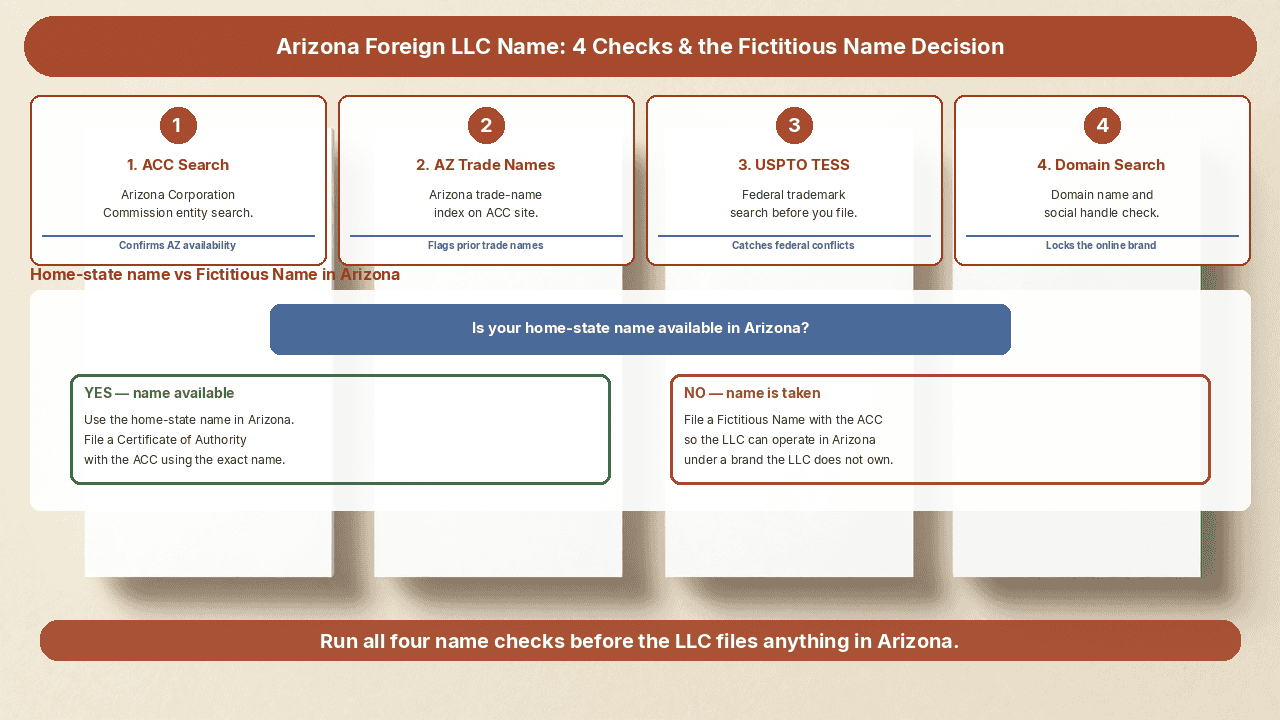
What the home-state name gets you in Arizona in 2026
Under A.R.S. § 10-1502, an Arizona foreign LLC registers with the ACC by filing an Application for Certificate of Authority. The application requires the LLC’s legal name, the LLC’s state of formation, the LLC’s principal office address, and the LLC’s Arizona statutory agent. The legal name the LLC provides is the LLC’s home-state name — the name on the Articles of Organization (or equivalent) in the LLC’s state of formation. In most cases, the home-state name carries into Arizona as the LLC’s Arizona registered name. The ACC records the name as written, and the LLC does business in Arizona under that name without filing anything extra.
The pattern is: an Arizona foreign LLC gets to keep its home-state name by default. The LLC only needs a Fictitious Name when the home-state name is not available in Arizona.
When an Arizona foreign LLC actually needs a Fictitious Name
Under A.R.S. § 10-1506, an Arizona foreign LLC has to file a Fictitious Name with the ACC when the LLC’s home-state name is not distinguishable on the ACC’s records from another Arizona entity’s name. The “distinguishable on the records” standard is narrower than the home-state name being identical. The ACC treats names as not distinguishable when the names are deceptively similar to a degree that reasonable persons would believe the entities are the same.
The most common situations in 2026 where an Arizona foreign LLC has to file a Fictitious Name:
- The home-state name is identical to another Arizona entity’s name on the ACC’s records. The most common cause of a Fictitious Name filing.
Two LLCs with the same name on the ACC’s records cannot both register without one of them adopting an alternative name in Arizona.
- The home-state name differs from an existing Arizona entity’s name only by a suffix, abbreviation, or article. Names that differ by “LLC” vs. “L.L.C.”, “Inc.” vs. “Incorporated,” “The” at the start, or a single word can still trigger the Fictitious Name rule if reasonable persons would believe they refer to the same entity.
- The home-state name contains a word or phrase the ACC treats as restricted. Some words — “bank,” “trust,” “engineer,” “pharmacy,” and a handful of others — trigger extra review even when the name is otherwise distinguishable.
The Fictitious Name rule does not require a name change here — the LLC files an Application for Certificate of Authority and the ACC’s expedited-name review kicks in.
- The home-state name is on a name reservation that is about to expire. An Arizona foreign LLC that does not file a Certificate of Authority before the Arizona reservation expires may have to file a Fictitious Name if the reservation lapses and another filer takes the name.
The Fictitious Name filing is the LLC’s clean way out when the home-state name cannot carry into Arizona as-is. The Fictitious Name is the LLC’s Arizona-specific trade name; the LLC keeps the LLC’s home-state name on the home-state record and uses the Fictitious Name only in Arizona.
For the broader picture on Arizona-specific documents that may matter alongside the name, including statutory-agent designation and ACC records the LLC will see, see Arizona LLC Documents: Examples & State Comparisons.
The four name availability checks before the LLC files anything
The right time to run the four checks is before the LLC files the Application for Certificate of Authority, not after. A rejection at the name-check stage costs the LLC $0 and a few days. A rejection after the LLC has paid the filing fee and started lining up vendor relationships costs more.
- ACC entity-search portal. The Arizona Corporation Commission entity search is the official source.
The LLC searches the exact home-state name plus the closest variations and confirms whether the ACC has an existing entity with the same or a deceptively-similar name. The ACC’s “distinguishable on the records” standard is the rule that controls this check.
- Arizona Secretary of State trade-name search. Trade names (also called assumed business names or DBAs) registered with the Arizona Secretary of State have a separate search portal.
An Arizona trade name does not directly block an Arizona foreign LLC from registering — but it does give the holder a public-record basis to object if the LLC’s name is deceptively similar.
- The federal trademark register. The USPTO’s TESS search shows registered trademarks and pending applications.
An Arizona foreign LLC that uses a name identical to a federal trademark in the LLC’s industry line is exposed to trademark infringement regardless of state registration. The ACC will register the LLC’s name, but the trademark holder can still sue in federal court.
- Domain name availability. The domain-name check is unofficial but practical.
An Arizona foreign LLC that cannot register the .com of its home-state name has a brand-discoverability problem that the name-availability search cannot fix. The LLC does not need to buy the domain at this stage, but the LLC should know what the LLC is going to do about it.
The LLC runs all four checks before the LLC files the Application for Certificate of Authority. The four-check bundle is the LLC’s first-line defense against name-conflict friction during the ACC review window.
How to file the Fictitious Name with the ACC in 2026
The Fictitious Name filing goes through the Arizona Corporation Commission eFile portal as part of, or alongside, the Application for Certificate of Authority. The filing path:
- The LLC creates an eFile account at the ACC eCorp portal.
The account is tied to the LLC’s federal EIN and the LLC’s principal office address.
- The LLC starts the Application for Certificate of Authority under the foreign-LLC section of the eFile portal.
The portal walks the LLC through the LLC’s home-state legal name, the LLC’s state of formation, and the LLC’s date of organization.
- If the home-state name is not distinguishable from an existing Arizona entity’s name, the portal prompts the LLC to enter a Fictitious Name.
The Fictitious Name is the LLC’s Arizona-only trade name — the LLC keeps the LLC’s home-state name on the home-state record.
- The LLC designates an Arizona statutory agent on the application.
A statutory agent is Arizona’s term for what other states call a registered agent. The statutory agent must have an Arizona street address (not a P.O. box) and must be available during normal business hours to receive service of process. For the distinctions between an Arizona statutory agent and a national registered agent, see Arizona Statutory Agent vs Registered Agent: What LLC Owners Need to Know in 2026.
- The LLC pays the filing fee.
The Certificate of Authority fee is $50 for a foreign LLC under the ACC’s fee schedule. A separate $50 fee applies if the ACC also processes a Fictitious Name filing as part of the same application — the fees are tracked separately but paid in one transaction.
- The ACC reviews the application within approximately 7 to 10 business days.
Approval letters and the Certificate of Authority are issued through the eFile portal as downloadable documents.
For an Arizona foreign LLC that needs to qualify quickly, the in-person or expedited path through the ACC’s Phoenix office is available for an additional expedited fee.
What the Fictitious Name does and does not do
The Fictitious Name filing under A.R.S. § 10-1506 is a state-level name-registration filing, not a trademark filing. The filing gives the LLC the right to do business in Arizona under the Fictitious Name. The filing does not:
- Grant trademark rights. Trademark rights arise from use in commerce, not from state registration.
The LLC’s Fictitious Name registration does not give the LLC any priority in federal trademark law.
- Block other Arizona entities from using a similar name. The Fictitious Name filing only registers the LLC’s Arizona use of the Fictitious Name; it does not prevent another Arizona entity from later registering a similar name.
- Replace the LLC’s home-state name. The Fictitious Name is the LLC’s Arizona-specific operating name.
The LLC’s home-state name remains the LLC’s legal name in the LLC’s state of formation, and the LLC’s Certificate of Good Standing from the home state still bears the home-state name.
- Expire. A Fictitious Name filing stays in effect as long as the LLC’s Arizona Certificate of Authority is active.
The Fictitious Name does not have its own separate renewal cycle — it tracks the LLC’s foreign qualification.
An Arizona foreign LLC that wants trademark protection has to file a separate trademark application with the USPTO, independently of the Fictitious Name filing.
If you want the broader picture on what registered-agent compliance looks like in the multi-state context an Arizona foreign qualification kicks off, here is the foundational walkthrough:
Why Fictitious Name filings trip people up in 2026
The most common Fictitious Name trouble in 2026:
- The LLC files the Certificate of Authority without checking the ACC’s records first. The ACC’s entity search is the first place the LLC should look.
An LLC that files without checking pays the $50 fee, then gets a notice that the home-state name is not available, then pays another $50 fee to file a Fictitious Name on a separate application. The two-step process costs more time and more money than the four-check bundle would have.
- The LLC adopts a Fictitious Name that is itself not distinguishable. The LLC picks a Fictitious Name without checking the ACC’s records under the new name.
The ACC rejects the Fictitious Name filing because the new Fictitious Name is already on someone else’s record. The LLC has to amend and re-file, which can run another 7 to 10 days.
- The LLC forgets the Arizona statutory agent. The Application for Certificate of Authority requires a statutory agent at the time of filing.
An LLC that files without a statutory agent gets the application rejected within a day or two and has to amend to add the statutory agent before the ACC will re-review.
- The LLC assumes the Fictitious Name gives it trademark rights. The Fictitious Name is a state-level operating name.
The LLC’s brand protection comes from trademark registration, not from Fictitious Name filing.
The common thread: the four-check bundle in the order listed above catches most Fictitious Name trouble before it costs the LLC any filing fees.
For the broader picture on Arizona filings the LLC will touch beyond the Fictitious Name, including which Arizona counties still require publication for newly-formed domestic LLCs, see Arizona LLC Publication Rules in 2026: Which Counties Still Require Notice? — note that the publication rules described there apply to domestic LLC formation and do not affect foreign LLC qualification.
The relationship between the Fictitious Name and the LLC’s home-state record
The Fictitious Name filing is purely an Arizona-state artifact. The LLC’s home-state record is unchanged. The LLC’s home-state Certificate of Good Standing still bears the home-state name. The LLC’s bank account in the home state is still in the home-state name. The LLC’s EIN records are still in the home-state name.
The pattern: the Fictitious Name is a name-availability workaround, not a name change. The LLC’s vendors, customers, lenders, and tax authorities in the home state see the home-state name. The LLC’s Arizona vendors, customers, lenders, and tax authorities see the Fictitious Name — and on Arizona-state-facing documents like the LLC’s Arizona income tax filings (when applicable), the LLC uses the Fictitious Name.
For the LLC’s full Arizona document set — including statutory-agent designation, ACC records the LLC will see, and the LLC’s Certificate of Authority — see Arizona LLC Documents: Examples & State Comparisons.
The practical order for 2026
The practical order for an Arizona foreign LLC in 2026 is to run the four name availability checks before the LLC files anything with the ACC, and to file the Fictitious Name only when the home-state name cannot carry into Arizona as-is. The LLC confirms the home-state name is distinguishable on the ACC’s records. The LLC confirms there is no deceptively-similar federal trademark in the LLC’s industry line. The LLC confirms the domain name is at least registerable (even if the LLC is not buying it today). The LLC files the Application for Certificate of Authority with the home-state name if the LLC’s checks pass. The LLC files the same application with a Fictitious Name under A.R.S. § 10-1506 when the home-state name is not available in Arizona. The LLC designates the Arizona statutory agent at the time of the application — the Arizona statutory-agent rules cover what counts as a valid designation and what does not. The LLC pays the $50 Certificate of Authority fee plus the Fictitious Name fee if applicable. The LLC waits 7 to 10 business days for the ACC’s review. The LLC delivers the issued Certificate of Authority to banks, landlords, and vendors in Arizona.
The order is the value. The LLC runs the four checks before any filing fees change hands. The LLC files once, with the right name, and the LLC’s Certificate of Authority issues the first time around. An Arizona foreign LLC name requirements check coordinated with the home-state Certificate of Good Standing, the statutory-agent designation, and the Fictitious Name filing clear the LLC’s Arizona record in one pass, instead of one rejected filing at a time. That is the practical path on Arizona foreign LLC name requirements in 2026 — and now you know when you actually need a Fictitious Name versus when the home-state name carries through.
Related reading
- Arizona Statutory Agent vs Registered Agent: What LLC Owners Need to Know in 2026
- Arizona LLC Publication Rules in 2026: Which Counties Still Require Notice?
- Arizona LLC Documents: Examples & State Comparisons
It is the rule that an Arizona foreign LLC's home-state legal name carries into Arizona as the LLC's Arizona registered name when the LLC files an Application for Certificate of Authority under A.R.S. § 10-1502. The Arizona Corporation Commission requires the LLC to file a Fictitious Name under A.R.S. § 10-1506 only when the home-state name is not distinguishable on the ACC's records from another Arizona entity's name. No. The Fictitious Name filing under A.R.S. § 10-1506 is only required when the LLC's home-state name is not distinguishable on the Arizona Corporation Commission's records from another Arizona entity's name. Most LLCs whose home-state name is unique in Arizona register under their home-state name and skip the Fictitious Name filing entirely. The Certificate of Authority filing fee is $50 for a foreign LLC under the Arizona Corporation Commission fee schedule. A separate $50 fee applies when the LLC also files a Fictitious Name at the same time. Expedited processing is available for an additional fee through the ACC's Phoenix office. No. The Fictitious Name filing under A.R.S. § 10-1506 is a state-level operating-name registration. It does not give the LLC federal trademark rights, does not block other entities from registering similar names, and does not replace the LLC's home-state legal name. Trademark rights arise from use in commerce and require a separate USPTO application. Online applications through the ACC eFile portal typically clear within 7 to 10 business days. In-person filings at the ACC's Phoenix office with expedited processing can clear within 1 to 3 business days for an additional fee. The Certificate of Authority is delivered through the eFile portal as a downloadable document. Run the four-check bundle before any filing: ACC entity search, Arizona trade-name search, federal trademark register, and domain availability. If the home-state name is not available in Arizona, the LLC files a Fictitious Name under A.R.S. § 10-1506 as part of the Application for Certificate of Authority and keeps the home-state name on the home-state record. The LLC's Arizona vendors and customers see the Fictitious Name; the LLC's home-state records stay under the home-state name.Frequently Asked Questions
What is an Arizona foreign LLC name requirement in 2026?
Does an Arizona foreign LLC always have to file a Fictitious Name?
How much does an Arizona foreign LLC Certificate of Authority cost?
Does an Arizona Fictitious Name filing give the LLC trademark rights?
How long does it take to get an Arizona foreign LLC's Certificate of Authority in 2026?
What should an Arizona foreign LLC do when the home-state name is already taken in Arizona?
Arizona Foreign LLC Name
Arizona Foreign LLC Name Requirements: When You Need a Fictitious Name
When a foreign LLC registers in Arizona, it can use its existing legal name if that name is available in Arizona — but if another company already registered it, or if the name doesn’t meet Arizona’s naming standards, the LLC must use a fictitious name instead. Filing a fictitious name with the Arizona Corporation Commission is a separate registration step that’s easy to miss. Rapid Registered Agent handles the full Arizona foreign LLC registration, including any fictitious name filing, so your business operates legally under the right name.