
Arizona Compliance News in Late 2026: What LLC Owners Should Recheck Before the Year Closes

Arizona Compliance News in Late 2026 starts with a fact that surprises most Arizona LLC owners: your business does not file an annual report. Arizona corporations do — the Arizona Corporation Commission requires annual reports from corporations by March 31 for domestic entities and August 31 for foreign ones. But Arizona LLCs? No annual report requirement from the ACC. That gap in the compliance calendar is exactly what causes problems. An Arizona LLC that never checks its ACC status can go years without realizing its statutory agent information is stale, its foreign LLC registration is outdated, or its TPT filings with the Arizona Department of Revenue are missing. This guide covers what every Arizona LLC owner should recheck before the year closes.
Why Arizona LLCs Do Not File Annual Reports — and Why That Creates Its Own Risk
The Arizona Corporation Commission requires annual reports from corporations, not LLCs. This is a meaningful difference in the compliance landscape. If you own an Arizona LLC, the ACC is not sending you an annual report reminder. There is no filing window, no March 31 deadline, and no form to submit. Most Arizona LLC owners find this comforting. Some find it dangerous.
The danger is that without an annual compliance trigger, it is easy to let other registrations drift. Your statutory agent information may be outdated. Your foreign LLC registration in another state may have lapsed. Your TPT account with the Arizona Department of Revenue may need attention. These items do not send automatic reminders the way an annual report would. They pile up silently until something forces a check — a loan application, a contract negotiation, a business sale.
The Arizona Corporation Commission uses eCorp, the online business filing portal, for all corporate filings. LLCs can access their entity records through the same portal, but the LLC section does not include an annual report filing requirement. Confirm your entity type in eCorp before assuming you are on top of compliance. Arizona business entity records are searchable through the Secretary of State as a free public lookup if you need to verify your entity status.
Statutory Agent Changes: The $5 Filing That Catches Big Problems
Every Arizona LLC must maintain a statutory agent — the person or company authorized to accept legal documents on behalf of the business. Changing your statutory agent requires filing a Statement of Change with the ACC using Form L020. The filing fee is $5 for LLCs. That is not a typo. The form is inexpensive. The cost of not filing it is not.
If your statutory agent resigns and you do not file the Statement of Change to appoint a replacement, the ACC may classify your LLC as pending inactive. Once an LLC is flagged inactive, it cannot file additional documents with the commission — which means you cannot file amendments, registrations in other states, or any other ACC filing on behalf of the entity. Unblocking that status requires filing the reinstatement paperwork and paying any outstanding fees. The cost compounds quickly.
The resignation process for an Arizona statutory agent requires the agent to notify the LLC in writing. The LLC then has a window to file the Statement of Change before the resignation takes effect. Unlike some states, Arizona does not have an extended statutory grace period — the inactivity risk begins as soon as the resignation is processed without a replacement on file. Arizona Corporation Commission business services has the form and instructions for making this change online.
Rapid Registered Agent provides statutory agent service for Arizona LLCs with continuous coverage and same-day Statement of Change filing when a replacement is needed. If your current agent has sent a resignation notice, the replacement appointment should be filed the same day — not the same week.
Transaction Privilege Tax: The Filing Arizona LLC Owners Forget
Arizona assesses a Transaction Privilege Tax on businesses that sell goods or provide taxable services in the state. This is the state equivalent of a sales tax, and it applies to most retail, rental, and professional service activities. If your Arizona LLC sells anything taxable — products, equipment leases, consulting services, construction — you need a TPT license with the Arizona Department of Revenue and you need to file TPT returns on the prescribed schedule.
The TPT filing schedule depends on your tax liability. New TPT filers typically start with monthly or quarterly filings and may qualify for an annual filing if their liability is below a certain threshold. The threshold changes, so verifying your current filing frequency with the AZ DOR before year-end is worth doing regardless of how long you have been in business.
If you stopped filing TPT because your business paused or changed structure, the AZ DOR may have assessed a liability for unfiled periods. Addressing this before year-end — rather than waiting for a notice — gives you time to negotiate a payment arrangement if needed. The Arizona Department of Revenue has online account access for registered businesses to review filing history and outstanding balances.
Foreign LLC Registration: Operating Across State Lines Creates Double Compliance
If your Arizona LLC is registered to do business in other states, those registrations have their own annual compliance obligations. Most states require foreign LLCs to file an annual report or some equivalent registration update. Some require a registered agent in that state at all times. Missing those filings can result in the revocation of your authority to do business in that state — which means you lose access to that market.
The compliance calendar for foreign registrations varies by state. Texas, California, and Nevada are the most common states where Arizona LLCs seek foreign registration, and each has its own deadline structure. Review each state where you are registered and confirm the current filing status before year-end.
Your Arizona registration does not automatically update other states. When you change your statutory agent at the ACC, that change does not propagate to your foreign registrations. Each state requires its own amendment if the registered agent information has changed. This is a common oversight — an Arizona LLC changes its statutory agent and then discovers six months later that its California foreign registration still lists the old agent address, which is now stale.
What Changes When a Statutory Agent Resigns Without Warning
An Arizona statutory agent resignation does not always come with a graceful handoff. Sometimes the agent simply stops responding. Sometimes a commercial registered agent decides to exit the Arizona market and files a bulk resignation. In either case, the effect on your LLC is the same: you have a narrow window to file Form L020 and appoint a replacement before the ACC flags your entity as inactive.
The ACC does not send a second notice when your statutory agent resigns. The inactivity flag is applied administratively, often without a warning letter first. By the time you realize the resignation happened, your LLC may already be unable to file new documents with the state. Contracts, leases, and bank accounts opened in the LLC’s name may be affected if the entity’s good standing is questioned.
Verifying your statutory agent information in the Arizona Secretary of State business entity search once a quarter takes less than five minutes and prevents this scenario. If the listed agent does not match who you think is serving you, file the Statement of Change immediately.
The Arizona Unique Advantage: No State Income Tax and Simpler Filings
Arizona does not assess a state income tax on LLCs or corporations. This is a meaningful advantage over California, New York, Oregon, and several other states where LLC owners face both federal and state self-employment or entity-level income taxes. For businesses that operate across multiple states, this makes Arizona an attractive state of formation for the tax planning benefits alone.
The tradeoff is the TPT obligation. Arizona’s Transaction Privilege Tax is broader than most state sales taxes — it applies to gross receipts from most business activities, not just retail sales. The TPT is remitted to the AZ DOR and the rate varies by business classification. Understanding which TPT classification applies to your business activity, and whether you are collecting and remitting correctly, is worth a year-end review with an Arizona tax professional.
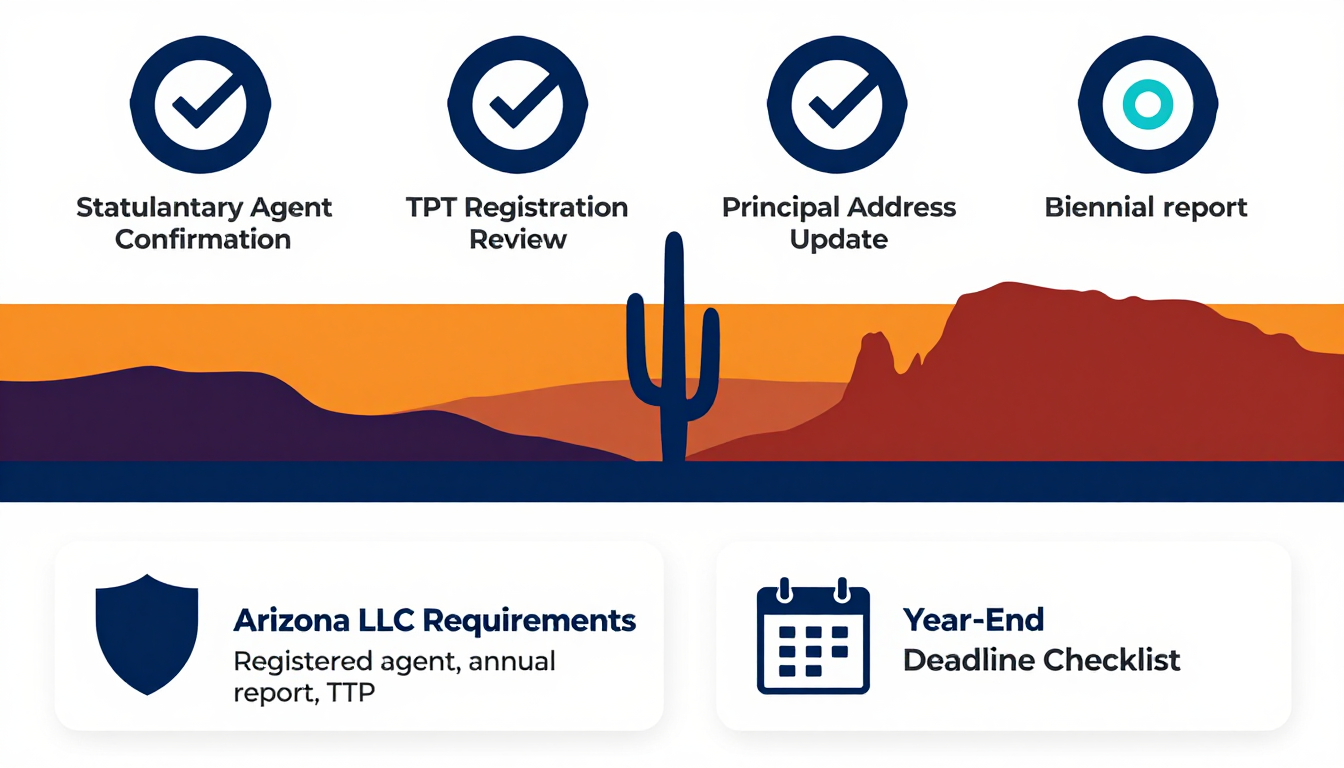
What to Recheck Before the Arizona Year-End
Put these five items on your compliance checklist before the year closes.
First, check your statutory agent information in the ACC eCorp portal. Confirm the name and address on file matches your current agent. If there is any discrepancy, file Form L020.
Second, review your TPT filing history with the AZ DOR. Confirm all periods are filed, all returns are current, and the tax classification matches your actual business activity. If you added a new service line or product category during the year, your TPT classification may need updating.
Third, audit your foreign LLC registrations in every state where your Arizona LLC is registered to do business. Check the annual report or equivalent filing deadlines and confirm they are filed. Update the registered agent information in each state to match your current agent.
Fourth, verify your ACC entity registration is active and has not been administratively voided for any reason. If your LLC was administratively dissolved for failure to pay TPT or maintain a statutory agent, reinstatement is possible but takes time. Discovering this in December during a business transaction is a worst-case scenario.
Fifth, update your registered agent service agreement to confirm it covers the upcoming year and that your agent’s authorization to serve in Arizona is current. If your agent is a commercial registered agent, confirm their listing is active with the ACC.
Common Mistakes Arizona LLC Owners Make in Late Year
The most common mistake is assuming no annual report means no compliance work. Arizona LLCs that operate under the assumption that the ACC filing system will alert them to problems find out the hard way that the system does not work that way for LLCs. There is no reminder. There is no filing window. There is just the quiet accumulation of stale information until something forces a check.
Another mistake is mixing up the Arizona Department of Revenue obligations with the Arizona Corporation Commission obligations. The TPT is a tax matter handled through AZ DOR. The statutory agent and entity registration are corporate matters handled through the ACC. Different agency, different portal, different deadlines. Both need attention.
A third mistake is assuming the statutory agent handles TPT filings or vice versa. They are unrelated obligations handled by different parts of the government. Your registered agent does not file your TPT returns. Your accountant does not update your ACC registered agent information unless you specifically ask.
Forgetting about foreign registration compliance during the busy season is a fourth mistake. If your Arizona LLC is active in multiple states, those states have their own filing calendars. An Arizona holiday closure in December means December 31 deadlines in other states can arrive faster than expected. Set those reminders now, not in the last week of December.
Frequently Asked Questions
Do Arizona LLCs file annual reports with the Arizona Corporation Commission?
No. Arizona requires annual reports from corporations, not LLCs. LLCs are not subject to the ACC annual report filing requirement. However, LLCs must still maintain a current statutory agent on file and may have TPT filing obligations with the Arizona Department of Revenue.
How do I change my Arizona statutory agent?
File a Statement of Change using Form L020 with the Arizona Corporation Commission. The filing fee is $5 for LLCs. The form can be filed online through the ACC eCorp portal. The change takes effect upon processing.
What happens if my Arizona statutory agent resigns and I do not file a replacement?
The ACC may classify your LLC as pending inactive. Once flagged inactive, the LLC cannot file additional documents with the commission — including amendments, foreign registrations, or any other filings — until the statutory agent issue is resolved and the entity is reinstated.
Does an Arizona LLC need to file TPT returns if it has no physical presence in Arizona?
Arizona TPT applies to businesses operating in Arizona, regardless of where the LLC is formed. If your Arizona LLC is actively engaged in business in Arizona — selling goods, providing services, or leasing property in the state — you need a TPT license and must file returns on the prescribed schedule.
How often should I verify my Arizona LLC compliance status?
At minimum once per quarter and whenever a major business event occurs — a new state of registration, a change in business activity, or a change in your registered agent. Annual review before year-end catches problems before they create emergencies during transactions.
Can an Arizona LLC lose its authority to do business in another state without the owner knowing?
Yes. Most states revoke foreign LLC authority for failure to file annual reports or maintain a registered agent. If your Arizona LLC is registered in another state, that state will not notify the Arizona LLC directly — you must monitor each registration independently.
Arizona Compliance News in Late 2026 is a reminder that no annual report reminder does not mean no compliance work. The statutory agent needs checking, the TPT filings need confirming, and the foreign registrations need auditing before the year closes. Five minutes in the ACC eCorp portal and the AZ DOR online account tells you where you stand. Rapid Registered Agent monitors Arizona statutory agent status year-round so your LLC stays active and in good standing without you having to remember to check.
Aggressive Representation. Proven Results.
We Fight For The Justice You Deserve.
When you’ve been injured, you need a powerful legal team on your side. We have recovered over $500 Million for our clients. Don’t settle for less.