
Oregon Trust Pages in 2026: What a Small LLC Website Should Say About Its Registered Agent
Oregon trust pages in 2026 are the sections of a small LLC website that tell visitors who receives legal documents on behalf of the business. Most Oregon LLC websites mention what they sell and how to contact them. Few mention the registered agent. That is a missed trust signal. This guide shows what to put on an Oregon trust page and why it helps the business.
Why Oregon Registered Agent Information Belongs on an LLC Website
A registered agent is the person or service designated to receive legal documents for an LLC. That includes lawsuit summonses, state correspondence, and official notices. When a vendor, lender, or potential business partner researches an Oregon LLC online, they often check the public business record. The Secretary of State database shows the registered agent name and address. If that information is nowhere on the business website, the site misses a chance to signal legitimacy.
The Oregon Secretary of State Corporation Division maintains the public record for every LLC in the state. The Oregon business registry search tool lets anyone look up an LLC and see its registered agent information. A website that matches what appears in that database builds trust with visitors who have just checked the public record. A website that says nothing about the registered agent feels incomplete by comparison.
The practical reason to include registered agent information on a website is simpler than it sounds. It answers a question that informed visitors already have. It reduces the back-and-forth with prospects who need to know they are dealing with a legitimate Oregon LLC. It signals that the business is compliant and transparent.
What an Oregon Trust Page Should Say About the Registered Agent
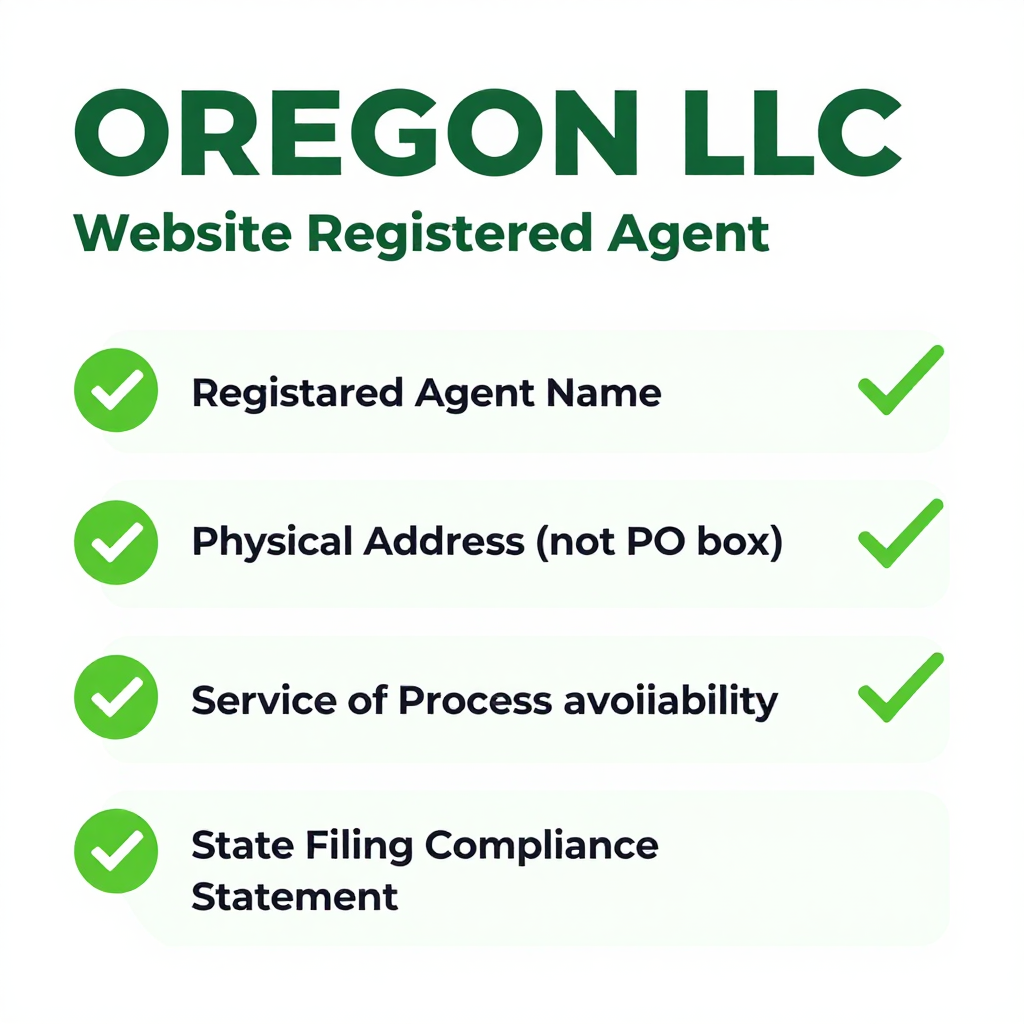
An Oregon trust page does not need to be long. It needs to be accurate. The page should state the registered agent name exactly as it appears on the Oregon Secretary of State filing. It should include the agent’s address. It should note that the registered agent is the designated recipient for legal documents and state service of process.
The page should not include the home address of an individual who is the registered agent if that person is using their home address for privacy reasons. Most small LLC owners who serve as their own registered agent use a commercial registered agent service address, not their home address. If the registered agent address is a commercial address, include it. If it is a home address, omit it and refer visitors to the Secretary of State registry for official verification instead.
The tone should be matter-of-fact. The purpose is information, not marketing. Visitors who are checking the registered agent information are doing due diligence, not shopping. A straightforward statement of the facts builds more trust than a sales pitch about the registered agent.
How Oregon Registered Agent Information Builds Trust With Site Visitors
The people who notice the registered agent information on a business website are usually the most important visitors from a business standpoint. They include lenders evaluating a loan application, commercial landlords reviewing a lease, government agencies reviewing a license, and established businesses deciding whether to sign a contract. These visitors are not influenced by flashy design. They are influenced by accuracy and completeness.
When the registered agent name and address on the website match exactly what appears on the Oregon Secretary of State filing, the visitor’s confirmation check passes without friction. That moment of confirmation — seeing the same information on the website and in the public record — is a trust signal that takes less than thirty seconds to deliver and has an outsized effect on how professional the business appears.
When the website omits the registered agent entirely, the visitor cannot confirm the information. That does not mean they assume the worst, but it means the business missed an opportunity to demonstrate transparency. In competitive markets like Portland, Bend, and Eugene, where small LLCs compete for contracts with larger businesses, every trust signal matters.
What to Include and What to Leave Off an Oregon Trust Page
Include: the registered agent name exactly as filed. Include the Oregon registered agent address exactly as filed. Include a statement that the agent is the designated recipient for legal documents. Include a link to the Oregon Secretary of State business registry search for visitors who want to verify the filing directly.
Leave off: the home address of any individual serving as registered agent. Leave off personal phone numbers or email addresses associated with the registered agent individual. Leave off any claim that the registered agent address is an “office” or “headquarters” unless that is literally true. Leave off any comparison to competitors. The trust page is not a marketing piece. It is a disclosure.
The Better Business Bureau’s guidance on business transparency notes that accurate publicly accessible business information is one of the highest-impact trust signals for small businesses. An Oregon LLC that posts accurate registered agent information on its website is demonstrating the same transparency standard that BBB accreditation requires.
The Connection Between an Oregon Trust Page and Local Search Rankings
Local search rankings for Oregon service businesses are influenced by the completeness of the business information across the web. Google pulls business facts from multiple sources simultaneously. When the registered agent address appears on the LLC website and matches the address on the Secretary of State filing, it reinforces the accuracy of the business data that Google has collected.
This is the same principle that applies to NAP consistency — name, address, phone — in local SEO. A complete business information profile on the website, including the registered agent address, gives Google more confirmed data points. More confirmed data points means higher confidence in the listing. Higher confidence means better ranking in local map and organic results.
For an Oregon LLC targeting local searches in a specific city, the trust page should be part of a broader information architecture that includes the registered agent address, the service area, the physical address if applicable, and contact information. Every data point that matches across sources strengthens the local search presence.
The Google Business Profile technical guidelines confirm that business information consistency across a website and the Business Profile is a positive ranking factor. An Oregon LLC that has accurate registered agent information on its website is already partway toward the information consistency that local search algorithms reward.
How to Format the Trust Page on an Oregon LLC Website
The trust page works best as a dedicated page in the footer navigation, labeled something like “Registered Agent Information” or “Business Information.” It should be easy to find from any page on the site. A link in the footer satisfies both visitors who are looking for it and search engines that expect to find business information in a predictable location.
The page content should be short and factual. A good structure is a heading, a one-paragraph description of what a registered agent does, the agent name, the agent address, and a link to the Oregon Secretary of State registry. No images are required for this page. No video is required. No call to action is needed, except perhaps a link to the main service page.
The page should be linked internally from the footer on every page of the website. That internal link pattern signals to search engines that the trust page is a standard, supported page on the site, not an afterthought.
When an Oregon LLC Should Update Its Trust Page Information
An Oregon trust page becomes outdated whenever the registered agent changes. That happens when an LLC switches registered agent services, when the registered agent moves to a new address, or when the LLC dissolves and reforms under a new filing. The trust page should be updated within a few days of any such change.
Leaving outdated registered agent information on a website is worse than having no trust page at all. A visitor who checks the Secretary of State registry and finds different information than what is on the website has just lost trust in the business. That loss of trust is the opposite of what the page is supposed to accomplish.
Set a calendar reminder to verify the trust page information once a year at the same time the annual report is filed. If the information matches, the page stays. If it has changed, update it. The check takes two minutes and prevents the worst-case scenario of an outdated trust page eroding credibility right before a major business decision.
The Oregon Annual Report and How It Connects to the Trust Page
The Oregon annual report filed with the Secretary of State is the document that confirms the registered agent information on the public record. The annual report must be filed every year by the anniversary of the LLC formation date. The information on the trust page should match what was filed in the most recent annual report.
If the annual report was filed and the trust page still shows old information, update the trust page immediately. If the annual report filing is pending, wait until it processes before updating the trust page, to ensure the new information is confirmed before it goes live.
For the full Oregon annual report filing process, see the guide to Oregon annual reports for LLCs in 2026, which covers the deadlines, the online filing portal, and what happens when the report is filed late.
Building an Oregon Service Page That Supports the Trust Page
The trust page works best when it is surrounded by service page content that is equally transparent. An Oregon service area page that names the cities served, the types of clients worked with, and the experience level of the business is more credible than a service page with generic language. The trust page and the service pages should feel like they belong to the same legitimate business.
For guidance on building service area pages that convert, see the guide to Oregon service area pages for LLCs in 2026, which covers how to structure location and service information in a way that supports both user trust and local search visibility.
The Oregon Secretary of State business registry is where anyone can verify the registered agent information on file. The IRS EIN application page covers when an LLC needs a federal employer ID number, which often surfaces as a trust-related question from new clients evaluating an Oregon LLC. The Oregon Business Registry Act governs what information an Oregon LLC is required to maintain and make available publicly, which is the legal foundation for why a trust page adds credibility.
Common Mistakes Oregon LLCs Make With Trust Page Information
Mistake 1: Listing the wrong registered agent name. This happens when the LLC updated the registered agent but forgot to update the website. Always verify the name against the current Secretary of State filing before posting it.
Mistake 2: Listing a personal home address when the registered agent is a commercial service. If the registered agent is a commercial service at a specific address, list that address. If the registered agent is an individual using a home address for privacy, omit the address from the website and refer visitors to the registry instead.
Mistake 3: Using the word “office” or “headquarters” when the address is a registered agent service address. A registered agent service address is a mailing address, not necessarily a place of business. Describing it as an office misleads visitors who interpret that word to mean a staffed location.
Mistake 4: Posting the trust page without linking it from the rest of the site. A trust page that exists but is not linked from the footer or navigation is invisible to visitors and useless as a trust signal. It also is invisible to search engine crawlers, which means it does not contribute to local SEO.
The Business Case for an Oregon Trust Page in 2026
The cost of adding a trust page to an Oregon LLC website is zero if the website is already built. It takes an hour to write and publish. The return on that hour is harder to measure than a direct response campaign, but it is real. Every lender, landlord, government agency, and established business that checks the public record and finds a matching website is a deal that advances instead of stalls.
For an Oregon LLC in Portland competing for commercial contracts, a trust page that clearly lists the registered agent information is a differentiator. Many competitors have not bothered. The LLC that has it looks more prepared. In Bend, Eugene, and Salem, the same dynamic applies to local service businesses competing for government contracts, commercial leases, and B2B clients.
Oregon trust pages in 2026 work best when they are accurate, current, and easy to find. They are one of the simplest trust signals a small LLC can add to its website. They take an hour to build and they do not require maintenance except once a year at annual report filing time. Oregon trust pages work best when the information is verified against the current Secretary of State filing before the page goes live.
Frequently Asked Questions
What is an Oregon trust page on an LLC website?
An Oregon trust page is a section of a small LLC website that displays the registered agent name and address as it appears on the Oregon Secretary of State filing. It helps visitors verify that the business is a legitimate LLC in good standing and builds trust with prospects who check the public record before signing a contract.
Does an Oregon LLC have to publish its registered agent information on its website?
No. There is no Oregon state law requiring an LLC to publish its registered agent information on its website. Publishing it is a best practice for transparency, but it is not legally required. The information does appear on the public Secretary of State record regardless of whether the website displays it.
What address should an Oregon trust page list?
List the registered agent address exactly as it appears on the current Oregon Secretary of State filing. If the registered agent is a commercial service, list that commercial address. If the registered agent is an individual using a home address, omit the home address from the website and link to the Secretary of State registry for verification instead.
Can I list a commercial registered agent address as my business address?
No. The registered agent address and the business address are different. The registered agent address is for receiving legal documents. The business address is where the business actually operates. Listing a registered agent service address as a business address misleads visitors. List each address for its intended purpose.
How often should an Oregon LLC update its trust page?
Update the trust page any time the registered agent changes. Check the information against the current Secretary of State filing once a year during the annual report review. Outdated registered agent information on a website is worse than having no trust page at all.
Does a trust page help with Oregon local search rankings?
Yes. Consistent business information across a website, the Google Business Profile, and the Secretary of State registry is a positive local SEO signal. A trust page that displays the registered agent address contributes to the overall information completeness that Google rewards in local search results.
Oregon Trust Pages
Add a Registered Agent Trust Page to Your Oregon LLC Website
Oregon trust pages in 2026 tell visitors who receives legal documents for the LLC and why it matters. A trust page with accurate registered agent information builds credibility with lenders, landlords, and clients who check the public record before signing. Rapid Registered Agent helps Oregon LLC owners handle registered agent filings and stay compliant so the information on the website stays current.
- Trust Page Time to Build
- Under 1 Hour
- Annual Review Time
- 2 Minutes
- Legal Documents Received
- By Registered Agent