
Registered Agent Mail Automation: AI Workflows for Multi-State Compliance Teams

Why multi-state compliance teams feel the mail problem first
A multi-state compliance team is not a single team. It is a portfolio of entities, each with its own registered agent address, its own state filing cadence, its own Secretary of State, and its own version of “urgent.” Mail arrives at every entity’s registered office, gets scanned (sometimes), gets forwarded (sometimes), gets summarized (rarely), and reaches the person who can act on it (rarely on time). The first filing you miss is rarely the one that was hard. It is the one that looked like the others.
The fix is not more people reading mail. The fix is a workflow that classifies, routes, and timestamps every piece of mail before a human ever has to read it. That workflow is what people in 2026 are calling “registered agent mail automation,” and it pairs a registered agent’s standardized intake with an internal AI routing layer.
This article is for the compliance lead, operations lead, or founder sitting on 10 to 50 entities who wants the workflow to be predictable, not heroic. It walks through what the workflow looks like end to end, what AI should and should not do inside it, the guardrails a multi-state team should require, the data the workflow produces for audits, and a practical sequence for standing it up over a quarter.
What “registered agent mail automation” actually means in 2026
The phrase gets used loosely. In practice, it is a stack of three layers, each with a clear job.
Layer 1: the registered agent’s intake. A national registered agent receives mail at every state address on file, scans the mail at intake, and produces a digital record with the date received, the sender, the entity name, the jurisdiction, and a scan of the document. The intake is already standardized — that is the main reason companies use a registered agent instead of listing their own address. The 2026 layer on top of intake is OCR confidence scoring and per-page classification at the agent’s portal, so the entity-side team receives a structured record rather than a folder of PDFs.
Layer 2: the entity-side AI classifier. The structured record enters the entity’s own workflow. An AI model reads the metadata and the document, classifies the mail (service of process, annual report notice, tax notice, secretary of state correspondence, routine correspondence, junk), and assigns a priority label. The classifier uses entity-specific context — the entity’s name, the entity’s state, the entity’s filing calendar, the entity’s prior handling of similar mail — not just generic document type detection.
Layer 3: the routing and escalation layer. Based on the classification, the workflow routes the mail to the right human (legal, compliance, finance, founder, outside counsel) through the channel that team actually uses (email, Slack, Teams, ticketing system). The routing rule is documented. The handoff is timestamped. The human is accountable for acknowledgment and next action.
The three layers together are what people mean by “mail automation.” None of them replaces the others. The registered agent’s intake is the source of truth. The AI classifier is the speed layer. The routing layer is the accountability layer.
The four problems a multi-state team is actually solving
Most multi-state compliance teams are not starting from a blank page. They have a patchwork that has grown with the entity count. The workflow exists to fix four specific problems.
Problem 1: mail arrives in many places, on no shared schedule
Each entity’s registered agent receives mail in its own state, on its own cadence. The compliance team learns about the mail when the agent’s portal updates, when an email arrives, or when someone remembers to log in. A 30-entity portfolio with no unified feed has 30 different schedules and 30 different chances to be missed.
The workflow collapses the 30 schedules into one feed. The registered agent’s API or daily export delivers structured records into a single queue. The team’s view of the queue is the team’s view of incoming compliance pressure — regardless of how many states are involved.
Problem 2: classification depends on who reads the mail
A piece of mail can be a routine state notice or a deadline that triggers administrative dissolution, depending on the document language, the entity’s standing, and the entity’s calendar. The classification is not obvious. A junior staffer who has not seen a California Franchise Tax Board notice before may treat it as routine correspondence. A senior staffer who has seen three of them in the past month will escalate immediately.
The AI classifier applies the same logic every time. It does not get tired, it does not skip a step because of a long week, and it does not get better at one entity’s pattern while forgetting another. The human reviewer still applies judgment, but the human reviewer starts from a structured classification instead of from a blank page.
Problem 3: routing depends on who is in the office
When the person who normally handles legal mail is on vacation, sick, or simply buried, the routing breaks. A piece of mail sits in someone’s inbox for two days before anyone else looks at it. The next person to look at it does not know what to do with it. The chain of custody is gone.
The workflow specifies the routing rule in advance. If the primary recipient is unavailable for more than 24 hours, the system routes to the secondary. The escalation time is set. The audit log captures who received the notification and when.
Problem 4: the team cannot prove what happened
When a regulator, lender, investor, or counterparty later asks, “When did you receive this notice, and what did you do?”, the team has to reconstruct the answer from email forwarding chains, calendar entries, and memory. The reconstruction is slow, partial, and often wrong.
The workflow produces a complete record by default. Every classification, every routing decision, every acknowledgment, every action is timestamped and tied to a user, an entity, and a document. The record is exportable for an audit, a lawsuit response, or a board update without anyone having to chase it down.
A practical end-to-end workflow for a 30-entity portfolio
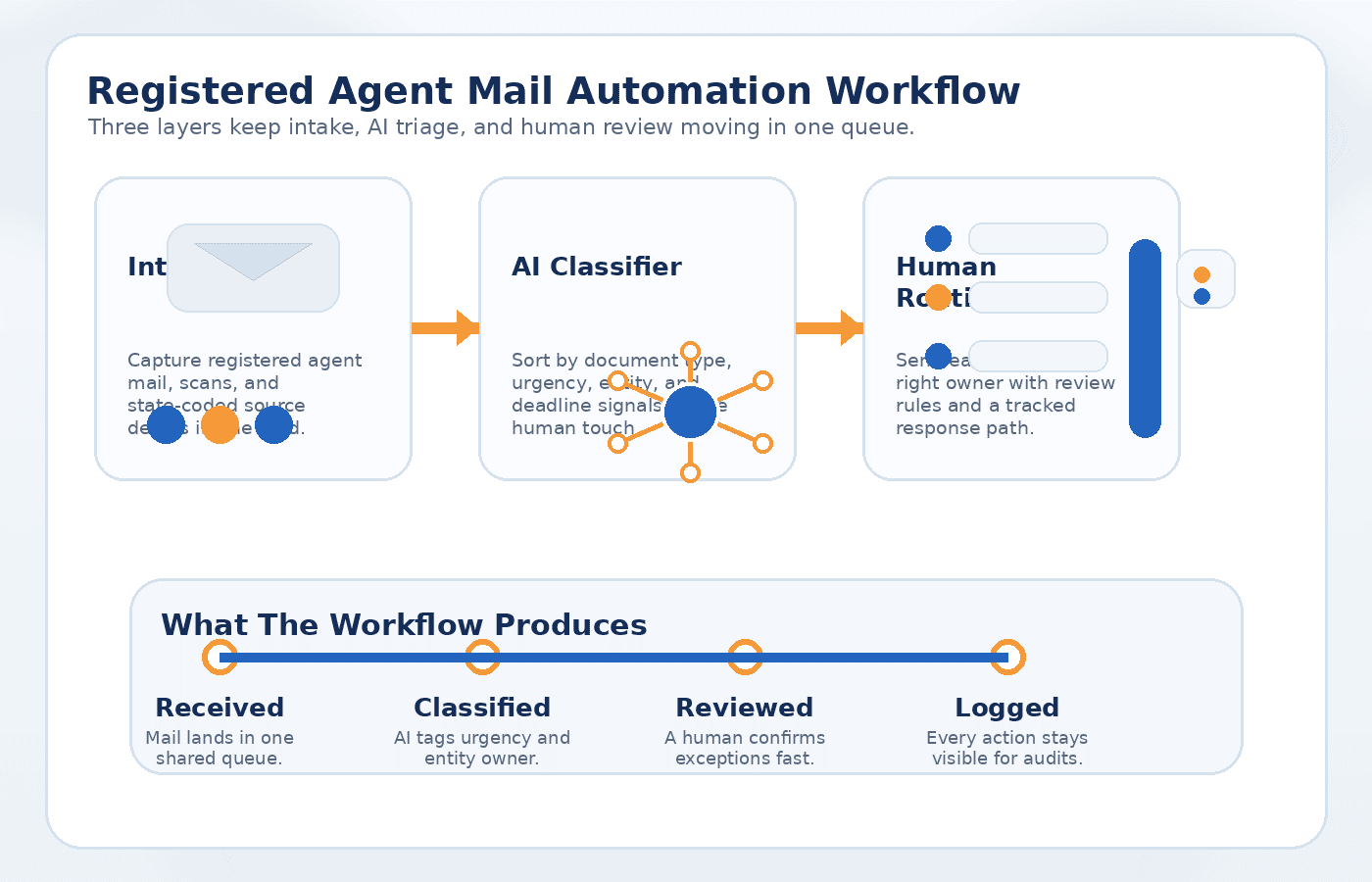
Below is a workflow that has been working in 2025 and 2026 for compliance teams running 20 to 50 entities. It is not a research project. It is a stack of off-the-shelf components wired together with the team’s own routing rules.
Step 1: standardize the registered-agent intake across the portfolio
Pick one national registered agent. Move every entity’s appointment to that agent on the standard renewal cycle (do not wait for a crisis to consolidate — the cost of a mid-year agent change is real but smaller than the cost of running a fragmented portfolio for another year). Confirm that the agent provides structured intake records with at minimum: date received, sender, entity, jurisdiction, document type hint, and a per-page scan.
If your current agent does not provide structured intake, you are paying for a mailbox. The first automation decision is the agent choice, not the AI choice.
Step 2: pull the agent’s feed into a single queue
Connect the agent’s API, daily email digest, or portal export to a single queue. The queue is the source of truth for incoming mail. Common queue backends in 2026 include a dedicated inbox, a Slack channel, a ticketing system, a low-code automation platform, or a compliance platform with mail-handling built in. The right choice depends on how the rest of the team already works — pick the queue the team will actually open, not the queue that is architecturally purest.
Step 3: classify with an AI layer
Run the structured intake records through an AI classifier. The classifier outputs:
- document type (service of process, state annual report notice, state tax notice, secretary of state correspondence, registered-agent-related correspondence, federal notice, vendor correspondence, junk)
- priority label (critical, high, standard, low)
- deadline language flag (whether the document contains a hard deadline, and if so, the date)
- entity match confidence (how sure the system is that the document actually refers to the right entity)
- suggested next step (a one-line hint for the human reviewer)
The classifier is the part that benefits most from a guardrail framework. A widely cited reference for thinking about AI risk in production workflows is the NIST AI Risk Management Framework (AI RMF) and its companion Generative AI Profile, which describe how teams should govern, map, measure, and manage AI risk in document-handling workflows. The framework is voluntary and non-sector-specific, but the four-function structure (Govern, Map, Measure, Manage) maps cleanly onto a registered-agent mail workflow.
Step 4: route to a human with a documented rule
Each classification maps to a documented routing rule. Examples:
- service of process → legal team, immediate notification, 24-hour acknowledgment required
- state tax notice with a deadline → finance and compliance, same-day notification, 48-hour acknowledgment required
- state annual report notice → compliance, next-day notification, 7-day acknowledgment required
- routine correspondence → compliance, batched daily digest, no acknowledgment required
- junk → no notification, archived for 90 days
The routing rule is in the workflow, not in someone’s head. When a new document type appears, the rule is updated once and the workflow continues.
Step 5: enforce human-review triggers
The AI should never be the final decision on a high-stakes classification. The workflow should force human review when:
- the document type is service of process
- the deadline flag is set and the deadline is fewer than 14 days out
- the entity match confidence is below a threshold (for example, 85%)
- the document references litigation or a regulatory action
- the document language is not English (or the team’s working language) and translation is required
- the document scan quality is below the OCR confidence threshold
The human review is logged. The human’s decision is the decision.
Step 6: produce an audit log
Every action — intake timestamp, classification, priority label, routing decision, recipient, acknowledgment, next-step action — is recorded. The log is exportable as a CSV or JSON. The log is searchable by entity, by state, by document type, by recipient, and by date range. The log is the answer to the question, “What happened with this notice?”
The log is also the input to the next cycle of improvement. A workflow that produces a clean log is a workflow that can be tuned. A workflow that produces a noisy log is a workflow that cannot be improved.
What AI should not do in this workflow
The temptation, especially in 2026, is to over-automate. The right discipline is to keep the human in the loop for the decisions that actually matter.
AI should not decide whether to respond to a lawsuit. A service-of-process document may need a response in 7 days, 21 days, or 30 days depending on the jurisdiction, the entity’s standing, and the nature of the claim. The decision to respond, the decision on what to file, and the decision on who signs the response are legal decisions. AI can classify the document and route it. It should not draft the response.
AI should not decide whether a tax notice is a real liability. Tax notices often include amounts, due dates, and penalty calculations that depend on facts the system does not have. The decision on what to pay, what to dispute, and what to ignore is a finance and legal decision. AI can flag the document and route it. It should not pick the action.
AI should not rewrite or summarize a state filing requirement. State-specific filing language is precise. A summary that drops a phrase like “must be filed within 60 days” can turn a 60-day deadline into a 30-day misunderstanding. The workflow should preserve the original document language and let the human read the language the state actually wrote.
AI should not silently update entity records. Some compliance teams are tempted to let the AI parse a state annual report confirmation and update the entity’s standing in the internal system. The temptation should be resisted. The internal record is the system of record. Updates from AI-parsed mail should be queued for human confirmation before they write to the system of record.
AI should not run unsupervised for long periods. A workflow that runs without review for months will drift. The classifier’s accuracy will degrade as state forms change. The routing rules will fall out of date as the team changes. The workflow should be reviewed quarterly and adjusted.
The guardrails a multi-state team should require
The workflow needs guardrails in writing. The guardrails are the difference between a workflow a team trusts and a workflow a team is afraid of.
Guardrail 1: confidence thresholds for every classification. The classifier outputs a confidence score. The workflow escalates anything below the threshold. The threshold is documented and reviewed quarterly.
Guardrail 2: human-in-the-loop for high-stakes document types. Service of process, tax notices with deadlines, and regulatory correspondence always go to a human before any action is taken. The human acknowledgment is logged.
Guardrail 3: entity-context awareness. The classifier uses the right entity’s context, not a generic model. The system should not confuse an entity named “Atlas Holdings LLC” in Delaware with a similarly named entity in another state. Entity disambiguation is a feature, not a nice-to-have.
Guardrail 4: data residency and access control. The mail data may include personally identifiable information, financial information, or legal communications. The workflow should specify where the data is stored, who can access it, and how long it is retained. The retention policy should match the team’s document-retention policy and the applicable state bar requirements.
Guardrail 5: rollback capability. If a misclassification cascades — a service-of-process document routed as routine correspondence, for example — the team must be able to find the document, identify the failure, and correct the routing rule. The audit log is the rollback path.
Guardrail 6: vendor and model transparency. If the AI layer is a third-party model or platform, the team should know which model is in use, what data the model sees, and whether the vendor uses the data for training. The answer affects the team’s own data-handling obligations.
Guardrail 7: periodic review of the routing rules. The team should review the routing rules at least quarterly. New document types appear. Team members change. State filing cadences shift. The rules should change with them.
The data the workflow produces, and what it is good for
A working workflow produces a steady stream of structured data. Most teams under-use that data.
For the compliance team: the workflow produces a daily feed of incoming mail, classified by type and priority, with routing acknowledged. The team’s morning review is a 10-minute review of the feed, not a 2-hour review of 20 inboxes.
For the legal team: the workflow produces a record of every service-of-process receipt, every regulatory notice, and every state correspondence that touches the entity portfolio. The legal team uses the record to track litigation exposure, regulatory exposure, and the chain of custody on every matter.
For finance: the workflow produces a feed of state tax notices, fee notices, and penalty notices. Finance uses the feed to plan payments, to dispute incorrect assessments, and to reconcile the entity portfolio’s actual state-level cost.
For leadership: the workflow produces a quarterly compliance summary — how many notices received, how many deadlines met, how many missed, how the trend compares to prior quarters. The summary is the basis for the leadership conversation about whether the compliance function is keeping up with the entity count.
For audits and disputes: the workflow produces an exportable log that supports an audit response, a litigation hold, a regulatory inquiry, or a board request. The log is the team’s evidence that the compliance function was working.
The practical sequence for standing the workflow up over a quarter
A team that has never run a structured mail workflow before should not try to stand up the entire system in a week. The realistic sequence is a quarter.
Month 1: foundation. Consolidate the registered-agent relationship. Confirm the agent provides structured intake. Set up the queue. Document the routing rules in a shared document. Define the document types and priority labels the team will use.
Month 2: AI layer and guardrails. Stand up the AI classifier. Define the confidence thresholds. Define the human-in-the-loop rules. Test the classifier against a held-out set of historical mail (with redaction as needed). Tune the classifier. Document the guardrails.
Month 3: routing and audit. Wire the routing rules to the queue. Wire the audit log. Run the workflow in shadow mode for two weeks (the AI classifies and routes, but the team double-checks every decision). Adjust the rules based on shadow-mode findings. Turn on live mode at the end of month 3.
Month 4 onward: tune. Review the routing rules quarterly. Review the classifier accuracy quarterly. Review the guardrails annually. Adjust as the entity count grows and as state filing requirements change.
A team that follows this sequence will spend the first quarter building a workflow the team actually uses, not a workflow that looks impressive in a vendor demo and falls apart in week three.
What the workflow does not solve
Honesty matters. The workflow does not solve every problem a multi-state compliance team faces.
The workflow does not replace a competent registered agent. If the agent misses mail, scans documents poorly, or fails to flag a service-of-process receipt, the workflow has nothing to work with. The first decision is the agent.
The workflow does not replace state-specific expertise. Some state filings have odd requirements. Some state notices are written in language that only an expert recognizes. The workflow routes the notice to the expert. It does not replace the expert.
The workflow does not replace a calendar of filing deadlines. The workflow handles incoming mail. It does not generate outgoing filings. The team’s filing calendar — annual reports, biennial reports, business privilege tax returns, foreign qualification renewals — is a separate system, and it should be maintained with the same discipline as the mail workflow. The mail workflow and the filing calendar should be designed to work together: the mail workflow surfaces the notices, the filing calendar schedules the responses, and the two systems share the same entity-level source of truth.
The workflow does not eliminate the need for human judgment. It compresses the time between intake and judgment. It does not eliminate the judgment.
The workflow does not fix a fragmented registered-agent relationship on its own. A team that automates around five different agents in five different states has built five separate workflows that happen to use the same AI. Standardizing the registered-agent relationship across the portfolio is the prerequisite. Once the intake is consistent, the rest of the workflow can be consistent too.
How Rapid Registered Agent fits into the workflow
Rapid Registered Agent’s role in this workflow is the intake layer. The company provides structured intake for mail received on behalf of client entities, with date-received metadata, sender information, entity and jurisdiction tagging, document-type hints, and per-page scans delivered through a portal. The intake is the foundation that the AI classifier and the routing layer depend on.
For a multi-state compliance team, that foundation is what makes the rest of the workflow possible. A team that has standardized on a single national registered agent with consistent intake across all 50 states is a team that can run the same AI classifier and the same routing rules across the entire portfolio. A team that has not standardized the intake is a team that is rebuilding the workflow for every state.
For teams that want to evaluate the intake side, the practical first step is a multi-state registered agent setup that consolidates every entity under a single provider with a single master service agreement, a single set of governance documents, and a single intake feed. Teams that handle a higher volume of service-of-process receipts and want a closer look at the reliability side of multi-state registered-agent operations can also review Rapid Registered Agent’s guide on how service-of-process reliability affects brand trust for multi-state businesses.
Frequently Asked Questions
How much does it cost to hire a personal injury lawyer?
We work on a contingency fee basis. This means you do not pay any upfront costs or hourly fees. We only get paid if we successfully recover compensation for you, and our fee is a percentage of the settlement or verdict.
How long do I have to file a personal injury claim in Texas?
In Texas, the statute of limitations for most personal injury cases is two years from the date of the accident. However, certain exceptions apply depending on the specific circumstances. It is important to consult with an attorney as soon as possible to ensure your claim is filed within the legal deadlines.
What if I was partially at fault for the accident?
Texas follows a “modified comparative fault” rule. You can still recover damages as long as your share of the fault is not greater than 50%. Your compensation will simply be reduced by your percentage of fault. If you are found to be 51% or more responsible, you cannot recover damages.
Will my case have to go to trial?
Most personal injury cases are settled out of court through negotiations with the insurance company. However, if a fair settlement cannot be reached, we are fully prepared to take your case to trial to advocate for your rights in front of a judge and jury.
AI sits between intake and human review. It classifies the document, sets a priority, identifies deadlines, and routes the document to the right human. The human still reviews the high-stakes classifications and makes the final decisions.
“},{“question”:”How does the workflow handle service of process specifically?”,”answer”:”Service of process is the highest-priority document type. The classifier identifies it, the workflow routes it to legal immediately, and the human acknowledgment is required within a defined window (typically 24 hours). The physical document is forwarded to outside counsel or in-house legal under the team’s standard service-of-process protocol. A useful companion read is Rapid Registered Agent’s AI Playbooks for Escalating Urgent Legal Mail for a closer look at the escalation side.
“},{“question”:”What is the biggest mistake teams make when standing this up?”,”answer”:”The biggest mistake is starting with the AI layer before the intake layer is standardized. A team that picks an AI tool before it has consolidated its registered-agent relationship ends up tuning the AI to compensate for inconsistent intake. Fix the intake first.
“},{“question”:”How long does it take to see value?”,”answer”:”Most teams see value within the first month of running the workflow in shadow mode. The classifier’s classifications are useful even before the routing rules are live, because the team can see what is coming in and triage manually against the classifier’s output. The full value \u2014 fewer missed deadlines, faster escalation, clean audit logs \u2014 compounds over the first two quarters.
“},{“question”:”Does this workflow replace the team’s compliance staff?”,”answer”:”No. The workflow compresses the time the staff spend on intake and routing. The staff still own the legal, regulatory, and filing decisions. For most teams, the workflow is what makes the existing staff scalable as the entity count grows.
“}]} /–>The bottom line
A multi-state compliance team does not need more people reading mail. It needs a workflow that classifies, routes, and timestamps every piece of mail before a human ever has to read it. The workflow is three layers: a registered agent’s standardized intake, an entity-specific AI classifier, and a documented routing rule that forces human review on the high-stakes document types. The workflow is governed by confidence thresholds, human-in-the-loop rules, and a quarterly review cycle. The workflow produces a clean audit log that supports the team, the legal function, finance, and leadership.
The teams that run this kind of workflow in 2026 are the teams that scale their entity count without scaling their compliance headcount, that answer “what happened with this notice” in minutes instead of days, and that catch the unusual document before the deadline is gone. The teams that do not run this kind of workflow are the teams that discover the missed filing in the reinstatement notice.
The workflow is not magic. It is disciplined, documented, and auditable. That is exactly what compliance work is supposed to be.
Compliance Automation
Registered Agent Mail Automation: AI Workflows for Multi-State Compliance Teams
RRA automates registered agent mail workflows across every state your LLC is filed in, giving multi-state compliance teams a centralized, auditable system for every piece of state correspondence.