
How Franchises Should Standardize Registered Agent Processes Across Multiple States in 2026
A franchise operating in 12 states does not have 12 registered-agent problems. It has one registered-agent problem — the same problem — repeated in every state where the franchise holds a franchise entity, a subsidiary LLC, or a foreign qualification. The problem is operational: who is the registered agent of record in each state, who manages the agent changes when the franchise opens or closes a location, how does the franchise track the annual-report calendar across the portfolio, how does the franchise escalate a service-of-process receipt when it arrives at a state where the franchise has no staff, and how does the franchise keep the franchise’s master service agreement with the registered-agent provider consistent across the portfolio.
A franchise that has not standardized those five answers is a franchise that is going to discover the problem in the worst possible way — at a loan closing, at a franchise renewal cycle, at a franchisee audit, or at a federal regulator inquiry. The failures are not catastrophic one at a time. They are quiet and cumulative: a missed annual report in one state becomes an administrative dissolution, a stale registered-agent address becomes an ignored service of process, a multi-state portfolio with no master service agreement becomes a per-state negotiation with no pricing leverage.
This article walks through why multi-state franchises are uniquely exposed to registered-agent drift, the five elements of a standardized multi-state registered-agent program (single provider, single internal owner, single annual-report calendar, single service-of-process escalation protocol, single set of governance documents), how the standardization compounds savings and reduces compliance risk over time, and the practical order for a franchise that wants to consolidate from a portfolio of inconsistent state-by-state registered-agent arrangements into a single coordinated program.
Why multi-state franchises are uniquely exposed
A franchise is exposed to registered-agent drift in a way that a single-state LLC is not. The reasons compound.
Reason 1: the franchise’s entity count grows with the franchise. A franchise that opens 50 locations across 20 states holds — typically — one or more entities in each state. A franchise with 50 locations in 20 states might hold 20 to 25 franchise entities (one per state, plus a parent entity, plus state-level subsidiaries for real estate, plus state-level subsidiaries for specific franchisee arrangements). Each entity requires its own registered agent in its own state. The franchise’s registered-agent complexity grows with the franchise’s location count, not with the franchise’s headcount.
Reason 2: the franchise’s entity count contracts and expands through franchisee turnover. Franchise entities are not static. A franchise opens a new location (new entity in a new state, or new entity in an existing state); a franchise closes a location (the entity needs to be administratively dissolved or merged); a franchisee transfers ownership (the entity may need to be retitled, and the registered agent may need to be changed). Each transition creates a registered-agent event that has to be coordinated across the portfolio.
Reason 3: the franchise’s state-by-state registered-agent arrangements drift over time. A franchise that opened its first location in 2010 may have hired a local attorney as registered agent in that state, hired a national registered-agent provider for the next three states, hired a different national provider for the next two states, hired a different local attorney for the next five states, and so on. Each state was an independent decision made at the time of entry. The portfolio is now a patchwork with no consistent pricing, no consistent service-of-process handling, no consistent annual-report cadence, and no consistent governance documentation.
Reason 4: the franchise’s annual-report calendar fragments across the portfolio. Each state has its own annual-report deadline, its own annual-report fee, its own late-file penalty, and its own escalation sequence when an annual report is missed. A franchise with 20 entities in 20 states has 20 annual-report deadlines on 20 different dates. Without a centralized calendar, the franchise misses annual reports — and the franchise’s first indication of a missed annual report is the Secretary of State’s administrative dissolution notice, which arrives after the LLC has already lost its good standing.
Reason 5: the franchise’s service-of-process exposure multiplies. Service of process is the registered agent’s primary compliance function — the agent receives lawsuits, subpoenas, and other legal process on the LLC’s behalf and forwards them to the LLC. A franchise operating in 20 states receives service of process at 20 different addresses, through 20 different agents, on 20 different service-level agreements. The franchise’s risk of missing a service of process — or handling it inconsistently — multiplies with the entity count. For a related operational angle, see How Service-of-Process Reliability Affects Brand Trust for Multi-State Businesses.
The combined effect: a multi-state franchise without a standardized registered-agent program is paying for the worst of both worlds — multiple providers’ fees without consolidated pricing, multiple service-level agreements without consistent handling, and multiple compliance gaps without a centralized owner.
The five elements of a standardized multi-state registered-agent program
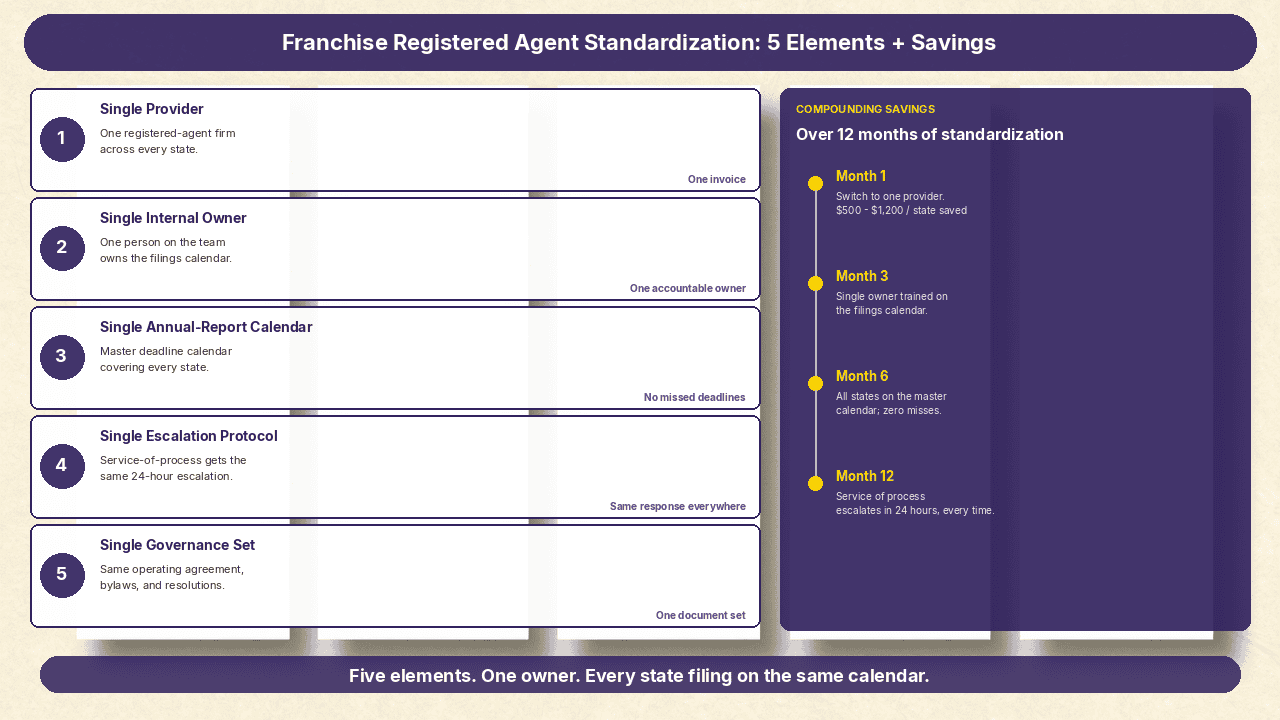
The standardization has five elements. Each one is a discrete decision that the franchise can make and document.
Element 1: a single national registered-agent provider. The franchise appoints one registered-agent provider with coverage in every state where the franchise operates (and in every state where the franchise is likely to operate in the next 12 to 24 months). The provider holds the registered-agent appointment for every franchise entity, in every state. The provider delivers a single master service agreement that covers all entities, all states, all service-of-process handling, and all annual-report reminders. The franchise’s pricing is consolidated — typically a per-entity, per-state annual fee, with volume discounts above a threshold. The franchise’s service-of-process handling is uniform — every process receipt, in every state, follows the same escalation protocol. The franchise’s annual-report reminders come through a single dashboard, not 20 separate emails from 20 separate providers.
Element 2: a single internal owner for the franchise’s multi-state entity portfolio. The franchise appoints one person (or one role) inside the franchise who owns the multi-state entity portfolio. The owner is responsible for the franchise’s entity count, the franchise’s registered-agent appointments, the franchise’s annual-report calendar, the franchise’s service-of-process escalations, and the franchise’s compliance standing in every state. The owner has authority to make entity-level decisions on behalf of the franchise (open, close, merge, retitle). The owner is the single point of contact between the franchise and the national registered-agent provider.
Element 3: a single annual-report calendar. The franchise builds a single annual-report calendar that covers every entity, every state, every deadline, every fee, every late-file penalty. The calendar is typically maintained in a spreadsheet or a compliance platform (Rapid Registered Agent offers a multi-state compliance dashboard for this purpose). The calendar generates reminders 60 days, 30 days, and 7 days before each deadline. The owner reviews the calendar weekly. The franchise’s annual-report compliance is measured against the calendar — every entity either is current on its annual report or has a documented exception. When the franchise adds a new state, the owner can also cross-check official filing contacts using the IRS state government websites directory.
Element 4: a single service-of-process escalation protocol. The franchise designs a single service-of-process escalation protocol that the registered-agent provider follows in every state, for every entity, for every process receipt. The protocol specifies: (a) who at the franchise receives the initial notification (typically the internal owner); (b) how quickly the franchise must acknowledge receipt (typically 24 hours); (c) who receives the physical process (typically in-house counsel or outside counsel, depending on the matter type); (d) how quickly the physical process must be forwarded (typically 24 hours); (e) who decides on the substantive response (typically the franchise’s general counsel or outside litigation counsel). The protocol is documented in the master service agreement with the registered-agent provider, and the protocol is enforced through the provider’s service-level commitment.
Element 5: a single set of governance documents. The franchise maintains a single set of governance documents for every franchise entity: a single operating agreement template, a single member consent template, a single assignment template, a single dissolution template. Each entity’s actual operating agreement is customized to the entity’s specific role (real estate subsidiary, franchisee entity, IP holding entity) but follows the template. The franchise’s governance documentation is consistent across the portfolio — the franchise can pull any entity’s governance documents and find the same structure, the same provisions, and the same definitions across the portfolio. The simplification makes the franchise’s annual governance reviews faster and cheaper.
The five elements compound. A single provider reduces per-entity cost. A single owner reduces coordination overhead. A single calendar reduces missed-deadline risk. A single protocol reduces service-of-process mishandling. A single document set reduces governance overhead. Each element on its own improves the franchise’s standing; the five together transform the franchise’s compliance posture.
How standardization compounds savings over time
The standardization is not free. The franchise pays the national provider’s annual fee for every entity (typically $100 to $150 per entity per state for a national provider, less than a local attorney’s $250 to $500 per entity per state). The franchise pays the internal owner’s salary (or allocated portion of the salary) for the multi-state entity portfolio management. The franchise pays the compliance platform’s subscription (or the spreadsheet maintenance time).
The savings compound over three horizons.
Year 1 horizon: lower per-state cost, faster entity onboarding. The franchise’s per-entity registered-agent fee drops from $250-$500 per state (local attorney) or $150 per state (national provider, inconsistent) to $100-$150 per state (national provider, consistent). The franchise opens new entities faster because the registered-agent appointment is a single onboarding event with a single provider, not a per-state negotiation. The franchise’s pricing leverage on the national provider is meaningful above 50 entities — most national providers offer volume discounts above 50, 100, and 250 entities.
Year 2-3 horizon: lower annual-report compliance cost, lower missed-deadline cost. The franchise’s annual-report compliance cost drops because the annual-report calendar is centralized. The owner spends less time chasing per-state deadlines. The franchise’s missed-deadline cost drops because the calendar prevents the franchise from missing annual reports in the first place — and a missed annual report in a single state can cost the franchise the LLC’s good standing in that state, which can trigger franchise-renewal issues, loan-covenant breaches, and franchisee-relationship disputes.
Year 4-5 horizon: lower service-of-process cost, lower governance cost. The franchise’s service-of-process handling cost drops because the protocol is consistent — every process receipt follows the same escalation, every escalation reaches the right person, every response is handled within the protocol’s timing. The franchise’s governance cost drops because the document set is consistent — the franchise can run governance reviews across the portfolio in a fraction of the time it took when each entity had its own bespoke operating agreement.
The compounding effect: a franchise that standardizes its registered-agent program at 25 entities and grows to 75 entities over five years spends less in year five (per entity, per state) than the franchise spent in year one — because the standardization scales, while the per-state cost does not.
How standardization reduces compliance risk
The compliance risk reduction is more meaningful than the cost reduction.
Risk 1: missed annual reports. A franchise without a centralized calendar misses 5% to 10% of annual reports in any given year (the typical industry rate for multi-state entities without centralized tracking). A franchise with a centralized calendar and a 60/30/7-day reminder sequence misses under 1%. The avoided missed annual reports save the franchise from administrative dissolutions, from reinstatement fees, and from the franchise-renewal-cycle disruptions that follow an administrative dissolution.
Risk 2: stale registered-agent appointments. A franchise without a single provider has stale registered-agent appointments scattered across the portfolio — a resigned local attorney in one state, a defunct local firm in another, an outdated national provider relationship in a third. A franchise with a single provider has current appointments in every state because the provider’s relationship is the source of truth. The franchise’s service-of-process receipts always reach a current agent.
Risk 3: inconsistent service-of-process handling. A franchise without a single protocol handles service-of-process inconsistently — a critical lawsuit gets escalated immediately in one state, sits in a regional manager’s inbox for a week in another, and gets forwarded to the wrong person in a third. A franchise with a single protocol handles every process receipt the same way. The franchise’s litigation response time drops. The franchise’s litigation outcomes improve.
Risk 4: governance documentation drift. A franchise without a single document set has governance documentation that drifts over time — older entities have old operating agreements, newer entities have updated agreements, and the franchise’s counsel cannot reconcile the two when a dispute arises. A franchise with a single template has consistent governance documentation across the portfolio. The franchise’s counsel can run portfolio-level governance reviews and identify issues quickly.
The combined risk reduction is the franchise’s primary value from standardization. The cost savings are the secondary value. Both compound.
The practical order for consolidating a multi-state portfolio
A franchise that wants to consolidate from a patchwork of registered-agent arrangements into a single standardized program should follow a five-step sequence.
Step 1: inventory the current portfolio. The franchise pulls every state-level entity record, every registered-agent appointment, every annual-report history, every service-of-process receipt history (typically through the registered-agent provider’s account), and every governance document. The inventory establishes the baseline — what the franchise has, where the franchise has it, and what the franchise is paying for it.
Step 2: select a single national registered-agent provider. The franchise evaluates national providers against five criteria: coverage in every state where the franchise operates, master service agreement flexibility, service-of-process handling capabilities, annual-report reminder and filing capabilities, and per-entity pricing at the franchise’s volume. The franchise selects one provider and negotiates a master service agreement that covers the entire portfolio. Franchisors also need to keep this operating model aligned with the FTC Franchise Rule when disclosure and renewal systems rely on accurate state-by-state entity data.
Step 3: appoint the internal owner. The franchise appoints one person (or one role) to own the multi-state entity portfolio. The owner has authority to make entity-level decisions, is the single point of contact with the registered-agent provider, and is accountable for the portfolio’s compliance standing.
Step 4: build the annual-report calendar. The franchise builds a centralized annual-report calendar that covers every entity, every state, every deadline. The calendar generates 60/30/7-day reminders. The owner reviews the calendar weekly. The franchise’s annual-report compliance is measured against the calendar.
Step 5: document the service-of-process escalation protocol and the governance templates. The franchise documents the escalation protocol in the master service agreement with the registered-agent provider. The franchise updates the governance templates and rolls the templates out across the portfolio as entities come up for annual review.
The five steps typically take 60 to 90 days for a franchise with 25 to 50 entities. The savings and risk reduction begin in the first full quarter after the standardization is complete.
What changes when the franchise opens a new state
The franchise’s standardization changes the cost of opening a new state.
Without standardization, opening a new state is a 30-to-60-day project that includes: selecting a registered agent in the new state, negotiating a per-state agreement, drafting state-specific governance documents, setting up the entity, filing formation, and adding the new state to the franchise’s ad-hoc annual-report tracking. The franchise pays full per-state pricing and absorbs the coordination overhead.
With standardization, opening a new state is a 1-to-3-day project that includes: requesting the new entity from the national provider, executing the master service agreement’s state addendum (if needed), using the franchise’s standard governance templates, filing formation through the franchise’s existing workflow, and adding the new state to the centralized annual-report calendar. The franchise pays the national provider’s per-state rate, with the volume discount, and absorbs minimal coordination overhead. The same repeatable playbook helps when expansion is triggered by hiring across state lines, which is why this process pairs naturally with When a Remote Hire Triggers Foreign Qualification: A 2026 Multi-State Guide for Employers.
The difference is the difference between the franchise treating multi-state expansion as a custom project and treating multi-state expansion as a repeatable process. The franchise that scales is the franchise that has made multi-state expansion repeatable.
What changes when the franchise closes a state
The franchise’s standardization also changes the cost of closing a state.
Without standardization, closing a state is a 60-to-90-day project that includes: filing articles of dissolution in the state, settling state tax obligations, terminating the local registered-agent relationship, archiving the entity’s governance documents, and updating the franchise’s ad-hoc tracking. The franchise pays full coordination overhead and risks leaving stale registered-agent appointments or governance documents in the closed state.
With standardization, closing a state is a 7-to-14-day project that includes: filing articles of dissolution through the franchise’s existing workflow, settling state tax obligations through the franchise’s existing owner, terminating the registered-agent relationship through the master service agreement, archiving the governance documents using the franchise’s standard templates, and updating the centralized calendar. The franchise’s standardized workflow handles the close.
The difference is the difference between the franchise treating multi-state contraction as a custom project and treating multi-state contraction as a repeatable process.
The relationship between the standardization and the franchisee’s own compliance
The standardization described in this article is at the franchisor level — the franchisor’s portfolio of franchise entities, subsidiary LLCs, and state-level holdings. It is separate from the franchisee’s own compliance obligations.
A franchisee is an independent business owner who holds the franchisee’s own entity (typically an LLC), files the franchisee’s own state filings, and maintains the franchisee’s own registered agent in the franchisee’s state. The franchisee’s compliance is the franchisee’s responsibility, not the franchisor’s.
The standardization matters for the franchisor’s portfolio, not for the franchisee’s entity. The franchisor’s portfolio is what the franchisor manages directly; the franchisee’s entity is what the franchisee manages. The two are independent.
This separation is one reason why the standardization compounds. The franchisor’s portfolio is bounded — it grows with the franchisor’s locations, not with the franchisee’s locations. The franchisor can design a program that scales across the franchisor’s portfolio without coordinating with the franchisee’s separate compliance obligations.
The practical rule for 2026
The practical rule for a multi-state franchise that wants to standardize its registered-agent program in 2026 is that the standardization is at the franchisor level — one national provider, one internal owner, one annual-report calendar, one service-of-process escalation protocol, one set of governance documents. The five elements compound. The cost savings begin in year one and grow with the portfolio. The compliance risk reduction begins in year one and persists across the portfolio’s lifetime.
The decision rule: if the franchise operates in more than three states with more than five entities, the franchise should standardize. Below that threshold, the per-state overhead is manageable without a centralized program. Above that threshold, the per-state overhead exceeds the cost of the centralized program — and the missed-deadline risk exceeds the cost of the centralized calendar.
For a franchise that wants the multi-state entity portfolio audited, the registered-agent provider selected, the master service agreement negotiated, the annual-report calendar built, the service-of-process escalation protocol documented, and the governance templates rolled out — typically when the franchise is consolidating from a patchwork of state-by-state arrangements into a single coordinated program — request a multi-state franchise compliance review through Rapid Registered Agent.
A short walkthrough of the broader registered-agent compliance cycle a franchise needs to standardize — useful background before the master service agreement conversation starts:
Frequently Asked Questions
How should franchises standardize registered agent processes across multiple states in 2026?
Franchises standardize the multi-state registered-agent program by appointing one registered-agent provider nationwide, centralizing the annual-report calendar into a single dashboard, defining a single service-of-process escalation protocol, gating state openings and closings through a centralized checklist, and bringing franchisees onto the same master service agreement. The five moving parts — provider, calendar, escalation, new-state checklist, master agreement — are the elements of a standard program, and the franchise's head office runs all five for every state on behalf of every franchisee.
What does a standardized multi-state registered-agent program actually cost?
A standardized program typically runs $10/month per state per entity on a monthly subscription, or $100/year per state per entity on a yearly subscription. For a 30-state franchise, the annual program cost lands around $30,000-$36,000 with the multi-state discount most registered-agent providers offer. Per-franchisee filings (formation, foreign qualification, amendments) carry their own state-specific fees that the franchise budget books separately from the registered-agent subscription.
What does standardization actually save?
Standardization reduces three cost lines. It cuts the per-franchisee billable-hour rate the franchise spends chasing missed deadlines because the calendar is centralized. It reduces the renewal error rate because the same template runs across every state. It shortens onboarding time when the franchise opens a new state, because the new-state checklist has been written once and runs in every state the franchise enters.
What does the franchise gain by consolidating registered-agent providers?
The franchise gains a single billing relationship, a single service-of-process escalation protocol, a single annual-report calendar, and a single point of contact for any state-specific compliance question. The franchise's head office stops managing 30 separate providers and starts managing one master service agreement. The cost savings show up on the franchise's compliance team's billable time, on the reduced missed-deadline rate, and on the faster onboarding when the franchise opens new states.
How does standardization reduce compliance risk?
Standardization reduces compliance risk by eliminating the per-state variability the franchise is exposed to under a patchwork of providers. A missed annual report in one state cannot be missed if all annual reports run through the same calendar with the same escalation. A signed-and-undelivered service-of-process letter in one state cannot happen if all service flows through the same protocol. The franchise's compliance posture becomes auditable in a single file rather than reconstructed across 30 separate providers.
Should the franchise standardize the master service agreement across franchisees?
Yes. The franchise benefits from getting every franchisee onto the same master service agreement at formation, so the franchise's compliance posture is uniform from the moment each franchisee opens. Standardizing the master agreement at the franchise formation level also gives the franchise central negotiating leverage with the registered-agent provider, which typically lands a better multi-state rate than the per-franchisee rate the franchisee could negotiate alone.
Franchise Compliance
How Franchises Should Standardize Registered Agent Processes Across Multiple States
RRA consolidates franchise registered agent services across every state of operation, giving franchise compliance teams a single point of contact and a unified record for every state filing.