
Washington B&O Tax Registration After LLC Formation in 2026: Steps Founders Skip

Most founders think forming a Washington LLC is the state-setup step, which is why Washington B&O tax registration is the step that gets skipped the most.
It is the first half of the state-setup step.
The second half is B&O tax registration through the Department of Revenue, and it is the part that gets skipped, delayed, or handled in the wrong order more often than any other.
In 2026, the clean Washington setup is:
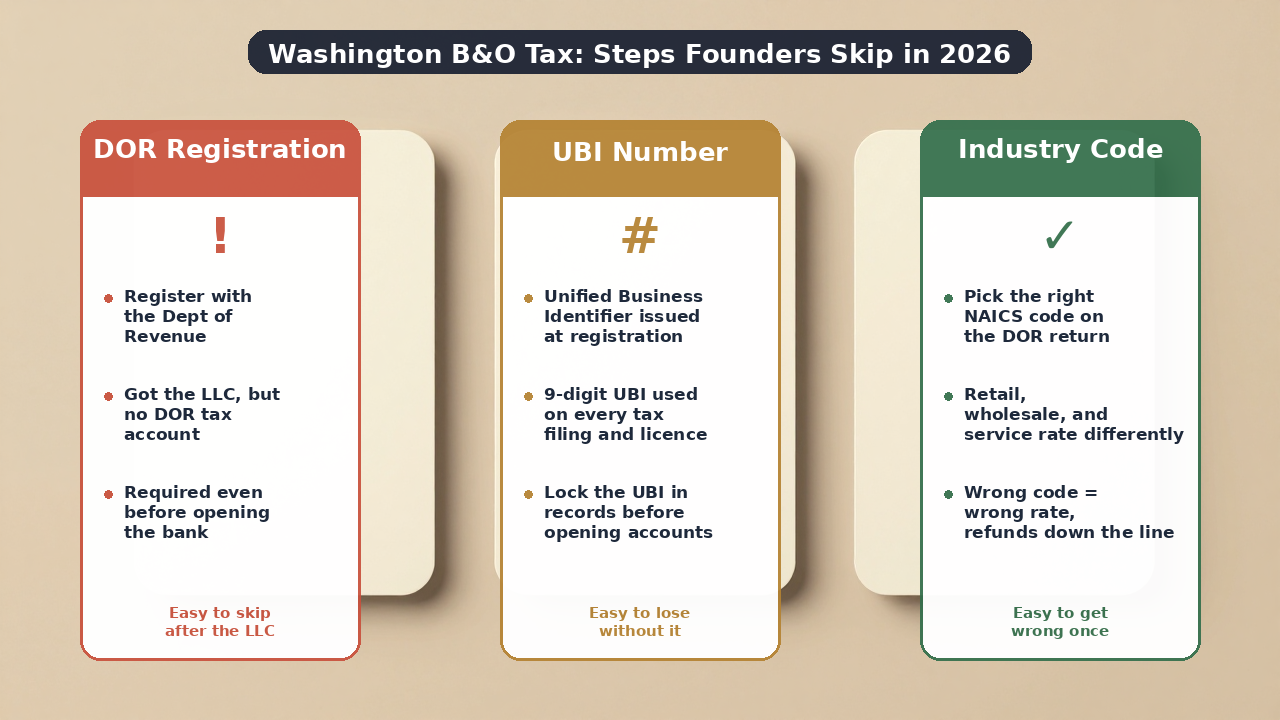
1. Form the LLC with the Washington Secretary of State.
2. Get the EIN from the IRS tied to that LLC.
3. Apply for the Washington business license and register for B&O tax through the Department of Revenue.
4. Wait for the UBI number and the filing-frequency assignment before starting taxable activity.
Skipping any of those steps, or assuming the LLC filing alone covers the DOR side, creates compliance friction that the state will eventually surface.
## What the LLC filing actually covers
The LLC is filed with the Washington Secretary of State Corporations and Charities division.
That is the filing that creates the legal entity under Washington law.
It is also the filing the DOR expects to see first.
The Department of Revenue’s business-license guidance is direct: if your business structure is a Washington domestic LLC, you must file with the Washington Secretary of State before filing the Business License Application.
So the LLC is a prerequisite to the DOR application, not a substitute for it.
For a closer look at the LLC formation documents themselves, this related guide is useful: Washington LLC Documents: Example and State Comparisons.
## What B&O tax actually is
Washington’s business and occupation tax is the state’s gross receipts tax.
The Department of Revenue says most businesses in Washington are subject to it, and that it is calculated on the total value of products sold or the total income the business earns.
That is the part founders miss most often.
B&O is not a tax on profit.
It is calculated on gross income.
The DOR says businesses cannot deduct expenses such as labor, materials, taxes, or other costs of doing business against B&O tax.
So an LLC that bills $500,000 and nets $80,000 still has the B&O calculation built off $500,000.
That changes how a founder should think about pricing, expense timing, and the working capital needed to cover B&O obligations on top of federal income tax.
## The B&O rate depends on what the LLC actually does
The same DOR page says there are more than 50 different B&O tax classifications, and a business must report under the classification that matches the activities it performs in Washington.
If the LLC performs more than one type of activity, it may owe tax under more than one classification.
That is the second thing founders skip.
They assume “B&O tax” is one rate.
It is not.
A consultant LLC and a retail LLC will report under different classifications with different rates, and a single LLC that consults and sells goods may have to split-report.
The DOR also points to a small business B&O tax credit and the Multiple Activities Tax Credit (MATC) for businesses with more than one classification.
These credits exist because the state knows the classification rules catch people off guard.
## Why the business license comes after the LLC and before the first sale
The Department of Revenue’s business-license application page lists the registration triggers that pull a Washington business into DOR oversight.
A business must register and get a Washington business license if it:
– plans to hire employees within the next 90 days,
– sells a product or provides a service that requires the collection of sales tax,
– has gross income of $12,000 per year or more,
– is doing business using a name other than your full legal name,
– requires city, county, or state endorsements,
– is a buyer or processor of specialty wood products,
– meets a nexus reporting threshold,
– or is required to pay other DOR taxes or fees.
The page is also clear that for an LLC, the SOS filing comes first, then the Business License Application.
The order is not optional.
The same page says online applications take approximately 10 business days to process, and applications with city or state endorsements can take an additional 2 to 3 weeks.
Mailed applications can take up to six weeks.
That timing matters because of a line on the DOR next-steps page: do not begin any business activity until you receive your business license.
A founder who forms the LLC on Monday and starts invoicing on Tuesday has skipped the license step, even if the LLC itself is fine.
## The UBI number is the piece everything else hangs on
The DOR assigns a Unified Business Identifier (UBI) number when the business license application is approved.
That UBI is not just a confirmation.
It is what the LLC uses to file B&O tax returns, change business information, and tie the entity to other state agencies including Labor and Industries and Employment Security.
The next-steps page also says the DOR will assign a filing frequency — monthly, quarterly, or annually — at the time the application is approved, and the LLC will need to file an excise tax return even if it has no business to report for a period.
That is the third thing founders skip.
They expect to file B&O tax only when they have revenue.
In Washington, an LLC with a UBI files on the assigned frequency whether or not there is anything to report, until the entity is closed.
## A real-world example: the consulting LLC that registered but never filed
Picture a solo consultant in Seattle who formed an LLC, got an EIN, and started taking on client work.
She figured the LLC filing covered the state side and the federal side handled the rest.
Six months in, she received a letter from the Department of Revenue.
The letter asked why her LLC had a UBI number but no excise tax returns on file.
She had been billing clients for six months and had no idea she was supposed to file B&O returns on a quarterly cadence.
The fix was straightforward: register a MyDOR account, file six zero returns for the prior periods, and start filing on the assigned cadence going forward.
The lesson was more expensive: forming an LLC and registering for B&O are not the same step, and “I haven’t done anything yet” is not the same as “I don’t owe anything yet.”
That is the everyday shape of what gets skipped after a Washington LLC formation.
## Other state-agency steps founders skip
The DOR next-steps page is also explicit about what else comes online the moment an LLC starts operating in Washington.
If the LLC hires employees, it must submit quarterly reports to the Washington Department of Labor and Industries and the Employment Security Department, even with zero active hours.
The LLC may also need to apply for a Federal Employer Identification Number from the IRS at IRS.gov — and the IRS expects the LLC to be formed before the EIN is issued, mirroring the same sequence the DOR expects.
LLCs may also need to report beneficial ownership information to FinCEN under the Corporate Transparency Act rules.
Washington also requires businesses that use personal property (equipment or assets used in conducting business) to file a personal property listing with the county assessor by April 30 of each year.
That is a separate filing from B&O, and it is the fourth thing founders skip.
## The clean 2026 sequence for Washington B&O tax registration after LLC formation
The clean sequence is:
1. Form the LLC with the Washington Secretary of State.
2. Get the EIN from the IRS tied to the new entity.
3. Apply for the Washington business license through the DOR and complete the B&O registration.
4. Wait for the UBI number and the assigned filing frequency before starting taxable activity.
5. If hiring employees, set up the L&I and Employment Security quarterly reporting cycle.
6. If using personal property in the business, plan the county assessor listing by April 30.
7. If the LLC qualifies, claim the small business B&O tax credit on the first filed return.
That sequence is what makes Washington B&O tax registration a setup step instead of a cleanup step in 2026.
If you want the Washington LLC side handled correctly from the start, including the registered agent piece that supports ongoing state compliance, start your Washington LLC with Rapid Registered Agent.
A clean Washington B&O tax registration in 2026 is the difference between a UBI that is set up correctly on day one and a state-compliance gap that surfaces six months later.
Frequently Asked Questions
Does forming a Washington LLC cover B&O tax registration?
No. Forming a Washington LLC with the Secretary of State creates the legal entity but does not register the business with the Department of Revenue. The DOR business-license guidance is direct: for a Washington domestic LLC, you must file with the Secretary of State before filing the Business License Application. The LLC filing is a prerequisite to the DOR application, not a substitute for it.
What is the Washington B&O tax?
Washington’s business and occupation tax is the state’s gross receipts tax. The Department of Revenue says it is calculated on the total value of products sold or the total income the business earns. Because it is based on gross income, businesses cannot deduct expenses such as labor, materials, taxes, or other costs of doing business. The B&O tax is not collected from customers; it is paid by the business itself.
Why is the Washington B&O tax rate not one flat rate?
The DOR says there are more than 50 different B&O tax classifications, and a business must report under the classification that matches the activities it performs in Washington. If the LLC performs more than one type of activity, it may owe tax under more than one classification. The DOR also points to the small business B&O tax credit and the Multiple Activities Tax Credit (MATC) as common credits for qualifying businesses.
When does a Washington LLC need to register with the Department of Revenue?
The DOR lists registration triggers including planning to hire employees within the next 90 days, selling a product or providing a service that requires sales tax collection, having gross income of $12,000 per year or more, doing business under a name other than the owner’s full legal name, requiring city, county, or state endorsements, meeting a nexus threshold, or being a buyer or processor of specialty wood products. In practice, almost every operating LLC triggers at least one of these.
What is a Washington UBI number and why does it matter?
A Unified Business Identifier (UBI) number is the identifier the Department of Revenue assigns when the business license application is approved. The UBI is what the LLC uses to file B&O tax returns, change business information, and tie the entity to other state agencies. The DOR also assigns a filing frequency (monthly, quarterly, or annually) at approval, and the LLC must file an excise tax return on that frequency even if there is no business activity to report.
How long does Washington business license processing take in 2026?
The Department of Revenue says online applications take approximately 10 business days to process, and applications with city or state endorsements can take an additional 2 to 3 weeks. Mailed applications can take up to six weeks. The DOR next-steps page is also clear that a business should not begin any business activity until the license has been received, which means the license step should be planned for, not assumed to be instant.
Related reading
Washington LLC Documents: Example and State Comparisons — What your Articles of Organization and Operating Agreement actually contain.
Washington Registered Agent Requirements in 2026 — The compliance piece that supports every other Washington filing.
Washington LLC compliance support
Stay ahead of B&O tax and state registration in Washington
Keep your Washington LLC in good standing with help that makes B&O tax registration, the UBI number, and multi-state growth easier to manage.
- States Covered
- 50 + DC + PR
- Serving Businesses Since
- 2007
- Plans Start At
- $10/mo per state