
Mississippi Operating Agreement Cleanup in 2026: The Clauses Small LLCs Outgrow Fast

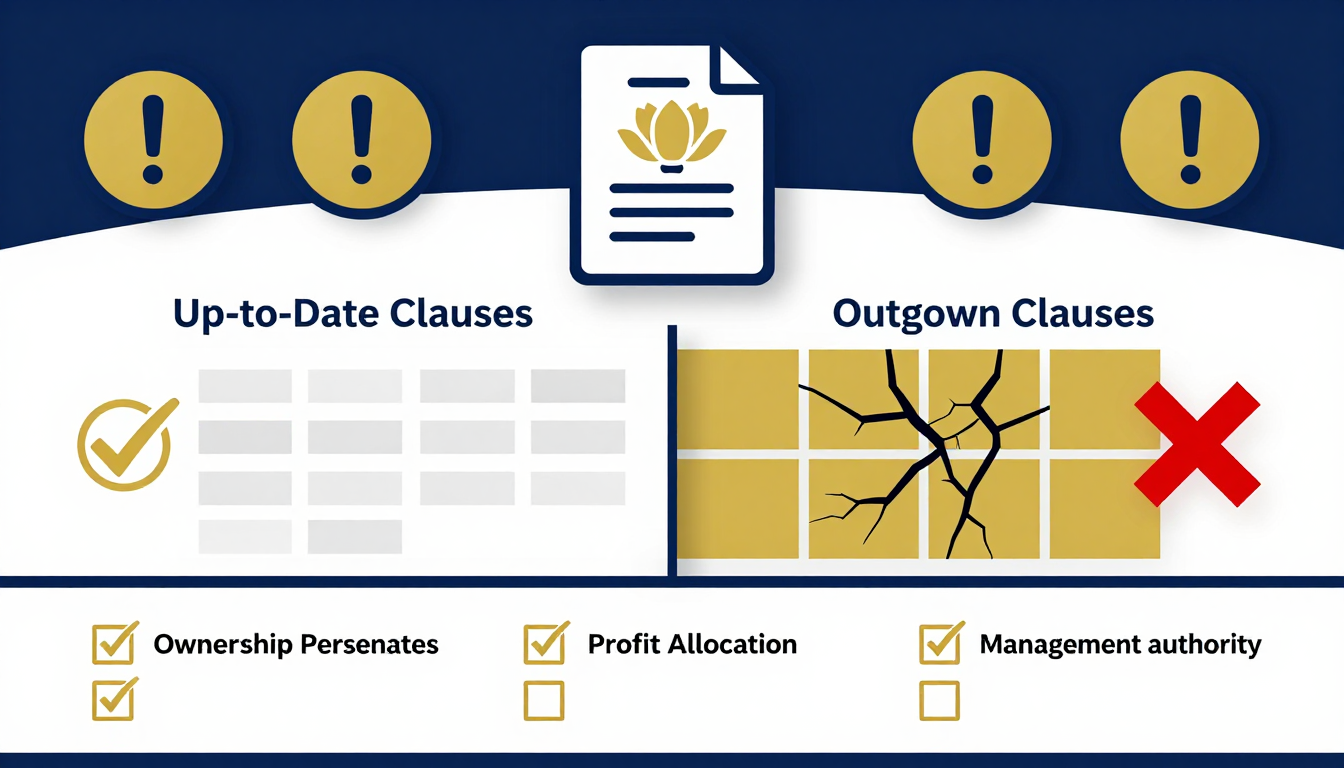
Mississippi Operating Agreement Cleanup in 2026 is the project a Gulf Coast LLC owner starts when they realize their formation paperwork has three members listed but the operating agreement says two. That gap is not a technicality. Under Mississippi law, the operating agreement governs how the LLC runs. If the document does not match who actually owns and runs the company, disputes that should be simple become expensive. This guide covers the specific clauses that stop fitting as a Mississippi LLC grows, and exactly what to fix before those clauses cause a problem.
What a Mississippi Operating Agreement Actually Controls
A Mississippi operating agreement is the governing document for a limited liability company. It sets out who owns what, how profits and losses are divided, how decisions get made, and what happens when a member leaves or dies. Mississippi Code § 79-29-205 explicitly permits — but does not require — LLCs to adopt an operating agreement, and the statute makes clear that the agreement governs the relations among members and between members and the LLC itself.
One common misunderstanding: Mississippi does not require the operating agreement to be filed with the Secretary of State. It stays in the company’s records. That means it is not automatically updated when membership changes, when a new member joins, or when the business pivots. The document can drift from reality for years before anyone notices, and by then the outdated clauses are controlling outcomes that the members never intended.
For a Mississippi LLC that has been operating for more than a few years, the operating agreement is almost certainly out of date in at least one material way. The business that exists today is not the business that the document describes. That gap is the risk.
Why Ownership Percentages Drift From Reality
Most Mississippi LLCs start with equal ownership percentages because that is simple. Member one gets 50 percent. Member two gets 50 percent. Or three members at roughly 33 percent each. That works fine on day one. It stops working the moment one member stops contributing cash, time, or expertise at the same rate as the others.
A member who contributed $5,000 at formation and then stopped participating in daily operations is not the same as a member who contributed $5,000 and runs the business full-time. But if the operating agreement still says both own 50 percent, Mississippi courts will apply the document as written when a dispute arises. The operating agreement is the evidence of what the members agreed to, even if the actual arrangement changed without anyone updating the paperwork.
The fix is a capital account schedule and a contribution tracker attached to the operating agreement. Track what each member contributed, in what form, and when. Update ownership percentages to match actual economic contributions, not just the number on the formation document. This protects both the contributing member and the LLC when it comes time to bring in new members, sell the company, or handle a departure.
If your Mississippi LLC has changed members or contribution levels since formation and you have not updated the operating agreement, start there. The full text of Mississippi Code Chapter 29 covers LLC operating agreement requirements and what happens when agreements are silent on specific issues.
Profit and Loss Allocation Clauses That Create Tax Problems
Mississippi LLCs that have grown revenue often have profit allocation clauses that made sense at formation and do not make sense now. A common example: the operating agreement specifies that profits are distributed according to ownership percentages, but the members have been taking draws unevenly based on actual cash needs. The IRS looks at what the agreement says, not what actually happened at the end of the year. A mismatch between the allocation clause and actual distributions creates a tax issue that requires the LLC to file an amended return and reallocate income retroactively.
For multi-member Mississippi LLCs that are treated as partnerships for federal tax purposes, the operating agreement should specify how profits and losses are allocated, and that allocation should match what actually happens in practice. The IRS LLC tax classification rules confirm that the operating agreement is the primary document for determining how an LLC is classified for tax purposes and how allocations are made.
Single-member Mississippi LLCs that are disregarded entities for tax purposes do not face the same allocation issues, but they do face a related problem: if the single member later converts to a multi-member structure, the old operating agreement rarely has the allocation language needed for partnership classification. Updating the agreement before that transition happens avoids retroactive tax adjustments.
Another clause to check: the distribution waterfall. Most formation-era operating agreements specify a simple 50/50 distribution. Businesses that raise outside capital, bring in new members with preferred return rights, or structure seller financing need a more sophisticated waterfall that prioritizes certain distributions before others. Without that language, Mississippi defaults under § 79-29-701 apply — and the statutory default may not match what the members actually negotiated.
Management Structure: The Clause That Causes the Most Disputes
Is your Mississippi LLC member-managed or manager-managed? The answer sounds simple, but it determines who has authority to sign contracts, hire employees, open bank accounts, and make day-to-day operating decisions. If the operating agreement says member-managed but the members have handed daily operations to a manager without formally amending the document, the members may be exceeding their authority under the agreement when they make decisions that should have gone through the manager.
In a member-managed LLC, each member is an agent of the LLC and can bind it to contracts within the scope of the business. In a manager-managed LLC, the manager has that authority and the members do not — unless the manager specifically authorizes them. If your Mississippi LLC hired a general manager and gave that person a salary but never updated the operating agreement to reflect manager-managed status, the members may be legally liable for contracts the manager signed that exceeded actual authority.
Bank lenders know this issue well. When a Mississippi LLC applies for a commercial loan, the bank’s counsel often asks to review the operating agreement specifically to confirm who has authority to sign the note. An outdated management clause can delay or kill a loan that the business otherwise qualifies for. Updating the operating agreement to accurately reflect how the business is actually run removes that obstacle.
Signing authority and bank resolution language should be reviewed every time the management structure changes. The Mississippi Secretary of State business services FAQ confirms that LLC authority and management structure are determined by the operating agreement, not by the articles of organization filed at formation.
Voting Rights and Decision-Making Clauses That Stall When Members Disagree
Most operating agreements have a simple majority threshold for ordinary business decisions and some form of supermajority or unanimous consent for major actions. The problem is that ordinary business decisions is rarely defined clearly, and major actions gets a vague list that does not include whatever the members actually consider major in practice.
A common scenario: the LLC is considering selling a piece of equipment that represents 30 percent of its assets. The operating agreement says major decisions require 75 percent member consent, but the agreement does not define what constitutes a major decision. One member says this is a major decision. Two members say it is ordinary course. The disagreement lands in the middle of a business negotiation where the buyer needs an answer in 48 hours.
Defining major decisions explicitly in the operating agreement eliminates this problem. Add a schedule that specifically lists which decisions require supermajority approval, which require unanimous consent, and which are delegated to the manager or managing member. Update that schedule as the business acquires assets, takes on debt, or enters new lines of business.
The voting clause also needs to account for member absence or deadlock. If two 50/50 members cannot agree and the operating agreement has no deadlock resolution mechanism, Mississippi law applies. The statutory default under § 79-29-802 allows members to pursue judicial dissolution when the LLC cannot conduct business profitably due to member disagreements. That is an expensive outcome. A simple arbitration clause or mediator designation in the operating agreement prevents it.
Buyout Rights and Member Exit Provisions
This is the clause most likely to create a crisis if it is missing or inadequate. When a member wants to leave, sells their interest, dies, or becomes disabled, what happens to their ownership stake?
If the operating agreement does not have a buyout provision, Mississippi law applies its default rules, which may not reflect what the members actually intended. The statutory buyout right under § 79-29-806 allows a member who exercises dissociation rights to receive the fair value of their interest — but fair value is disputed territory when the remaining members and the departing member cannot agree on a number.
A proper buyout provision specifies the valuation method. Is it a multiple of EBITDA? A formula based on book value? An independent appraisal process? Specifying the method in advance removes the negotiation from a moment when emotions and financial pressure are at their highest.
Transfer restrictions are equally important. Without explicit language in the operating agreement restricting transfers, a member could sell their interest to a stranger with no say from the remaining members. That stranger then becomes a co-owner of the LLC with full economic rights but potentially no operational role. Most Mississippi LLC operating agreements include a right of first refusal provision that gives existing members the chance to buy a departing member’s interest before it can be sold externally.
If your Mississippi LLC has members who are married, consider whether the operating agreement addresses what happens to a member’s interest in a divorce. Without specific language, a divorcing member’s spouse may be entitled to a community property share of the LLC interest. Adding language that makes the LLC interest separate property — or requiring spousal consent to transfer — protects the LLC from becoming entangled in divorce proceedings.
Amendment Procedures and Why They Matter More Than the Original Document
Most Mississippi LLC operating agreements have an amendment provision that requires a certain percentage of member consent to make changes. The standard threshold is high — often 75 percent or unanimous consent — which makes sense for protecting minority members from being steamrolled. The problem is that a high amendment threshold also makes it nearly impossible to update the document when circumstances change.
If your operating agreement requires unanimous consent to amend, and one member has left the state, is deceased, or is otherwise unreachable, the document cannot be updated. That member’s passive stake effectively gives them a veto over every amendment, even though they are no longer participating in the business. This is a common problem that compounds over time as LLCs accumulate former members who are still on the cap table but no longer engaged.
The practical fix is a broader amendment provision that allows certain categories of updates — adding new members, updating contribution schedules, changing profit allocation percentages — with a lower threshold such as a majority vote. Specify which provisions can be amended by majority vote and which require supermajority or unanimous consent. This gives the LLC flexibility to adapt the document to changing circumstances without exposing minority members to arbitrary changes.
A periodic review clause — requiring the members to review and reaffirm or update the operating agreement every two to three years — prevents the document from drifting too far from reality. Adding this clause to the operating agreement itself creates the structural habit of reviewing it during the annual compliance checkup, alongside the Mississippi annual report filing.
What to Update Before Your Mississippi LLC’s Next Major Transaction
Before you sign a commercial lease, apply for a business loan, bring in a new investor, or sell the company, review the operating agreement. These transactions often have representations and warranties about the LLC’s authority and governance that require the operating agreement to accurately reflect current membership and management structure.
A buyer conducting due diligence on a Mississippi LLC will request the operating agreement and compare it to the membership ledger, the bank signature card, and the most recent tax returns. Discrepancies between these documents are red flags that cause buyers to either renegotiate the price or walk away. The cost of updating the operating agreement is a fraction of the discount a buyer applies when they find governance documents that do not match reality.
For a Mississippi LLC seeking a commercial loan, the bank’s counsel will review the operating agreement to confirm that the person signing the note has authority to do so. An outdated management clause — or a provision that requires member consent for borrowing that was never formally granted — can delay closing. Updating the operating agreement before the loan application process begins eliminates that delay and the legal fees that come with it.
If your LLC has never had an operating agreement reviewed by an attorney since formation, make this the year. Mississippi LLCs formed with a generic online template often have language that was appropriate for a two-member equal ownership scenario and has never been updated to reflect actual contributions, actual management, or actual exit expectations. The longer the document sits unchanged, the larger the gap between what it says and how the business actually runs.
Related reading
Mississippi registered agent service
Mississippi compliance news 2026
Mississippi annual report and registered agent guide
Frequently Asked Questions
Does Mississippi require an LLC to have an operating agreement?
Mississippi does not require an operating agreement to be filed with the Secretary of State, but the state Code explicitly recognizes operating agreements as the governing document for LLC member relations. Without one, Mississippi default rules under Chapter 29 apply, and those defaults may not match what the members intended.
How often should a Mississippi LLC update its operating agreement?
Review the operating agreement at minimum every two to three years and whenever a major business event occurs — a new member joining, a member leaving, a change in management structure, or a new line of business. The operating agreement should match the business as it actually runs, not the business as it was at formation.
What clauses in an operating agreement cause the most disputes?
Ownership percentage misalignment, ambiguous profit and loss allocation language, unclear management authority, missing buyout provisions, and restrictive transfer limitations are the most common sources of dispute. Each can be resolved by updating the operating agreement with specific, current language.
Can an operating agreement be updated without unanimous member consent?
It depends on what the amendment provision in the operating agreement says. If the current agreement requires unanimous consent for all amendments, it cannot be changed without it. That is why including a tiered amendment provision — allowing certain updates with majority consent while protecting minority members on major changes — prevents the gridlock problem.
What happens to a Mississippi LLC member who dies without a buyout provision?
Without a buyout provision in the operating agreement, Mississippi Code § 79-29-806 governs. The departing member or their estate is entitled to the fair value of their interest, determined through a process that often involves litigation if the parties cannot agree on a number. Specifying a valuation method in the operating agreement prevents this.
Can an outdated operating agreement affect a business loan or sale?
Yes. Commercial lenders and buyers both review the operating agreement during due diligence. An outdated management clause, an incorrect membership ledger, or provisions that do not reflect current authority can delay or kill a transaction. Updating the operating agreement before engaging with buyers or lenders eliminates this obstacle.
Mississippi Operating Agreement Cleanup in 2026 starts with reading what the document actually says and comparing it to how the business actually runs. If those two things match, the agreement is doing its job. If they do not, the gap is the risk — and it grows every year the document goes unchecked. Updating the operating agreement before a dispute, a loan application, or a sale is far less expensive than litigating what the members should have agreed to years earlier. Rapid Registered Agent helps Mississippi LLC owners understand what their operating agreement covers and when it is time to revise it.
Mississippi LLC Governance
Clean Up Your Mississippi Operating Agreement Before It Causes a Dispute
Mississippi operating agreement cleanup in 2026 means updating the clauses that stopped matching how your LLC actually runs. Rapid Registered Agent helps Mississippi LLC owners identify what needs to change, when to change it, and how to do it without disrupting business operations.
- States Served
- 52
- Active Businesses
- 300,000+
- Years in Business
- 15+