
Missouri Operating Agreement Red Flags in 2026: Clauses Small LLCs Should Recheck

Missouri Operating Agreement Red Flags in 2026 trip up small LLC owners who thought their paperwork was done. Most Missouri LLCs file their Articles of Organization and then move on. The operating agreement sits in a drawer. Nobody looks at it again — until something breaks. A member leaves. A profit split goes sideways. Someone claims they never agreed to a capital call. These moments do not announce themselves in advance. They show up as disputes, lawyers, and frozen bank accounts. Missouri law does not require an operating agreement for a single-member LLC, but the moment you have more than one member, the rules shift. The operating agreement is the rulebook. When it has gaps, Missouri courts step in — and their default rules do not always match what the members actually intended.
Here are the most common Missouri Operating Agreement Red Flags that Paige has seen in LLC agreements over the past year.
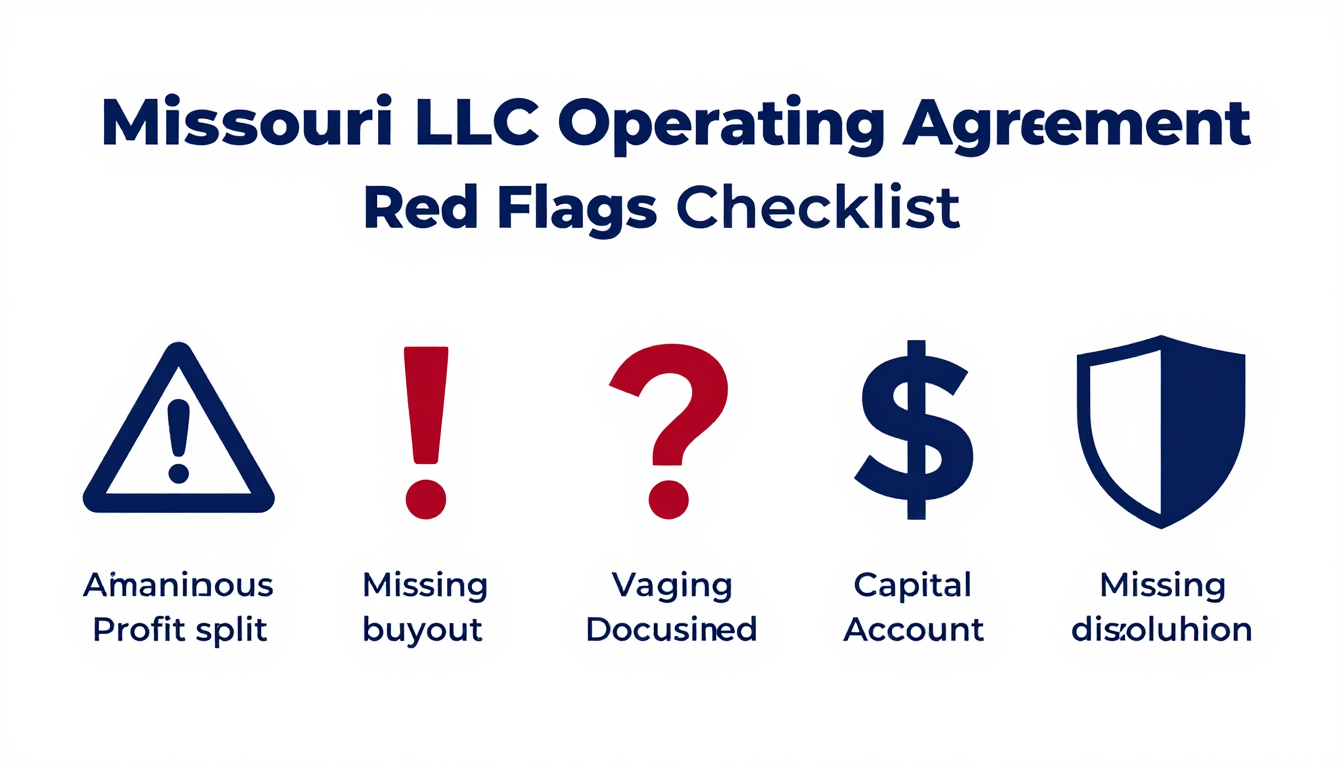
Missouri Operating Agreement Red Flags: What to Recheck in 2026
The Profit Split Does Not Match What Members Actually Agreed
Most operating agreements describe a profit split in a single sentence. That sentence often says “profits and losses are split equally” or “per their membership interests.” That sounds clear until a member contributes $5,000 and another contributes $50,000 and both get 50 percent. The member who put in ten times more money notices the problem at the first distribution.
Missouri statute Section 347.093 allows members to agree to any profit-sharing arrangement they want. The default is equal split only if the agreement is completely silent on the topic. If your members discussed something different over coffee, in a text, or in a handshake deal, that is not in the agreement — and that is a red flag.
A client in Springfield, Missouri learned this the hard way. Three members started a consulting firm. One handled all the sales and brought in every client. The agreement said “profits split equally.” The other two members did not write a single line of business but each got a third of the distributions. The rainmaker quit after eight months. The dispute took eleven months to resolve.
The fix is straightforward. Open the agreement. Read the profit and loss section. Ask every member to confirm it matches their understanding. Update it if it does not. A quick amendment costs far less than a dispute over $30,000 in distributions.
No Clause for Member Exit or Buyout
When a member wants to leave, sell their stake, or becomes incapacitated, the operating agreement needs a plan. Many small Missouri LLC agreements are completely silent on this. No buyout price. No valuation method. No timeline for the remaining members to decide whether they even want to buy the departing member out.
Without those terms, Missouri law applies its default rules. Under Section 347.093, a member’s interest can be assigned, but the assignee does not automatically get management rights. That creates a gray zone where someone who no longer participates still holds an economic stake — and may claim rights you never intended to give them.
Missouri farmland LLCs and rental property LLCs run into this constantly. A family member moves out of state and wants to cash out their share. The remaining members want to keep the property. Nobody knows what the departing member’s interest is actually worth because the agreement never defined it. Everyone argues. The property sits in limbo.
A solid exit clause names the triggering events, sets a valuation formula, and gives remaining members a right of first refusal. Right of first refusal means if a member wants to sell to an outsider, the existing members get to match the offer first. That protects the LLC from having an unwanted third party brought in without consent.
Voting Rights Were Never Defined Clearly
“Who gets a vote on this?” sounds like a simple question. In practice, it is where many Missouri LLC agreements fall apart. Some agreements give every member one vote regardless of ownership. Others tie votes to ownership percentage. Some decisions require unanimous consent. Others only need a majority. When those lines are fuzzy, every major decision becomes a negotiation — and some negotiations end in lawsuits.
Consider a real scenario from a Kansas City LLC. Four members owned a restaurant. Two of them wanted to take out a second loan for a renovation. One member objected. The disagreement escalated because the agreement never said whether loan authorization needed a simple majority, a two-thirds vote, or unanimous consent. The restaurant closed while the members argued in circuit court.
Missouri courts have seen LLC disputes where the disagreement was entirely about whether the members had the authority to vote on the underlying decision in the first place. The problem was not the business outcome — it was that nobody had written down the voting rules.
A clean voting clause specifies which decisions need member approval, what percentage is required, and whether members can act by written consent instead of holding a formal meeting. For restaurants, retail shops, and professional service firms with multiple owners, this clause alone can prevent years of conflict.
The Capital Contribution Section Is Outdated
Members forget to update the operating agreement when they make additional contributions. A member puts in another $10,000 to cover a business shortfall in St. Louis. The agreement still shows the original $5,000 contribution from three years ago. The tax returns show the real number. The bank statements confirm it. The operating agreement does not.
This gap creates confusion during buyouts, distributions, and even basic accounting. If a member later claims they are owed more because they contributed more over time, the agreement is the first piece of evidence a judge will look at. Judges look at what is written down, not what was discussed informally.
Missouri LLCs that have been operating for more than two years almost always have contribution records that do not match their operating agreements. The discrepancy usually favors whoever has been managing the money — because they know the real number and the other members have to take their word for it.
Update the contribution schedule whenever a member adds capital. It takes twenty minutes and prevents a six-month dispute later. Keep a running table in the agreement that shows the date, the amount, and whether it was a loan or a contribution. That record-keeping habit alone has saved Missouri LLCs thousands of dollars in legal fees.
No Management Structure Was Chosen
Missouri LLCs can be member-managed or manager-managed. The choice affects who has authority to sign contracts, open bank accounts, and make business decisions on behalf of the LLC. A member-managed LLC gives every member equal standing to act on behalf of the company. A manager-managed LLC centralizes control with one or a few designated managers.
Many small Missouri LLC agreements do not address this at all. That means the LLC defaults to member-management under Missouri law. For a five-member LLC where one member is supposed to handle all operations, this default creates an unexpected problem — every member has equal legal authority to bind the company without the others knowing.
A client in Columbia, Missouri ran into this when one member signed a vendor contract that the other four members had never seen. The vendor sued the LLC. The defending members argued the one member had no authority to sign. The court found that because the LLC was member-managed by default and the agreement did not restrict any member’s authority, the contract was valid and binding.
If the intent was centralized management, that needs to be written into the agreement. If the agreement is silent and the members have been acting as if one person is in charge, it is worth clarifying before a new member pushes back on authority — or before a rogue member makes commitments the others never agreed to.
The Operating Agreement Has No Amendment Process
Agreements that are difficult to amend tend to get ignored. When a clause becomes outdated — a new Missouri law changes the rules, a member joins, a business line closes — the members need a clear path to update the document.
Without a specified amendment process, members often fall back to informal verbal agreements. Those agreements are hard to prove and easier to dispute. One member remembers the conversation one way. Another remembers it differently. The dispute is not really about the business — it is about whose version of a conversation from two years ago is correct.
A simple clause that requires a majority or supermajority vote of members to amend specific sections removes the ambiguity entirely. Some agreements require unanimous consent for any change. That sounds protective but creates paralysis when something genuinely needs updating.
Missouri does not require notarized amendments or elaborate procedures. A written consent signed by the required percentage of members is typically enough to make a change enforceable — but it has to be written down, signed, and stored with the original agreement where all members can access it later.
No Dispute Resolution Clause
LLC disputes in Missouri can end up in circuit court. That process is public, slow, and expensive. A dispute that could be resolved in mediation in thirty days takes two years in litigation. Every document produced during discovery becomes part of the public record. Business relationships get exposed. Personal finances get examined.
Many operating agreements never consider what happens when members disagree. They just assume it will not happen. When the dispute arrives, everyone involved is already angry and has lost the ability to be objective about the business.
A dispute resolution clause can require mediation before litigation, specify St. Louis or Kansas City as the venue, or even require arbitration through a service like the American Arbitration Association. For small LLCs where members also have a personal relationship, a clause that keeps business disputes out of public court records is often worth adding just for that protection alone.
How to Get Your Missouri Operating Agreement Reviewed
Rapid Registered Agent works with business attorneys who can review your Missouri operating agreement and flag the gaps before they become problems. If your LLC is registered in Missouri and your agreement has not been reviewed in the past two years, the risk of an undetected gap grows with every new member you add and every profit distribution you make.
The members who come to us most often are the ones who had a handshake deal that worked fine for two years — until it did not. The agreement they never finalized becomes the evidence that sinks them in a dispute they never expected to have.
A half-hour review call can surface the clauses that need updating. The cost of that call is a fraction of what a single LLC dispute can cost in legal fees, lost business, and damaged relationships.
Start with the profit split. Then the exit clause. Then the voting rights. That covers the three triggers for most LLC disputes in Missouri. Get those three right and your agreement is already ahead of most.
Related Reading
Missouri Employer Registration in 2026 — If you have employees in Missouri, your LLC has payroll obligations that your operating agreement should account for.
Missouri AI Call Summaries in 2026 — Running an LLC means keeping track of decisions made across many conversations.
South Carolina Operating Agreement Updates in 2026 — Operating agreement triggers are similar across states.
Frequently Asked Questions
Does Missouri require an LLC to have an operating agreement?
Missouri does not require a single-member LLC to have an operating agreement, but it is strongly recommended. For multi-member LLCs, an operating agreement is essential because Missouri law applies default rules — such as equal profit splits and member-management — that may not match what the members intended.
What happens if a Missouri LLC has no written operating agreement?
Without a written operating agreement, Missouri courts apply the default rules in Section 347.093 of the Missouri Revised Statutes. These defaults include equal profit sharing, member-management for all members, and no restrictions on transferring membership interests. These defaults often conflict with what members actually agreed to verbally.
Can a Missouri LLC operating agreement be amended?
Yes. A Missouri LLC operating agreement can be amended at any time by the vote or written consent of the members as specified in the agreement itself. If the agreement does not specify an amendment process, Missouri law requires the consent of all members to amend it. Any amendment should be documented in writing and kept with the original agreement.
Who can help review a Missouri LLC operating agreement?
Business attorneys who specialize in Missouri LLC formation and governance can review operating agreements. Rapid Registered Agent works with legal professionals who understand Missouri LLC law and can identify gaps, outdated clauses, and missing provisions that create risk for LLC members.
How often should a Missouri LLC review its operating agreement?
A Missouri LLC operating agreement should be reviewed whenever a significant event occurs — a new member joins, a member leaves, the business adds a new revenue line, or the LLC takes on debt. Even without a triggering event, an annual review is a good practice for LLCs with more than one member.
Missouri LLC Services
Missouri Operating Agreement Red Flags in 2026
Small changes to your operating agreement today can prevent expensive disputes tomorrow. Rapid Registered Agent connects Missouri LLCs with the resources to get it right.
- Missouri LLCs Formed in 2025
- 19,400+
- States Served
- 50
- Annual Renewal Support
- Included