
Minnesota LLC Conversion Planning in 2026: When a Sole Proprietor Should Move Up
Minnesota LLC Conversion Planning in 2026 starts with one question every Minnesota sole proprietor eventually asks. Is it time to stop running this business as a personal operation and start running it as a legal entity? The answer is not the same for everyone. But there is a point where the math tips and the protection wins. This guide walks through when to move, how the conversion works, what it costs, and what changes the day the filing is complete.
Why Minnesota Sole Proprietors Put Off the LLC Conversion
Most Minnesota sole proprietors know they should eventually convert to an LLC. They keep waiting for the right moment. Revenue is not quite high enough. The business is not quite stable enough. There is always a reason to wait another quarter. The problem is that every quarter waiting is a quarter of personal liability exposure that does not need to exist.
The LLC conversion itself is not complicated. Minnesota makes it straightforward. The cost is modest. The filing takes less than an hour. The thing that keeps people from converting is not the process. It is the unclear return on the decision. This guide makes that math clear.
The Minnesota Secretary of State business filing page covers the official LLC formation requirements and the conversion filing process step by step.
The Five Signs It Is Time to Convert to a Minnesota LLC
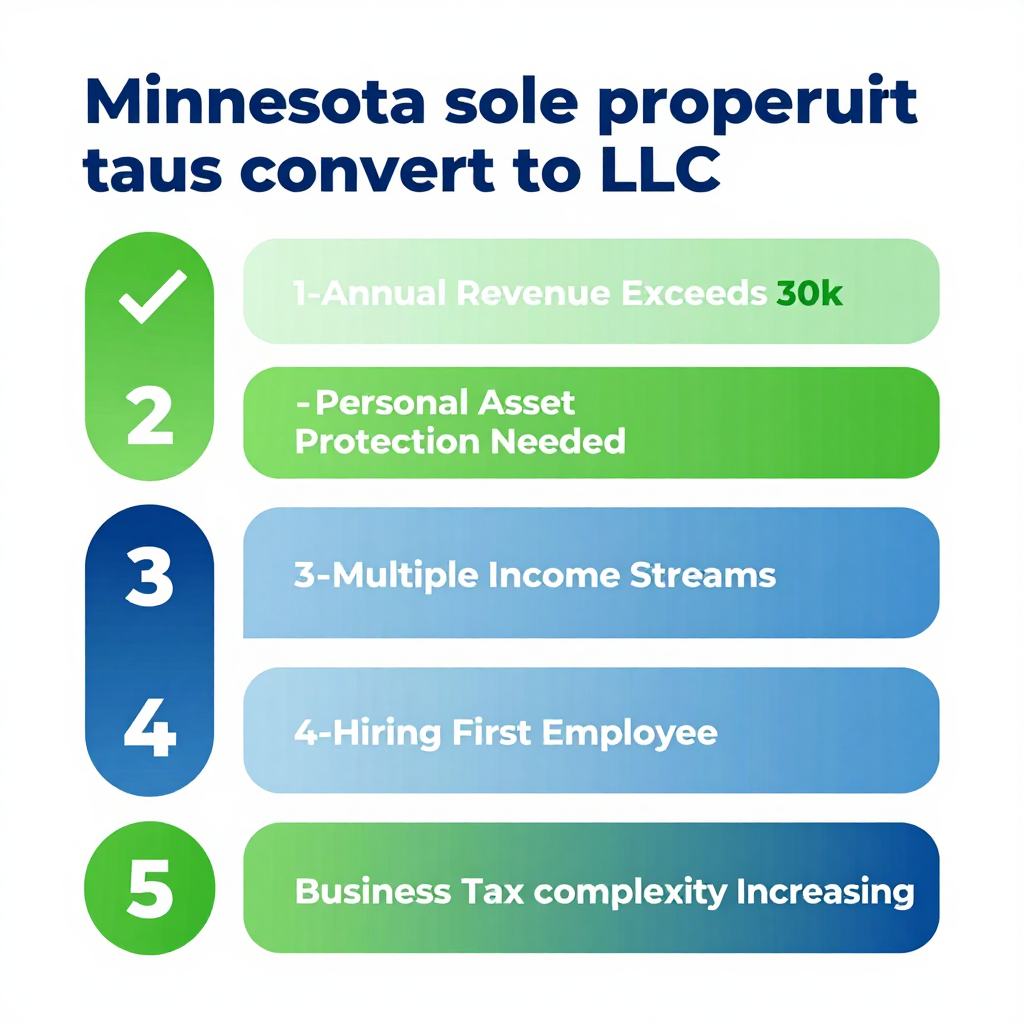
Revenue Is Growing and the Personal Tax Exposure Grows With It
A sole proprietorship files Schedule C with the owner’s personal tax return. Every dollar of business income is personal income. Every business liability is a personal liability. When revenue crosses fifty thousand dollars annually, the exposure is meaningful. When it crosses one hundred thousand, the personal exposure is significant. The LLC puts a legal wall between the business and the owner.
The IRS guide to Schedule C and LLC taxation explains how sole proprietor income becomes self-employment tax and how an LLC elects S-corp status to reduce that burden. Minnesota also has guidance on LLC taxation at the state level that affects how the conversion changes the state tax picture.
Business Contracts Are in the Owner’s Name Personally
Freelance agreements, vendor contracts, and service agreements written in the owner’s personal name are a liability problem. If the business gets sued, those contracts are personal assets. An LLC in the business name enters contracts separately from the owner. The LLC’s contracts belong to the LLC.
Clients or Customers Are Asking for a W-9 or Certificate of Insurance
Commercial clients regularly request a W-9 before paying an invoice. They also request a certificate of insurance naming the business as certificate holder. A sole proprietorship operating in the owner’s personal name creates friction at payment time. An LLC has an EIN and can provide a W-9 in the business name. Insurance policies name the LLC, not the individual.
The Owner Is Starting to Hire or Bring On Contract Workers
A sole proprietorship with no employees is one thing. A sole proprietorship that starts hiring is another. Workers compensation, payroll tax obligations, and employer liability all kick in when employees are added. An LLC has a clearer structure for handling those obligations.
Personal Assets Are Being Used as Business Collateral
When a personal car is used for business deliveries, a personal credit card funds business purchases, or a home equity line pays for business equipment, the line between personal and business finances is already blurred. The LLC formalizes the separation. It does not create it out of nothing. It makes it legally enforceable.
How the Minnesota LLC Conversion Actually Works
Get an EIN from the IRS
The Employer Identification Number is the first step. Apply online at IRS.gov. The application takes fifteen minutes and the EIN is issued immediately. The EIN goes on the LLC formation documents and every tax filing after.
File Minnesota Articles of Organization
The LLC formation document in Minnesota is called the Articles of Organization. It is filed with the Minnesota Secretary of State. The filing fee is based on the LLC type. The standard filing is online through the Minnesota SOS business filings portal. Processing takes one to three business days.
The Articles of Organization cover the LLC name, the registered agent address, the principal business address, and the names of the LLC members. The registered agent in Minnesota must have a physical address in the state, not a PO box.
Set Up a Business Bank Account
After the LLC is filed, open a business checking account using the EIN and the Articles of Organization. The business account is separate from the personal account. Every business transaction moves through the business account from this point forward.
Transfer Contracts and Assets to the LLC
Contracts written in the owner’s personal name can be renegotiated or assigned to the LLC. Assignment means the existing contract transfers to the LLC as the contracting party. Not every counterparty will accept an assignment. Some require a new contract in the LLC name. Either way, the goal is to move business activity into the LLC name.
Equipment, vehicles, and other business assets used personally should be formally transferred to the LLC. The transfer is a simple bill of sale at fair market value. It documents that the asset now belongs to the LLC.
File the First Annual Registration with Minnesota
Minnesota requires every LLC to file an annual registration with the Secretary of State. The due date is December 31 each year. The filing confirms the LLC’s registered agent, principal address, and member information. Missing the annual registration puts the LLC in bad standing and risks administrative dissolution. The Minnesota annual registration requirements are on the SOS website.
What Changes Immediately After the Minnesota LLC Conversion
The LLC files its own tax returns. Federal and state tax filings change from Schedule C on a personal return to an LLC-level filing. The EIN separates from the owner’s Social Security Number. The business checking account separates from every personal account.
Business contracts sit in the LLC name. Vendor agreements, client service contracts, and equipment financing all belong to the LLC. When a client sues for a contract dispute, the LLC is the named party. Personal assets are not on the hook unless the LLC wall has been broken through commingling or personal guarantees.
The LLC can now deduct employee wages as a business expense. The LLC can open a retirement account like a SEP-IRA or Solo 401(k) in the business name. The LLC can build business credit separate from the owner’s personal credit.
Liability protection is not automatic or absolute. It requires the LLC to be treated as a separate entity. Business decisions made in the LLC name. Business finances kept separate from personal finances. LLC records maintained as a distinct set of documents. Commingling personal and business funds breaks the liability shield.
The Minnesota DOR business tax page covers how Minnesota taxes LLC income and what the LLC must file each year at the state level.
The Cost of Converting to a Minnesota LLC in 2026
Minnesota LLC filing fees are nominal. The Secretary of State charges a one-time Articles of Organization filing fee at formation. The annual registration renewal is a separate annual fee. Registered agent service runs an annual cost but the state requires it. Business checking accounts at most Minnesota banks are free to low-cost for small business volume.
The hidden cost of not converting is higher. A lawsuit against a sole proprietorship attacks the owner’s personal assets directly. Home equity, personal savings, and personal vehicle values are all at risk. The LLC conversion cost is an insurance premium against that exposure. Most business owners find the annual cost of maintaining the LLC is less than the legal fees from a single unresolved liability claim.
The SBA guide to choosing a business structure covers the cost-benefit comparison of sole proprietorship versus LLC across all major factors.
Minnesota LLC Conversion and Taxes: What the Owner Needs to Know
A single-member LLC is a disregarded entity by default for federal tax purposes. That means the LLC files the same Schedule C the sole proprietor filed before. The income flows through to the owner’s personal return. The self-employment tax applies to the net income.
An S-corp election changes this. An LLC that elects S-corp status pays the owner a reasonable salary and passes remaining income as a distribution. The salary is subject to payroll tax. The distribution is not. This can reduce the overall tax burden significantly for LLCs generating more than seventy-five thousand dollars in net income annually.
The S-corp election requires filing Form 2553 with the IRS. It also requires payroll administration and potentially a state S-corp election. The ROI on the S-corp election depends on the net income. A business accountant can model it in thirty minutes.
Minnesota does not have a separate state-level S-corp election. The state follows federal S-corp treatment for most purposes. The Minnesota tax treatment of LLCs is on the DOR website. Consult a Minnesota-licensed CPA before making the S-corp election. The election has payroll administration implications and annual filing requirements that need to be set up correctly from the start.
When to Make the Move
The right time to convert is when the cost of not converting exceeds the cost of converting. Personal liability exposure, contract friction, client requirements, and growth plans all factor in.
A Minnesota sole proprietor with no employees, no contracts in the business name, and revenue under thirty thousand dollars has a lower urgency case. The conversion is still worth doing for liability protection, but the risk is manageable.
A Minnesota sole proprietor with commercial contracts, employees, or revenue above fifty thousand dollars has a higher urgency case. The liability exposure is real. The conversion should happen within the next quarter.
For related steps after the conversion, see the Minnesota annual report guide for LLCs and the Minnesota registered agent change guide.
Frequently Asked Questions
When should a Minnesota sole proprietor convert to an LLC?
When revenue exceeds personal risk tolerance, when contracts are in the personal name, when clients request business documentation, or when hiring employees. The conversion cost is low enough that waiting for the perfect moment is not worth the liability exposure.
How does a Minnesota sole proprietor file an LLC conversion?
File Minnesota Articles of Organization with the Secretary of State, obtain an EIN from the IRS, open a business bank account, and transfer contracts and assets to the LLC name. The process takes a few days.
Does an LLC change how Minnesota taxes a sole proprietor's income?
A single-member LLC is a disregarded entity by default. Income still flows through to the personal return as Schedule C. An S-corp election splits income into salary and distributions, reducing self-employment tax on the distribution portion.
What does a Minnesota LLC cost to form and maintain?
The Articles of Organization filing fee is a one-time cost. The annual registration renewal is a separate modest annual cost. Registered agent service is an annual cost. Business bank accounts are typically free to low-cost.
Can a sole proprietor convert to an LLC without an attorney?
Yes. A single-member LLC with no complex assets is a straightforward DIY conversion. Business accountants handle the tax transition. An attorney is only necessary for complex structures or multi-member LLCs.
What is the biggest risk of staying as a sole proprietorship in Minnesota?
Personal liability for every business debt, contract dispute, and lawsuit. A sole proprietor’s personal assets are business assets. The LLC creates the legal separation that protects personal assets from business claims.
Minnesota LLC Conversion Planning
Make the Move to an LLC Before the Next Liability Event
Minnesota LLC Conversion Planning in 2026 means filing the Articles of Organization, separating finances, and setting up the business infrastructure that protects personal assets from business claims. Rapid Registered Agent helps Minnesota sole proprietors handle the LLC formation and registered agent service that makes the conversion straightforward.
- Articles of Organization
- One Business Day Filing
- EIN from IRS
- Fifteen Minutes Online
- Annual Registration
- December 31 Deadline