Hawaii Service Pages in 2026: Keeping a Multi-State Brand Clear Without Sounding Generic
The Problem With Multi-State Service Pages That All Sound the Same
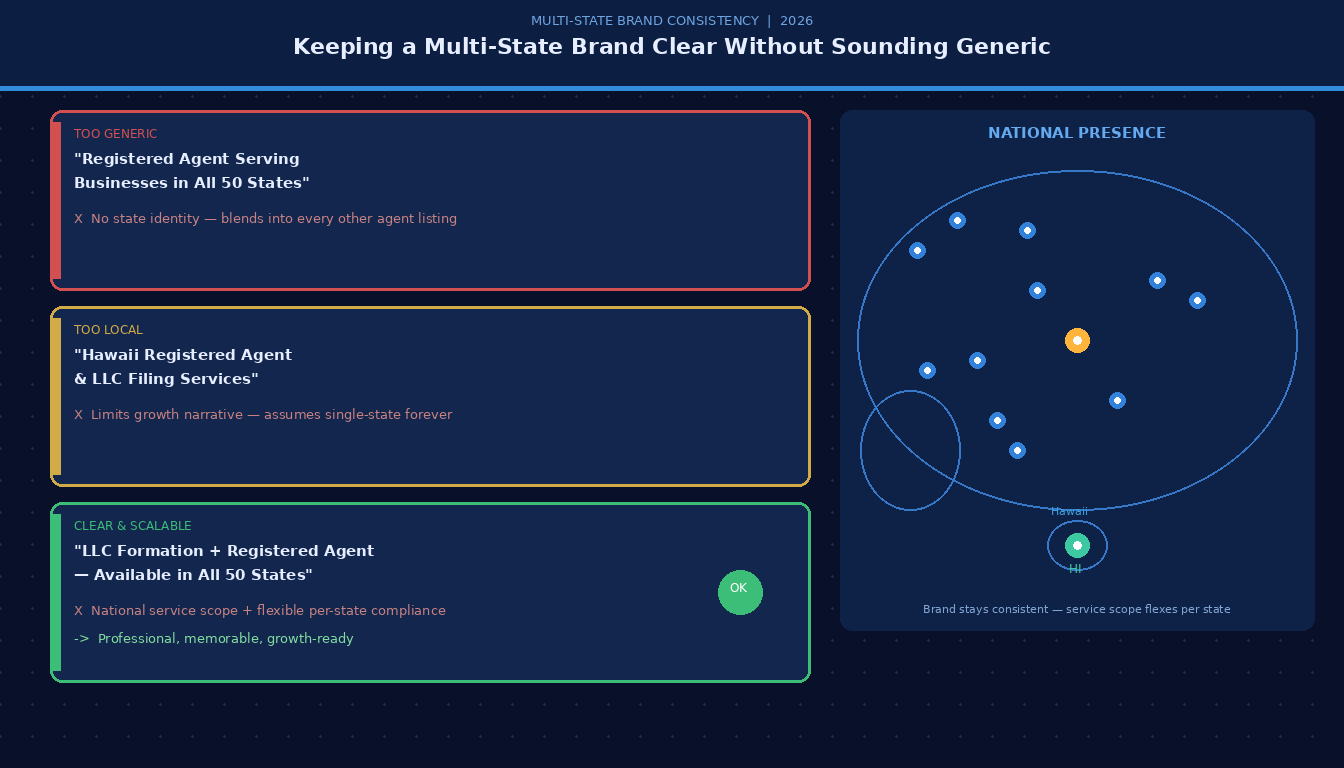
Hawaii service pages for a multi-state brand face a problem that most page templates never solve. You have one brand voice. You have one set of service descriptions. And you have fifty states, each with its own registration rules, fee structures, and small business culture. When every state page reads identically, Google notices. More importantly, Hawaii business owners notice. A visitor from Honolulu should not read the same paragraph about registered agent service as a visitor from Ohio. The content has to shift, even when the brand backbone stays the same.
This article breaks down what makes Hawaii service pages work for a multi-state brand in 2026. It covers what to keep consistent, what to localize, and how to avoid the generic sound that hurts both your search rankings and your conversion rate.
What Hawaii Business Owners Actually Need From a Service Page
Hawaii has a unique small business environment. The state economy leans heavily on tourism, small hospitality businesses, agriculture, and remote work. Many Hawaii LLCs are sole proprietors who eventually hire, out-of-state entrepreneurs forming a holding company, or local service providers expanding beyond a single island. The registered agent and LLC formation needs of these owners look different from the needs of a Texas manufacturing startup or a Florida real estate investor.
When a Hawaii business owner searches for “Hawaii registered agent” or “form an LLC in Hawaii,” they are looking for confirmation that the service they are evaluating actually understands Hawaii. They scan for state-specific details. Does the page mention the Hawaii Business Registration Division? Does it reference the Honolulu office? Does it acknowledge the higher cost of living and what that means for service pricing? Pages that skip these details feel like they were written for nobody in particular. Hawaii owners move on.
State-Specific Registration Context
Hawaii requires every LLC to have a registered agent with a physical street address in the state. This is not unusual, but it matters for multi-state brands. A registered agent service that only offers Hawaii agents in Honolulu may not be sufficient for businesses operating on the Big Island, Maui, or Kauai. The physical address requirement means your service page should confirm coverage across all Hawaii islands, not just Oahu.
The Hawaii Department of Commerce and Consumer Affairs (DCCA), Business Registration Division handles LLC formations, annual filings, and trade name registrations. The Hawaii State Planning Act and local county regulations add layers for businesses in visitor industry sectors. Your service page should reference the actual state agency, not just “the state.”
Cost of Living and Service Pricing Context
Hawaii has the highest cost of living of any US state. Service pricing that makes sense for a Kansas LLC does not automatically make sense for a Hawaii LLC. Business owners in Honolulu, Hilo, or Kailua-Kona comparing registered agent services are already adjusting for this. If your Hawaii service page shows the same pricing as your national pages without explanation, Hawaii visitors may assume the service is overpriced relative to local alternatives. Address pricing honestly and explain what the Hawaii-specific coverage adds.
The Architecture of a Multi-State Brand Service Page That Does Not Sound Generic
Multi-state brand service pages work best with a consistent framework that gets filled in with state-specific content. Think of it as a template with required customization slots. The brand voice, core service descriptions, and CTA structure stay consistent. The state-specific facts, local agency references, and regional context get swapped in for each state.
Slot 1: The State-Specific Opening Problem Statement
Every state service page should open by naming a problem or question that is specific to that state. For Hawaii, the problem is not “you need a registered agent.” The problem is: “Your Hawaii LLC needs a registered agent with a physical address on the islands, and most national services only offer Oahu coverage.” That is a Hawaii-specific opening that tells the visitor the page was written for them.
Slot 2: The State Agency Reference
Name the actual state agency that handles business registrations. For Hawaii, this is the DCCA Business Registration Division, not just “Hawaii state government.” Linking to the actual agency website gives the page authority and tells the visitor you know the local landscape.
Slot 3: The State-Specific Requirement Callout
Every state has one or two requirements that distinguish it from the baseline. Hawaii’s distinction is the physical registered agent address requirement and the state’s jurisdiction in the Pacific, which affects shipping and remote business contexts. Florida’s distinction is the lack of state income tax and the annual report requirement. Texas’s distinction is the lack of state income tax and thePublic Utility Commission rules for certain industries. Each page should call out the state-specific requirement, not just repeat the generic service description.
Slot 4: The Local Trust Signal
Local trust signals look different for different states. For Hawaii, this might mean mentioning Honolulu coverage, in-state customer support, or familiarity with Hawaii county-level requirements (Maui County, Hawaii County, Kauai County each have slightly different business license processes). For other states, it might mean mentioning a state-specific partnership, a regional office, or familiarity with a particular industry cluster.
Common Mistakes That Make Multi-State Brand Pages Sound Generic
Repeating the Same Opening Paragraph Across All States
The most common mistake is using a template opening that works for the brand nationally but does not mention the state at all. “A registered agent is required for every LLC in the United States” is true but useless for a Hawaii business owner who searched specifically for Hawaii. The opening paragraph should name Hawaii within the first two sentences.
Skipping Internal Links to State-Specific Content
Multi-state brands usually have blog content, guides, or landing pages for individual states. Our hawaii llc formation guide covers the basics. Your Hawaii service page should link to hawaii registered agent service page and any Hawaii-specific guides or blog posts on the site. Failing to link to your own Hawaii content makes the page feel like an isolated landing page rather than part of a resource-rich site.
No External Links to State Government Sources
Service pages that never link to the actual state agencies they reference feel like they were written without research. Hawaii pages should link to the DCCA Business Registration Division and the Hawaii State Planning Office. These links give the page authority and give visitors a way to verify the information you are providing.
Using the Same CTA for Every State
Multi-state brands often use a single CTA button across all service pages. This is fine as a baseline, but the supporting CTA text should be customized. For Hawaii, the CTA subtext might acknowledge the islands directly: “We cover all Hawaii islands — Honolulu, Hilo, Maui, and Kauai — with a local registered agent address.” That specificity builds trust in a way that generic CTAs do not.
What Stays Consistent Across All State Service Pages
While state-specific customization is essential, certain elements should stay consistent across every state page. These elements define the brand and make sure visitors who navigate between pages have a coherent experience.
- Brand voice and tone. Short sentences, plain language, benefit-first paragraphs. This should not change from Hawaii to Ohio.
- Core service description. What your registered agent service actually does should be described the same way everywhere. The value proposition does not vary by state.
- CTA button design and placement. The primary CTA should be in the same position with the same design across all state pages.
- Pricing transparency standard. If you show pricing on one state page, show it on all of them.
- Trust signals that apply nationally. BBB ratings, industry certifications, and national client counts belong on every state page.
How to Write Hawaii Service Pages That Rank Without Sounding Stiff
Search engines reward pages that thoroughly answer what a searcher is looking for. “Hawaii registered agent service” is a phrase with commercial intent. Someone searching for it wants to know if your service works for Hawaii, what it costs, and how to get started. Your page needs to answer all three questions within the first 300 words, then go deeper with Hawaii-specific details.
The key to writing pages that rank and convert is specificity without formality. You are not writing a government bulletin. You are writing for a small business owner in Honolulu or Kailua who needs to form an LLC fast and correctly. Write like you are explaining it to a smart friend who is busy. Every paragraph should add a new piece of information or address a specific objection.
Hawaii Service Page Checklist
Use this checklist when reviewing or creating a Hawaii service page for a multi-state brand:
- Hawaii is named in the first two sentences of the opening paragraph
- The page links to the DCCA Business Registration Division and our hawaii registered agent service page
- Registered agent physical address requirement for Hawaii is explicitly mentioned
- The page covers all Hawaii islands, not just Honolulu or Oahu
- Internal links connect to other Hawaii-specific content on the site, including the hawaii articles of amendment guide and hawaii llc vs sole proprietorship comparison
- Pricing section acknowledges Hawaii cost-of-living context if applicable
- CTA subtext is customized for Hawaii, not generic brand text
- External links point to official Hawaii government sources
- Page does not contain H1 headings (H2 and H3 only)
- Page ends with a state-specific rls-hero block with a Hawaii background
Hawaii service pages work best when they sound like someone on the islands wrote them. You do not have to be based in Honolulu to write a useful Hawaii service page. You just have to include the details that matter to Hawaii business owners. Hawaii service pages built with specific facts, local agency references, and island-wide coverage signals turn generic multi-state templates into pages that rank and convert in Hawaii.
Frequently Asked Questions
What makes Hawaii service pages different from other states for a multi-state brand?
Hawaii has the highest cost of living of any US state, a Pacific island jurisdiction with multi-island coverage needs, and a distinct small business environment driven by tourism and hospitality. Hawaii service pages should reference the Hawaii DCCA Business Registration Division specifically, address the physical registered agent address requirement across all Hawaii islands, and acknowledge the Hawaii market context rather than using generic national content.
Does a registered agent in Hawaii need a physical address on every island?
A Hawaii registered agent must have a physical street address within the state. Most services use an Honolulu address. For businesses operating on multiple islands, confirm that your registered agent service covers all Hawaii counties: Hawaii County (Big Island), Maui County (Maui, Molokai, Lanai), Kauai County, and City and County of Honolulu.
How does Hawaii's cost of living affect service page messaging?
Hawaii business owners comparing registered agent services adjust their expectations for higher pricing due to the cost of living. Service pages that show identical pricing to other states without context may lose credibility with Hawaii visitors. Acknowledging the Hawaii market specifically and explaining what the service covers justifies the pricing for a Hawaii audience.
What government agency handles Hawaii LLC registrations?
The Hawaii Department of Commerce and Consumer Affairs (DCCA) Business Registration Division handles LLC formations, annual reports, and trade name registrations. The agency website is cca.hawaii.gov.
How can a multi-state brand write service pages that do not sound generic?
Use a consistent template framework but fill in four required customization slots for each state: a state-specific opening problem statement, the actual state agency name and website, the state-specific requirement callout, and a local trust signal. These four slots, when customized per state, transform a generic template into a state-specific page that ranks and converts.
Hawaii Registered Agent Service
Registered Agent Service Across All Hawaii Islands
Rapid Registered Agent provides a physical Hawaii registered agent address covering Honolulu, Hilo, Maui, and Kauai. We handle state compliance so your Hawaii LLC stays in good standing year after year.
- Coverage
- All Hawaii Islands
- Physical Address
- Honolulu, HI
- Filings Tracked
- Annual Reports