
Florida Certificate of Status in 2026: When Banks and Vendors Need It Faster Than Owners Expect
Florida Certificate of Status in 2026 trips up business owners in one predictable way: someone else needs it before you expected to need it.
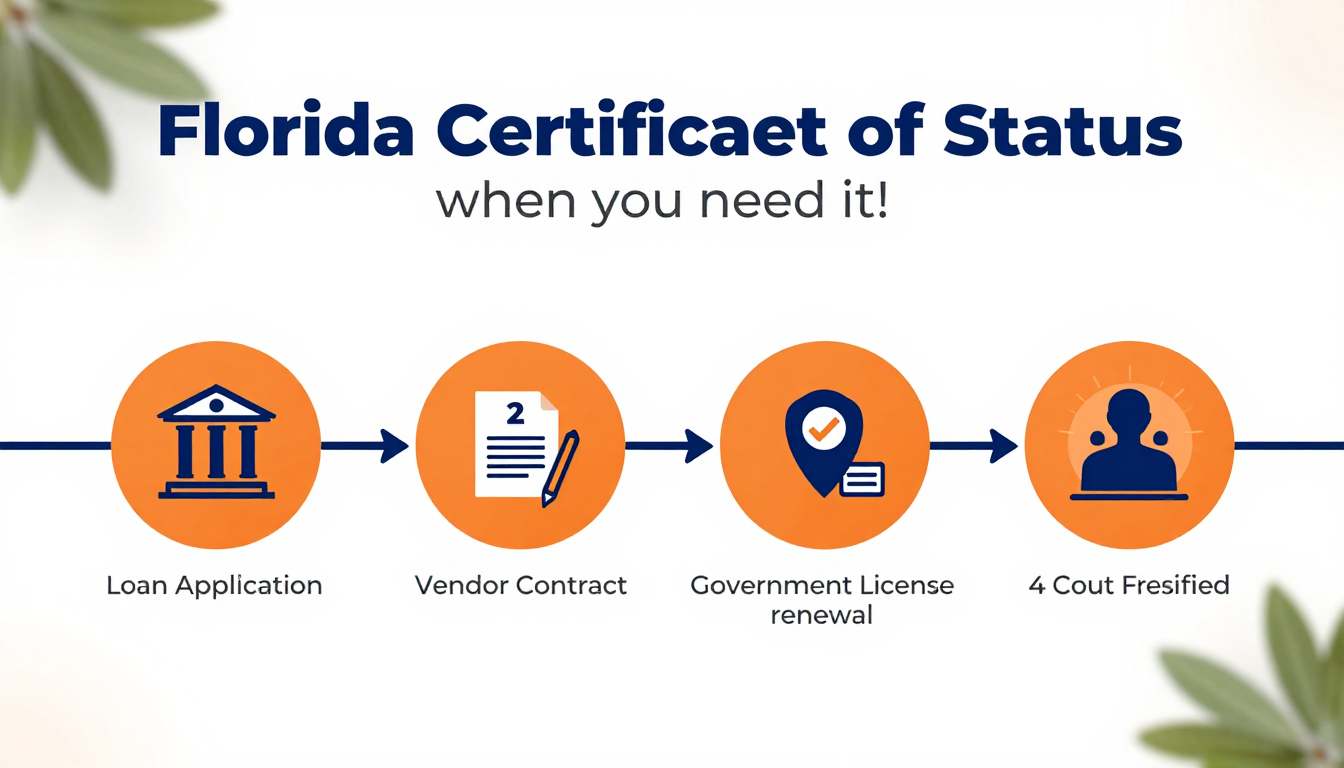
Your LLC is running fine. Annual reports are filed. You are not thinking about the Division of Corporations. Then a bank calls and says the loan packet needs a Certificate of Status before closing. Or a vendor you just signed sends a procurement email requiring one before they release your account. Or you are bidding on a contract and the form says “attach Certificate of Good Standing.”
You log into Sunbiz. You do not have a clear path to the certificate. You find the form. You file it. And then you wait — and the other party is already asking where it is.
This article covers exactly what a Florida Certificate of Status is, why it becomes urgent without warning, how to get it fast, and what breaks the process when you are racing a deadline.
What a Florida Certificate of Status Actually Is
A Florida Certificate of Status is an official document from the Florida Division of Corporations confirming your business entity is active and in good standing with the state. It certifies that your LLC, corporation, or limited partnership was properly formed, has filed all required annual reports, has paid all state fees, and has not been administratively dissolved or revoked.
In practice, it is the same document other states call a Certificate of Good Standing. Florida uses “Certificate of Status” as the official name. The term “Certificate of Good Standing” is functionally identical and shows up on most bank and vendor forms interchangeably. KMF Business Advisors notes that the difference is linguistic, not substantive — the document proves the same thing in every state that requires it.
The certificate confirms four facts to anyone who requests it:
- The entity exists and is registered with the state
- All annual reports are current
- All franchise taxes and fees are paid
- The entity has not been dissolved or revoked
Why Banks and Vendors Ask for It in 2026
A Certificate of Status is their proof that your business is real and compliant before they commit money or credit.
Banks want it for loans, lines of credit, and commercial real estate transactions. The document tells the lender your entity has not been dissolved — which would mean there is no borrower entity left to hold the debt. It also confirms the business is current on its annual reports, which is often a loan covenant condition.
Vendors and suppliers ask for it during onboarding. If a vendor extends trade credit, net-30 terms, or requests a deposit, they want assurance your business will still exist in six months. The Certificate of Status is that assurance. Procurement departments at larger companies require it as part of supplier registration.
Commercial landlords pull it during lease negotiations. If you are signing a office or retail lease, the landlord wants to confirm your entity is active before locking in a multi-year commitment.
Government agencies and courts may request it when you register to do business in another state, when you file a lawsuit, or when you respond to a legal filing.
The common thread: someone is taking on financial risk tied to your business, and they want a third-party document — not just your word — as proof you are still operating.
The Timing Problem That Catches Every Owner Once
Here is what goes wrong. You get the email from the bank on Monday. The loan closes on Friday. You need the Certificate of Status by Thursday afternoon to wire the funds.
You file the request on Monday. The Florida Division of Corporations typically processes Certificate of Status requests within one to two business days for standard processing. Rush processing — if available at the time — can shorten that window.
But there is a catch that catches people every year: your annual report must be current for the Division to issue the certificate. If you filed the annual report but it is still marked “pending” in the Sunbiz system, the certificate will not generate. The system will reject the request and you will get an email saying your entity is not in good standing — even though you already filed.
This is the most common delay. Business owners think they are done with the annual report and then find out the state processing queue has not cleared it yet. Now you are waiting for two things at once: the annual report to clear and the certificate to issue.
The solution is to check your annual report status in Sunbiz before you file the certificate request. If the report shows as pending, wait for it to clear first. Filing both at the same time creates a race condition where the certificate system cannot yet confirm your compliance.
How to Request a Florida Certificate of Status Through Sunbiz
Here is the exact process to get the certificate in 2026.
Step 1 — Access the Sunbiz Certificate Request System
Go to dos.fl.gov/sunbiz and click “Order Certificate” or navigate to the Certificates section. You will need to log in or create a Sunbiz online account if you do not have one. The certificate request is separate from the annual report filing — you can request a certificate at any point during the year, not just during the report window.
You do not need an attorney or a service company to request this. It is a direct state service.
Step 2 — Search for Your Business Entity
Use the entity search to find your LLC or corporation. The search returns the document number, entity type, and status. Make sure the status shows as “Active” before proceeding with the certificate request.
If the status shows anything other than Active — “Dissolved,” “Revoked,” “Merged Out” — the certificate will not issue until you address the underlying status issue.
Step 3 — Submit the Certificate Request
Select “Certificate of Status” from the certificate options. Florida offers different certificate types including long-form and short-form versions. Most bank and vendor requests accept the standard certificate. Confirm with the requesting party if they have a specific format requirement.
The filing fee for a Florida Certificate of Status is $30 for a paper certificate and the online system accepts credit and debit card payments. Electronic certificates may have a lower fee depending on the processing option selected. Check the current fee schedule on the Division of Corporations website as fees are subject to change.
Step 4 — Receive the Certificate
For online requests, you will typically receive the certificate via email within one to two business days. Paper certificates are mailed and take longer. If you are working against a deadline, choose the electronic option if available and confirm your email address is correct in the Sunbiz account.
What Causes the Certificate Request to Be Rejected
Several issues can prevent the certificate from issuing:
Annual report not filed. This is the number one cause. Florida requires all annual reports to be filed and processed before a certificate can be issued. If you filed the report but it is still showing as pending, wait for processing to complete.
Outstanding fees or penalties. If your entity has unpaid franchise taxes, annual report late fees, or other state fees, the certificate will not issue until they are paid.
Entity status is not Active. If your LLC was administratively dissolved for failure to file the annual report, you will need to reinstate it before requesting a certificate. The reinstatement process requires filing a reinstatement application and paying any outstanding fees and penalties.
Incorrect entity name in the request. The name on the certificate request must match the entity name exactly as it appears in the Sunbiz record. A minor typo will cause the request to fail.
How Fast Can You Get It?
Standard processing takes one to two business days. If you are working against a tight deadline — a loan closing, a contract signing, a vendor account opening — call the Division of Corporations customer service line directly. They can sometimes confirm whether your entity is eligible for immediate certificate issuance if all filings are current.
The fastest path is to keep your annual report filed early in the year (January through March) so that by the time a certificate request comes in, there is no annual report queue to clear.
Florida vs. Other States — Certificate of Status Differences
Florida’s Certificate of Status is functionally equivalent to a Certificate of Good Standing in other states, but the naming and processing varies enough to trip up business owners who operate across multiple states.
Florida issues the certificate through the Division of Corporations at Sunbiz. The fee is $30 for most certificate types. The certificate can typically be requested online and delivered electronically within one to two business days.
Illinois, by comparison, issues the Certificate of Good Standing through the Secretary of State Business Services division. The Illinois certificate is widely accepted by banks and vendors nationally, which makes it one of the most commonly requested documents for any business operating or expanding into Illinois. The Illinois Secretary of State has its own processing timeline, separate from Florida’s.
California’s Certificate of Status is issued by the Secretary of State. California charges $20 for a certified copy and certificate. The California certificate is often required for out-of-state LLCs registering to do business in California.
When you work with a bank or vendor that operates nationally, they often accept certificates from any state — but they want the official state-issued version, not a notarized statement or an uncertified printout from your computer.
What to Do If Your Certificate Is Denied
If you receive a denial or error message when requesting the certificate, check these four items in order:
First, verify the annual report status. Log into Sunbiz and check whether your most recent annual report shows as “Filed” or still shows as “Pending.” If pending, wait for processing.
Second, check for outstanding fees. Look for any outstanding annual report late fees, franchise tax payments, or other state fees. Pay them before resubmitting the certificate request.
Third, confirm the entity name matches exactly. The name on the request must match the Sunbiz record character for character.
Fourth, check the entity status. If it shows as dissolved or revoked, you need to file for reinstatement before the certificate can issue.
Related Reading
- Illinois Certificate of Good Standing in 2026: What to Fix Before a Lender or Marketplace Checks Status — Cross-state comparison of what breaks a certificate request and how to fix it.
- Florida DBA Branding in 2026: When a New Offer Needs a New Name and When It Does Not — Operating under a different name? Banks and vendors may need your legal entity name on file to match the certificate.
- Florida Sunbiz Name Search Mistakes in 2026: Branding Checks Before You Form an LLC — Before you register a new entity or request a certificate, make sure the name is clean on Sunbiz.
Frequently Asked Questions
Is a Florida Certificate of Status the same as a Certificate of Good Standing?
Yes, in practical use they are the same document. Florida uses “Certificate of Status” as the official document name. Other states use “Certificate of Good Standing.” Banks and vendors accept either term and treat the documents as equivalent.
How much does a Florida Certificate of Status cost in 2026?
The state filing fee is typically $30 for a paper certificate, with electronic options available at varying fees. Check the current fee schedule at dos.fl.gov/sunbiz before filing, as fees are subject to change.
How long does it take to receive the certificate?
Standard processing takes one to two business days for electronic delivery. Paper certificates take longer to print and mail. Processing times may be longer during high-volume periods such as the annual report filing window from January through May.
My LLC was administratively dissolved. Can I still get a Certificate of Status?
No. The certificate will not issue for a dissolved or revoked entity. You must first file for reinstatement with the Division of Corporations, pay any outstanding fees and penalties, and have the reinstatement approved before requesting a certificate.
Can I get a Florida Certificate of Status if my annual report is pending?
No. The Division of Corporations requires the annual report to be fully processed before issuing the certificate. If your annual report shows as pending, wait for it to clear before submitting the certificate request.
Who can request a Certificate of Status for my Florida LLC?
Anyone can request one. The Florida Division of Corporations issues certificates as public records. Business owners, banks, vendors, landlords, and attorneys commonly request them. You do not need to be the LLC member or manager to apply.
Aggressive Representation. Proven Results.
Need a Florida Certificate of Status Fast?
Rapid Registered Agent can check your Sunbiz status, confirm your annual report is current, and help you get the certificate before your loan or vendor deadline slips.
- States Covered
- 50 + DC + PR
- Serving Businesses Since
- 2007
- Plans Start At
- $10/mo per state
Frequently Asked Questions
Is a Florida Certificate of Status the same as a Certificate of Good Standing?
Yes, in practical use they are the same document. Florida uses “Certificate of Status” as the official document name. Other states use “Certificate of Good Standing.” Banks and vendors accept either term and treat the documents as equivalent.
How much does a Florida Certificate of Status cost in 2026?
The state filing fee is typically $30 for a paper certificate, with electronic options available at varying fees. Check the current fee schedule at dos.fl.gov/sunbiz before filing, as fees are subject to change.
How long does it take to receive the certificate?
Standard processing takes one to two business days for electronic delivery. Paper certificates take longer to print and mail. Processing times may be longer during high-volume periods such as the annual report filing window from January through May.
My LLC was administratively dissolved. Can I still get a Certificate of Status?
No. The certificate will not issue for a dissolved or revoked entity. You must first file for reinstatement with the Division of Corporations, pay any outstanding fees and penalties, and have the reinstatement approved before requesting a certificate.
Can I get a Florida Certificate of Status if my annual report is pending?
No. The Division of Corporations requires the annual report to be fully processed before issuing the certificate. If your annual report shows as pending, wait for it to clear before submitting the certificate request.
Who can request a Certificate of Status for my Florida LLC?
Anyone can request one. The Florida Division of Corporations issues certificates as public records. Business owners, banks, vendors, landlords, and attorneys commonly request them. You do not need to be the LLC member or manager to apply.
Aggressive Representation. Proven Results.
Need a Florida Certificate of Status Fast?
Rapid Registered Agent can check your Sunbiz status, confirm your annual report is current, and help you get the certificate before your loan or vendor deadline slips.
- States Covered
- 50 + DC + PR
- Serving Businesses Since
- 2007
- Plans Start At
- $10/mo per state