Georgia Brand Voice for Multi-City Service Pages in 2026: How to Sound Local Without Repeating Yourself
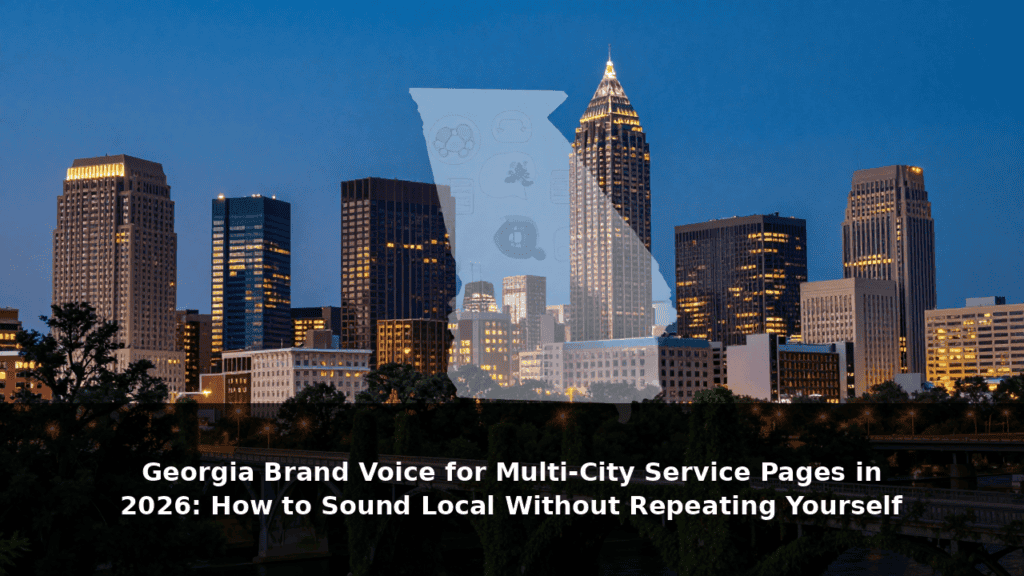
Georgia brand voice for multi-city service pages in 2026 is the problem most agencies solve by copy-pasting the same page with only the city name changed. That approach tanks your rankings and makes your content feel robotic. Georgia homeowners and business owners in Atlanta, Augusta, Savannah, Alpharetta, and Macon can tell the difference between a generic page and one written by someone who actually knows their neighborhood. This guide shows you how to build a consistent brand voice across multiple Georgia service pages while giving each city page its own local identity.
Why the City-Name-Swap Strategy Fails in Georgia
Google’s algorithm has gotten much smarter about detecting thin, duplicated content. When you publish seventeen pages that say “We offer plumbing services in [City], Georgia” with the only difference being the city name, Google sees that pattern and demotes all of them. The pages look like they were generated to manipulate local rankings rather than to help actual people. Google’s official guidance on local content quality makes clear that content needs to demonstrate genuine expertise about the specific location you are targeting.
Beyond SEO, the city-name-swap approach insults the intelligence of your Georgia audience. A Marietta homeowner who searches for “water heater installation Marietta GA” and lands on a page that talks generically about “Georgia homeowners” without referencing Marietta specifically will notice the disconnect. They will bounce. They will call the competitor whose page mentions the Chattahoochee River corridor or the Atlanta metro housing stock by name. Local relevance is a conversion signal, not just a ranking factor.
Start With a Brand Voice Framework Before You Write Any City Page
Before you touch a single Georgia city page, establish your core brand voice. Your brand voice is what stays constant across all markets. Your local flavor is what changes. These two elements need to be deliberately separated in your content strategy so you are not reinventing your brand on every page.
Ask yourself what your company genuinely stands for. Are you the contractor who shows up first thing in the morning and cleans up the job site before leaving? Are you the HVAC company that takes the time to explain options without pushing the most expensive unit? Are you the cleaning service that sends the same crew every time so they know your home? That personality needs to come through on every page you publish, whether you are targeting Atlanta or Albany.
Your brand voice anchors the reader to your company identity. The local details on each page create the sense that you are a real business that serves that specific community. Without the brand voice anchor, local details feel like filler. Without local details, the brand voice feels generic. The combination of both is what makes a multi-city content strategy work.
Use Georgia Neighborhood and Market Context as Your Local Flavor
The fastest way to sound local in a Georgia city page is to reference the right neighborhood context. Each Georgia market has distinct characteristics that you can weave into your content naturally. These references signal to readers that you are a local business, not a national franchise with a token Georgia page.
For Atlanta and its perimeter cities like Decatur, Brookhaven, and Sandy Springs, talk about the housing stock. These neighborhoods have a mix of historic homes from the 1950s and new construction that creates different service needs. A page targeting Decatur should mention that many homes there have older plumbing systems that need careful handling during remodels.
For Savannah and the Coastal Empire including Hilton Head and Bluffton, reference humidity and its effect on HVAC systems, crawl spaces, and mold prevention. Savannah homeowners deal with high humidity year-round in ways that Athens or Rome residents never think about. A service page that mentions “Savannah’s humidity and how it affects your AC system” resonates differently than generic “Georgia weather” language. The Georgia Coastal Ecosystems report from the University of Georgia provides local data on humidity patterns and environmental conditions specific to the Savannah area.
For Augusta and the CSRA (Central Savannah River Area), reference Fort Eisenhower and the military community. Many service businesses in that region serve a significant military customer base, and acknowledging that in your brand voice builds trust quickly. For Middle Georgia markets like Macon and Warner Robins, talk about the mix of historic downtown properties and newer suburban development that creates a wide range of service needs.
The Georgia Secretary of State Corporate Division maintains records for all LLCs registered in Georgia, and the Georgia Department of Community Affairs publishes economic development data for every region of the state that can inform your local market content.
These references take five minutes of research on each city. They are not expensive or time-consuming. They are the difference between a page that reads like it was written in a cubicle in Ohio and one that reads like it came from someone who has worked in that community for years.
Build a Service-by-City Content Matrix
The most efficient way to build multi-city service pages without duplicating yourself is to use a content matrix. List every service you offer across the top of the matrix. List every Georgia city or region you serve down the side. Each cell in the matrix is a combination of one service in one city. You write each cell independently, with the local flavor for that city applied to the service-specific content.
This sounds like more work, but it produces genuinely differentiated content. A drain cleaning service in Savannah needs different opening paragraphs than one in Atlanta because the soil composition, housing age, and common plumbing problems differ by region. Savannah’s sandy soil and historic downtown infrastructure create different drain issues than Atlanta’s red clay and suburban development. Writing to those real differences produces content that readers and search engines both reward.
For each cell, ask three questions. What is different about this service in this city compared to other Georgia markets? What would a local customer in this city recognize as a sign that the service provider knows their area? What local landmarks, neighborhoods, or community characteristics can you reference to build familiarity? The answers to those three questions become the backbone of each page.
Write the Service Core Once, Then Localize
The content that does not change by city is your service core. Your descriptions of what you do, how you do it, your certifications, your guarantees, your company story — all of that stays consistent across pages. You write it once, and it travels with you to every city page. This is your brand voice anchor.
Then you layer the local content on top. The introduction to each city page should reference what makes your service important in that specific market. The body should include local trust signals like nearby landmarks, regional weather patterns, or neighborhood characteristics that affect the service you are offering. The call to action can stay consistent because the brand voice carries it.
This approach solves the repetition problem at the structural level. You are not copy-pasting the same page. You are assembling each page from shared components and unique local components. Google sees unique local content on each page. Georgia readers see content that feels written for their city. Your team spends less time writing because the service core is reusable.
Add Internal Links That Reflect Real Site Architecture
Internal links between city pages and related service pages should follow a logical path. When someone lands on your “Plumbing Services in Atlanta” page, they should be able to find the pages for your other Atlanta services and your other Georgia city pages through a clear linking structure. These internal links help Google understand your site architecture and distribute ranking signals across your service area.
Link each city page to the nearest related service page on your site. If you have a page about drain cleaning that is not tied to a specific city, that page should link to your city-specific drain cleaning pages, and vice versa. This creates a web of related content that Google reads as topical authority, which helps all your Georgia pages rank for their respective local searches.
The Tennessee Multi-State Brand Architecture in 2026 guide covers how to structure brand voice and internal linking across multiple state markets. The principles apply directly to Georgia multi-city content strategies. For a deeper look at how service area pages fit within a broader local SEO system, see Montana Service Area Pages in 2026: A Local SEO Framework That Scales. Both posts show how to build internal link architecture that supports local rankings without creating a confusing mess of cross-linked pages.
Optimize Each Page for Its Specific Local Search Intent
Search intent in Buckhead differs from search intent in Buckner. Someone searching “emergency plumber Atlanta” wants immediate help and is likely a stressed homeowner or property manager with a burst pipe at 11pm. Someone searching “plumber near me in Atlanta” may be a new homeowner doing research or a business owner comparing options for routine maintenance. Same city, different intent.
Your Atlanta emergency plumber page should be written for someone in crisis. Your Atlanta routine maintenance page should be written for someone in comparison mode. Both pages are about plumbing services in Atlanta. Both need local identity. But the tone, the urgency, the trust signals, and the call to action differ based on what the reader is actually looking for in that moment.
Use the H2 and H3 structure to signal intent alignment. An H2 that says “24-Hour Emergency Plumbing in Atlanta” immediately tells both the reader and Google that this page serves emergency search intent. An H2 that says “Routine Plumbing Maintenance for Atlanta-Area Homes” serves the comparison shopper. Matching heading language to search intent is one of the most underused SEO tactics in multi-city content.
Track Performance Per City Page, Not Just the Campaign
When you publish a batch of Georgia city pages, resist the urge to only look at aggregate traffic numbers. Open Google Search Console and filter by page URL to see how each individual city page is performing for its local keyword targets. A page that targets “Savannah HVAC services” should be tracked against Savannah-specific queries, not Georgia-wide HVAC queries.
This per-page performance view tells you which city pages are working and which are getting ignored by Google’s local algorithm. A page that ranks well for its target city queries means the local content strategy is sound. A page that gets no impressions despite having the right keywords likely has a content quality or technical issue that needs fixing. Aggregate reports hide these differences and make it hard to know where to invest your next round of content updates.
Georgia Business Context That Shapes Brand Voice Decisions
Georgia’s business environment adds real texture to multi-city brand voice work. The Atlanta metro generates roughly half the state’s economic output, but secondary markets like Augusta, Savannah, and the Coastal Empire have distinct economic identities. Fort Moore, the military installation in Fort Benning’s former footprint near Columbus, shapes consumer spending patterns across a wide swath of Middle Georgia. The Savannah port drives logistics and contracting businesses throughout the southeastern part of the state.
Georgia’s climate zones range from the mountains in the north around Blue Ridge and Helen to the subtropical coastal climate around Savannah and the Sea Islands. HVAC businesses that serve both North Georgia mountain towns and Coastal Georgia coastal communities face completely different seasonal service patterns. A one-size-fits-all brand voice cannot capture those regional differences authentically. Each Georgia market deserves a page that reflects the actual conditions your customers live and work in.
How Rapid Registered Agent Supports Multi-State Service Businesses
Georgia brand voice for multi-city service pages is a content strategy challenge. Keeping all those pages legally compliant across Georgia markets is a registered agent challenge. Rapid Registered Agent provides Georgia registered agent service so your LLC has a consistent commercial address on file with the Georgia Secretary of State across every market you serve. We handle the compliance infrastructure while you build the content infrastructure that attracts customers in Atlanta, Savannah, Augusta, and every city in between. Start your Georgia LLC today with a registered agent that scales with your multi-city growth.
Build a content matrix that separates your reusable service core from city-specific local flavor. Write the service description once and layer city-specific neighborhood context, regional climate references, and local trust signals on top of it for each market. No. Google detects thin, duplicated content across city pages and demotes all of them. Each city page needs genuine local content that reflects the specific market, not just a changed city name in the title tag. Focus on the cities where you actually have customers or a realistic service radius. A page for every city in Georgia is not necessary. Three to five well-written pages for your primary markets beats twenty thin pages for every town in the state. Yes. Your company personality, values, and service standards should come through consistently across all markets. The local flavor changes by city, but the brand voice anchor stays constant. Readers should recognize your company identity whether they land on your Atlanta page or your Savannah page. Link each city page to related service pages on your site and to other city pages in your service area. This helps Google understand your site architecture and distributes ranking signals across your content. Use descriptive anchor text that includes the city and service name. Use Google Search Console filtered by page URL to see per-page performance for city-specific queries. Track each page against its target local keyword set rather than looking only at aggregate campaign numbers. This reveals which pages are working and which need content improvements.
Frequently Asked Questions
How do I make each Georgia city page sound different without duplicating content?
Does the city-name-swap approach still work for local SEO in Georgia?
How many Georgia city pages should I create for my service business?
Should my brand voice be the same on every Georgia city page?
How do internal links work across multi-city service pages?
How do I track whether each Georgia city page is actually ranking?
Aggressive Representation. Proven Results. Build multi-city service pages that sound genuinely local without repeating yourself. Rapid Registered Agent keeps your Georgia LLC compliant across every market you serve.Georgia Brand Voice for Multi-City Service Pages in 2026