
Wisconsin AI SOPs in 2026: How Small LLCs Turn Repeating Compliance Tasks Into Checklists

Wisconsin AI SOPs in 2026 solve a problem every small Wisconsin LLC owner knows. The compliance work that repeats every quarter — the annual report reminder that shows up unexpectedly, the withholding tax reconciliation that slips until the penalty notice arrives, the registered agent change that gets filed but never confirmed with the state — all of it can be systematized with AI tools that do not require a tech background to set up. Wisconsin AI SOPs in 2026 is the guide to building that system before the penalty notice shows up in the mail.
This article covers how small Wisconsin LLCs can use AI tools to turn their repeating compliance tasks into reliable checklists, what to automate first, and what still needs a human eye before the state gets a filing.
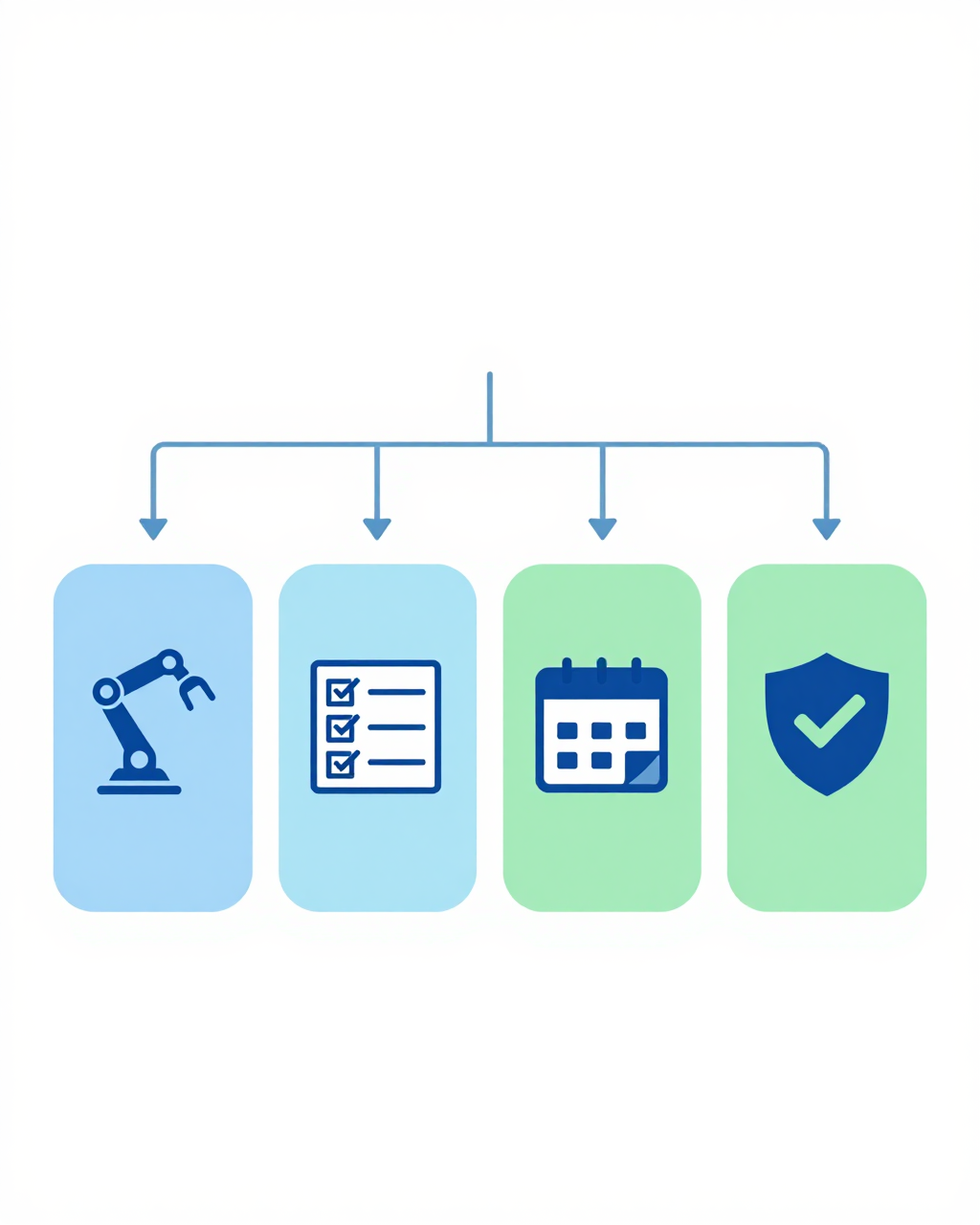
Wisconsin AI SOPs in 2026: How Small LLCs Turn Repeating Compliance Tasks Into Checklists
The Compliance Repetition Problem for Wisconsin LLCs
A Madison consulting LLC that started in 2024 has a compliance calendar that looks roughly the same every year. Annual report due in the anniversary month. Quarterly withholding tax reconciliations in January, April, July, and October. Annual withholding reconciliation in January. Registered agent annual fee in the same month as formation. Each of these items produces a document, a filing, or a payment — and each one has a deadline that a missed notice turns into a penalty.
The reason these tasks cause problems is not complexity. It is repetition without a system. A business owner who handles everything in email and a calendar app is relying on memory to catch every deadline. Memory fails. The result is a penalty notice that cost $200 to avoid and $2,000 to resolve after the fact.
AI tools in 2026 are sophisticated enough to help a two-person LLC build a compliance system that catches every one of these items automatically — without hiring a bookkeeper, without a compliance officer, and without spending more than a few hours setting it up initially.
What an AI SOP Actually Means for a Small LLC
An AI standard operating procedure is a repeatable workflow where an AI tool helps with some or all of the steps. In practice for a Wisconsin LLC compliance SOP, this means using AI to monitor for deadlines, draft filing documents, track what was submitted and what is pending, and send reminders before deadlines arrive.
The AI does not replace the filing. The LLC owner or their advisor still reviews and submits the actual form. What the AI handles is the tracking, drafting, and reminder layer that sits in front of the filing.
A practical AI SOP for a Wisconsin LLC might work like this: an AI tool monitors the registered agent email for state correspondence, summarizes each notice into a task with a deadline, routes it to the right person, and creates a draft of the response or filing. The owner reviews the draft, makes any needed changes, and approves the filing. That turns a two-hour research task into a fifteen-minute review task.
Building the Wisconsin Compliance AI SOP Step by Step
Step 1: Inventory Every Compliance Task That Repeats
Before automating anything, list every compliance task the LLC has faced in the past two years. For most Wisconsin LLCs this includes the annual report filed with the Wisconsin Department of Financial Institutions, quarterly withholding tax returns filed with the Wisconsin Department of Revenue, the annual withholding reconciliation due in January, any annual business tax return, and the registered agent annual service fee. If the LLC has employees, it also includes quarterly unemployment insurance filings with the Wisconsin Department of Workforce Development.
Writing this inventory takes 20 minutes. It is the foundation of the SOP. An AI tool cannot track a task that was never put on its list.
The Wisconsin Department of Financial Institutions is the primary agency for LLC annual reports and entity filings. The Wisconsin Department of Revenue handles withholding and business tax. The Department of Workforce Development handles unemployment insurance. Each agency has its own filing schedule and notice system.
Step 2: Setting Up AI Monitoring for Each Agency
Most Wisconsin compliance notices arrive through the registered agent mail portal or by email if the LLC has set up a business tax account. The AI monitoring layer reads incoming mail or email, extracts the key information — agency name, deadline, penalty amount if referenced — and creates a task with a deadline in a project management tool.
A simple setup uses a registered agent service that provides a scanned mail portal, combined with an AI document processing tool that reads the scanned notice and extracts the filing requirements. The AI summarizes the notice into two or three sentences and routes it to the LLC owner with a deadline attached.
Most of these tools use plain language prompts and do not require programming knowledge. The LLC owner describes the task in plain English and the AI builds the workflow.
Step 3: Drafting the Filing Using AI
Once the AI has routed a compliance task to the right person with a deadline, the next step is drafting the actual filing. AI tools in 2026 can draft routine government filings when given the right context — the LLC entity information, the prior year filing data, and the current year changes.
For a Wisconsin annual report, the AI can draft the updated entity information form using the prior year filing as a template. The owner reviews the draft, updates the member information if it changed, and submits. This turns an annual report update from a research task into a review task.
For quarterly withholding tax filings, the AI can pull the payroll data and draft the reconciliation form. The owner reviews the numbers and submits. This is where the time savings accumulate most — a task that used to take two hours takes thirty minutes.
Step 4: Building the Review and Approval Checkpoint
Every AI-drafted filing needs a human review checkpoint before submission. The checkpoint has three questions: Are the entity name and ID number correct? Are the dates and amounts consistent with our records? Is this being filed with the correct agency?
These three questions take a minute to answer. They catch the AI occasional error on a form field or an agency-specific requirement the AI did not have in its context. The review checkpoint is the quality control step that makes the SOP reliable.
The Wisconsin Compliance Items That Need the Most Attention
Annual Report with the Wisconsin DFI
The Wisconsin annual report is a factual update filed with the Department of Financial Institutions. It confirms the principal office address, the registered agent information, and the member or manager information. For most Wisconsin LLCs it is due every year in the anniversary month of the formation filing.
The filing fee is nominal for most entities. The penalty for missing it is administrative revocation — the LLC loses its certificate of authority and cannot enforce contracts in Wisconsin courts until it is reinstated. An AI SOP that sends a reminder 45 days before the anniversary month and drafts the annual report update using the prior year form as a template prevents this.
The DFI annual report catches many LLCs off guard because it is not a tax filing — it does not arrive with a tax notice and does not get a second reminder after the first one is missed.
Quarterly Withholding Tax with the Wisconsin DOR
Wisconsin requires quarterly withholding tax filings from any LLC that has employees. The quarterly returns are due the last day of the month following the quarter — April 30, July 31, October 31, and January 31. The annual reconciliation is due January 31.
The penalty for missing a quarterly filing applies from the original due date, not from the date the LLC realized it missed the filing. Interest accrues monthly. An LLC that missed three quarterly filings faces a penalty assessment significantly larger than the underlying tax.
An AI SOP that tracks quarterly filing due dates and drafts the reconciliation form using payroll data eliminates the most common reason these filings get missed — not complexity but forgetting.
Unemployment Insurance with DWD
Wisconsin employers pay unemployment insurance tax to the Department of Workforce Development. New employers start at a base rate and adjust based on claims experience. Quarterly wage reports must be filed even when no tax is due. The penalty for late filing applies from the first day past the due date.
An LLC that hired its first Wisconsin employee needs to register with DWD before the first payroll is run. An AI SOP that includes the DWD registration step in the onboarding checklist for new employees prevents the common mistake of running payroll before registering with the state.
What AI Cannot Handle in a Wisconsin Compliance SOP
AI drafting tools handle document drafting and deadline tracking. They do not handle judgment calls. If a Wisconsin LLC receives a penalty notice disputing the amount, the AI can summarize the notice and identify the relevant statute, but the decision to pay, dispute, or request a hearing requires a human decision.
Similarly, if the AI drafts a filing with an error — a wrong date, a missed field, a form version that was updated — the human review checkpoint catches it. The SOP reduces the time spent on routine drafting so the human reviewer can focus on accuracy rather than research.
The SOP also cannot replace the relationship with a Wisconsin-licensed attorney or CPA for complex situations. LLCs with international members, multi-state operations, or prior compliance failures should involve professional advisors before relying entirely on an AI SOP for those items.
Building the System in One Afternoon
The fastest path to a working AI compliance SOP for a Wisconsin LLC is to start with the three highest-frequency tasks: annual report tracking, quarterly withholding filings, and registered agent mail monitoring. Each of these can be set up in a tool like ClickUp, Notion, or a dedicated AI compliance platform by uploading the LLC entity information and the prior year filings as context.
The AI is prompted to track each filing type by deadline, draft the form using the prior year as a template, and alert the owner 30 days before each due date. This takes one to two hours to set up and produces a system that runs on autopilot.
As the LLC adds employees or taxable activities, the SOP expands to cover new filing types. The inventory built in Step 1 grows with the business. The system gets smarter as it accumulates more prior filings and more context about the LLC specific situation.
The businesses that handle compliance best in 2026 are not the ones with the biggest legal team. They are the ones with the best checklists. AI SOPs are how a two-person LLC builds the checklist infrastructure of a business three times its size.
Related Reading
Pennsylvania Compliance Mail Triage in 2026 — The same AI mail monitoring and document processing principles covered here apply to any state registered agent compliance system. This guide walks through the full setup for Pennsylvania LLCs and works as a template for Wisconsin.
Frequently Asked Questions
What is an AI SOP for a Wisconsin LLC compliance?
An AI SOP is a standard operating procedure where AI tools help draft, track, and route compliance filings instead of the owner handling every step manually. The AI handles the drafting and reminder layer; the owner reviews and approves before submission.
What Wisconsin compliance tasks should an LLC automate first?
Start with the three highest-frequency items: annual report tracking with the Wisconsin DFI, quarterly withholding tax filings with the DOR, and registered agent mail monitoring. These three cover most of the penalties Wisconsin LLCs face and take the least time to automate.
Does Wisconsin require an annual report for every LLC?
Yes. Every Wisconsin LLC must file an annual report with the Department of Financial Institutions each year. The report confirms the registered agent, principal address, and member or manager information. Missing it can result in administrative revocation of the LLC certificate of authority.
Can AI draft a Wisconsin tax filing?
AI can draft the routine Wisconsin tax filings — quarterly withholding returns and annual reconciliations — using the LLC prior year filings as context. The owner must review and approve before submission. AI does not replace the human review step for any government filing.
What happens if a Wisconsin LLC misses a quarterly withholding filing?
The Wisconsin Department of Revenue assesses penalties and interest from the original due date. Even if no tax was owed, a zero-return filed on time satisfies the requirement. A missed zero-return triggers a penalty assessment as if tax was owed.
How does a Wisconsin LLC get started with AI compliance tools?
Start with the LLC current task list — everything that has a deadline. Upload the prior year filings as context. Set up AI monitoring for the registered agent mail portal. Prompt the AI to draft each filing and alert the owner 30 days before each deadline.
Wisconsin LLC Services
Wisconsin AI SOPs in 2026
AI tools turn repeating Wisconsin compliance tasks into reliable checklists. Rapid Registered Agent helps Wisconsin LLCs build the SOPs that keep filings on time and penalties away.
- Wisconsin LLCs Formed in 2025
- 3,100+
- States Served
- 50
- Annual Renewal Support
- Included