Minnesota Member Capital Contributions in 2026: How to Document Owner Money the Right Way

Minnesota member capital contributions in 2026 trip up more LLC owners than almost any other formation topic — and the mistake usually happens before the first dollar goes in.
The owner writes a check from a personal account to the business account, labels it “capital contribution,” and moves on. That works fine until there is a dispute, an audit, or a new member joining who wants to know what everyone actually contributed. At that point, the informal check memo is not enough. The IRS wants documentation. Minnesota law expects it. And the LLC operating agreement should already have the answer.
This article covers how Minnesota LLCs should handle member capital contributions in 2026 — what counts as a contribution, how to document it, what the tax implications are, and what mistakes to avoid before they become problems.
What Counts as a Member Capital Contribution in a Minnesota LLC
A capital contribution is anything a member puts into the LLC to fund the business. The most common form is cash — a member transferring money from a personal account to the business checking account. But cash is not the only type.
Under Minnesota law, members can contribute property, tangible assets, intellectual property, and services rendered to the business. Each type of contribution has its own documentation requirements and different tax treatment.
The key rule that applies to all types: the contribution must be recorded at fair market value at the time it is made. If a member contributes equipment worth $5,000, the capital contribution is $5,000 — not whatever was paid for the equipment originally, and not zero just because no cash changed hands.
Why the Operating Agreement Is Not Optional in Minnesota
Minnesota does not require an LLC to have an operating agreement filed with the Secretary of State, but the state treats it as a required internal document nonetheless. The Minnesota Revised Uniform Limited Liability Company Act in Chapter 322C, governs how LLCs handle capital contributions, profit-sharing, and member rights. The statute provides default rules — but those defaults only apply when the operating agreement does not address an issue.
If your operating agreement does not specify how capital contributions are valued, how capital accounts are maintained, or how profits and losses are allocated, Minnesota’s default rules apply. Those defaults may not reflect what the members actually agreed to. That is where disputes start.
Your operating agreement should document every member’s capital contribution — the amount, the form (cash, property, or services), the date contributed, and the valuation method used for non-cash contributions. unclekam.com’s 2026 LLC operating agreement guide confirms that the agreement must clearly define the amount, type, and timing of all capital contributions to prevent disputes and establish each member’s tax basis in the LLC.
The Three Types of Contributions and How to Document Each
Cash Contributions
Cash is the simplest contribution to document. The paper trail is straightforward: a cancelled check, a bank transfer receipt, or a journal entry showing money moving from the member’s personal account to the LLC’s business account.
What should be in the record: the date, the amount, the source account, the destination account, and a notation that it is a capital contribution — not a loan. The operating agreement should reflect this cash contribution as part of the member’s capital account.
Property Contributions
When a member contributes property — equipment, furniture, a vehicle, software, a domain name — the contribution must be documented at fair market value. The member’s capital account is credited with that fair market value.
Documentation requirements for property contributions:
- A description of the property and its condition at the time of contribution
- The fair market value assigned and the method used to determine it
- The member’s cost basis in the property (this matters for the member’s tax basis calculation)
- Whether the property is subject to any debt (which affects the net contribution amount)
If the property has appreciated value, the LLC receives the appreciation as well as the basis. This can create a taxable gain for the contributing member in some circumstances. Consult a tax professional before contributing appreciated property.
Services Contributions
A member can contribute services to the LLC — work performed, expertise provided, or services rendered — in exchange for a capital interest. This is one of the most heavily scrutinized types of contributions by the IRS.
The IRS requires that services contributed to an LLC be documented with a reasonable valuation. The contribution is taxable income to the LLC equal to the fair market value of the services received. The contributing member’s capital account is credited with that same value.
Documentation for services contributions should include a description of the services, the hours or scope of work, the agreed-upon value, and confirmation that the services were actually performed.
How Capital Accounts Work in a Minnesota LLC
Every member of a Minnesota LLC has a capital account. The capital account tracks what the member has contributed and what distributions the member has received. It is the running ledger of each owner’s equity in the business.
The capital account is increased by: additional capital contributions, the member’s share of LLC profits, and any allocations of income. The capital account is decreased by: distributions to the member, the member’s share of LLC losses, and any allocations of deductions.
Capital accounts matter in several practical situations. When a new member joins, the existing capital accounts determine the buy-in price and the new member’s ownership percentage. When a member leaves, the capital account balance determines what they are owed. When the LLC is sold, capital accounts affect how the sale proceeds are allocated.
Minnesota law allows LLCs to choose between different capital account accounting methods in their operating agreement. The most common approach is the “positive capital account” method, where members have personal capital accounts that must be brought to a certain minimum level before distributions are made. Make sure your operating agreement specifies which method applies.
Tax Implications of Member Capital Contributions in 2026
Capital contributions to a Minnesota LLC are not taxable income to the LLC. The contribution increases the member’s capital account and their tax basis in the LLC.
The member’s tax basis in the LLC is important because it determines how much of a distribution the member can receive before that distribution becomes taxable. When a member’s basis is high, they can receive more distributions tax-free. When the basis is low, distributions may trigger capital gains.
For a cash contribution, the member’s basis in the LLC equals the amount of cash contributed. For a property contribution, the member’s basis equals the property’s adjusted cost basis at the time of contribution, plus any gain recognized on the contribution. For a services contribution, the member’s basis equals the fair market value of the services at the time they are contributed.
The IRS treats LLC capital contributions as non-taxable events for the business. The member’s basis is adjusted, but no gain or loss is recognized at the time of the contribution. This is governed by Internal Revenue Code Section 721. Understanding how this works is essential before making any contribution — particularly if the contribution involves property that has appreciated in value. unclekam.com’s 2026 guide confirms that a member’s basis in the LLC is directly affected by the amount and type of their capital contribution, and that miscalculating basis is one of the most common errors in LLC tax planning.
What Happens When Contributions Are Not Documented
An undocumented capital contribution is not automatically invalid, but it creates three serious problems.
First, the IRS may recharacterize the contribution as a loan — which has different tax consequences for both the member and the LLC. A loan means the member receives interest income. The LLC may be able to deduct interest payments. The documentation standards for a loan are different from those for a contribution.
Second, without documentation, it is difficult to establish each member’s ownership percentage if the operating agreement is silent. If two members each put in money but one contributed more, the undocumented contribution creates ambiguity about who owns what percentage of the LLC.
Third, if the LLC brings in a new member or sells an ownership interest, the absence of contribution records makes it nearly impossible to determine the correct valuation. The new member or buyer will want to see exactly what each existing member contributed — and if those records do not exist, the deal stalls or the valuation defaults to the lower end.
Minnesota Secretary of State Filing Requirements
Minnesota does not require the operating agreement to be filed with the Secretary of State. The Minnesota Secretary of State’s LLC page makes clear that formation and public filing records live with the state, while internal company documents stay with the business. The operating agreement is an internal document — but it must be maintained and available for inspection by members and, in some cases, by creditors.
What does get filed with the Minnesota Secretary of State:
- Articles of Organization (upon formation)
- Annual renewal filings (biennial for most LLCs)
- Any amendments to the Articles of Organization
- A copy of the operating agreement is not filed, but the LLC must keep one on file and produce it upon request
When you open a business bank account, the bank will typically request a copy of the operating agreement to verify who has authority to manage the account. If you also need to keep the entity active while organizing owner records, use the Minnesota annual renewal guidance from the Secretary of State so your internal paperwork and your state status stay aligned. This is another reason to have the document properly drafted before you need it — not after.
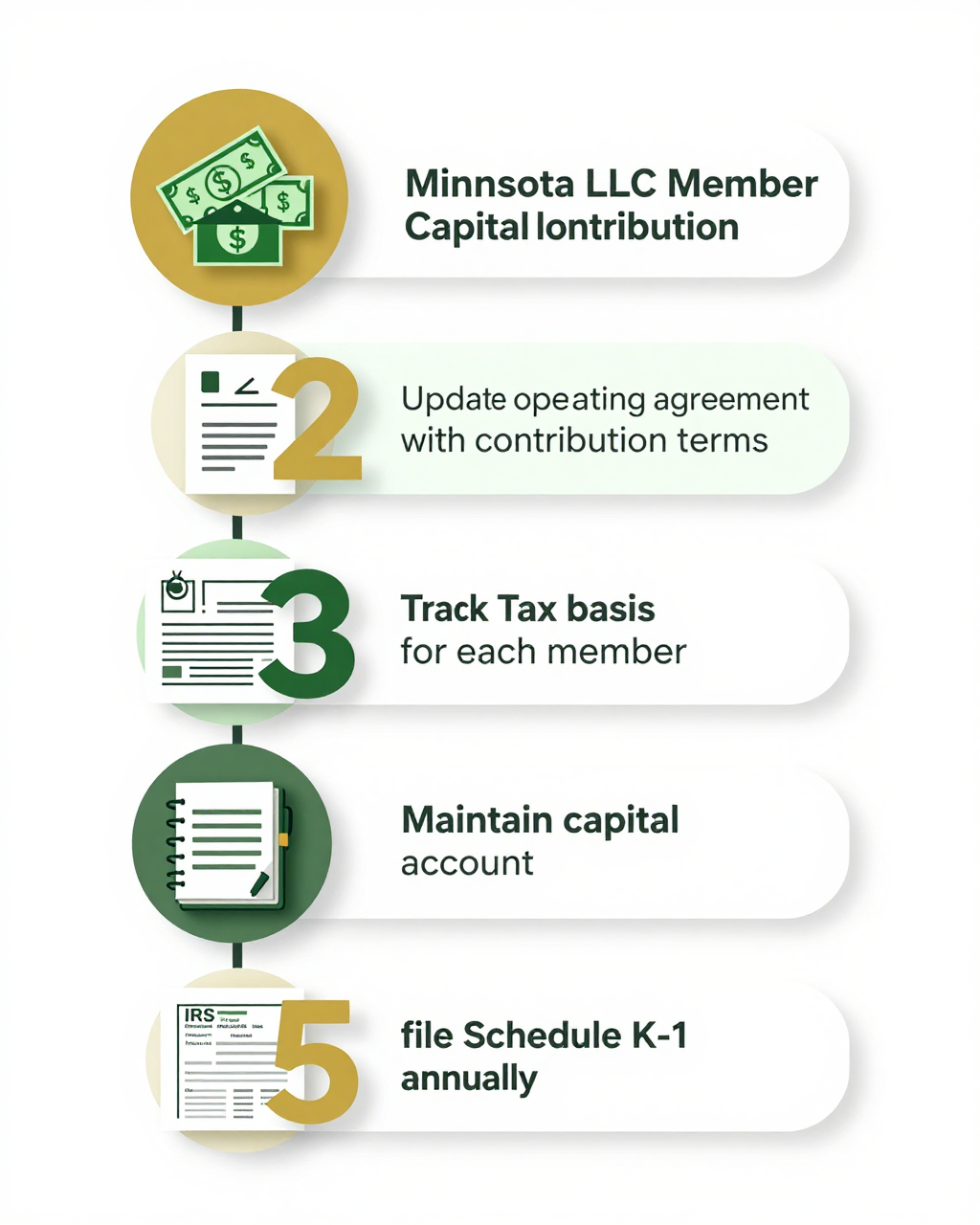
How to Record a Capital Contribution Step by Step
Here is the practical sequence for documenting a Minnesota member capital contribution correctly.
Step 1 — Confirm the contribution amount and form in the operating agreement. Before any money or property changes hands, the operating agreement should already specify what each member is expected to contribute and when. If it does not, amend it before making the contribution.
Step 2 — Execute the transfer. Move the cash or transfer the property. For cash, initiate a wire transfer or check payable to the LLC. For property, prepare a bill of sale or assignment document transferring ownership to the LLC.
Step 3 — Create a journal entry in the LLC books. Record the contribution in the LLC’s accounting records. Debit the appropriate asset account (cash or the contributed property), credit the member’s capital account.
Step 4 — Get written acknowledgment. The member should sign a written acknowledgment of the contribution — confirming the amount, the form, the date, and that it is a capital contribution and not a loan. This is a simple one-page document that becomes part of the LLC’s records.
Step 5 — Store the documentation. Keep the bank statements, wire transfer confirmations, property valuation documents, bills of sale, and the signed acknowledgment in the LLC’s records folder. Physical and digital copies are best.
Common Mistakes Minnesota LLC Owners Make With Capital Contributions
Treating a contribution as a loan without the paperwork. If a member intends a transfer to be a loan, document it as a loan — with a promissory note, an interest rate, and a repayment schedule. Without those documents, the IRS may treat it as equity.
Skipping the operating agreement amendment when contributions change. If the members agree to contribute additional capital after the LLC is formed, that change should be documented in an amendment to the operating agreement, not left in an email thread.
Valuing non-cash contributions without documentation. Claiming a piece of equipment is worth $10,000 without an appraisal or comparable market analysis invites IRS scrutiny. The IRS recordkeeping rules for businesses are a useful baseline here, and IRS Publication 583 is a smart starting point. Get something in writing, especially for significant assets.
Not tracking capital accounts annually. Capital accounts need to be maintained every year — updated for contributions made, distributions taken, and the member’s share of profits and losses. Waiting until a member leaves or the LLC is sold to reconstruct this history is painful and expensive.
Related Reading
- Minnesota LLC Documents: Example and State Comparisons — What your Minnesota LLC formation documents should include and how they compare across states.
- Minnesota LLC Conversion Planning in 2026: When a Sole Proprietor Should Move Up — If you are converting from a sole proprietorship to an LLC, capital contributions are part of setting the new entity up right.
- Minnesota Annual Renewal Filing: A 2026 Checklist for LLCs — After documenting your capital contributions, make sure your annual renewal is filed on time to keep the LLC in good standing.
Frequently Asked Questions
Does a Minnesota LLC member have to contribute capital at formation?
No. Minnesota law does not require a minimum capital contribution. Members can contribute whatever amount they agree upon, including nothing at formation, with contributions made later as the business needs capital. The operating agreement should still specify what each member is expected to contribute and when.
Are capital contributions taxable income to the LLC?
No. Under IRC Section 721, capital contributions are generally not taxable to the LLC at the time of receipt. The contribution increases the member’s capital account and tax basis, but it is not treated as business income.
How do I document a non-cash capital contribution?
Document a non-cash contribution with a written description of the property, its fair market value on the contribution date, the valuation method used, and the member’s cost basis in the property. A bill of sale or assignment should transfer the property to the LLC, and a written acknowledgment signed by the contributing member is also smart.
Can a Minnesota LLC member contribute services instead of cash?
Yes. Services can be contributed as a capital contribution, but they should be recorded at fair market value and documented carefully. The contributing member receives a capital account credit for that value.
What happens if a member contributes more than the operating agreement says?
The extra amount is still usually treated as a capital contribution, but the operating agreement should be amended to reflect the real contribution history so ownership and capital accounts stay clear.
Does Minnesota require the operating agreement to be filed with the Secretary of State?
No. Minnesota does not require the operating agreement to be filed with the Secretary of State. It remains an internal LLC record, but banks, members, buyers, and tax advisors may all ask to review it.
Aggressive Representation. Proven Results.
Need Help Documenting Your Minnesota LLC Capital Contributions?
Rapid Registered Agent can help Minnesota LLC owners set up their operating agreement and documentation process correctly — so your capital contributions are clean, auditable, and ready for whatever comes next.
- IRS Section
- IRC §721
- MN Statute
- Ch. 322C
- Filing Required
- No (internal)