
Massachusetts Registered Agent Change in 2026: Filing Steps Before a Move or Rebrand

Massachusetts registered agent change in 2026 starts with a form most owners have never heard of — and it is free to file online.
The person or company handling your legal mail in Massachusetts is called a resident agent under state law. Most LLC owners set one up when they form the entity and then forget about it. That works fine until you move your office, hire a professional service, or need to clean up your address on the public record. Then you find out you need the Limited Liability Company Statement of Change of Resident Agent/Resident Office — and you want to know exactly what you are signing before you file it.
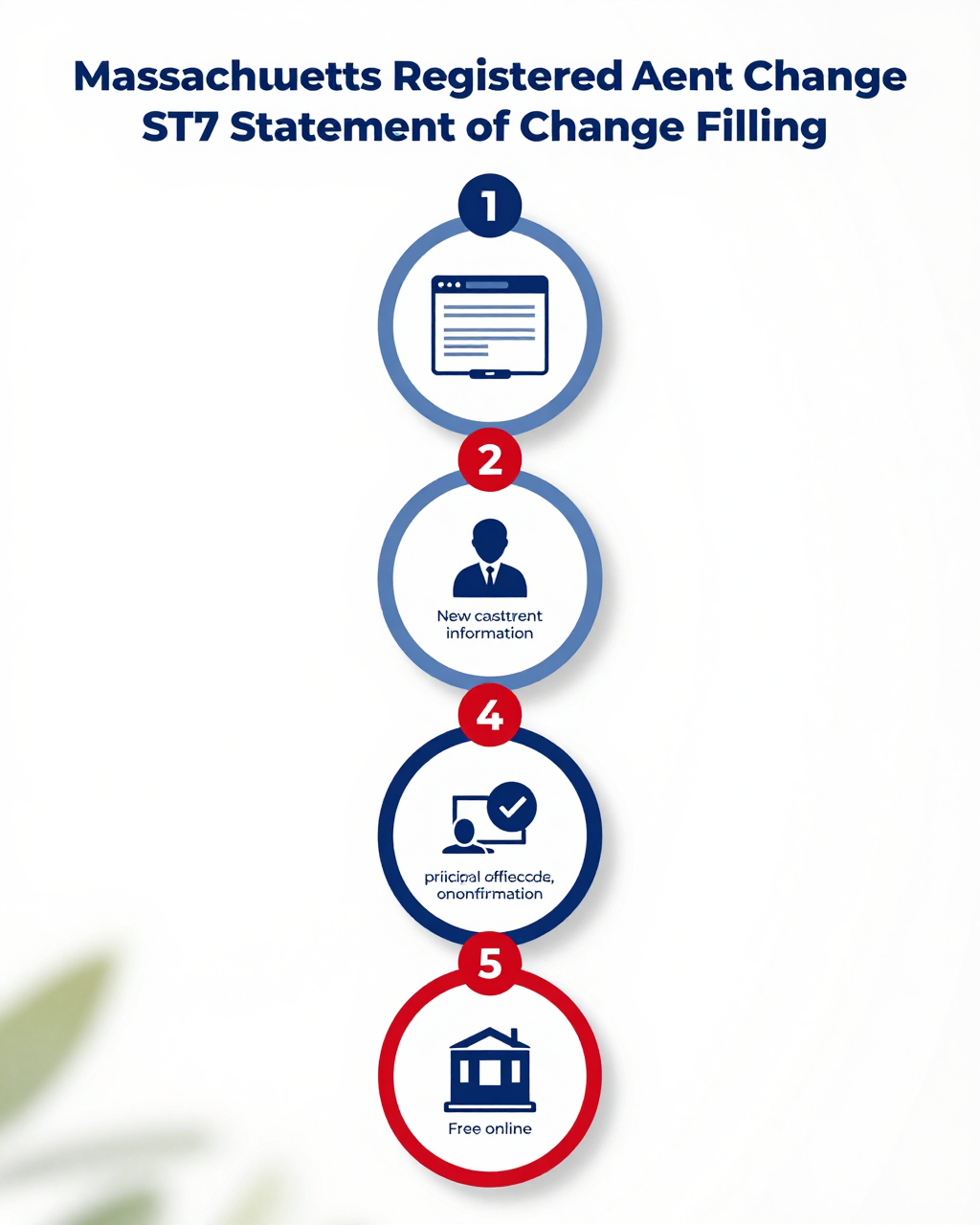
This article covers the Massachusetts resident agent change process in 2026, what triggers the switch, what can go wrong, and how to protect yourself before the state record gets stale.
Why Massachusetts Calls It a Resident Agent (And Why the Name Matters)
Massachusetts uses the term “resident agent” where most other states say “registered agent.” The function is identical: a person or company located at a physical address in the state who accepts legal documents and state notices on behalf of your LLC. The name is just a Massachusetts convention rooted in state statute M.G.L. c. 156C § 5A, which governs how an LLC changes its resident agent and resident office address.
It matters because when you search for forms or talk to the Secretary of the Commonwealth’s Corporations Division, you will see the phrase “resident agent” — not “registered agent.” If you search for the wrong term, the form does not show up.
Under M.G.L. c. 156C § 5, your resident agent must be either an individual Massachusetts resident, a domestic corporation authorized to do business in Massachusetts, or a foreign corporation qualified to operate in the Commonwealth. The agent must have a physical street address — not a PO Box — in Massachusetts at all times. maregisteredagent.org confirms that this eligibility requirement applies to every resident agent in the state.
What Triggers a Massachusetts Registered Agent Change in 2026
A resident agent change in Massachusetts is more common than most owners realize. Here is why people file it:
Moving your business address. If you are relocating your principal office within Massachusetts, the resident agent address on file may need to match. The change of resident agent form also covers a change of resident office address.
Switching to a professional service. Many owners list their own address or an accountant’s address when they form the LLC. As the business grows, using a commercial registered agent service provides privacy, reliability, and a professional address on the public record.
Privacy on the public record. The LLC’s address appears in the state database. Using a professional resident agent service replaces your home or office address with a commercial address that receives mail on your behalf.
Your current agent resigned or became unreachable. If your current resident agent sent a notice of resignation, the clock is already running. Massachusetts requires the entity to maintain an active resident agent at all times. Filing promptly prevents the entity from falling out of good standing.
Rebranding or restructuring. When an LLC undergoes a restructuring or ownership change, it is a good time to audit who is listed as the resident agent and whether the current arrangement still makes sense.
The Massachusetts Statement of Change: What You Need to Know
The form is officially titled the Limited Liability Company Statement of Change of Resident Agent/Resident Office. Massachusetts does not assign the form a number — it is simply filed as a Statement of Change with the Secretary of the Commonwealth’s Corporations Division.
Here are the key facts before you file:
- Online filing fee: $0 (free through the Secretary of the Commonwealth’s online portal)
- Mail or walk-in filing fee: $25
- Processing time for mail: Typically 3–5 business days
- Expedited processing: Available for an additional $5 fee
- Authority: M.G.L. c. 156C § 5A
To file online, you need a Customer ID Number and a PIN from the Secretary of the Commonwealth. These were assigned when your LLC was formed. If you do not have them, you can retrieve them through the Commonwealth’s online portal or by contacting the Corporations Division directly.
Step-by-Step: How to File the Massachusetts Resident Agent Change Online
Step 1 — Gather Your Business Information
Before logging in, have your LLC’s document number (also called the charter number) ready. You can find it by searching your business name in the Commonwealth’s online corporation database. Also confirm the name and Massachusetts address of your new resident agent.
Step 2 — Access the Secretary of the Commonwealth Online Portal
Go to the Secretary of the Commonwealth’s Corporations Division portal at sec.state.ma.us. Log in with your Customer ID Number and PIN. If this is your first time using the online portal, you may need to register the LLC under your account before you can file changes.
Step 3 — Select the Statement of Change Filing
Choose the option to file a Statement of Change for your LLC. The form will ask for the current resident agent information and the new resident agent information. Fill in the new agent’s name, Massachusetts street address, and confirm the change of resident office address if applicable.
Step 4 — Submit and Pay
For online filing, the fee is $0 — no payment is required. Submit the form and note the confirmation number. The Corporations Division will process the filing and update the public record.
If filing by mail, send the completed form with a $25 check or money order payable to the Commonwealth of Massachusetts. Mail to the Corporations Division at the address listed on the form. Expect 3–5 business days for processing without expedited service.
Step 5 — Verify the Change in the State Record
After filing, search for your LLC again in the Commonwealth’s database. The resident agent name and address should update within the processing window. If you used expedited processing, check within one business day. If the record has not updated after the expected timeframe, contact the Corporations Division to confirm the filing was received and processed.
Common Mistakes That Delay a Massachusetts Agent Switch
Filing the wrong form. Some owners try to change the resident agent using the annual report form. The annual report is for confirming your existing information — it does not change the resident agent. Use the Statement of Change form specifically.
Using a PO Box for the new agent. Massachusetts requires a physical street address for the resident agent. A PO Box will be rejected. Make sure the new agent’s address is a real Massachusetts street address.
Not having the new agent’s consent. The new resident agent should be aware they are being listed and should confirm they meet the eligibility requirements under M.G.L. c. 156C § 5. Most professional services provide this confirmation as part of their onboarding.
Filing with the wrong entity type. The LLC Statement of Change is specific to LLCs. If you have a corporation, limited partnership, or other entity type, you need the corresponding Statement of Change form for that entity type.
Waiting until the current agent has already resigned. If your current resident agent has already sent a resignation notice, you are in a race against time. The state requires an active resident agent at all times. File the Statement of Change immediately, even if you have not yet selected a permanent replacement — you can list a temporary agent while you finalize the decision.
The Mail Gap: What Happens During the Switch
Between the moment you submit the Statement of Change and the moment the state record updates, there is a window where the old resident agent and the new one may both believe they are responsible for your mail — or neither does.
During this gap, legal summons, state notices, and annual report reminders can be delivered to the old address. If the old agent is already in the process of closing out your account, those documents may not be forwarded.
This is especially risky during the Massachusetts annual report filing period. The annual report is due to the Secretary of the Commonwealth by a specific date each year — missing it can result in penalties and a loss of good standing status. If your annual report notice gets sent to an agent who is no longer handling your mail, you may not know about the deadline until the penalty clock starts.
The solution: do not cancel service with your old resident agent until the state record shows the new agent is active. This is the single most important step in avoiding a compliance gap.
Massachusetts vs. Other States: How the Process Compares
Massachusetts has one of the more owner-friendly registered agent change processes in the country — the online filing is free, which is not common across states.
Florida, by comparison, charges $25 for a registered agent change and requires a separate filing from the annual report through the Sunbiz e-filing portal. Florida also requires the new agent to sign an acceptance — Massachusetts does not require a separate consent form, though the new agent should be informed and willing.
Illinois uses a registered agent change amendment filed with the Secretary of State. The Illinois process requires the new agent’s written consent as part of the filing. Illinois charges a filing fee for the amendment and processing times vary by volume.
California requires a Statement of Information update for most entities, which includes the registered agent section. The California filing is included as part of the biennial Statement of Information requirement and the fee is included in that filing.
Massachusetts stands out for the $0 online filing fee and the ability to file the change at any point during the year without bundling it into an annual report.
What to Look for in a New Massachusetts Resident Agent
When selecting a replacement resident agent, there are a few things that separate a good service from a bare-minimum one:
Physical presence in Massachusetts. The agent must have a real street address in the Commonwealth. Some services use a mail-forwarding address that is not truly a physical office. Ask specifically whether the address is a physical location where someone is present during business hours.
Legal document handling. A resident agent’s core job is accepting service of process. Some services scan everything and only forward what looks important. That approach loses lawsuits. Ask how they handle legal summons specifically.
Response time. If the agent receives a document on your behalf, how quickly do they notify you? A same-day scan-and-forward service is the standard. Anything slower than 24 hours is a red flag.
Additional services. Many resident agent services also handle annual report filings, certificate of good standing requests, and other Commonwealth filings. Using one service for multiple filings reduces the chance of a missed deadline.
Related Reading
- Illinois Registered Agent Change in 2026: How to Update SOS Records Before Mail Problems Spread — Cross-state comparison of what the change filing looks like in a neighboring state.
- Massachusetts Annual Report vs Certificate of Good Standing in 2026: What Banks and Landlords Treat Differently — After you change your resident agent, make sure your annual report and good standing status are both in order.
- Massachusetts DBA vs LLC Name in 2026: When to File a Business Certificate Instead of Renaming — If your agent change coincides with a rebrand, here is how Massachusetts handles doing business under a different name.
Frequently Asked Questions
Frequently Asked Questions
- Illinois Registered Agent Change in 2026: How to Update SOS Records Before Mail Problems Spread — Cross-state comparison of what the change filing looks like in a neighboring state.
- Massachusetts Annual Report vs Certificate of Good Standing in 2026: What Banks and Landlords Treat Differently — After you change your resident agent, make sure your annual report and good standing status are both in order.
- Massachusetts DBA vs LLC Name in 2026: When to File a Business Certificate Instead of Renaming — If your agent change coincides with a rebrand, here is how Massachusetts handles doing business under a different name.
Frequently Asked Questions
How much does a Massachusetts registered agent change cost in 2026?
Filing online is free. Mailing the Statement of Change costs $25. Expedited processing is available for an additional $5 fee.
Can I change my Massachusetts resident agent myself, or do I need an attorney?
You do not need an attorney. The Statement of Change is a standard form available through the Secretary of the Commonwealth’s online portal. Most business owners can complete it without legal assistance.
What is the processing time for a Massachusetts resident agent change?
Online filings are processed within the portal system immediately upon submission. Mail filings typically take 3–5 business days. Expedited processing reduces this to one business day for an additional $5 fee.
Can I use a PO Box as my Massachusetts resident agent address?
No. Massachusetts law requires the resident agent to have a physical street address in the Commonwealth. A PO Box does not satisfy this requirement.
What happens if my current resident agent resigns and I do not file a change immediately?
Your LLC is required to maintain an active resident agent at all times. If the current agent resigns and no replacement is filed promptly, your entity may fall out of good standing with the Commonwealth. The Corporations Division may also flag the entity for administrative dissolution.
Do I need the new resident agent's written consent before filing the Statement of Change?
Massachusetts does not require a separate consent form to be filed with the Statement of Change. However, the new resident agent should be aware they are being listed and should confirm they meet the eligibility requirements under M.G.L. c. 156C § 5.
Can I change both my resident agent and my business address on the same form?
Yes. The LLC Statement of Change of Resident Agent/Resident Office covers both changes. You can update the resident office (principal business address) and the resident agent information on a single filing.
Aggressive Representation. Proven Results.
Need to Switch Your Massachusetts Resident Agent?
Rapid Registered Agent handles the Massachusetts Statement of Change filing for you — free to file online, no confusing forms, no compliance gaps.
- Online Filing Fee
- $0
- Processing Time
- Same day
- States Covered
- 50
Frequently Asked Questions
How much does a Massachusetts registered agent change cost in 2026?
Filing online is free. Mailing the Statement of Change costs $25. Expedited processing is available for an additional $5 fee.
Can I change my Massachusetts resident agent myself, or do I need an attorney?
You do not need an attorney. The Statement of Change is a standard form available through the Secretary of the Commonwealth’s online portal. Most business owners can complete it without legal assistance.
What is the processing time for a Massachusetts resident agent change?
Online filings are processed within the portal system immediately upon submission. Mail filings typically take 3–5 business days. Expedited processing reduces this to one business day for an additional $5 fee.
Can I use a PO Box as my Massachusetts resident agent address?
No. Massachusetts law requires the resident agent to have a physical street address in the Commonwealth. A PO Box does not satisfy this requirement.
What happens if my current resident agent resigns and I do not file a change immediately?
Your LLC is required to maintain an active resident agent at all times. If the current agent resigns and no replacement is filed promptly, your entity may fall out of good standing with the Commonwealth. The Corporations Division may also flag the entity for administrative dissolution.
Do I need the new resident agent's written consent before filing the Statement of Change?
Massachusetts does not require a separate consent form to be filed with the Statement of Change. However, the new resident agent should be aware they are being listed and should confirm they meet the eligibility requirements under M.G.L. c. 156C § 5.
Can I change both my resident agent and my business address on the same form?
Yes. The LLC Statement of Change of Resident Agent/Resident Office covers both changes. You can update the resident office (principal business address) and the resident agent information on a single filing.
Aggressive Representation. Proven Results.
Need to Switch Your Massachusetts Resident Agent?
Rapid Registered Agent handles the Massachusetts Statement of Change filing for you — free to file online, no confusing forms, no compliance gaps.
- Online Filing Fee
- $0
- Processing Time
- Same day
- States Covered
- 50