Iowa Cash Flow Cleanup in 2026: The Simple Expense Tags That Make Tax Prep Easier

Iowa business owners who skip expense tagging lose hundreds of dollars every year. Iowa cash flow cleanup starts with one habit: putting the right label on every dollar before the year ends. That habit is what this guide is about.
If you run an Iowa LLC, you already know the clock runs out in November. Receipts pile up. The shoebox under the desk gets heavy. Your accountant asks for a list of expenses and you send a Zip file of photos with names like “misc 10-4” and “Receipt 47.” That gap between what you spent and what you can prove you spent is where money disappears. Iowa cash flow cleanup solves that problem one tag at a time.
The Expense Problem Nobody Talks About
Most Iowa small business owners are good at earning revenue. They are not always good at tracking it. A study by the National Small Business Association found that 40% of small business owners reported missing out on legitimate tax deductions because they could not document them. That is a real number with a real dollar sign attached.
The fix is not a new app. The fix is a consistent tagging system applied to every transaction from day one. Iowa businesses that tag expenses as they happen finish tax season in hours, not days. They also tend to owe less because they actually claimed everything they were entitled to claim.
Pick One System and Stay With It
Iowa bookkeepers and tax professionals agree on this point: the best expense system is the one you will actually use. That might be QuickBooks, Wave, or a spreadsheet. It does not matter which tool you choose. What matters is that every income and expense transaction gets a category on the day it happens.
Iowa LLC owners who try to catch up at year end almost always miss things. A purchase made in March gets forgotten by October. A mileage deduction for a client visit evaporates because nobody wrote down the destination. Tagging daily is the only way to capture everything.
The Five Tags That Cover Most Iowa Small Business Expenses
The IRS publishes a guide to business expenses at irs.gov/businesses/small-businesses-self-employed/business-expenses that is worth reading before you set up your categories. The U.S. Small Business Administration also offers a practical small business expense guide at sba.gov/business-guide/launch-your-business/choose-a-business-structure-and-registration that covers registration, structure, and ongoing compliance costs. Most Iowa small business expenses fall into five buckets.
1. Ordinary and Necessary Business Expenses
The IRS calls this the foundation of every deduction. An expense is ordinary if it is customary in your trade or profession. It is necessary if it helps your business function. This category is broader than most people think. It covers office supplies, professional fees, software subscriptions, and equipment repairs. Iowa businesses should tag anything that keeps the lights on and the work moving as “Ordinary-Necessary” before anything else.
2. Meals and Entertainment
Iowa business owners take clients out to eat. That is normal. What a lot of people miss is that the IRS allows a 50% deduction for business meal expenses when they are directly related to business activity. The key rules are that the meal cannot be lavish and you need documentation: who, what, where, and why. Tag these as “Meals-Business” and save the receipt every time.
3. Vehicle and Mileage Expenses
If you drive for work in Iowa, you need a system for tracking miles. The IRS standard mileage rate changes every year, and the Iowa Department of Revenue may have its own rules for commercial vehicle deductions. You can either track actual expenses or use the standard mileage rate. Either way, tag every work drive with the date, destination, and purpose. Do not wait until December to reconstruct a trip to a client site in Des Moines or Cedar Rapids.
4. Home Office Deduction
Iowa LLC owners who work from home can deduct a portion of their housing costs. The IRS allows either the simplified method (five dollars per square foot, up to 300 square feet) or the regular method (a percentage of actual costs). Either way, tag home office expenses separately and keep a floor plan or room-by-room breakdown.
5. Professional Services and Contractors
If you hired a web designer, accountant, attorney, or consultant in Iowa, those payments are deductible. If you paid the contractor more than $600 in a year, you may need to file a 1099-NEC. Tag these as “Professional Services” and keep copies of invoices.
Match Your Iowa Business Type to the Right Tags
A construction LLC in Davenport has different expense patterns than a freelance designer working from a home office in Iowa City. The tagging system should reflect what you actually spend money on.
If you run a retail or service business in Iowa, focus on cost of goods sold, supplies, and equipment. If you run a professional services firm, prioritize software subscriptions, professional development, and client meals. Iowa agricultural businesses have their own set of deductions for feed, equipment, and land improvements that deserve their own category tags.
How to Tag Without Slowing Down
The biggest objection Iowa business owners raise is time. Tagging every transaction takes too long, they say. Here is what works in practice: do it in batches. Every Monday morning, open your bank feed and tag the prior week’s transactions. It takes fifteen minutes if you stayed on top of it. It takes two hours if you let it pile up for six weeks.
Another option is to use a business credit card for everything business-related and a personal card for personal spending. That separation alone cuts your tagging work in half. Iowa businesses that use a dedicated business bank account finish tax prep faster and with fewer errors.
Iowa Tax Deadlines That Should Be on Your Calendar
Iowa LLCs have specific filing deadlines that affect expense planning. The biennial report for Iowa LLCs is due every other year by a date set by the Iowa Secretary of State. Missing that deadline triggers a penalty and can put your LLC in bad standing. An LLC in bad standing loses some legal protections and may face bank complications.
Iowa businesses also need to stay current with the Iowa Department of Revenue on sales tax and withholding filings. The state corporate income tax return is due on the 15th day of the fourth month after your fiscal year ends. For most calendar-year businesses, that is April 15. Iowa businesses that need help with deadlines and compliance can work with a registered agent service to stay on top of filing windows.
You can check current Iowa filing requirements and deadlines at sos.iowa.gov/business and revenue.iowa.gov/businesses.
The Numbers Behind the Habit
Here is what consistent expense tagging actually produces for an Iowa small business. A service business with $120,000 in revenue that properly tags and claims all legitimate deductions might reduce taxable income by $18,000 to $25,000 compared to a business with loose records. At the Iowa corporate income tax rate, that is real money back in the business.
Equipment purchases deserve special mention. Section 179 of the IRS tax code, detailed at irs.gov/businesses/small-businesses-self-employed/section-179-deduction, lets small businesses deduct the full purchase price of qualifying equipment in the year it is bought instead of depreciating it over time. Iowa businesses that buy computers, machinery, or vehicles should tag those purchases separately so the accountant can apply the correct deduction method.
What Happens If You Skip It
Iowa businesses that do not track expenses face three problems. First, they overpay taxes because deductions were missed. Second, they waste time reconstructing records during tax season, often paying their accountant extra for the privilege. Third, they make worse business decisions because they do not have clean data on where money is actually going.
An Iowa HVAC contractor once told his bookkeeper that he was making 30% profit on every job. After a proper expense tagging and review, he discovered his real margin was 11%. He had been pricing jobs based on bad numbers. Fixing the tagging habit changed his pricing within 90 days.
Setting Up Your Iowa Expense Tags Today
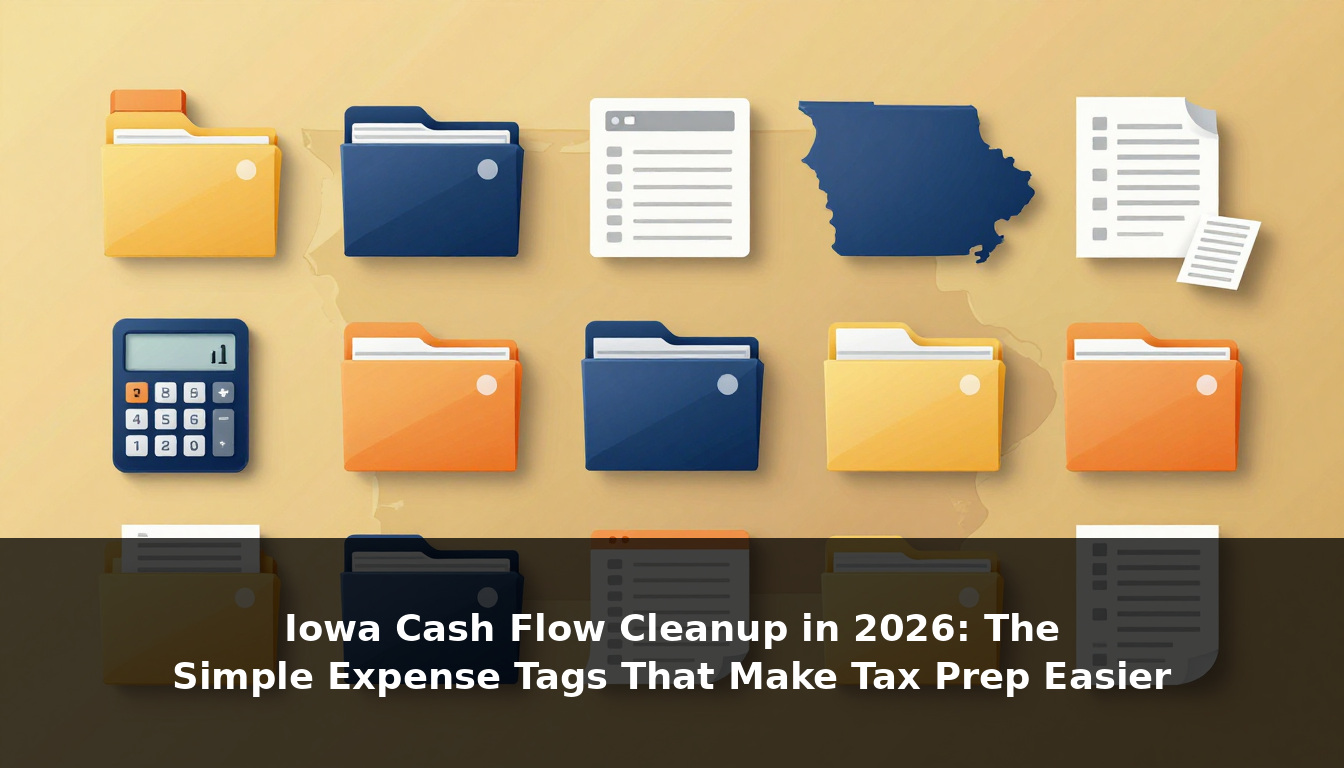
Start with your chart of accounts. Most accounting software lets you build custom categories. Create these five core tags as a minimum viable system: Ordinary and Necessary, Meals and Entertainment, Vehicle and Mileage, Home Office, and Professional Services. Add subcategories as needed.
Then set a weekly reminder on your phone. Monday morning, 8 a.m., tag last week’s transactions. That single recurring appointment is what separates Iowa businesses that finish tax season in peace from those who spend April in a panic.
Iowa cash flow cleanup works best when your LLC is set up right from the start. If your Iowa registrations are not in order, everything downstream gets harder. Get the filings right the first time.
Related Reading
Iowa Sales Tax Permit vs LLC Filing in 2026 — get the registrations in the right order.
Iowa Registered Agent Statement of Change 2026 — keep your registered agent information current.
Iowa Biennial Report Deadlines 2026 — stay compliant while you clean up cash flow.
Iowa cash flow cleanup does not happen at year end. It happens every Monday morning, one tag at a time — Iowa Cash Flow Cleanup.
The IRS business expenses guide at irs.gov identifies five core categories that cover most Iowa small business costs: ordinary and necessary operating expenses, meals and entertainment (50% deductible when documented), vehicle and mileage costs, home office deductions, and professional services or contractor payments. Tag every transaction into one of these five buckets from day one and your tax prep will be significantly simpler. Yes. An Iowa LLC owner who uses part of their home exclusively and regularly for business can claim the home office deduction. The IRS allows either the simplified method ($5 per square foot, up to 300 sq ft) or the regular method (actual costs divided by the percentage of the home used for business). Tag home office expenses separately so your accountant can apply the right method. The Iowa Secretary of State imposes a penalty fee for late biennial reports and may put the LLC in bad standing. An LLC in bad standing loses legal protections and may have trouble opening a business bank account or signing contracts. Set a reminder well before the filing window or use a registered agent service that tracks due dates for you. If an Iowa LLC pays a contractor $600 or more in a year for services, the LLC generally must file a 1099-NEC with the IRS. This applies to most types of services including legal, accounting, construction, and consulting work. Tag all contractor payments throughout the year so you can produce the totals at year end. Section 179 of the IRS tax code lets small businesses deduct the full purchase price of qualifying equipment in the year it is bought rather than depreciating it over multiple years. Iowa businesses that buy computers, machinery, commercial vehicles, or office furniture may qualify. Tag equipment purchases separately and tell your accountant so they can apply the Section 179 deduction if it benefits your business.Frequently Asked Questions
What are the most important expense categories for an Iowa small business?
Can an Iowa LLC deduct home office expenses?
What happens if an Iowa LLC misses the biennial report deadline?
Does an Iowa business have to file a 1099 for contractors?
What is Section 179 and does it apply to Iowa businesses?
Iowa Small Business Resource A registered agent service keeps your Iowa LLC compliant while you focus on clean books and smart growth. Get started today.Iowa Cash Flow Cleanup Starts Here