Vermont Small-Business Trust Signals in 2026: How a Registered Agent Supports Brand Credibility

Aggressive Representation. Proven Results.
We Fight For The Justice You Deserve.
When you’ve been injured, you need a powerful legal team on your side. We have recovered over $500 Million for our clients. Don’t settle for less.
Frequently Asked Questions
What are Vermont small-business trust signals actually built on?
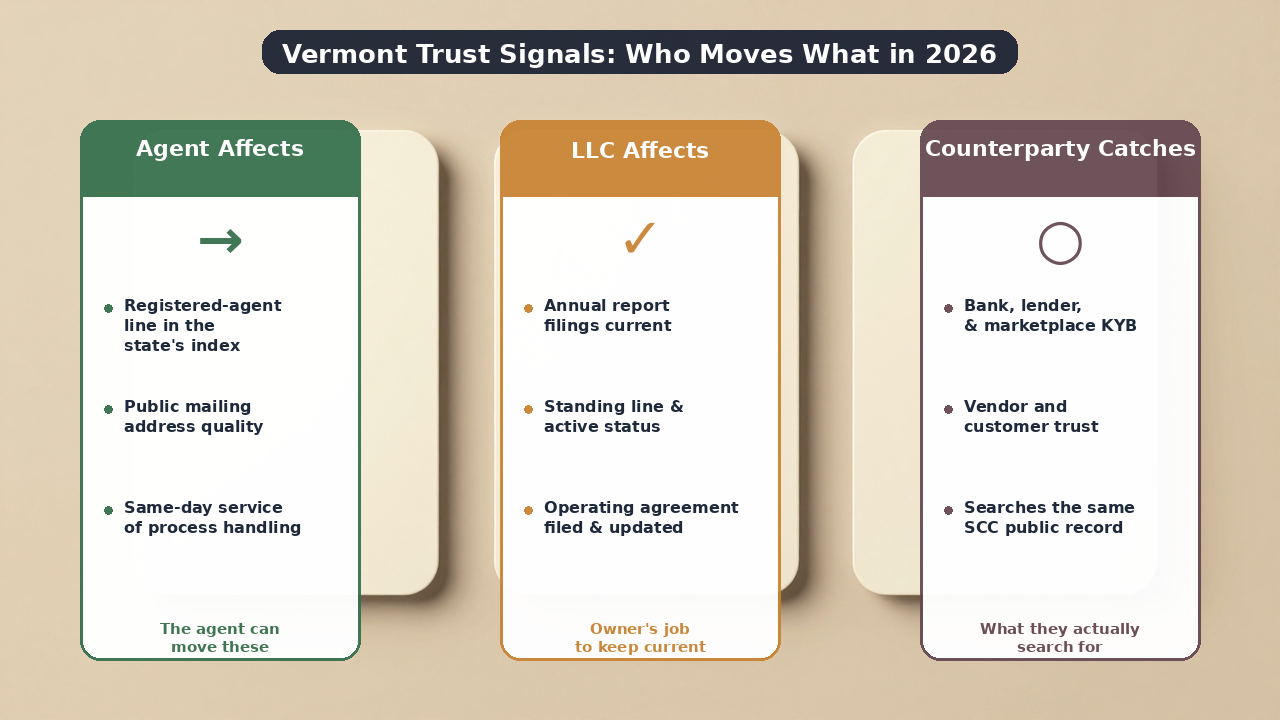
Vermont small-business trust signals are built on the public record that shows up when someone pulls the LLC’s information from the Vermont Corporation and Business Services Division database. That record covers the registered-agent line, the principal-office address, the organizer and member information, the entity’s current standing, and the most recent annual report. A mismatch on any of those fields is a credibility hit. The registered agent moves one of those fields. The rest are the LLC’s responsibility.
Which trust signal does a Vermont registered agent actually move?
A Vermont registered agent moves the registered-agent line on the public record. Replacing a residential street address with a registered agent’s commercial Vermont address takes the home address off that one line and gives the LLC a consistent commercial mailing address on file. The statute that controls this is 11 V.S.A. Chapter 25, which requires an LLC to designate and continuously maintain an agent for service of process with a street and mailing address in Vermont.
Which trust signals does a Vermont registered agent not move?
A Vermont registered agent does not move the principal-office address, the organizer information, the member information, the entity’s standing, or the annual-report history. If the LLC’s principal office is a residential address and the LLC listed that address as the principal office, that address is still on the public record. The registered-agent line being clean does not retroactively clean the principal-office line, and a mismatch between the two is itself a credibility hit.
How is annual-report hygiene a Vermont small-business trust signal?
Annual-report hygiene shows up in two ways on the Vermont public record. An LLC that files on time stays in good standing, while an LLC that misses the deadline can be terminated administratively and its standing line shows the termination. The annual report is also a periodic chance to correct stale information on file, including a registered-agent swap or a principal-office move that never made it to the latest filing. A stale annual report is a credibility hit even when the registered-agent line is clean.
How is service of process reliability a Vermont small-business trust signal?
Service of process on a Vermont LLC is delivered to the LLC’s registered agent. If the agent does not accept the service or does not forward it, the LLC can miss a lawsuit deadline without ever knowing there was a deadline to miss. A commercial registered agent with a staffed commercial address and a forwarding workflow reduces that risk. That is what the registered-agent line on the public record is actually signaling operationally: this is the place where legal process will be received, and there is a real workflow for handling it.
What can a Vermont registered agent not substitute for?
A Vermont registered agent cannot substitute for a working business address, a working phone number, a working email, a current website, a current Google Business Profile, or a real bank account. It cannot substitute for filing the annual report on time, keeping the public record consistent across all of its fields, or running an actual operating business. Treating the registered-agent line as a substitute for those moving parts produces a public record that looks polished on one line and empty on the rest, which is a worse credibility signal than a consistent record that says a small business is in fact small.