
Arizona Multi-Member LLC Money Rules in 2026: How Owners Track Contributions, Draws, and Approvals

Arizona Multi-Member LLC Money Rules in 2026 cover the three things that cause disputes between members: who contributed what, how profits move out, and how decisions get authorized. A Phoenix two-member LLC that splits contributions unevenly, takes draws unevenly, and has no operating agreement specifying the approval process is one contract disagreement away from a fight that the Arizona statutes do not automatically resolve. This guide covers how the money moves, what requires a vote, and what the operating agreement should say before the money moves.
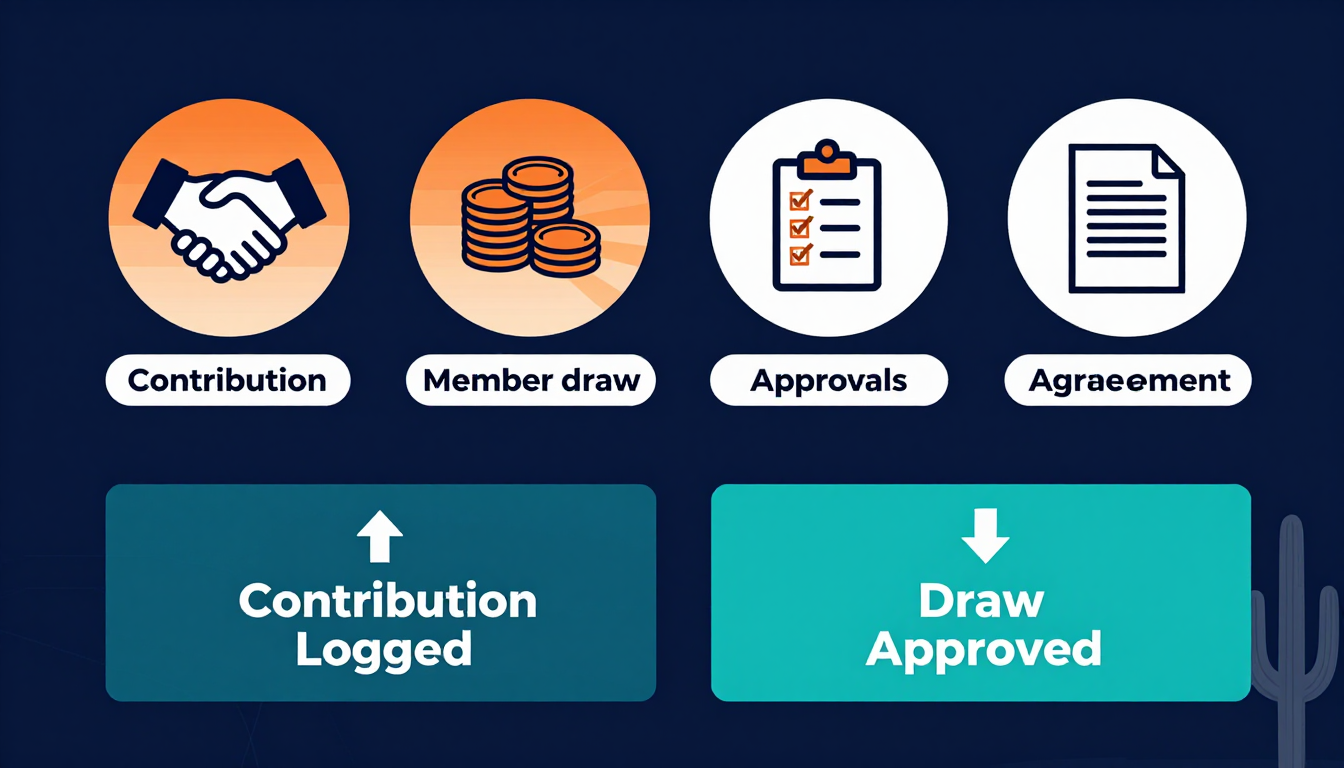
Capital Contributions: What Counts and How to Document Them
A capital contribution is anything a member adds to the LLC that becomes part of the permanent equity of the business. Cash is the most obvious contribution. A member who contributes $25,000 in cash gets a $25,000 capital account balance. That balance is not income to the other members. It is equity. Tracking it correctly matters for exactly this reason — when distributions happen, the starting point is what each member actually contributed, not what the members assumed was contributed.
Non-cash contributions require documentation at the time they are made. A member who contributes equipment, intellectual property, or a vehicle needs a recorded fair market value at the time of contribution. That valuation becomes the member’s capital account basis for future distributions. Getting it wrong — or leaving it vague — creates disputes that surface years later when someone leaves and the capital account balance is disputed. The IRS LLC tax classification rules confirm that capital account balances and contribution documentation are the business’s record to maintain, not the IRS’s — the IRS receives Schedule K-1 at tax time, but the LLC is responsible for the underlying account tracking.
For Arizona LLCs, the operating agreement should specify the contribution amount, the form of contribution, and the timeline for funding. If a member promised a $15,000 cash contribution and only delivered $8,000, the operating agreement controls what happens next — whether the shortfall triggers a dilution, a default, or a grace period. Without that language, Arizona default rules apply, and default rules do not account for your specific deal.
Distributions: How Money Leaves the LLC Legally
A draw is not a salary. The distinction matters for tax and for legal compliance. A draw is a distribution of profits — the LLC distributes cash or property to members proportionally to their capital accounts or per the operating agreement. A salary is compensation for services rendered, subject to employment taxes and withholding. Conflating the two — calling a draw a salary to avoid payroll taxes — creates IRS exposure. Treating a salary as a draw creates wage statement exposure. Arizona LLCs with employees should use the payroll system correctly from day one.
For Arizona multi-member LLCs, distributions follow the operating agreement or the default rules. Arizona Revised Statutes § 29-851 et seq. governs LLC distributions. The statute specifies that distributions are split proportionally to capital account balances unless the operating agreement says otherwise. If Member A has a $60,000 capital account and Member B has $40,000, a $10,000 distribution splits $6,000 / $4,000 by default. A draw taken disproportionately — Member A takes $7,000 and Member B takes $3,000 — requires either operating agreement language permitting it or unanimous consent at the time of the draw. Doing it without authorization is a breach of the operating agreement or the default statute.
Arizona LLCs benefit from no state income tax — distributions pass through to members’ personal returns with no Arizona LLC-level income tax. That simplifies the accounting compared to states with entity-level taxes. The compliance focus stays on the federal Schedule K-1 and the operating agreement’s distribution language, not state filings.
Member Approvals: What Requires a Vote
The operating agreement specifies what decisions require member approval. The default is one vote per LLC interest, unless the agreement specifies something else. Most operating agreements include a list of reserved matters — decisions that require member approval. Common reserved matters include admitting new members, amending the operating agreement, approving a buyout or redemption, and approving a merger or sale of substantially all assets.
For an Arizona multi-member LLC, the approval process should specify the form of consent — written consent, meeting minutes, or electronic approval. Arizona permits member approval by written consent without a meeting, which is practical for LLCs with members in different cities. The approval language in the operating agreement controls whether a text message or an email constitutes valid consent or whether a signature on a document is required.
Major financial decisions — taking on debt, guarantee obligations, signing long-term leases — are often reserved to members in operating agreements even when the management structure delegates day-to-day authority to a manager. A Tucson HVAC LLC with a manager-member running operations still needs member approval for borrowing against the LLC’s assets. The manager’s authority to bind the LLC is limited by the operating agreement. A contractor who signs a lease in the manager’s name beyond the operating agreement’s authorization creates personal exposure for the signing member.
The Arizona Corporation Commission business entity records do not govern member approvals — those are internal LLC governance matters. The ACC tracks the entity, not the operating agreement provisions. The operating agreement is the member-level contract. Keep a signed copy with the LLC records, not just in a cloud folder that no one remembers.
Member Loans vs. Contributions: The IRS Distinction That Catches People Off Guard
A loan from a member to the LLC is not a contribution. A loan creates a payable — the LLC owes the member money. A contribution creates equity. Conflating the two — calling a contribution a loan to avoid income tax consequences, or calling a loan a contribution to avoid repayment — creates IRS exposure and potential fraud exposure. Arizona LLCs with multiple members should document every financial interaction explicitly.
If a member lends the LLC money, document it with a promissory note that specifies the principal, interest rate, maturity date, and repayment schedule. If a member contributes money as equity, document it with a capital account entry and an acknowledgment in writing. Mixing the two — or leaving the characterization ambiguous — is one of the most common audit issues in multi-member LLCs.
The IRS looks through form to substance. If the parties treated a transaction as a loan on the books but the operating agreement treated it as a contribution, the IRS applies the characterization that matches economic reality. A loan with no real repayment terms is a contribution. A contribution with repayment terms is a loan. Document correctly at the time of the transaction.
Operating Agreement Money Provisions Every Arizona Multi-Member LLC Needs
The operating agreement controls the money. For Arizona LLCs, these are the provisions worth specifying explicitly.
Contribution obligations should specify the amount, form, and timing. Include what happens if a member misses a capital call. Default: the LLC can pursue the contribution or dilute the non-contributing member. Specify which applies.
Distribution порядок — how distributions split and when they occur — should specify the split, the trigger for distributions (quarterly, annual, discretionary), and whether distributions require formal approval. Include a distribution waterfall for preferred returns if one member has a priority distribution right.
Draw authorization — whether members can take draws without approval, whether draws require a manager’s consent, and whether draws are limited to available cash — prevents the scenario where one member takes a draw that exceeds available cash while the other member expects the cash to stay in the LLC.
Valuation for buyouts — what formula applies when a member exits — prevents a dispute over what the LLC is worth. Specify a method: agreed value, appraisal, or formula. Specify a timeline for the valuation process.
What Triggers an Arizona LLC Tax Filing Issue in Multi-Member LLCs
Arizona multi-member LLCs with two or more members are classified as partnerships for federal tax purposes. That means Schedule K-1 is filed annually, and each member receives a K-1 reporting their share of income, deductions, and credits. The LLC files Form 1065 annually. The deadline is the 15th day of the 10th month after the fiscal year closes — generally October 15 for calendar-year LLCs. Missing that deadline creates automatic penalties.
The operating agreement should designate a tax matters member — the person responsible for ensuring K-1s go out and Form 1065 is filed. For LLCs with members who change during the year, the K-1 reflects the transfer. A member who joins in July receives a K-1 for the portion of the year they held the interest.
Arizona has no state income tax, which simplifies the K-1 picture. Members report Arizona-source income on their individual returns. The Arizona Department of Revenue does not require a separate Arizona LLC-level filing for multi-member LLCs — the income flows through to members’ Arizona non-resident returns if they have Arizona-source income.
For LLCs with members in multiple states, each state has its own income allocation rules. A member in Nevada with no Arizona filing requirement still reports Arizona-sourced income on their home state return. The operating agreement should specify which state the LLC treats as the primary jurisdiction and who is responsible for multi-state filings.
Common Arizona Multi-Member LLC Money Disputes and How to Prevent Them
The most common dispute in a two-member Arizona LLC is one member taking more in draws than the other, or one member contributing more time and expecting that time to count as a contribution without documentation. Time contributed is not automatically a capital contribution. If the operating agreement does not specify that hours worked count toward the capital account, the hours do not change the equity split. Document time as labor credits or guaranteed payments if it is meant to compensate for the contribution imbalance.
A second common dispute: one member making decisions that cost money without member approval. The manager-member runs operations and spends $30,000 on equipment without a vote, then the other member objects to the expenditure. The operating agreement’s management provisions control whether that expenditure was authorized. If it was not, the spending member may have personal liability for the unauthorized commitment. Resolve this before signing — the operating agreement’s management clause should explicitly delegate authority to spend or require approval above a threshold.
A third dispute: a departing member claiming a larger distribution than the capital account supports. Without a clear operating agreement with a buyout formula, Arizona law applies the statutory buyout process, which can be expensive and slow. Specify the valuation method in the operating agreement before a member exits.
The Arizona LLC Act gives default rules for each of these scenarios. Defaults are a starting point, not a substitute for the operating agreement. Get the agreement in writing before the money moves.
Frequently Asked Questions
Are capital contributions to an Arizona multi-member LLC taxable?
Contributions of cash or property to an LLC capital account are generally not taxable to the receiving LLC or the other members. The contributing member’s basis adjusts. Taxable events arise when distributions exceed basis or when the LLC recognizes gain on contributed property with built-in appreciation.
Can a member of an Arizona LLC take draws whenever they want?
Draws are governed by the operating agreement. If the agreement is silent, Arizona default rules apply — distributions split proportionally to capital accounts and draws require no approval if cash is available. Draws disproportionate to capital accounts require member consent.
Does an Arizona multi-member LLC need an EIN if it has employees?
Yes. An LLC with employees files Form 941 and pays employment taxes. A multi-member LLC with no employees files Form 1065 annually and issues K-1s. Single-member LLCs with no employees use the owner’s SSN or apply for an EIN.
What happens if a member contributes less than promised in an Arizona LLC?
The operating agreement controls the remedy — dilution, assessment, or forfeiture of the membership interest. If the agreement is silent, the default rules allow the LLC to enforce the contribution obligation. Document contribution terms in writing before the contribution is made.
Does Arizona have a state income tax filing requirement for multi-member LLCs?
No. Arizona has no state income tax. Multi-member LLCs file federal Form 1065 and issue K-1s to members. Members with Arizona-sourced income report it on their individual Arizona non-resident returns if they live outside Arizona.
What records must an Arizona multi-member LLC keep for money transactions?
Capital account statements, draw authorizations, contribution receipts, loan documentation, and bank statements. The operating agreement is the governing document for money decisions. Keep signed copies of all approvals. The LLC should maintain records separate from the members personal finances.
Arizona Multi-Member LLC Money Rules in 2026 come down to three things: document the money before it moves, get written approval for decisions that cost money, and keep the operating agreement current with the actual contributions and draws. The statute fills the gaps the operating agreement leaves open — but defaults never match what the members actually agreed to. Get the agreement in writing before the first contribution. Rapid Registered Agent helps Arizona multi-member LLCs stay current on compliance and governance records so the money rules are clear before the dispute, not after.
Aggressive Representation. Proven Results.
We Fight For The Justice You Deserve.
When you’ve been injured, you need a powerful legal team on your side. We have recovered over $500 Million for our clients. Don’t settle for less.