
Arizona AI Voice Notes in 2026: A Simple Way to Turn Missed Call Details Into Next-Step Tasks
Arizona AI Voice Notes in 2026 start with what a Scottsdale contractor loses on a Tuesday afternoon. He pulls into a job site, checks his phone, and sees a voicemail from a potential client. He listens to the full message, thinks he will remember the details, and gets back to work. Two days later he cannot recall the client’s address. He calls back, leaves a message, waits three days, and loses the job to someone who called back within 24 hours. That voicemail was worth $4,200. Arizona AI Voice Notes in 2026 cover what the contractor should have used instead: an AI voice note tool that transcribes the call, extracts the key action items, and turns a five-minute voicemail into a next-step task before he drives away from the job site.
Why Voice Notes Beat Memory for Arizona Small Business Owners
Running a service business in Arizona means driving between job sites, managing crews, and handling calls from leads while you are already on another call. The average Phoenix-area contractor receives three to five inquiry calls per day during peak season. Most of those calls come in while the phone is in the truck cupholder. The information — address, scope, timeline, budget — arrives in a voicemail and evaporates within hours unless it is captured immediately.
The brain is not designed for this kind of retrieval. Research on working memory consistently shows that details fade within 48 hours without external capture. The contractor who thinks he will remember the address is relying on a cognitive system that was not built for multitasking under pressure. The voice note tool removes the reliance on memory entirely. The call gets transcribed, the key details get extracted, and the next action — call back, confirm the address, schedule a site visit — lands in the task list before the truck leaves the driveway.
For Arizona small business owners, this matters especially during the high-season months from February through May, when inquiry volume is highest and the cost of a missed lead is at its peak. An SBA guide on small business technology tools confirms that operational efficiency tools — including voice capture and transcription — rank among the highest-ROI technology investments for businesses with mobile workforces.
What AI Voice Note Tools Actually Do With a Voicemail
Most people think of voice notes as audio recordings. That is the old version. The AI voice note tools available in 2026 do something more useful: they transcribe the voicemail and then extract the structured information from it. The transcript is secondary. The extraction is the product.
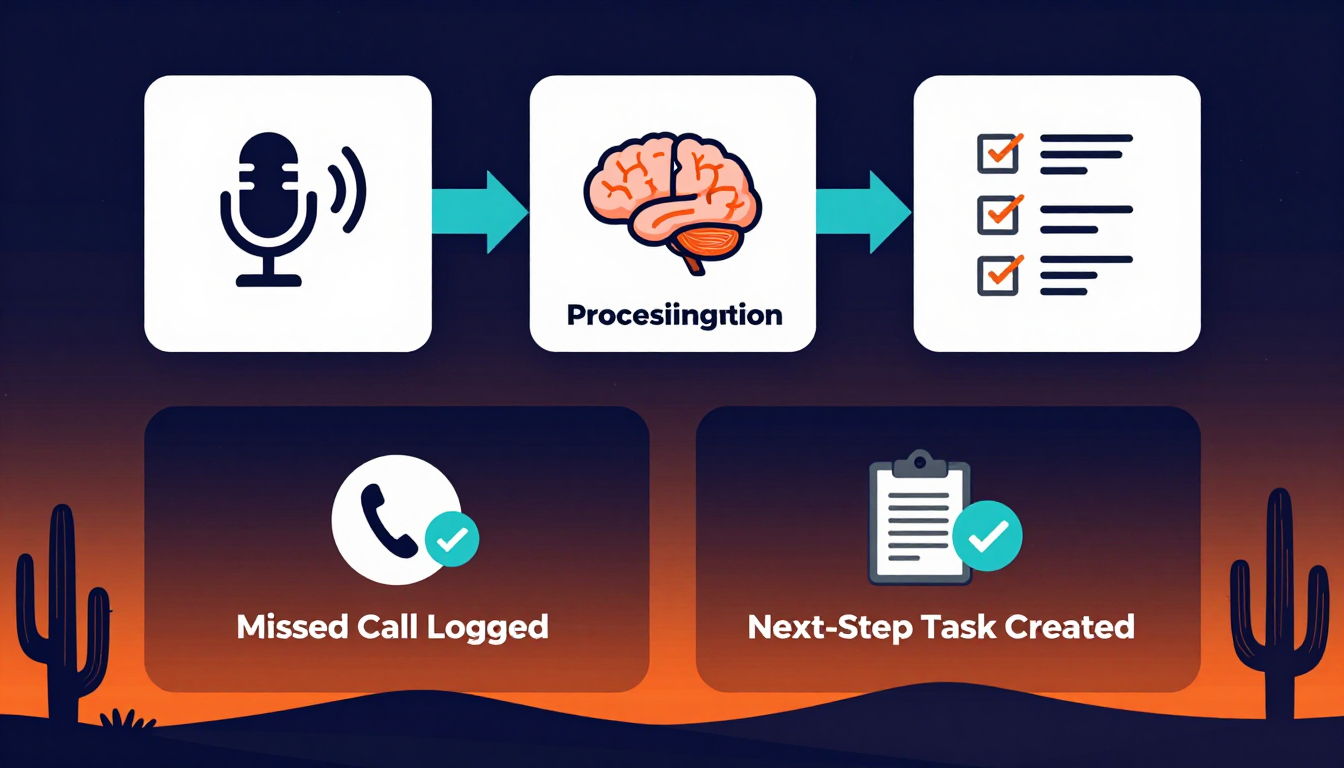
When a potential client leaves a voicemail, an AI voice note tool captures the audio, transcribes it, and then applies a language model to pull out the key fields: who called, what they need, when they need it, and what the next step is. That structured output — not a five-minute audio file to be reviewed later — is what lands in the task list.
The accuracy of transcription has improved significantly. Most current AI transcription tools achieve above 95 percent accuracy on clear phone audio. Background noise from a job site, wind on an open call, or a client speaking quickly still creates some errors, but the structured extraction still surfaces enough actionable details to be useful. Reviewing a transcript takes 30 seconds. Listening to a five-minute voicemail takes five minutes. The transcript is faster.
How Voice Notes Fit Into an Arizona Service Business Workflow
The workflow is simple enough to actually stick. When the call comes in and goes to voicemail, the AI tool captures it automatically through call forwarding or an app notification. The transcription arrives within seconds. The extracted fields — client name, service type, timeline, budget signal — appear in the task queue as a drafted next-step note.
For an Arizona HVAC company in Mesa, this means the technician in the field gets a text message or app notification with the voicemail summary before he finishes the previous job. He can call back during his drive to the next site without pulling over and replaying a voicemail. The response time shrinks from days to hours. For a service business competing on responsiveness, that speed difference is the entire competitive edge.
The calendar integration matters for Arizona businesses that manage scheduling manually. Some voice note tools connect to Google Calendar, Outlook, or job management software like Jobber or Housecall Pro. The voicemail summary creates a calendar hold or a task with a due time attached. That task does not disappear into a voicemail folder. It generates a reminder.
The Arizona Business Context for AI Voice Notes
Arizona’s business registration environment creates specific timing pressures that make voice capture urgent. An Arizona contractor who receives a commercial inquiry for a tenant improvement job in Tempe or a retail buildout in Chandler needs to respond before the client calls the next contractor on the list. The average commercial inquiry in Arizona’s construction market moves within 24 to 48 hours of first contact. A voicemail sitting unprocessed for two days is effectively a lost lead.
The Phoenix-Mesa-Chandler triangle is one of the fastest-growing commercial construction markets in the Southwest. CBRE market data for Phoenix commercial real estate confirms continued demand for tenant improvement work through 2026. That demand generates inquiry volume. The businesses that capture and respond to that inquiry fastest win the work.
For service businesses that operate in Tucson, Flagstaff, or Prescott as well, the geographic spread makes voice capture even more valuable. A contractor covering multiple cities drives more than 100 miles per day and takes calls from unfamiliar numbers at odd hours. The voicemail summary arrives in writing regardless of where the call came in or when it was received. That written record survives the drive, the lost signal, and the full inbox.
Privacy and Call Recording Law in Arizona
Arizona is a one-party consent state for call recording. Under Arizona Revised Statutes § 13-3005, one party to the conversation needs to consent to recording — meaning the business owner can record calls they are part of without informing the other party. For voicemail transcription, this matters differently: you are transcribing a voicemail, which is a received communication, not a recorded call in the traditional sense. The voicemail was left for you. Transcribing it for business purposes is generally permissible under standard business use cases.
If you use an AI voice tool that also outbound calls — not just transcribing received voicemails but placing outbound calls to clients — that outbound recording requires the same one-party consent awareness. Any tool used in Arizona should have a clear privacy policy specifying how call audio and transcripts are stored and used. Review that policy before activating any voice AI tool on a business line. Most reputable services store audio and transcripts encrypted and do not use them to train models without consent.
The Arizona Attorney General’s consumer privacy resources confirm that Arizona’s data breach notification laws apply if a business’s voice transcription data is involved in a breach. Using a business-grade transcription service — not a consumer app — provides better data security and clearer business use terms.
What to Look for in an AI Voice Note Tool in 2026
Not all tools are equal. For an Arizona service business, the features that matter most are call forwarding capture, CRM integration, calendar sync, and mobile-first design. Call forwarding capture means the tool picks up the voicemail automatically when it arrives, without the business owner manually saving audio. CRM integration means the transcript and extracted fields populate the contact record in whatever system the business uses. Calendar sync means the next-step task gets a due time and a place on the schedule.
Otter.ai, Fireflies.ai, and Similar.ai are the most commonly referenced tools for business voice transcription as of 2026. Each has a free tier for limited transcription and a paid business tier that includes CRM and calendar integration. The business tier is where the operational value appears — the free tier is useful for individual professionals, not for a crew of five technicians running calls simultaneously.
Mobile-first design matters for Arizona trades businesses. Tools that require logging into a desktop dashboard to configure call forwarding or review transcripts add friction that makes the tool get abandoned. The best tools for field-based businesses work entirely from a phone — call forwarding configured once, transcripts arriving as app notifications, next-step tasks generated in the field without touching a laptop.
Common Mistakes When Adding AI Voice Notes to a Business Workflow
The most common mistake is configuring call forwarding incorrectly and missing the first week of calls. Most AI voice tools require forwarding the business line to the tool’s number. If the forwarding is set up wrong, voicemails still go to the old voicemail box and the tool captures nothing. Test the setup by calling the business line from a personal phone and confirming the transcript arrives within 60 seconds.
Another mistake is not setting a response time expectation for the task queue. The AI extracts the details, but someone still has to call back. The tool generates the task — the human decides the priority and the response window. For a high-volume inquiry business, that human needs to know: call back within two hours or the lead is cold. Without that expectation embedded in the task queue, the transcript arrives and the follow-up still does not happen.
A third mistake is letting transcripts pile up unread. The value of the AI extraction is the structured fields — the address, the timeline, the budget signal. If no one reviews the task queue daily, the extraction has the same fate as the original voicemail. Schedule a daily five-minute review of the voice note queue at the same time every morning. For a Phoenix HVAC business, that review happens before the first job of the day.
Forgetting to update the CRM after the call is the fourth mistake. If the voice tool extracts a new contact’s details but the fields do not sync to the CRM, the information lives in the transcription tool and nowhere else. When the transcription tool account gets cancelled or the data gets wiped, the contact history goes with it. Set calendar and CRM sync as automatic, not manual.
Frequently Asked Questions
Are Arizona businesses allowed to use AI voicemail transcription tools?
Yes. Arizona is a one-party consent state under ARS 13-3005, meaning a business can transcribe voicemails left for the business without additional consent. If using outbound call recording features, one-party consent still applies. Review the specific tool privacy policy for data storage and breach notification obligations.
What does an AI voice note tool actually extract from a voicemail?
Beyond transcription, AI tools extract structured fields from the voicemail content: caller name, company, service type, requested timeline, budget range if mentioned, and next steps. That extraction produces a task entry, not just an audio file to be reviewed manually.
How fast does the transcription arrive?
Most AI transcription tools deliver a transcript within 30 to 90 seconds of the voicemail being left. The extracted task fields arrive in the business task queue within two minutes. For a responsive lead follow-up, that speed is fast enough to call back before the next competitor.
Do AI voice note tools work for calls in noisy job site environments?
Background noise from job sites, traffic, and open offices reduces transcription accuracy. Current tools handle moderate noise well enough to extract key fields accurately. Heavy machinery noise or wind on an open call may require the caller to speak clearly and the tool to be configured with noise filtering enabled.
What CRM and calendar tools integrate with AI voice note services?
Otter.ai, Fireflies.ai, and similar services integrate with Google Calendar, Outlook, Salesforce, HubSpot, Jobber, and Housecall Pro. Business-tier subscriptions are required for full integrations. Free tiers typically offer transcription only, without CRM or calendar sync.
How does faster voicemail follow-up affect Arizona service business revenue?
Commercial and residential service businesses that respond to inquiries within two hours convert at significantly higher rates than those that respond same day or next day. For Phoenix-area contractors in high-demand seasons, a 24-hour response time difference can represent the difference between booking the job and losing it to a competitor who called first.
Arizona AI Voice Notes in 2026 turn a five-minute voicemail into a 30-second task summary before the truck leaves the job site. The contractor who listens to the full message, thinks he will remember the details, and loses the lead to the next caller is a preventable failure. The AI transcription extracts the address, the timeline, and the budget signal, sends it to the task queue, and generates a same-day call-back. That response speed is the entire competitive edge in a Phoenix market where the next contractor is already dialing. The voice note tool costs less per month than one missed $4,200 job. Rapid Registered Agent helps Arizona small business owners find the right operational tools to stay competitive.
Aggressive Representation. Proven Results.
We Fight For The Justice You Deserve.
When you’ve been injured, you need a powerful legal team on your side. We have recovered over $500 Million for our clients. Don’t settle for less.