
West Virginia First Employee in 2026: Workers’ Compensation and Payroll Steps for New LLCs

You have been running your West Virginia LLC solo. The work is there. The revenue is there. You cannot do it alone anymore. Hiring your first employee is a milestone—but it is also a compliance trigger that brings a stack of new obligations most first-time business owners do not see coming. Workers’ comp, payroll registration, state tax accounts, federal withholding—the list feels overwhelming. It does not have to be. Here is exactly what to do, in the right order, so your first hire is a smooth start instead of a compliance scramble.
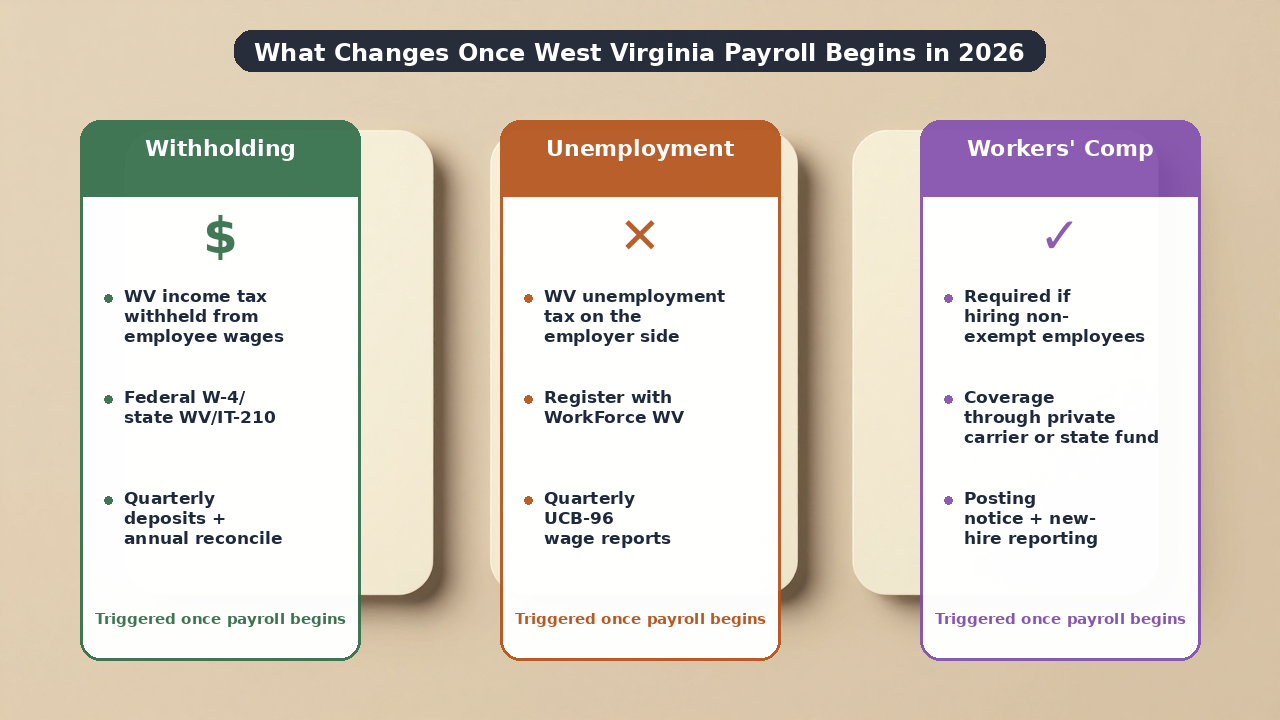
Why Your First Hire Changes Everything for Your LLC
Until now, your West Virginia LLC has been a one-person operation. You filed the annual report, paid the business registration tax, and that was the extent of your state obligations. One employee changes the legal relationship between your business and the government. You become an employer, and that triggers a completely different set of requirements at the federal, state, and local level.
The good news is that these requirements are all manageable once you know what they are. The bad news is that missing them is not forgiveable—penalties stack up quickly and the agencies that enforce these rules do not send advance warning. The West Virginia WorkForce agency and the West Virginia Tax Division are the two state agencies that matter most for new employers in West Virginia.
The key distinction is that most of these requirements start on day one of employment—before you run your first payroll. You cannot hire first and figure out the paperwork later. The agencies expect you to be registered before your employee shows up for their first day.
Step 1: Register as an Employer With West Virginia
Before you run payroll, register your LLC as an employer with the West Virginia Tax Division. This is the state-level registration that covers unemployment insurance tax—WV UI tax—which every West Virginia employer pays. The registration covers your LLC’s state tax account for employee withholding if you have West Virginia state income tax obligations.
The registration is done through the WV Tax Division employer portal. You will need your LLC’s West Virginia account number, your federal EIN, and your expected first payroll date. The registration is free to file. Once registered, the state will assign your employer account number and notify you of your UI tax rate—which starts at a standard rate and can change based on your claims history once you have employees.
Also register with the West Virginia WorkForce office for workers’ compensation insurance coverage. West Virginia requires most employers to carry workers’ comp insurance. The requirement kicks in the moment you have an employee, and operating without it when it is required can result in significant penalties. The U.S. Department of Labor’s Office of Workers’ Compensation Programs has the federal reference on this requirement.
Step 2: Get Your Federal Employer Identification Number—or Confirm You Already Have One
If your LLC already has employees through a previous hire, you have an EIN from the IRS. If this is truly your first employee, you need an EIN before you can withhold federal income tax, Social Security, and Medicare from your employee’s wages. The EIN is free and you get it immediately through the IRS employer responsibilities page or directly from the IRS website.
The EIN goes on every federal tax form you file as an employer, every payroll deposit you make, and every W-2 you issue at year end. Once you have it, keep it with your LLC records and do not lose it. If you ever need to look it up again, you can retrieve it from the IRS website with your LLC’s legal name and address on file.
Step 3: Set Up Payroll and Withholding
With your WV employer account and EIN in hand, you are ready to set up payroll. Federal withholding includes income tax, Social Security, and Medicare. Social Security and Medicare withholding are fixed rates—6.2% for Social Security on wages up to the annual cap and 1.45% for Medicare with no cap. Federal income tax withholding depends on your employee’s W-4 selections and the IRS withholding tables.
West Virginia has a state income tax, so you will also withhold state income tax from your employee’s wages using the state’s withholding tables. The amount depends on your employee’s WV W-4 elections and their income level. Both the federal and state withholding must be remitted to the respective agencies on the required schedule—usually monthly or semi-weekly depending on the size of your payroll.
For a first-time employer, the easiest path is to use a payroll service. Gusto, ADP, Paychex, and similar services handle the withholding calculations, the deposit schedules, and the year-end W-2 filing. The cost is modest for a small LLC and the peace of mind of knowing the deposits are going to the right agency on the right schedule is worth it. If you do payroll manually, the IRS and WV Tax Division both have withholding tables and deposit guides on their websites.
Step 4: Workers’ Compensation Insurance in West Virginia
West Virginia requires most employers to carry workers’ compensation insurance. This is not optional once you have an employee. The coverage pays for medical care and lost wages if an employee is injured or becomes ill because of their work. Without it, you are personally liable for those costs—and the penalties for non-compliance can far exceed what the insurance would have cost.
Workers’ comp in West Virginia is provided through the state fund or through private carriers. Shop around for rates. If your LLC is low-risk—a consulting business, a desk-based service—the premium is a small percentage of your payroll. If your LLC involves any manual labor or physical work, the rates are higher and the coverage is more important. The West Virginia WorkForce agency has information on the state’s workers’ comp requirements and can help you find coverage.
Do not make the mistake of assuming your first employee will not get injured. Workers’ comp claims happen across all industries. One workplace injury without coverage can wipe out months of revenue. The insurance is a business expense that protects your LLC’s financials, not just a regulatory box to check.
Step 5: New Hire Reporting in West Virginia
West Virginia requires employers to report all new hires and re-hires to the state within fourteen days of their start date. This is the New Hire Reporting program, and it is used to track child support obligations and prevent fraud in the unemployment insurance system. The report goes to the West Virginia WorkForce office.
The report is short—your LLC name, EIN, the employee’s name, address, and hire date. It is filed online through the West Virginia WorkForce portal. Most payroll services include new hire reporting in their platform. If you are running payroll manually, set a calendar reminder: file the new hire report within fourteen days of the start date, every time you bring someone on.
Failing to file new hire reports does not typically result in immediate penalties for a small LLC, but it creates compliance gaps that become problems if you ever have a child support withholding order or an unemployment insurance audit. It is a five-minute task—do it on day one.
Step 6: Post Required Workplace Notices
Federal and West Virginia law require employers to post certain notices in the workplace. These are the same posters that every business with employees is required to display: federal minimum wage, equal employment opportunity, Family and Medical Leave Act, and unemployment insurance notices. West Virginia also requires state-specific posters covering workers’ compensation and state minimum wage.
You can download the required federal posters from the Department of Labor website and the West Virginia state posters from the WV Labor Division or the WorkForce website. Print them, post them where employees can see them, and keep them current when the agencies update them—which happens periodically.
Step 7: Run Your First Payroll Correctly
With registrations in place, EIN assigned, workers’ comp coverage active, and new hire reported, you are ready to run payroll. For your first pay period, double-check every number. The wages, the federal withholding, the Social Security and Medicare withholding, the West Virginia state withholding, and the workers’ comp premium estimate.
Set aside the employee-facing amount—net pay—for payroll. Set aside the employer-facing amounts—Social Security matching, Medicare matching, WV UI tax, and workers’ comp premium—for the respective agencies. The employer taxes are in addition to the employee’s wages. Many first-time employers are surprised by how much the employer-side payroll taxes add to the cost of each employee.
The SBA first employee guide has a clear breakdown of the full cost of an employee, including the employer tax obligations that are easy to overlook when you are focused on the wage number. Read it before you set your first salary.
Common Mistakes First-Time West Virginia Employers Make
The most common mistake is hiring before registering as an employer. The penalties are not huge for a first violation, but the back paperwork and the letters from the WV Tax Division are an unnecessary distraction when you are trying to onboard your first team member.
The second most common mistake is forgetting that workers’ comp coverage needs to be in place before the first day of work. Some LLC owners think they will get coverage after the employee starts. In West Virginia, the requirement is effective from the date of hire. Get the coverage first.
The third mistake is treating payroll as an afterthought. Running payroll late—after the pay period ends—causes deposit penalties with the IRS and the WV Tax Division. Set up your payroll calendar before the first day and treat the first payroll date as a firm deadline, not something to figure out when you get there.
What to Do If You Made Mistakes on Your First Payroll
If you already hired someone and missed some of these steps, do not panic. Register now. Get workers’ comp coverage now. File the new hire report now. The agencies generally do not penalize first-time employers for administrative mistakes made in good faith if you come into compliance promptly.
If you missed a payroll deposit, file the overdue deposit as soon as you can and include the interest that accrues from the original due date. The IRS and WV Tax Division both have penalty relief provisions for first-time employers who correct mistakes quickly. Do not ignore overdue deposits. The penalties and interest compound faster than most people expect.
Bottom Line on Your West Virginia First Employee
Your West Virginia first employee does not have to be a compliance nightmare. The steps are straightforward: register as an employer with the state, get your EIN, set up payroll withholding, buy workers’ comp coverage, report the new hire, and post the required notices. Do these in order before your employee’s first day and you are compliant from the start.
The cost of doing this right is small compared to the cost of getting it wrong. Workers’ comp claims, missed payroll deposits, and unemployment insurance audits are all avoidable with proper setup. Your West Virginia first employee is a milestone worth celebrating—make sure your LLC is ready for it.
Frequently Asked Questions
What does hiring my first employee in West Virginia trigger?
Hiring your first employee triggers employer registrations with the West Virginia Tax Division, workers compensation insurance requirements, federal and state payroll withholding obligations, new hire reporting, and federal employer identification requirements. Most of these requirements are effective from the date of hire, not the date you get around to registering.
Does West Virginia require workers' compensation insurance for new LLCs with employees?
Yes. West Virginia requires most employers to carry workers compensation insurance from the first day an employee is hired. Operating without required workers comp coverage exposes your LLC to significant penalties and personal liability for workplace injuries.
What new hire reporting does West Virginia require?
West Virginia requires employers to report all new hires and re-hires to the West Virginia WorkForce office within fourteen days of the start date. The report includes your LLC name, EIN, the employees name and address, and the hire date. File it online through the WV WorkForce portal.
How do I register as an employer with West Virginia?
Register through the West Virginia Tax Division employer portal at tax.wv.gov. You will need your LLCs WV account number, federal EIN, and expected first payroll date. The registration covers your unemployment insurance tax account and employee withholding account.
What payroll taxes does a West Virginia LLC pay for the first employee?
As an employer, you pay federal Social Security (6.2% matching), Medicare (1.45% matching), West Virginia state unemployment insurance, and state income tax withholding. Your employee pays Social Security, Medicare, and federal and state income tax through payroll withholding. Both sides of the tax are your responsibility as the employer.
Can I run payroll manually for my first employee in West Virginia?
Yes, but a payroll service is recommended for first-time employers. The IRS and WV Tax Division have withholding tables and deposit guides, but the cost of a payroll service is modest and the risk of a missed deposit or incorrect withholding is significantly reduced.
- West Virginia Business Registration Tax and Hiring in 2026: What Changes Once Payroll Begins
- West Virginia Annual Report Filing and Business Registration Tax for LLCs in 2026
- West Virginia LLC Reinstatement in 2026: State Steps After Losing Good Standing
West Virginia LLC
Hiring in West Virginia? Get Registered Before Your First Employee Starts
Your first hire brings payroll taxes, workers comp requirements, and state employer registrations. Handle them before day one so your LLC stays compliant and your new employee starts on solid ground.
- States Served
- 53
- LLCs Formed
- 500,000+
- Annual Reports Filed
- Millions