July 2026 Compliance Pulse for Founders: The Federal Updates Most Likely to Affect New LLCs
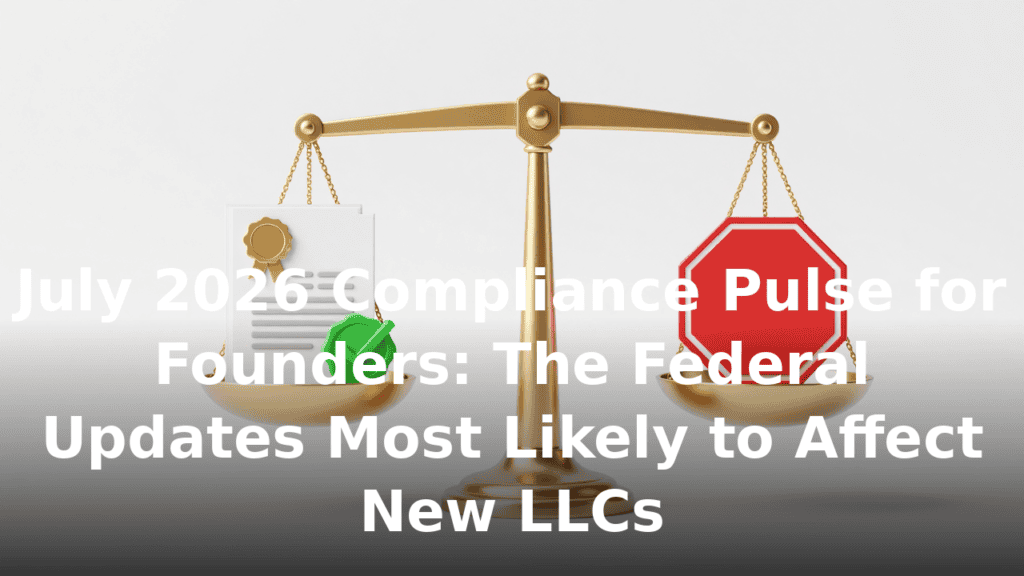
Halfway Through 2026: What the Compliance Landscape Looks Like for New LLC Founders
July 2026 Compliance Pulse for new LLC founders starts with an honest assessment: federal compliance for businesses in 2026 has been quieter than 2024 or 2025, but not silent.

The biggest federal story of mid-year 2026 was not a new requirement — it was the continuation of relief from one. Beneficial Ownership Information reporting under the Corporate Transparency Act remained paused for domestic U.S. entities through the first half of the year. New LLCs formed in the United States did not need to file a BOI report with FinCEN.
Then, on August 11, 2026 — after this article was drafted — FinCEN issued a final rule permanently eliminating the BOI reporting requirement for U.S. companies and U.S. persons. That update changes the picture for every new LLC formed in the United States. More on that below.
For now, here is what July 2026 looked like for new LLC founders — and what the mid-year compliance landscape actually required.
The Federal Updates That Defined the July 2026 Compliance Pulse
BOI Reporting Remained Paused Through Mid-Year 2026
Throughout the first half of 2026, FinCEN’s March 2025 interim final rule remained in effect. That rule removed most domestic U.S. entities — including standard LLCs formed in any U.S. state — from the CTA’s BOI reporting requirement. FinCEN’s official guidance page at fincen.gov/boi was the place to check current obligations.
The exemption was not permanent at the time. FinCEN had described it as an interim rule, and CTA advocates had challenged it in court. New LLCs forming in early 2026 had to weigh the possibility that the exemption could be reversed before year-end.
The practical compliance advice for new LLC founders in July 2026: monitor the FinCEN BOI page every quarter, confirm your entity type qualifies for the exemption, and keep records of your exempt status.
Then August 11 happened. More below.
Estimated Tax Deadlines Did Not Change
The federal estimated tax payment schedule for 2026 was unchanged from prior years. Calendar-year taxpayers — including LLCs treated as sole proprietors or partnerships for tax purposes — make four estimated tax payments per year. The IRS estimated tax calendar shows the 2026 due dates:
- April 15, 2026 — Q1 estimated tax payment due
- June 15, 2026 — Q2 estimated tax payment due
- September 15, 2026 — Q3 estimated tax payment due
- January 15, 2027 — Q4 estimated tax payment due
For new LLCs generating revenue for the first time in 2026, these dates do not wait for you to get comfortable. If you started earning income in Q1, Q2, or Q3, you owe estimated taxes on those deadlines. Underpayment penalties apply if you miss them by enough.
S Corporation and Partnership Deadlines Moved
One federal filing change that flew under the radar for many new LLCs: the deadline for S corporations and partnerships to file Form 1120-S and Form 1065 moved permanently from March 15 to March 16, starting with the 2025 tax year.
This matters for LLCs that elected S corp tax treatment. If your LLC filed as an S corporation, your federal return was due March 16, 2026, not March 15. Extended deadlines run through September 15, 2026.
New founders who were unaware of this change may have filed on March 15 and received a rejection or request to refile. The IRS system updated automatically for March 16 filings.
EIN Applications Remain Instant and Free
Getting an Employer Identification Number for your new LLC is one of the few federal processes that has not changed. Apply through the IRS EIN portal. It is free. It takes minutes. Have your LLC formation documents in hand before you start — the application asks for your entity type, state of formation, and responsible party information.
LLCs that need an EIN for the first time in 2026 can apply immediately after formation, before opening a bank account or signing your first contract.
What the August 2026 FinCEN Update Means for New LLCs
After this article was drafted, FinCEN issued a final rule on August 11, 2026, permanently eliminating the BOI reporting requirement for all U.S. companies and U.S. persons under the Corporate Transparency Act.
This is the most significant federal compliance development of 2026 for new LLCs.
The key points:
- Domestic U.S. LLCs have no BOI filing obligation. FinCEN permanently removed the requirement. There is no current deadline, no annual update requirement, and no pending obligation.
- FinCEN will delete existing BOI data for U.S. persons. Previously filed BOI reports for domestic entities will be removed from FinCEN’s database.
- Foreign entities still have obligations. If your LLC was formed outside the United States and qualifies as a foreign reporting company under the CTA, you still need to file with FinCEN. Check fincen.gov/boi for your current status.
For new LLCs formed after August 11, 2026: there is no federal BOI filing to add to your compliance to-do list. The compliance concern that dominated 2024 and early 2025 is gone.
Our 2026 Compliance News Roundup has the full breakdown of what this change means for registered agent clients.
What New LLCs Were Most Likely to Miss in the First Half of 2026
The September 15 Overload
September 15 is the most dangerous compliance date on the calendar for LLCs — and most new founders do not realize it until it hits.
September 15 is the deadline for:
- Q3 estimated tax payment
- Extended S corporation and partnership returns (for those who filed for an extension)
- Often multiple state annual reports with Q3 deadlines
The result: a single date that combines a federal payment, a federal filing, and potentially multiple state filings. New founders who were focused on Q1 and Q2 deadlines often have a quiet July and August and then get caught by September 15.
Setting a calendar reminder on August 15 — one month before — gives you time to prepare the cash to pay Q3 taxes without scrambling.
State Annual Reports Are Not Federal — But They Still Bite
Federal compliance updates dominated the conversation in 2024 and 2025. But state annual reports are where new LLCs most commonly get caught.
Every state has a different annual report deadline. Hawaii files quarterly. California has an extended deadline for LLCs. Delaware has a March 1 deadline for corporations. Some states charge late fees. Some will administratively dissolve your LLC for missing a single annual report.
The 50-state compliance calendar has the state-by-state annual report deadlines for 2026.
What to Watch for the Second Half of 2026
The September 15 Estimated Tax Payment
Q3 estimated taxes are due September 15. If your LLC earned income in Q1, Q2, or Q3 of 2026, you owe the IRS a quarterly payment. The amount is based on your annualized income, not your actual Q3 income alone.
New founders who started businesses in Q1 or Q2 are likely on the hook for Q3. Calculate your Q3 payment using Form 1040-ES and make the payment at irs.gov before September 15.
Q4 Estimated Tax Planning
January 15, 2027 is the Q4 estimated tax deadline for most LLCs. That deadline lands shortly after the holiday season — often when business finances are most chaotic. New founders should be tracking their Q4 income now, not waiting until January to calculate what they owe.
State Filing Seasons in the Second Half
Several states have annual report deadlines that fall in the second half of the year. If your LLC operates in California, Nevada, Texas, or any other state with a Q3 or Q4 annual report, confirm those dates before they arrive. Missing an annual report filing is one of the most preventable compliance failures — it just requires a calendar reminder.
How Founders Can Stay Ahead of Federal Compliance
Federal compliance for LLCs is simpler in the second half of 2026 than it has been in years. The BOI reporting obligation is gone for domestic entities. The estimated tax schedule is fixed. The EIN application is unchanged.
What has not changed: the IRS sends notices to the address on record. If your registered agent address is inaccurate, expired, or forwarding unreliably, you will not receive notices before penalties attach.
A registered agent that reliably receives and forwards your IRS mail — not just what looks urgent — is a genuine asset for new LLC founders. The compliance benefit of a responsive registered agent is not the annual fee. It is the envelope you receive before the penalty.
Frequently Asked Questions
Did FinCEN permanently end BOI reporting for new LLCs?
Yes. On August 11, 2026, FinCEN issued a final rule permanently eliminating the Corporate Transparency Act BOI reporting requirement for all U.S. companies and U.S. persons. New LLCs formed in the United States have no current federal BOI obligation. Foreign entities may still have reporting requirements — check fincen.gov/boi.
What are the federal estimated tax deadlines for LLCs in 2026?
The 2026 estimated tax due dates are April 15, June 15, September 15, and January 15, 2027. Missing the September 15 Q3 deadline is one of the most common compliance mistakes for LLCs that started earning income earlier in the year.
Did the S corporation filing deadline change in 2026?
Yes. S corporations and partnerships now file Form 1120-S and Form 1065 by March 16 — permanently, starting with the 2025 tax year. Extended deadlines run through September 15. New LLC founders who elected S corp treatment should note this date on their 2027 calendar now.
What is the most overloaded compliance date for LLCs in the second half of 2026?
September 15 combines the Q3 estimated tax payment, extended S corp and partnership return deadline, and state annual report deadlines for several states. It is the most compliance-dense single date on the calendar for LLCs.
Do new LLCs still need an EIN in 2026?
Yes. Every LLC that has employees, files federal taxes as anything other than a sole proprietorship, or opens a business bank account needs an Employer Identification Number. The EIN application is free and takes minutes at irs.gov.
What is the most common federal compliance mistake new LLC founders make?
Missing the September 15 estimated tax deadline is the most common. Many new LLCs do not realize they owe quarterly estimated taxes and scramble to pay in September without planning. Setting a reminder on August 15 gives you a full month to prepare.
July 2026 Compliance Pulse
Ready to Get Your LLC’s Federal Compliance in Order?
Rapid Registered Agent helps new LLC founders stay ahead of federal and state compliance deadlines from formation through year-end. From estimated tax reminders to annual report tracking, get the support that keeps your LLC in good standing through the second half of 2026 and beyond.
- EIN Filing Support
- Free
- Annual Report Tracking
- Included
- IRS Mail Forwarding
- Always