2026 Compliance News Roundup for Registered Agent Clients: What Changed, What Did Not, and What to Watch
title: “2026 Compliance News Roundup for Registered Agent Clients: What Changed, What Did Not, and What to Watch” description: “A plain-English breakdown of the compliance shifts that hit registered agent clients hardest in 2026 — and what still works the same way it always has.” slug: 2026-compliance-news-roundup-registered-agent neuronwriter_query: “” featured_image: “” featured_image_id: “” category: Uncategorized tags:
- workflow-generated
- template:single-article-pipeline
- cycle:single-article-pipeline-c315
date: 2026-08-08 —: null
Compliance News Roundup for registered agent clients in 2026 reads differently than it did three years ago. State governments are asking for more information, requiring it faster, and sharing it more broadly. For business owners who rely on registered agents to manage compliance mail, the changes landing in 2026 matter directly. This roundup covers what shifted, what held steady, and what deserves ongoing attention as the year unfolds.
What Changed: The Big 2026 Compliance Shifts
Washington Requires Business Email in Annual Report Filings
Effective January 20, 2026, the Washington Secretary of State began requiring a business email address in the key contact section of every Annual Report filing, as documented in their official annual report guidance. This applies to all entity types that file Annual Reports in Washington. The state wants a reliable electronic point of contact, not just a mailing address. Many businesses discovered the new requirement only when they tried to file. If your business maintains a Washington registration, confirm that your Annual Report filings now include a valid, monitored business email address. An inaccurate contact email means state correspondence can disappear without you knowing it. The requirement reflects a broader movement among state registries toward electronic contact reliability. FinCEN’s guidance on business contact data quality offers useful context for why these state-level changes matter at the federal level too.
Delaware Discloses Nature of Business on Corporation Annual Reports
Delaware updated its corporation Annual Report for the 2025 report year, with filings due March 1, 2026. Domestic corporations in Delaware must now describe the nature of their business when they file. This was a new disclosure field that did not exist in prior years. The addition brings Delaware’s registry closer to the informational standards used by larger commercial states. It also means corporations that previously filed minimal Annual Report data now need to provide a meaningful business description. If your business is a Delaware corporation, check your most recent Annual Report filing to confirm the nature of business field was completed correctly. An incomplete filing can complicate a Certificate of Good Standing request from a bank or lender. The Delaware Division of Corporations posts official form changes and filing guidance on its website at sos.delaware.gov.
New York Requires Beneficial Ownership Reports for Certain Foreign LLCs
Starting January 1, 2026, New York began requiring initial and annual beneficial ownership reports for foreign-country LLCs authorized to do business in the state. This requirement is separate from and in addition to New York’s biennial statement. The rule does not apply to all foreign LLCs — it targets specific entity structures. If your LLC is a foreign entity authorized in New York, this new reporting layer now applies to your business. Failing to file can affect your authority to operate in New York. The New York Department of State entity search tool lets businesses verify their current filing obligations and status. A registered agent who promptly forwards compliance mail from New York can help ensure these new notices reach you with enough lead time to respond. You can learn more about how the registered agent forwarding relationship works and why it matters for compliance deadlines.
Connecticut Shifted to Immediate Information Update Requirements
Effective January 1, 2025, Connecticut changed how businesses must handle entity information changes. Rather than waiting for the next annual report cycle, businesses in Connecticut must now file amended reports promptly when core information changes. This includes shifts in principal office address, registered agent details, or officer composition. The change moves Connecticut away from the annual-checkpoint model that has dominated entity compliance for decades. Businesses that treated annual reports as a once-a-year compliance task found themselves out of step when this rule first appeared. The practical effect in 2026 is that Connecticut entities need to treat information changes as events that trigger filings, not as items to address at the next annual due date. The Connecticut Secretary of State website outlines what qualifies as a reportable change and how quickly the filing must be submitted.
Pennsylvania Replaced Decennial Confirmation with Annual Verification
Pennsylvania retired its decennial confirmation system and replaced it with annual verification for business associations, starting in the 2025 filing year. For most businesses, this means moving from a once-every-ten-years reminder to an annual one. The change brings Pennsylvania into closer alignment with the compliance cadence used by most other states. Businesses that had grown comfortable with the decennial cycle needed to adjust quickly. If your business maintains a Pennsylvania registration, your annual verification is now a mandatory recurring deadline, not an occasional task. Missing the annual verification can put your business’s registered status at risk. The Pennsylvania Department of State Corporate section has the filing calendar and verification requirements posted at dos.pa.gov.
What Did Not Change: The Steady Foundation
The core registered agent function remained stable through all the 2026 changes. A registered agent still receives service of process, official state correspondence, and compliance mail on behalf of your business in every state where you operate. That fundamental role did not shift. The legal obligation to maintain a registered agent in each state of formation and each foreign qualification state also stayed unchanged. No state eliminated its registered agent requirement or moved to a voluntary system in 2026.
Annual report filing rhythms held steady in most places. You can check your registered agent requirements by state to confirm the rules in each state where you operate. While the content of Annual Reports grew more demanding in several states, the underlying annual and biennial schedule patterns did not change for most businesses. Most states still tie Annual Report due dates to the anniversary month of formation. Knowing your formation month still tells you your Annual Report deadline in the majority of jurisdictions. This consistency gives business owners a reliable rhythm to build around even as individual state requirements grow more complex.
The Certificate of Good Standing stayed as important as it has ever been. Maintaining good standing requires timely Annual Report filings in every state of registration. Banks still require them for commercial lending. Landlords still ask for them in commercial lease negotiations. Courts still demand them for a range of filings. The Certificate of Good Standing remains a foundational business credential that the 2026 state-level changes did not diminish or displace.
What to Watch: Emerging Risks and Trends
State registries are raising their data quality standards. The common thread through the 2026 changes is that states want better entity information and they want it kept current. Email contact requirements, nature of business disclosures, beneficial ownership reporting at the state level — all of these reflect a push toward more accurate and timely business registries. This trend is unlikely to reverse. Businesses that continue treating compliance as a once-a-year project will find themselves fighting a losing battle against increasingly demanding state requirements.
AI is becoming a practical tool for managing compliance mail volume. Businesses that receive significant amounts of registered agent correspondence are increasingly using AI to categorize documents, separate tax notices from entity filings, and flag upcoming deadlines. AI tools trained on state-specific compliance patterns can reduce the manual workload substantially. The ability to train an AI to recognize state-specific compliance patterns is making compliance management more scalable for small businesses that cannot afford dedicated compliance staff. If you currently sort compliance mail manually, the AI tools available in 2026 are worth evaluating seriously.
State-level beneficial ownership reporting may expand beyond New York. The New York requirement for certain foreign LLCs is being watched closely by other large-entity states. If Delaware, California, or Texas introduce similar legislation, the multi-state compliance landscape becomes significantly more complex. Businesses operating across several states should monitor legislative activity in each registration state on a quarterly basis throughout 2026 and into 2027.
Registered agent contact hygiene matters more than it did a few years ago. With Washington now requiring monitored business emails on Annual Report filings, and other states expected to follow, stale registered agent contact information can cause state correspondence to go missing. A missed Annual Report notice can put a business in bad standing quietly, with consequences that only become apparent when a bank or lender asks for a Certificate of Good Standing. Confirming that your registered agent’s contact details are current in every state of registration is a short task that prevents serious problems.
How to Audit Your 2026 Compliance Status Right Now
The most useful first step is a state-by-state inventory. If you have not audited your registered agent service lately, now is a good time to review how your current provider handles multi-state forwarding and urgency routing. List every state where your business is formed or foreign-qualified. For each state, record the entity type, the next Annual Report or biennial statement due date, and what that filing now requires in 2026. This inventory typically takes less than an hour to build and reveals exactly where compliance gaps exist. Many businesses discover at least one state where a filing deadline is closer than they realized.
Once the inventory is complete, verify your registered agent’s forwarding performance across all states. Your registered agent should be receiving and promptly forwarding compliance mail from every state on your list. If any state correspondence has been delayed or undelivered, that is a problem to fix immediately. The registered agent relationship is the compliance safety net for most small businesses, and it only works when forwarding is reliable.
Set compliance calendar reminders thirty days before each deadline. Most Annual Report deadlines are fixed monthly dates. A reminder fired a month in advance gives you time to gather required information, complete the filing, and resolve any issues before the deadline passes. Using a shared team calendar for this purpose creates accountability without requiring anyone to memorize individual state schedules. Thirty days is also enough notice to loop in an attorney or CPA if the filing has complexities.
Review your entity records in each state for accuracy before the next filing season hits. Check the principal office address, registered agent information, and officer or member data. In states like Connecticut and Delaware that now require more detailed disclosures, outdated records can cause filing rejections or compliance flags. Correcting records now is far easier than dealing with reinstatement proceedings if inaccurate records cause a problem later.
How This Roundup Connects to Your Other Compliance Work
Registered agent compliance does not exist in isolation. Your federal tax filings, FinCEN beneficial ownership obligations, and state-specific licensing requirements all interact with the state-level changes described in this roundup. A business that files its Delaware Annual Report on time but misses a federal BOI filing deadline has still exposed itself to risk. The themes running through this year’s changes are data quality, timeliness, and ongoing monitoring. Businesses that adapt best are the ones that treat compliance as a continuous operational process, not a seasonal project.
The practical tools have also improved. AI-powered document sorting, automated deadline calendars, and responsive registered agent forwarding services are more accessible to small businesses in 2026 than they were even two years ago. Evaluating which tools fit your business’s compliance workflow is a worthwhile exercise at any point in the year, not just during filing season.
Beyond the state-level changes, federal compliance obligations also evolved through 2025 and into 2026. The Corporate Transparency Act’s beneficial ownership information reporting requirement went through significant legal challenges and regulatory adjustments. The Financial Crimes Enforcement Network (FinCEN) maintains the official beneficial ownership reporting page at fincen.gov/boi, where businesses can find current filing instructions and exemption guidance. As of March 26, 2025, most U.S. citizens and domestic reporting companies were removed from the CTA’s BOI reporting requirement under an interim final rule, though foreign entities and certain reporting companies still have ongoing obligations. Businesses that assumed they had no BOI obligation based on older guidance should verify their current status, because the rules have shifted more than once in the past two years.
The multistate compliance picture also gained complexity. Businesses operating in five or more states face a patchwork of annual report due dates, beneficial ownership disclosure rules, and registered agent requirements that changes at different times in each jurisdiction. The National Association of Secretaries of State does not coordinate these deadlines, so the responsibility falls on the business owner and their compliance advisors. Using a registered agent service that actively monitors changes across all fifty states reduces the chance of missing a critical deadline simply because one state updated its requirements quietly.
On the state legislative side, several states beyond those covered above introduced or passed annual report reform legislation in their 2025 or 2026 legislative sessions. Connecticut, Delaware, New York, and Pennsylvania made the most visible changes, but states like Colorado, Arizona, and Nevada also considered modifications to their entity disclosure requirements. Businesses with registrations in multiple states should review each state’s SOS website annually, not just at filing time, to catch legislative changes before they take effect.
One practical shift worth noting is the continued move toward online-only Annual Report filing portals. Most states now require electronic filing for Annual Reports, and several have eliminated paper submission options entirely. This speeds up processing but also means that a clerical error in an online form can cause an immediate filing rejection rather than a paper follow-up. Double-checking all fields before submission, especially the business email address field in Washington filings, is now a standard best practice.
For registered agent clients specifically, the value of having a single point of contact who understands compliance mail across all fifty states cannot be overstated. When a compliance notice arrives from a state where your business has a foreign qualification, it needs to reach the right person quickly. Registered agents who use digital forwarding, priority routing for urgent items, and clear labeling of document types give small businesses an operational advantage that mirrors what larger companies get from dedicated compliance departments.
2026 Compliance News Roundup for Registered Agent Clients: What Changed, What Did Not, and What to Watch
Washington’s new requirement for business email addresses in Annual Report filings, effective January 20, 2026, was one of the most visible changes. It affects every entity that files an Annual Report in Washington State. As of March 26, 2025, FinCEN removed U.S. citizens and domestic entities from the CTA BOI reporting requirement under an interim final rule. Foreign entities and certain reporting companies still have ongoing obligations. Check FinCEN’s official BOI guidance for your current requirements. Registered agents receive and forward compliance mail, including Annual Report notices, but the business owner files the report directly. A good registered agent makes sure the right documents reach the right people with enough time to act before the deadline. Delaware added a nature of business disclosure for 2025 reports due March 1, 2026. New York began requiring beneficial ownership reports for certain foreign LLCs effective January 1, 2026. Connecticut shifted to immediate update requirements when entity information changes. Build a state-by-state compliance inventory, set calendar reminders thirty days before each deadline, keep entity records current in every state, and use a responsive registered agent who forwards compliance mail promptly year-round.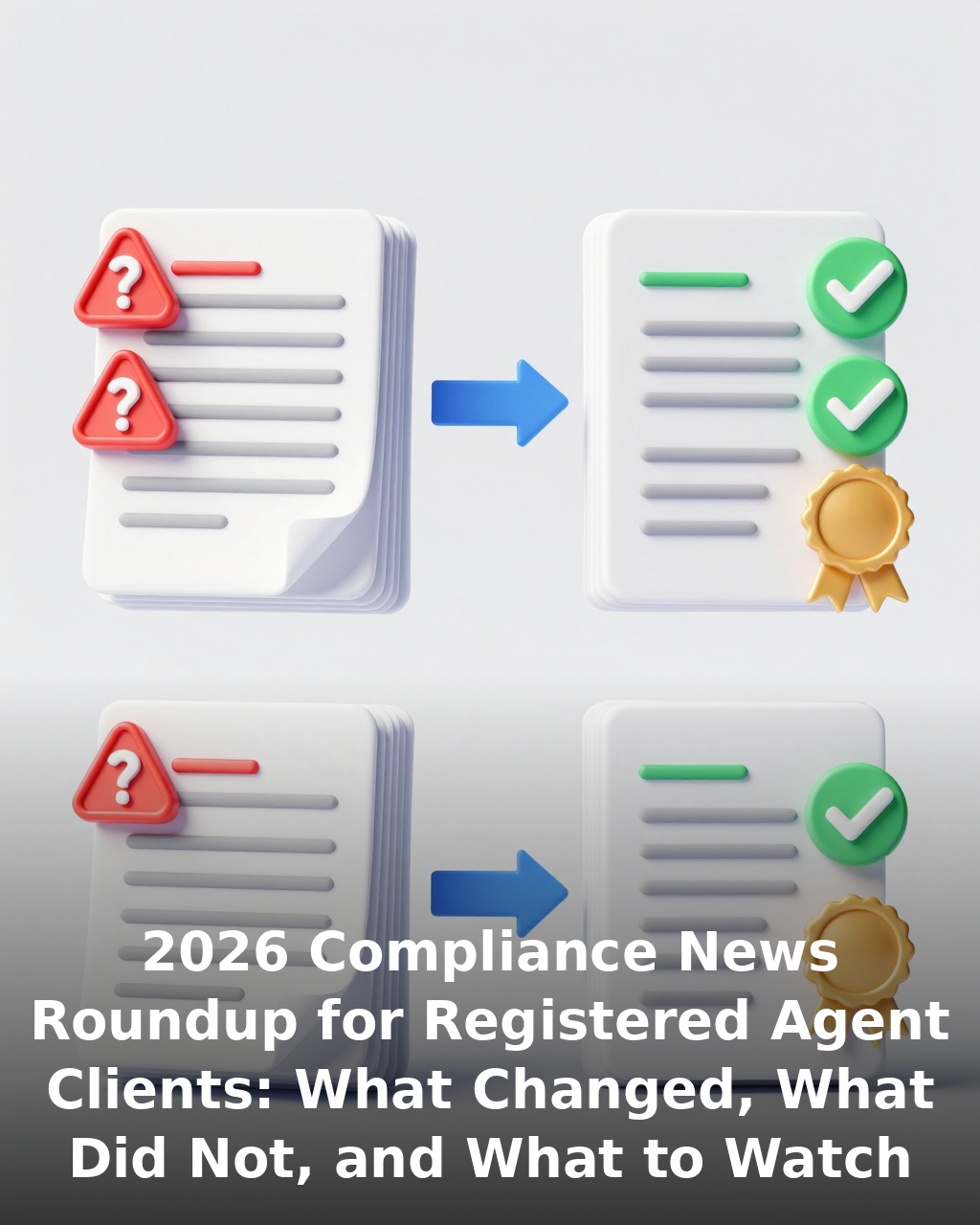
Frequently Asked Questions
What is the biggest registered agent compliance change in 2026?
Did Corporate Transparency Act BOI reporting requirements change in 2026?
Do registered agents handle annual report filing for LLCs?
What states changed Annual Report rules most visibly in 2026?
How can business owners manage compliance across multiple states in 2026?
2026 Compliance Rapid Registered Agent monitors state filing changes, routes urgent compliance mail, and keeps your business in good standing across every state where you operate.Stay on top of every compliance shift in 2026