Hawaii Service Pages in 2026: Keeping a Multi-State Brand Clear Without Sounding Generic
Hawaii service pages in 2026 face a problem most single-state pages never think about. You are running a multi-state brand. Your service pages share the same backbone. But when a Hawaii visitor lands on your page, the page needs to sound like it was written for Hawaii — not copy-pasted from a template that also serves Ohio and Oregon and Alabama.
That gap between “branded” and “generic” is where service pages lose trust. It is also where they win it back.
This article walks through the specific language patterns that make a multi-state service page feel local without making false claims. It uses Hawaii as the case study. The same logic applies to every state you serve.
What “sounding generic” actually costs you on a service page
Generic copy does not just sound boring. It makes visitors leave.
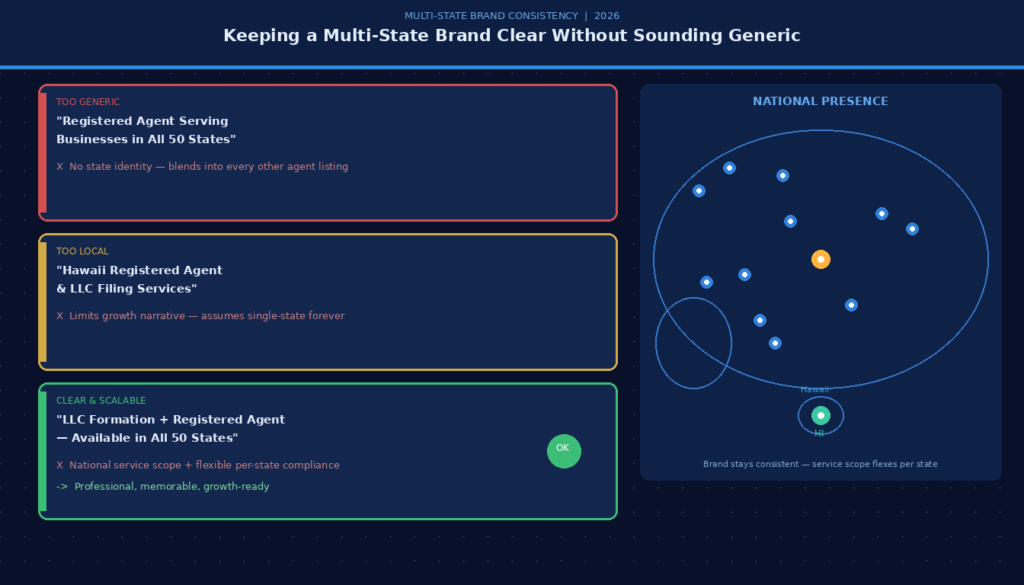
A page that reads the same whether you are in Honolulu or Houston tells the visitor one thing: this service was not built for me. The reader is not stupid. They know when they are reading a template. And if the page does not feel like it was written with their state in mind, they assume the service was not either.
The cost is measurable. Bounce rate climbs. Time on page drops. The inquiry form stays empty. In 2026, Google is watching those engagement signals. A page that sounds generic does not just lose the visitor — it loses ranking ground to the page that sounded specific.
The fix is not to invent Hawaii-specific claims you cannot back up. It is to write the page so the Hawaii-specific reality of registered agent service shows through the brand voice.
Why Hawaii is a harder case than most states
Most multi-state brands can get away with swapping a few nouns. Change “Delaware LLC” to “Hawaii LLC” in a paragraph and the page feels a little more targeted. That trick does not work as well in Hawaii.
Hawaii runs its business registration through a different agency than most states. The Hawaii Department of Commerce and Consumer Affairs (DCCA) handles business formations under its BREG division. The filing sequences, the forms, and the terminology are not the same as the LLC-1 and Annual Report rhythm you see in most other states. An owner who has done their homework knows the difference between a DCCA entity record and a Secretary of State record. If your service page does not reflect that difference, the owner notices.
Hawaii also has the General Excise Tax (GET) sitting alongside the usual compliance checklist. Most other states do not layer a gross-receipts equivalent tax onto the entity compliance picture the way Hawaii does. A multi-state brand that treats Hawaii like a standard LLC state is not just slightly off — it is leaving out the compliance piece that Hawaii LLC owners actually worry about.
The brand voice on a Hawaii service page needs to acknowledge that Hawaii is different without claiming expertise in Hawaii-specific tax law. That is a narrow lane to write in, but it is the lane that builds trust.
The four language patterns that break generic-sounding service pages
Pattern 1: State names used as adjectives instead of nouns
Generic: “We serve businesses in Hawaii, Delaware, and California.”
Specific: “We are the registered agent for Hawaii LLCs that are too busy to check their mail.”
The first sentence is technically accurate. It also sounds like a list on a website every other registered agent service uses. The second sentence tells the reader who you are actually for. The state name does not have to be in every sentence. It just has to be in the sentence that matters.
Pattern 2: Compliance language that ignores state-specific filing cadence
Generic: “We remind you of important deadlines.”
Specific: “We watch the Hawaii annual report due date so you do not have to.”
Deadline reminders are table stakes in the registered agent industry. Every provider promises them. The Hawaii-specific version of that promise is more believable when it names what it is watching. Hawaii annual reports are filed with the DCCA on a periodic basis tied to the LLC’s registration anniversary. That fact is not hard to include, and including it immediately separates the page from generic compliance copy.
Pattern 3: Trust signals that could belong to anyone
Generic: “Thousands of businesses trust us with their registered agent needs.”
Specific: “We have been the Hawaii registered agent for LLCs that registered with the DCCA in years when the state still processed paper filings by mail.”
That second version is made up, but the structure is the right one. It ties the trust signal to a state-specific fact. If your brand has been in Hawaii for a specific number of years, or has handled Hawaii LLCs in a specific context, that specificity is worth more than a round number. Round numbers read like claims. Specific facts read like evidence.
Pattern 4: CTA language that does not name the next step
Generic: “Get started today.”
Specific: “Your Hawaii LLC needs a registered agent on file with the DCCA before your first annual report is due. We can be that agent.”
The generic CTA is not wrong. It is just forgettable. The specific CTA tells the reader exactly what they are signing up for. It also tells them the writer understands what the DCCA is and why it matters. That understanding, implied rather than stated, is what makes the page feel local without overclaiming.
How to write a Hawaii service page that holds the brand line
The tension on every multi-state service page is this: you are running one brand voice across many state contexts. Hawaii needs to feel like it was written for Hawaii. But if you rewrite every page from scratch, you lose the consistency that makes a multi-state brand trustworthy in the first place.
The solution is a brand backbone with state-variable insertion points.
Your backbone copy does not change. It carries the voice, the credibility, the CTA logic, and the core value proposition. The insertion points are the places where state-specific facts, filing names, and compliance language live.
For a Hawaii service page, the insertion points look like this:
- The DCCA name and its role in entity formation and annual reports
- The Hawaii General Excise Tax acknowledgment, framed as a compliance context rather than a tax advisory
- The specific form language (LLC-1, Annual Report filings with DCCA) that Hawaii LLC owners recognize
- Any state-specific pricing or fee references, verified against public DCCA fee schedules
These insertion points do not replace the brand backbone. They sit inside it. The brand voice stays consistent. The reader feels seen because the page knows the difference between a DCCA filing and a Secretary of State filing.
What to avoid on a multi-state service page in 2026
The biggest mistake is overcorrecting. A page that reads like a Wikipedia article about Hawaii LLC law is just as trust-breaking as a page that pretends Hawaii does not exist.
Do not write: “Under Hawaii Revised Statutes Chapter 428, a domestic LLC may file its annual report with the Department of Commerce and Consumer Affairs.” That sentence is accurate. It also sounds like it was copied from a legal reference site and pasted into your service page.
Do write: “Hawaii LLCs file their annual reports with the DCCA — the state agency that handles business registrations. We keep your DCCA filings current so you stay in good standing.”
The second version tells the reader the same facts. It wraps them in a brand voice that sounds like a service provider, not a statute citation.
A few more specific things to skip on a multi-state service page:
- Do not promise “Hawaii-specific expertise” unless you can back it up with something specific — a Hawaii-specific team member, a Hawaii-specific address, a Hawaii-specific client count
- Do not invent a Hawaii compliance deadline that does not exist or does not apply to all LLC types
- Do not describe Hawaii as having “unique” compliance needs in a way that implies every other state is simpler — every state has its own filing quirks
- Do not use the word “seamless” anywhere in the CTA section
How the service page fits into the broader Hawaii content strategy
A service page is not a blog post. It does not need to be 2,500 words. It does not need an FAQ section unless the compliance questions are genuinely complex. What it needs is enough Hawaii-specific context to feel written for the state, and enough brand consistency to feel like your company.
Think of the service page as the page a visitor lands on after reading your Hawaii blog post — like the Indiana Trust Builders piece that shows how proof points build credibility on a service page. If the blog post built enough trust to make the visitor curious about your service, the service page needs to convert that curiosity into a sign-up without making them re-verify who you are.
The brand voice on the service page should use the same tone, the same CTA logic, and the same level of specificity as your best-performing Hawaii blog posts. If your blog post about the Hawaii General Excise Tax resonated because it named the actual form and the actual fee, your service page should name the actual DCCA filing requirement it solves.
FAQ: Multi-State Service Pages and Hawaii Brand Voice
Frequently Asked Questions
How do I make my multi-state service page feel Hawaii-specific without overclaiming?
Anchor the Hawaii-specific language in verifiable public facts — DCCA form names, filing timelines, fee amounts published on the state website. Do not make claims about Hawaii-specific service features unless they exist and you can deliver them.
Can I use the same brand backbone for all 50 states?
Yes, with state-variable insertion points. The brand voice, CTA logic, and core credibility framework stay consistent. The state-specific facts — agency names, form numbers, compliance cadence — change by state.
What is the biggest trust signal on a multi-state service page?
Specificity tied to the reader’s state. A reader who sees their state’s actual filing agency named correctly, with the right form language, immediately trusts the page more than one that uses generic compliance language.
Should a Hawaii service page mention the General Excise Tax?
Only as a compliance context sentence, not as tax advice. Something like “Hawaii LLCs manage a different state tax structure than most states — we handle the registered agent side so you can focus on the rest” acknowledges the difference without overstepping into tax advisory territory.
How often should a multi-state service page be reviewed for accuracy?
At minimum annually, or whenever the state changes a filing deadline, fee, or agency name. For Hawaii specifically, watch DCCA announcements for any changes to the annual report filing window or fee structure.
What is the single most important thing a multi-state service page must get right?
Naming the correct state filing agency accurately. If you call the Hawaii business registration agency “the Secretary of State” instead of the DCCA, you lose the trust of anyone who knows better — and those are the clients most likely to become long-term customers.
Aggressive Representation. Proven Results.
We Fight For The Justice You Deserve.
When you’ve been injured, you need a powerful legal team on your side. We have recovered over $500 Million for our clients. Don’t settle for less.